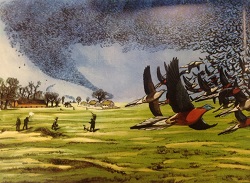
The End of Royalty?

Julian Pender Hume, cover Extinct Birds, accessed Errol Fuller, The Passenger Pigeon, pg. 74. As found on Flocks that Darken the Heavens: The Passenger Pigeon in Indiana, Annette Scherber Posted on February 14, 2017
Julian Pender Hume, cover Extinct Birds, accessed Errol Fuller, The Passenger Pigeon, pg. 74. As found on Flocks that Darken the Heavens: The Passenger Pigeon in Indiana, Annette Scherber
Posted on February 14, 2017

It was a spectacular scene that no living person has ever witnessed. John James Audubon said the sun would literally be blocked out for hours as the river of living creatures flew by from sunrise to sunset. Estimates place their population up to five billion. That’s FIVE BILLION. They represented 40% of all the living Class of Aves in North America and may have been the most abundant bird species in the entire world. They reached speeds over 60 miles per hour, and when flocks came to rest in forests their collective landings could topple large trees. They seemed invincible.

But in the 1870’s, European-Americans used shotguns which dropped dozens of Passenger Pigeons with each shot. They commercialized them as cheap food, sold their feathers to adorn hats, and cut down nesting-area forests.

As the birds began to disappear, measures were made to prevent their total loss. Several groups were captured and put in captivity, but breeding was unsuccessful. In 1901 the last wild “invincible” pigeon was shot. In 1914, the very last Passenger Pigeon died at the Cincinnati Zoo. They are gone. Five Billion then, zero now.

Monarch Butterflies, Courtesy and Copyright Becky Yeager, Photographer

We may be currently experiencing something of that depressing magnitude as we continue to record a consistent decline in the populations of once plentiful Monarch Butterflies. Adults may recall capturing the yellow-black-white striped larva from milkweeds in fields and along roadsides throughout Cache Valley. They would keep them in jars until the larva had its miraculous morphing, then release the dazzling orange and black flying flowers that everyone seemed to love. Unless humans take positive actions now, many newborn children may never have that butterfly-in-a-jar experience.
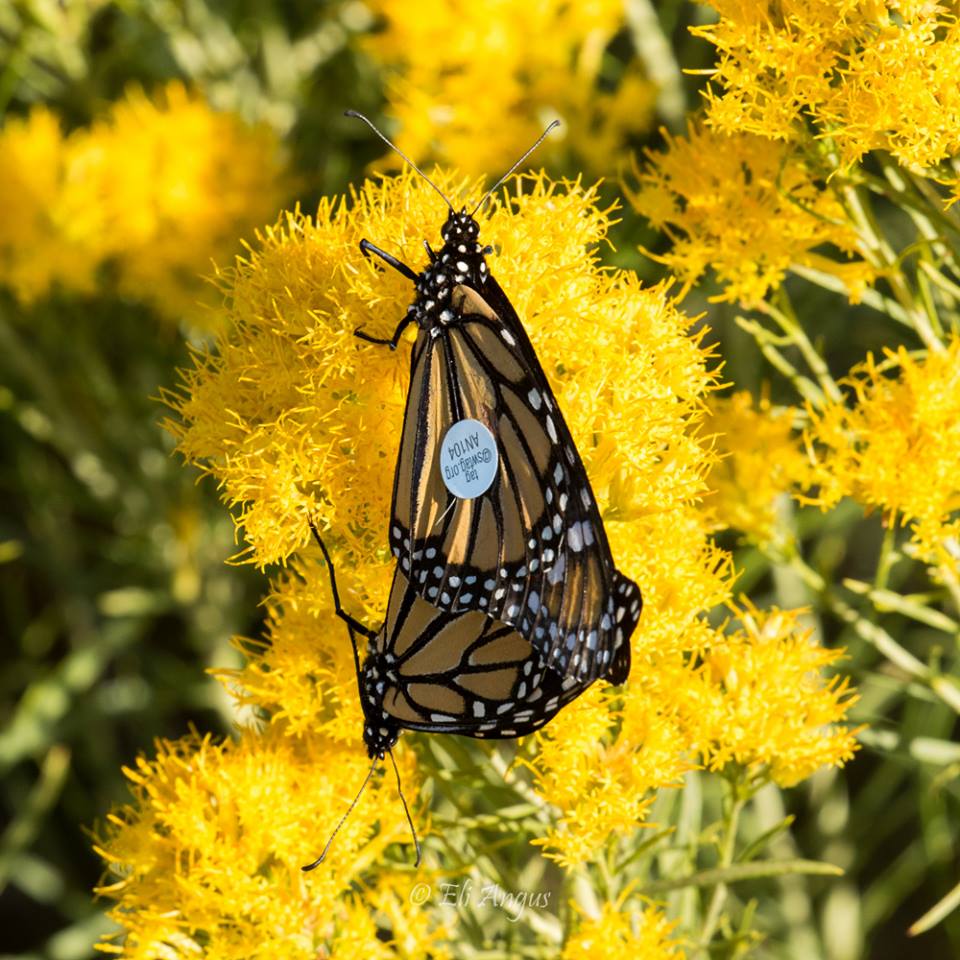
Tagged Monarch Butterfly, Courtesy and Copyright Becky Yeager, Photographer

I started tagging and releasing Western Monarchs at South Cache back in 1995. A harmless tag was placed on the front wing in hopes of tracking it to its overwintering site. We did hundreds at first, but each year larva was more difficult to find. Nibley’s Becky Yeager reigns as the Monarch tagging Queen, and she works tirelessly to preserve the species.

In December, six of us decided to investigate the Monarch sites in California listed by the Xerces Society. We went to each site from Santa Barbara along the coast up to Santa Cruz. We should have seen a quarter million Monarchs, but barely observed two thousand total.

Monarch Butterfly, Tagged and Ready-to-go, Courtesy and Copyright Becky Yeager, Photographer
Monarch Butterfly, Tagged and Ready-to-go,
Courtesy and Copyright Becky Yeager, Photographer

In 1997, California had 100 counting sites and observed well over one million Monarchs.
In 2016 they increased counting sites to 250, but the population has dropped to less than 300,000. If five billion pigeons can disappear, what are the odds of success for Monarchs?
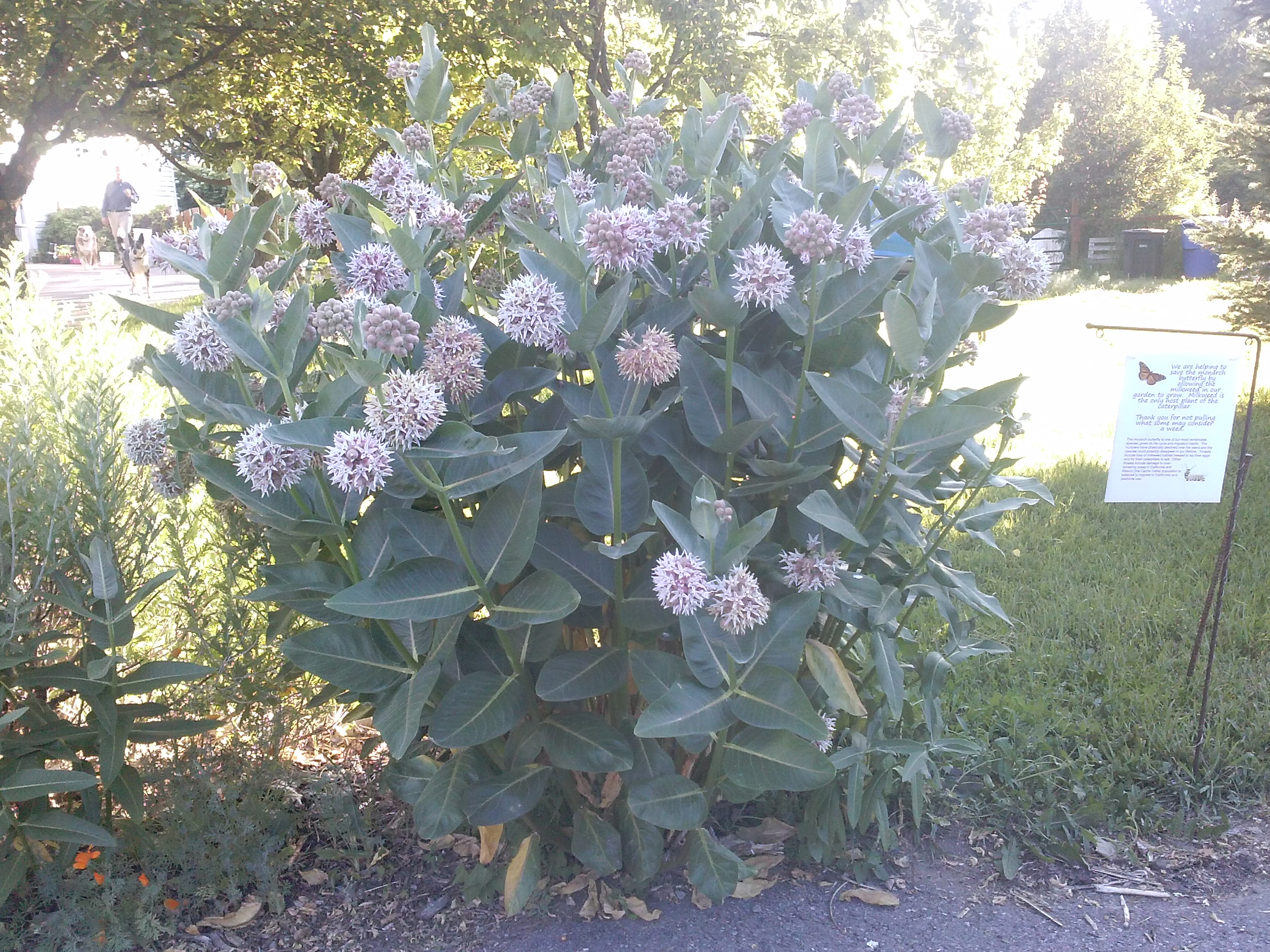
Milkweed Host for Monarch Butterflies Courtesy and Copyright Becky Yeager, Photographer
Milkweed Host for Monarch Butterflies
Courtesy and Copyright Becky Yeager, Photographer

We can do something about this. Plant milkweed, the only plant where they lay eggs. Use fertile, native plants in your flower gardens. Stop spraying pesticides. Let the Cache Valley Wildlife Association tag whatever Monarchs you might collect this summer. And join us at the Logan Gardeners’ Market for a Mariposa Festival on May 20.
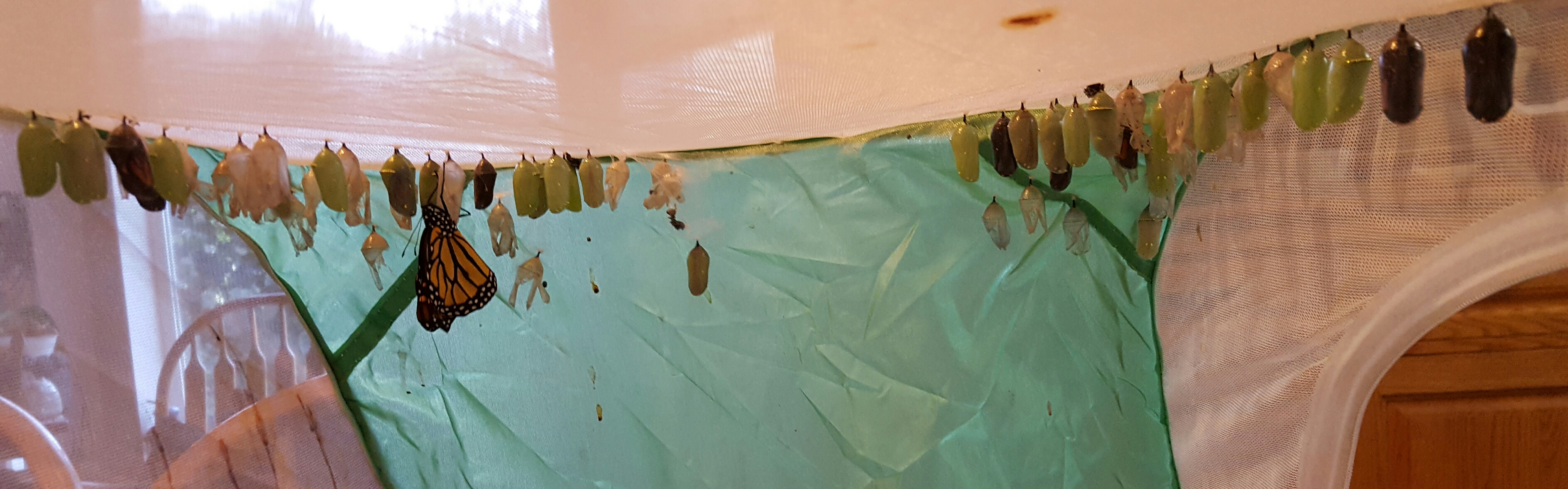
Monarch Butterfly Chrysalis, Courtesy and Copyright Becky Yeager, Photographer

Credits:

Images: Courtesy &
Copyright Becky Yeager, Photographer
Text:     Ron Hellstern, Cache Valley Wildlife Association

For Information On Tagging:
The Monarch Program: https://www.monarchprogram.org
To tag butterflies found in Cache Valley, please contact Monarch Program volunteer Ron Hellstern at 435-245-9186. Please note that captive caterpillars or chrysalises are easiest to tag, as capturing adults can harm their wings.

Growing milkweed:
Monarch Watch, Propagation (Growing Milkweeds). https://www.monarchwatch.org/milkweed/prop.htm
Additional Reading:

Pyle, Robert Michael. 1981. National Audubon Society: Field Guide to Butterflies, North America. Alfred A. Knopf: New York.
Monarch Watch: Monarch Life Cycle. https://monarchwatch.org/biology/cycle1.htm

National Geographic: Monarch Butterfly (Danaus plexippus). https://animals.nationalgeographic.com/animals/bugs/monarch-butterfly/

NRCS Partners with Farmers, Ranchers to Aid Monarch Butterflies, Posted by Jason Weller, Chief, Natural Resources Conservation Service, on November 12, 2015, USDA Blog, https://blogs.usda.gov/2015/11/12/nrcs-partners-with-farmers-ranchers-to-aid-monarch-butterflies/

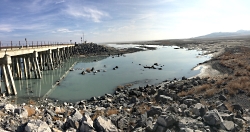
The Great Salt Lake–A Giant Among Us

A Giant Among Us, The Great Salt Lake: The Great Salt Lake Breach
The Great Salt Lake Breach
Courtesy U.S. Geological Survey
Department of the Interior/USGS
Mike Freeman, Photographer
10 Nov 2015
Water flowing through the Great Salt Lake breach in 2011, when lake levels were high due to above average snowfall in the Wasatch and Uinta Mountains. The Great Salt Lake breach is an area that allows water to travel between the southern and northern parts of the lake.
There is a giant among us with a profound influence on our past, present, and future. My first encounter with this giant was both buoyant and delightful as I floated in the brine on a lovely summer day. But I was oblivious to the Great Salt Lake’s immense value as an environmental, cultural, and economic resource.

A Giant Among Us–The Great Salt Lake

Much of what follows is taken from a very recently released collaborative study titled “Impacts of Water Development on Great Salt Lake and the Wasatch Front” which was a collaborative effort from four institutions(Utah State University, Utah Division of Water Resources, Salt Lake Community College, and the Utah Division of Wildlife Resources.)

A 2012 analysis by Bioeconomics estimated the economic value of the lake at $1.32 billion per year for mineral extraction, brine shrimp cyst production, and recreation. The abundant food and wetlands of the lake attract 3 million shorebirds, as many as 1.7 million eared grebes, and hundreds of thousands of waterfowl during spring and fall migrations. Because of this, it has been designated as a Western Hemisphere Shorebird Reserve Network Site. Due to its enormous surface area, it produces the “lake affect” which enhances our snow pack by an estimated 8%, a significant amount for both skiers and our available water. But our giant is shrinking.

Since the arrival of 19th Century pioneers water diversions for irrigation have decreased its elevation by 11 feet exposing much of the lake bed. Natural fluctuations in rainfall and river flow cause the lake level to rise and fall, but there has been no significant long‐term change in precipitation and water supply from the main tributaries since their coming in 1847.

The Great Salt Lake Breach 2015
The Great Salt Lake Breach
Credit: U.S. Geological Survey
Department of the Interior/USGS
Mike Freeman, Photographer
10 Nov 2015

For the first time since it was opened in 1984, water has stopped flowing through the Great Salt Lake causeway breach, an area that allows water to travel between the southern and northern parts of the lake.
To significantly reduce water use, a balanced conservation ethic needs to consider all uses, including agriculture, which consumes 63 percent of the water in the Great Salt Lake Basin. There are no water rights to protect our Great Lake, so water development currently focuses solely on whether there is water upstream to divert. If future water projects reduce the supply of water to the lake, (such as the Bear River Development Project, its level will (most likely) continue to drop.

We must look beyond the next few decades and decide how we value the lake for future generations. Lower lake levels will increase dust pollution and related human health impacts, and reduce industrial and environmental function of Great Salt Lake. We must be willing to make decisions now that preserve Great Salt Lake’s benefits and mitigate its negative impacts into the coming centuries.

John Muir, one of my favorite early American naturalists would most certainly agree with me. From his baptismal plunge into the Great Salt Lake. “I found myself undressed as someone else had taken me in hand and got myself into right lusty relationship with the brave old lake. I was conscious only of a joyous exhilaration….”
And where else could John and I have such a wonderfully buoyant experience?

This is Jack Greene reading for Wild About Utah.

2015 Great Salt Lake Breach at Lakeside, Utah
Gauge near the Great Salt Lake Breach
Credit: U.S. Geological Survey
Department of the Interior/USGS
Mike Freeman, Photographer
10 Nov 2015
A gauge to measure lake water levels stands dry in the lake bed of the Great Salt Lake. For the first time since it was opened in 1984, water has stopped flowing through the Great Salt Lake causeway breach, an area that allows water to travel between the southern and northern parts of the lake.
Credits:
Image: Courtesy U.S. Department of the Interior, U.S. Geological Survey(USGS), gallery.usgs.gov
Text:     Jack Greene, Bridgerland Audubon Society & USU Office of Sustainability
Additional Reading:

Great Salt Lake, Utah, Stephens, Doyle W. and Gardner, Joe, USGS Science for a Changing World, https://pubs.usgs.gov/wri/wri994189/PDF/WRI99-4189.pdf

Salt Lake Brine Shrimp, https://saltlakebrineshrimp.com/harvest/

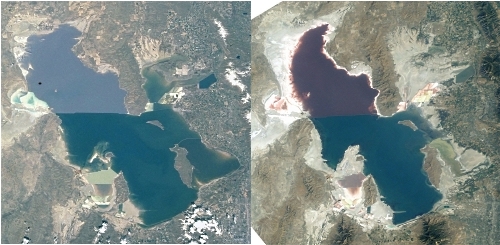
Great Salt Lake Footprint 2001 vs 2003 Comparison
Great Salt Lake Footprint Comparison
2001 vs 2003
Images Courtesy NASA
NASA’s Earth Observatory

Tree Talk

Quaking Aspen Sleek stands of quaking aspens (Populus tremuloides) grow in Zion's higher elevations Courtesy National Park Service U.S. Department of the Interior
Quaking Aspen
Sleek stands of quaking aspens (Populus tremuloides) grow in Zion’s higher elevations
Zions National Park
Courtesy National Park Service
U.S. Department of the Interior
The next time you take a walk in the deep woods or even a stroll through a local park, listen closely. You may hear the trees ‘whispering in the wind.’ We use this familiar phrase to describe the soothing sounds of a gentle breeze through the forest canopy; but it may delight and surprise many to know that this figure of speech is now a proven scientific fact. The trees are talking.

They don’t talk like you and I talk, of course. The spoken word is foregone by the plant kingdom, for now. Theirs is a much subtler form of communication. ‘The Wood Wide Web’, as the scientific journal Nature once dubbed it, is the woodland social network. Within it, trees send electric signals coursing through their roots in order to relay important messages to their neighbors.

Travelling at the speed of about a third of an inch every minute, these timber telegrams take quite a while to accomplish such a task; but what this system lacks in speed, it makes up for with complexity. A tree’s roots will often expand through the soil to an area twice the width of its crown, resulting in the ability of a single tree to grasp the roots of and pass messages to multiple far-away friends at once.

In undisturbed soils, these messages can be expedited symbiotically. Subsoil fungal networks, which intertwine with the roots of trees for nourishment sake, can relay messages much more quickly by connecting otherwise distant, unconnected trees to one another. This becomes quite important when the message pertains to danger: an invasion of damaging pests, for instance.

Usually, though, if a tree needs to get a warning out to its neighbors more quickly, it will do so by other means. When trees are attacked, they emit scent compounds through their leaves. These arboreal aromas can be registered by distant parts of the same tree, far-flung trees in the same grove, or, amazingly, even members of the animal kingdom, which trees will summon to their defense. Even more astonishing is that each scent is custom-catered. Trees will identify their attacker by its saliva and emit a corresponding pheromone meant to attract that attacker’s natural predators. Once they are warned of an invading pest, other trees in the grove may respond similarly.

The usefulness of a tree’s ability to communicate with its neighbors goes beyond emergency warnings or the spreading of other important information. Trees have developed a sophisticated redistribution system in which the strongest trees compensate for weaker ones by sharing their surpluses of sugar. In fact, this system is so efficient that, in the end, each individual tree is nourished at the same rate of photosynthesis. This means that every tree in a grove receives the same amount of sugar per leaf in its crown as every other tree, regardless of its own ability to photosynthesize. As it turns out, trees are highly sociable beings. They take responsibility for friends and family members and see to it that their loved ones are well cared for.

Not all groves are created equal, though. These natural behaviors can be inhibited by intensive thinning of wild groves or absent altogether in planted, monocultural forests. However, when granted enough space and time to be itself, even the most artificial forest can ‘return to its roots.’

So, whenever you find yourself following that wooded path into the forest, think of what secret messages might be coursing through the soil or floating invisibly upon the airwaves? Consider these possibilities, and your walks may now be a little more mysterious.

For Wild About Utah this is Josh Boling

Credits:
Photo: Courtesy & Copyright
Text: Josh Boling

Sources & Additional Reading

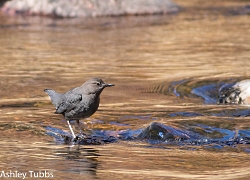
Why Dippers Dip

Why Dippers Dip: American Dipper Ashley Tubbs, Photographer Photo credit: ashleytisme via Visual Hunt / CC BY-ND
American Dipper
Ashley Tubbs, Photographer
Photo credit: ashleytisme via Visual Hunt / CC BY-ND

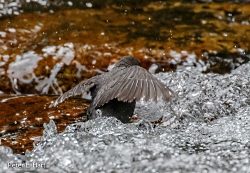
American Dipper Peter Hart, Photographer Photo credit: PEHart via Visual hunt / CC BY-SA American Dipper
Peter Hart, Photographer
Photo credit: PEHart via Visual hunt / CC BY-SA

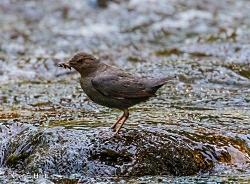
American Dipper Peter Hart, Photographer Photo credit: PEHart via Visual hunt / CC BY-SA American Dipper
Peter Hart, Photographer
Photo credit: PEHart via Visual hunt / CC BY-SA

Cinclus mexicanus is the only aquatic songbird found in North America, but it goes by several names—the American dipper, the water dipper, or the water ouzel. It is a grapefruit-sized bird that inhabits mountainous riparian areas. It has brownish gray plumage, stubby wings and tail, and ornithologists sometimes refer to it as “stocky,” “chunky,” and even “chubby-looking.” However, the dipper has no shortage of energy, and can be seen careening at low altitudes over mountain streambeds and crashing beak-first into fast-flowing water, always in the upstream direction.

The dipper hunts for food by diving into swift, shallow rivers and hunting underwater. It muscles its way upstream, picking off aquatic insect larva, crayfish, and even tadpoles and minnows. Several adaptations assist the dipper in this seemingly reckless feeding strategy. Nictitating eye membranes enable the dipper to see underwater, and specialized flaps of skin on the dipper’s beak seal its nostrils. Dippers produce more feather oil than less adventuresome songbirds, which keeps them warm and dry, even in near-freezing water. Perhaps most noticeably, the dipper has long legs and specialized, unwebbed toes to grip the stream bottom, hold steady in the current, and push along upstream.

The American dipper was once more commonly referred to as the “water ouzel,” after its European cousin, Cinclus aquaticus, but ornithologists changed the preferred common name to “American dipper” to better distinguish it based on a unique aspect of the bird’s behavior: American dippers dip.

The dipper bobs rapidly up and down by bending its legs—like deep knee bends. Dippers dip while paused on rocks between dives, they dip while feeding in the water, and they even dip while they’re still fledging in their nests.

So, why do dippers dip? There are a number of theories. First, dipping may help the birds visually isolate reference points beneath moving water, so that they can more accurately dive for prey. Dipping might also help to conceal dippers from predators against a busily moving backdrop. But the best theory about dipping is that it’s a form of communication between dippers within the noisy environment of mountain streams.

Ornithologists say dippers dip at different rates in different situations, sometimes as rapidly as 60 times per minute. Dipping could be used to convey messages such as “Go away, this is my territory,” or “Hi, I would like to mate with you.”

Unlike other songbirds of the United States, the dipper does not migrate to warmer climes in autumn—it stays put all year, usually moving only short distances to avoid iced-over streams or to take advantage of shifting forage availability.

Like the American dipper, I too am a year-round denizen of mountain streams. I enjoy fly-fishing all year, even when it’s very cold, and aside from trout, the dipper is the creature I most enjoy seeing while I’m fishing. I figure that if a 6-ounce bird with feathers and bare legs can brave summer’s roasting heat and winter’s bitter chill, then so can I. But more importantly, the American dipper is known as a “biotic indicator species,” meaning this bird is known to thrive in streams with clean water and robust forage, while it abandons streams which are impaired or polluted. So, when I see American dippers dipping and diving in my home waters, I know I’m fishing in a river system that is healthy and strong.

For Wild About Utah this is Chadd VanZanten.

Credits:

Theme: Courtesy & Copyright Don Anderson Leaping Lulu
Photo credit #1: ashleytisme via Visual Hunt / CC BY-ND
Photo credit #2 and #3: PEHart via Visual hunt / CC BY-SA
Text: Chadd VanZanten

Additional Reading:

The Water Ouzel from The Mountains of California as quoted in The Wilderness World of John Muir, https://www.amazon.com/Wilderness-World-John-Muir/dp/0618127518/ref=sr_1_1?

American Dipper-Cinclus mexicanus, Species, Utah Division of Wildlife Resources, https://fieldguide.wildlife.utah.gov/?species=cinclus%20mexicanus

A Bird for All Seasons, The American Dipper, Norm Davis as read by Linda Kervin, Wild About Utah, Apr 21, 2009, https://wildaboututah.org/a-bird-for-all-seasons-the-american-dipper/