Climb Grand Teton…Virtually

Grand Teton virtual climb

Click to view larger image of Grand Teton virtual climb, Photo Courtesy NPS Photo Courtesy NPS, K Kanes, Photographer
.

Photo Courtesy NPS
K Kanes, Photographer
 
Begin Tour
(Requires Adobe Flash Player)

Scaling “the Grand,” that picturesque mountain that hangs over Jackson, Wyoming, along with its battleship-gray sisters in the Teton Range, was a ridiculous thought that found harbor in the back of my mind in the spring of 1985 when I first glanced up at the peak.

Along with a dozen or so other neighboring peaks that rise above 10,000 feet, the Tetons form a ponderous, jagged stretch of rock that is the Lower 48’s most arresting mountain range. The soul of Grand Teton National Park, the Grand as it’s known harbors world-class climbs.

Some climbers tackle the mountain on their own, while neophytes such as myself are herded ever upward under the watchful guidance of one of Jackson’s two resident climbing outfitters, Exum Mountain Guides and Jackson Hole Mountain Guides.

To me, an Easterner by birth, the 13,770-foot tall Grand Teton is a breathtaking, and incredibly tall, mountain. But climb it? Not only am I usually most comfortable with both feet firmly planted flat on the ground, but the thought of only a thin rope and a precarious hand- or toe-hold between me and an incredible long way down scared the hell out of me, quite frankly.

The view from atop the Grand Teton is incredible. To the west, the Jedediah Smith Wilderness stands. To the north, Yellowstone National Park. To the east, Jackson Hole, with the moraine that is Timbered Island so very well defined.

Now, if you haven’t climbed to the roof of Grand Teton National Park, or can’t, you can still enjoy the view.

A new virtual tour produced by the park staff takes you from the Jackson Hole Valley to the summit from the comfort of your living room or office. No cold or pelting rain, no thunder claps or lightning strikes, just a nice mix of interactive still photos and video cuts that take you to the top.

This virtual mountaineering excursion—or eClimb, as the park dubs it—provides an introduction to the features, geology, history, and excitement of scaling the granite ledges and spires that form the Grand Teton massif: the highest peak in the Teton Range and second highest mountain in Wyoming. This web-based tour introduces viewers to the various elements (rocky terrain, plants and wildlife) that exist in Grand Teton’s forest and alpine communities.

As an eClimber you can control images and sounds at each stop along your virtual tour, and you can activate videos to explore the human and natural history related to each location along the climbing route. By hovering your mouse over a photograph, hidden images will be revealed through the click of a button.

eClimbers can also use videos to imagine scrambling over boulder fields and wedging through rocky alcoves as they experience the thrill of climbing and drama of a mountain rescue in a virtual landscape.

To find this virtual climb, go to Grand Teton’s website (www.nps.gov/grte) and click on  “Grand Teton eClimb” near the bottom of the home page.

For Wild About Utah, this is Kurt Repanshek with National Parks Traveler

Credits:
Image: Courtesy USGS, www.usgs.gov
Image: Courtesy and Copyright Kurt Repanshek, www.nationalparkstraveler.com
Text:     Kurt Repanshek, NationalParksTraveler.com.
 
Additional Reading:

Grand Teton National Park

Grand Teton eClimb

NationalParksTraveler.com

National Parks Traveler: Climb The Grand Teton…Virtually!


An Arizona Road Trip Back Into the Past

Montezuma Castle, Courtesy US NPS
Montezuma Castle
Courtesy US NPS
 
Location of Hubbell Trading Post NHS in the Southern Colorado Plateau Network,  Courtesy US NPSLocation of Hubbell Trading Post NHS in the Southern Colorado Plateau Network
Courtesy US NPS
 
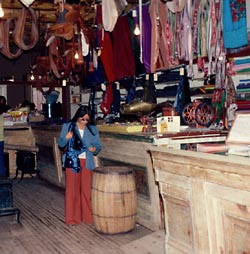
Hubbell Trading Post, Courtesy US NPSHubbell Trading Post Interior
Courtesy US NPS

Arizona is rich in history — from the 1800s all the way back to the Late Triassic Period. You can stitch together a road trip that winds out of Flagstaff to Montezuma Castle National Monument, to Petrified Forest National Park, and ends at Hubbell Trading Post National Historic Site. Along the way you’ll experience fascinating chapters of geologic and cultural history.

At Montezuma Castle, 45 minutes south of Flagstaff and just off Interstate 17 (Exit 289), a short walk places you in front of a 5-story-tall cliff dwelling that offered safety from invaders: it stands 100 feet above the valley floor, nestled into an alcove.

The site was misnamed Montezuma Castle in the late 1800s by whites who thought the structure had been built by the Aztec people. The original owners, members of the Southern Sinagua (seen aug wah) people, called this area home from roughly 1100-1425 A.D.

Stroll the short trail that loops around a vegetated landscape below the “castle,” and you’ll find great views as well of the remains of Castle A. That dwelling once rose 60 feet and was home to about 100 residents.

From Montezuma’s Castle, it’s 95 miles via Arizona 87 to Winslow, and then 34 miles east on Interstate 40 to Holbrook. Finally, another 19 miles southeast on Arizona 180 leads you into Petrified Forest National Park and its unusual landscape.

There’s no lodging within the park, and you have to leave by sundown, so you will need to make some tough decisions if you have just one day. Do you take time to tour the Rainbow Forest Museum with its dinosaur displays, or hike out to Agate House?

A building built of petrified wood is pretty cool, so stretch your legs with a walk to the house. Then head north and deeper into the park to the Crystal Forest Trail. Wander this path and you’ll find yourself surrounded by petrified wood with its hues of yellow, red, and green, black and white.

Blue Mesa is another great stop. There’s a trail that takes you down into another colorful landscape of badlands and chunks, logs, and even slabs of petrified wood in shades of red, blue, yellow and black.

The northern end of the park road is anchored by the Painted Desert, a great place for sunset photos. Here you’ll also see the Painted Desert Inn, which some day could put the Park Service back into the lodging business but today is just a museum piece.

Back on Interstate 40, drive 22 miles east to Chambers, and then north on U.S. 191 for about 38 miles to Ganado and Hubbell Trading Post. This authentic trading post was opened by John Lorenzo Hubbell in 1878 on the Navajo Reservation.

Although it was added to the National Park System in 1967, Hubbell is not a museum piece but an active trading post. As such, it still holds richly woven Navajo rugs, jewelry, and other Native American artworks for purchase.

Schedule your visit to Hubbell Trading Post for May and you just might be able to attend the annual Native American Art Auction. Check with the park (928-755-3475) for the exact date.

If you have a little more free time, you could extend your your trip by heading 39 miles north on 191 to Canyon de Chelly National Monument.

For Wild About Utah and National Parks Traveler, I’m Kurt Repanshek.

Credits:
Image: Courtesy and Copyright Kurt Repanshek, www.nationalparkstraveler.com
Text:     Kurt Repanshek, NationalParksTraveler.com.

Additional Reading:

Montezuma Castle National Monument, NationalParksTraveler.com, https://www.nationalparkstraveler.com/2012/03/visiting-montezuma-castle-national-monument-arizona9636

Montezuma Castle National Monument, US National Park Service, https://www.nps.gov/moca/index.htm

Geographic Area covered by the State of Deseret and Utah Territory, International Society Daughters of Utah Pioneers, https://www.dupinternational.org/dyn_page.php?pageID=54

Ruffed Grouse and the Christmas Bird Count

Ruffed Grouse and the Christmas Bird Count
Ruffed Grouse
Bonasa umbellus
Courtesy Utah Division of Wildlife Resources

I set out this week to investigate why so many gifts in ‘The 12 Days of Christmas’ are birds. You know the song: there are swans a swimming, geese a laying, calling birds, French hens, turtle doves, and that partridge in the pear tree. Well, I never did find the answer. But what I did find was some interesting information about a native bird often incorrectly referred to as a partridge –a bird that is supremely well adapted to life in winter.

Ruffed grouse resemble partridges in that they are ground-dwelling game birds of similar size and stature. Their name comes from a collar of long feathers surrounding the necks of males who fluff them out when seeking mates in spring. The birds come in two color phases, differentiated mainly by their tail feathers, which can be either gray or chestnut brown. While not well understood, a grouse’s color phase seems to be linked to climate. Grouse with gray tails are more prevalent in areas defined by cold winters, while brown grouse are more common in warmer climates.

Now that snow is blanketing the landscape across much of their territory, the ruffed grouse is in its element. Harsh winters that adversely affect populations of other ground-dwelling game birds such as quail, pheasant, and turkeys, don’t seem to faze ruffed grouse. Their ability to survive is dictated by a number of special adaptations. The first is on their feet, where each winter nubby feathers called pectinations grow on the sides of the birds’ toes. Looking like strange combs, the bristles act as snowshoes, allowing the grouse to walk on top of even the softest snow. More special feathers grow on grouse legs like personal leg-warmers, and also near the bird’s beak, covering its nostrils. Scientists believe the feathered mustache enables grouse to breathe in warmer air than they otherwise would, thus keeping their internal temperature more stable.

Changes in weather bring about some changes in behavior as well. Warmer months find the birds resting in evergreens or thick brush. But in winter, when a foot or more snow covers the ground, grouse roost in the snow. The birds create small burrows which hide them from predators, offer protection from frigid winter winds, and keep them surprisingly snug and warm. Many a backcountry skier or snowshoer has been startled by a hidden grouse bursting noisily from its snowy lair.

The birds’ diet also changes seasonally from a summer sampling of green foliage, seeds, berries and insects, to the protein-rich dormant flower buds of trees such as aspen and birch. Grouse also won’t hesitate to eat the sweet flower buds of domestic trees like apples, and were at one time considered a pest in New England orchards. And so it’s actually not out of the question that within ruffed grouse territory, you might wake up one Christmas morning to find a ‘partridge’ in your pear tree.

Speaking of birds and the holiday season, it’s nearly time for the Audubon Society’s annual Christmas Bird Count. Over the next few weeks, tens of thousands of volunteers around the country will join in this 113-year-old tradition, collecting data on the types and numbers of birds living in their area. This data allows scientists to monitor and track populations over time and space. Participants can be seasoned birders, first timers, or anything in-between. In Logan, Ogden, Salt Lake, and Zion National Park, the count takes place Saturday, December 20th. Other locations around the state will host their events between now and January 5th. To find a count near you, visit birds.audubon.org and click on Christmas Bird Count. For the Stokes Nature Center and Wild About Utah, this is Andrea Liberatore.

For the Stokes Nature Center and Wild About Utah, this is Andrea Liberatore.

Credits:

Theme: Courtesy & Copyright Don Anderson Leaping Lulu
Images: Courtesy Utah Division of Natural Resources
Text & Voice: Andrea Liberatore, Stokes Nature Center

Additional Reading:

Furtman, Michael. (1999) Ruffed Grouse: Woodland Drummer. Stackpole Books, Mechanicsburg, PA.
https://www.amazon.com/Ruffed-Grouse-Woodland-Michael-Furtman/dp/0811731227

Rawley, E. V., W. J. Bailey, D. L. Mitchell, J. Roberson, and J. Leatham. 1996. Utah upland game. Publication number 63-12. Utah Division of Wildlife Resources, Modified text available online at: https://fieldguide.wildlife.utah.gov/?species=bonasa%20umbellus

New York State Department of Environmental Conservation (2012) Ruffed Grouse. Available online at: https://www.dec.ny.gov/animals/45436.html

National Audubon Society’s Christmas Bird Count:
https://birds.audubon.org/get-involved-christmas-bird-count-find-count-near-you

Utah Christmas Bird Counts:
https://utahbirds.org/cbc/cbc.html

Logan Christmas Bird Count:
Bridgerland Audubon Society Logan Christmas Bird Count 15 Dec 2012

Dust in the Wind

Dust Storm Milford Flats
4 March 2009
US Geological Survey photo by Mark Miller


Hi, I’m Holly Strand of the Quinney College of Natural Resources at Utah State University.

American paleontologist Roy Chapman Andrews was a frequent visitor to the Gobi Desert. This is how he described being caught in a Gobi desert dust storm: “Seemingly a raging devil stood beside my head with buckets of sand, ready to dash them into my face…” “…after each raging attack it would draw off for a few moments’ rest. Then suddenly the storm devil was on us again, clawing, striking, ripping, seeming to roar in fury that any of the tents still stood.”

Andrews didn’t have to go so far to feel the rage of a dust storm. He could have come to western Utah. While we don’t have the monstrous storms of the Sahara and the Gobi/Manchurian deserts, the eastern Great Basin–which is essentially western Utah–sits secure on any global list of dust storm hotspots.

Let’s consider why this is so…

First and foremost, western Utah has the dust. In scientific terms, dust is any particle—organic or inorganic—that is less than .63 microns or smaller in diameter. .63 microns is about half the width of a single human hair. In geological terms think silt or clay particles. A grain of sand is much larger. If you are the size of a dust particle, then a relatively small puff of wind will release you into the air. And you’ll stay there until it’s completely calm or rain forces you down.

A great place to find geologic dust is in desert playas. For runoff sediments collect in these dry lake depressions. Western Utah has several of these desert dust bins. And satellite data have confirmed that playas such as Sevier Dry Lake, Tule Dry Lake, and Great Salt Lake Desert are major sources of dust plumes. The alluvial fans of the Great Basin mountains provide an additional source of dust.

To get this dust airborne you need wind which is also plentiful in western Utah. This region typically experiences strong south and southerwesterly winds called “hatu winds.” That’s Utah spelled backwards. The name was coined by colorful Utah meteorologist Mark Eubank. These hatu winds blow south to north or to the northwest. They pick up speed and dust as they race along the north-south trending Great Basin ridges. They can reach speeds of over 90 miles per hour.

Utah’s hatu winds peak in the spring months with a secondary peak in August-September. In spring these windy freight trains full of dust can hit the populated Wasatch Front wreaking havoc with air quality and human health.

Sometimes raindrops capture dust in the airstream and splat them onto our windshields and windows. These mud rains are most common in spring when the hatus are at their peak. And this is why saavy Utahns never bother washing their home windows until June.

While dust storms can be considered natural events, the fact that they are increasing in number and severity is definitely unnatural. The increase is caused by human-related activities that remove vegetation or break the biological soil crusts that help stabilize dust and soil. Overgrazing, water withdrawals, military operations, farming on marginal lands, off-road vehicle riding, fires, even restoration activities all release dust to be carried off by the next significant wind.

Thanks to Atmospheric Scientist Maura Hahnenberger for her help with this Wild About Utah story.

For Wild About Utah, and the Quinney College of Natural Resources, I’m Holly Strand.

Credits:

Images: Courtesy USGS.gov and NRCS.gov
Theme: Courtesy & Copyright Don Anderson as performed by Leaping Lulu
Sound: Wind sound effect from Sound Bible.com Recorded by Mark DiAngelo https://soundbible.com/1810-Wind.html
Text: Holly Strand

Sources & Additional Reading

Hahnenberger, M. and K. Nicoll. Geomorphic and land use characteristics of dust sources in the eastern Great Basin of Utah, U.S.A. Accepted Geomorphology. https://georesearch.ir/article-1-381-en.html

Hahnenberger, M. and K. Nicoll, 2012. Meteorological characteristics of dust storm events in the eastern Great Basin of Utah, U.S.A. Atmospheric Environment, 60, 601-612. https://doi.org/10.1016/j.atmosenv.2012.06.029, https://www.sciencedirect.com/science/article/abs/pii/S1352231012005808?via%3Dihub
https://sci-hub.se/https://doi.org/10.1016/j.atmosenv.2012.06.029

Jason P Field, Jayne Belnap, David D Breshears, Jason C Neff, Gregory S Okin, Jeffrey J Whicker, Thomas H Painter, Sujith Ravi, Marith C Reheis, and Richard L Reynolds The ecology of dust Front Ecol Environ 2010; 8(8): 423–430, doi:10.1890/090050 (published online 12 Oct 2009)https://www.esajournals.org/doi/pdf/10.1890/090050
https://sci-hub.se/https://www.esajournals.org/doi/pdf/10.1890/090050

Neff, J. C., A. P. Ballantyne, G. L. Farmer, N. M. Mahowald, J. L. Conroy, C. C. Landry, J. T. Overpeck, T. H. Painter, C. R. Lawrence, and R. L. Reynolds, 2008: Increasing eolian dust deposition in the western United States linked to human activity. Nature, 1, 189-195
https://www.nature.com/articles/ngeo133
https://sci-hub.se/https://doi.org/10.1038/ngeo133

Warner, Thomas T. 2004. Desert Meteorology. NY: Cambridge University Press
https://www.cambridge.org/core/books/desert-meteorology/830636E147078337D24957845F6A6855
https://doi.org/10.1256/wea.201.04

Washington, R., M. Todd, N. J. Middleton and A. S. Goudie, 2003. Dust-storm source areas determined by the Total Ozone Mapping Spectrometer and Surface Observations, Annals of the Association of American Geographers, 93(2), 297-313.
https://onlinelibrary.wiley.com/doi/abs/10.1111/1467-8306.9302003
https://sci-hub.se/https://doi.org/10.1111/1467-8306.9302003

Miller, M. E., et al. (2012). “Post-fire land treatments and wind erosion – Lessons from the Milford Flat Fire, UT, USA.” Aeolian Research 7: 29-44.
https://www.sciencedirect.com/science/article/abs/pii/S1875963712000171
https://sci-hub.se/https://doi.org/10.1016/j.aeolia.2012.04.001

Steenburgh, W. J., et al. (2012). “Episodic Dust Events of Utah’s Wasatch Front and Adjoining Region.” Journal of Applied Meteorology and Climatology 51(9): 1654-1669.
https://journals.ametsoc.org/view/journals/apme/51/9/jamc-d-12-07.1.xml