Academic Focus in the Classroom Courtesy & Copyright Joseph Kozlowski, PhotographerAcademic Focus in the Outdoors Courtesy & Copyright Joseph Kozlowski, PhotographerA recent educational outdoor experience (I’ll call field experience) with a homeschooled family, prompted me to reflect on the balance between academic focus and student-exploration when teaching outdoors. Yes, some balance of the two is necessary. In the extreme case of too explicit of academic focus, why be outdoors at all and not just at school in desks? Why all the logistics and planning to transport kids to some outdoor location then sit them at a picnic table to complete worksheets about some science-based academic standard, when you could do that all at school? In the other extreme, if you ‘let kids run free’ for the entirety of the field experience, they’ll have fun and make discoveries, but they will likely miss the intentional connections to curriculum that made the trip academically justifiable. So, when you take kids to learn outdoors, what is the right balance between academic focus and student-exploration and how can the instructor support such a balance?
In my experience, the way to think about this balance isn’t so much as a mixing of the two, but more of a time sequence. Here’s what I’ve found works well.
Prior to the field experience, formal academic focus should be the priority. Students should engage in academic activities that set them up to make explicit academic connections when they go to the field.
Then, when in the field, emphasis should be on student-exploration, and priority should be given to fostering children’s wonder, discovery, and inquiry about nature. Importantly, the instructor plays a vital role in in the field in helping refine student-exploration so it leads to academic connections. One major role of the instructor in the field is to arrange an outdoor experience that will likely lead to an encounter with the academic material that was previously focused on. For example, if you had academically focused on animals taking advantage of their habitats to survive, you may want to take children to a specific area that might have downed trees from a gnawing beaver so as to naturally lead kids to make their own nature to academic connections. Another major role of the instructor in the field needs to be expertly observing the kids engaging in the environment and noticing when there is an opportunity to highlight a child’s nature-to-academic connection, or prompt children to make such connections.
Finally, after the field experience, attention should shift back to academic focus in the form of documentation, which will help children formally connect their experiences in the outdoors to the academic topic they are learning about.
So, whether you’re a homeschooled family, related to the public- or private-school sector, or even just a parent considering how to make the most of an outdoor opportunity, consider this balance between formal academic focus and student-centered exploration in the wild Utah outdoors.
This is Dr. Joseph Kozlowski and I am Wild about Outdoor Education in Utah!
Steller’s Jay on Branch Courtesy & Copyright Joseph Kozlowski, PhotographerAcross my years of exploring the majestic outdoors with young children, I’ve experimented with nature journaling. I always have grandiose ideas. Ideas of what I want their entry illustrations to look like, ideas of what I hope their written words will sound like, and ideas about what memories I hope their journal will encapsulate.
The Steller’s Jay We Discovered in the Cemetery Courtesy & Copyright Joseph Kozlowski, Photographer
Steller’s Jay in Cemetery Courtesy & Copyright Joseph Kozlowski, PhotographerAs usual, kids surprise me.
What I think kids should focus on is rarely the object of their attention, and the way their journal ends up, both intellectually and physically, never resembles my lavish intentions.
If you’ve ever tried nature journaling with young children outdoors, you’ve probably realized that instead of the eloquent John James Audubon’s entries with magnificent illustrations of birds and poetic texts, what really manifests – if the child hasn’t lost their writing utensil altogether – is a half torn page, muddy and damp from being haplessly set in the dewy grass, with only the resemblance of barely decipherable images or text.
However, if you can accept the physical condition of the journal, with all its imperfections, you may come to find the true beauty and originality in the children’s thoughts, which usually ascend to places beyond our adult imagination.
The following nature journal entries are from 2nd-grade students (7-and-8-year-olds) and centered on a Steller’s Jay they discovered while birding at the Logan City Cemetery.
Across my years of exploring the majestic outdoors with young children, I’ve experimented with nature journaling. I always have grandiose ideas. Ideas of what I want their entry illustrations to look like, ideas of what I hope their written words will sound like, and ideas about what memories I hope their journal will encapsulate.
As usual, kids surprise me.
What I think kids should focus on is rarely the object of their attention, and the way their journal ends up, both intellectually and physically, never resembles my lavish intentions.
If you’ve ever tried nature journaling with young children outdoors, you’ve probably realized that instead of the eloquent John James Audubon’s entries with magnificent illustrations of birds and poetic texts, what really manifests – if the child hasn’t lost their writing utensil altogether – is a half torn page, muddy and damp from being haplessly set in the dewy grass, with only the resemblance of barely decipherable images or text.
However, if you can accept the physical condition of the journal, with all its imperfections, you may come to find the true beauty and originality in the children’s thoughts, which usually ascend to places beyond our adult imagination.
The following nature journal entries are from 2nd-grade students (7-and-8-year-olds) and centered on a Steller’s Jay they discovered while birding at the Logan City Cemetery.
Steller’s Jay Steller’s Jay you are so naughty
and above your eye you have a spotty
You steal food; we give food, you with a bad mood
But rarely I see you because you hide from my view.
Steller’s Jay Steller’s Jay black and blue
crest like a mohawk
in the sun, in the light, in a tree
flying out on a Thursday afternoon your colors shine
Steller’s Jay Steller’s Jay what a pretty sight.
You’re flying, I’m finding
It’s day but you’re night
You’re so pretty like flowers
You’re hiding but I’m still finding
You can hide but I’ll still find
It’s getting late so I have to leave.
Oh in the graveyard you blend in to the night
Your colors scare any visitors away from the house of the dead.
I am Dr. Joseph Kozlowski, and I am wild about outdoor education in Utah!
Elk Herd at Hardware Ranch Courtesy & Copyright Eric Newell, Photographer Click to view a larger image in a separate tab or windowHardware Wildlife Management Area (WMA) provides refuge for hundreds of elk who congregate each December and hunker down for the duration of the winter.
Riding Out to Feed the Elk Hardware Ranch Courtesy & Copyright Eric Newell, Photographer
Elk Merge on Dropped Hay Hardware Ranch Courtesy & Copyright Eric Newell, Photographer
Preparing to Push the Bale Hardware Ranch Courtesy & Copyright Eric Newell, Photographer
Elk Fed, Riding Back Hardware Ranch Courtesy & Copyright Eric Newell, Photographer
Thoughts to Paper Hardware Ranch Courtesy & Copyright Eric Newell, Photographer
Documenting the Experience Hardware Ranch Courtesy & Copyright Eric Newell, PhotographerIn 2008, Hardware Education Director Marni Lee and I established a service-learning partnership. Since then, I have ventured up northern Utah’s Blacksmith Fork Canyon with about a thousand 5th and 6th graders—a half-dozen students at a time—to spend the day with DWR biologists and managers. Each morning, we feed roughly 5,000 pounds of hay to wintering elk (about ten pounds of hay per head) and we learn first-hand the details of how biologists monitor and manage wildlife and wildlife habitat.
We typically see bulls sparring or cows boxing over who gets first dibs on the freshly tossed hay. We often observe bald eagles and sometimes golden eagles. We’ve discovered flattened dried-out snakes in the hay bales who were scooped up into the baler the previous summer. We’ve helped relocate wild turkeys. We’ve examined an elk fetus after a cow elk was hit by a vehicle and miscarried on the road. We’ve seen coyote and cougar tracks. We’ve encountered moose, porcupines, beaver, ermine weasels, and snowshoe hares. Many impromptu anatomy lessons have occurred upon discovering deer carcasses—something that always fascinates students. We’ve watched biologists tranquilize wildlife, helped them humanely trap elk so they can test them for disease, measure back fat, and attach GPS tracking collars—all of which enable them to gather data that informs wildlife management decisions.
Throughout the day (and back in the classroom), math, science, and language arts curriculum standards are woven into the experience. This is my kind of school. “Mister Nool’s Schewell,” as one student wrote with a giggle.
Depending on conditions, after lunch we hike, snowshoe, or cross-country ski to various overlooks where students sit down, pull out their field journals, and write. I never check their notebooks for writing conventions—there is plenty of time to polish spelling and grammar in the classroom. The goal here is to capture the magic of mountains.
Here are few recent samples of Edith Bowen Laboratory School 5th graders’ writings recorded in the wild, with the wind in background:
Harper:
“Have you ever wondered what it would be like to be sitting on the top of a mountain with the sun smiling warmly up above on your face and the birds ‘chirpling’ happily with the polka-dotty mountains?”
Macey:
“Hardware Ranch Hike: As I write, I bathe in the sun. I hear the pages turning and I see the lime-green rock and the evergreen trees battling the white snow. As the birds chirp, the breeze makes my hair flow. The light sprinkle of snow gets rushed by the wind. I get a little chilly but the view makes up for it. The gentle curves of the mountain covered in the snow, the dark green mountains surrounding me, and the moss-coved rocks that feel like a pillow.”
Boston:
“Today we went to Hardware Ranch. We went on a great hike to the top of a mountain. I am writing these words on the top of that mountain. The wind up here is whooshing through my ears. On this hike I have collected two things. A hawk feather and an elk tooth.
This fieldtrip to Hardware Ranch was a really great fieldtrip. I hope you get to come here too.”
Mike:
“I have experienced breathtaking views before and I have seen phenomenal creatures, but I’ve never seen so many different kinds on the same day. I could live here. It’s so peaceful. The wind is paralyzing. If you haven’t come here yet, you have to do it now. This place is for wildlife lovers, nature lovers, and if you’re like me, love both. Either way this place is spectacular. I wish that I could stay.”
I do too.
I am Eric Newell,
I am Harper Famer,
I am Macey Hill,
I am Boston Winn,
I am Mike Brandley,
and we are wild about writing in the wild country.
Link to Hardware WMA website and information about sleigh rides:
Haviland’s Old West Adventures will offer horse-drawn sleigh and wagon rides* through the elk herd on Fridays, Saturdays and Sundays from Dec. 6 through Feb. 9. Rides start at 10 a.m. and end at 4:30 p.m. each day. Each ride lasts about 40 minutes. Follow the link for more information, including rates: https://wildlife.utah.gov/hardware-visit.html
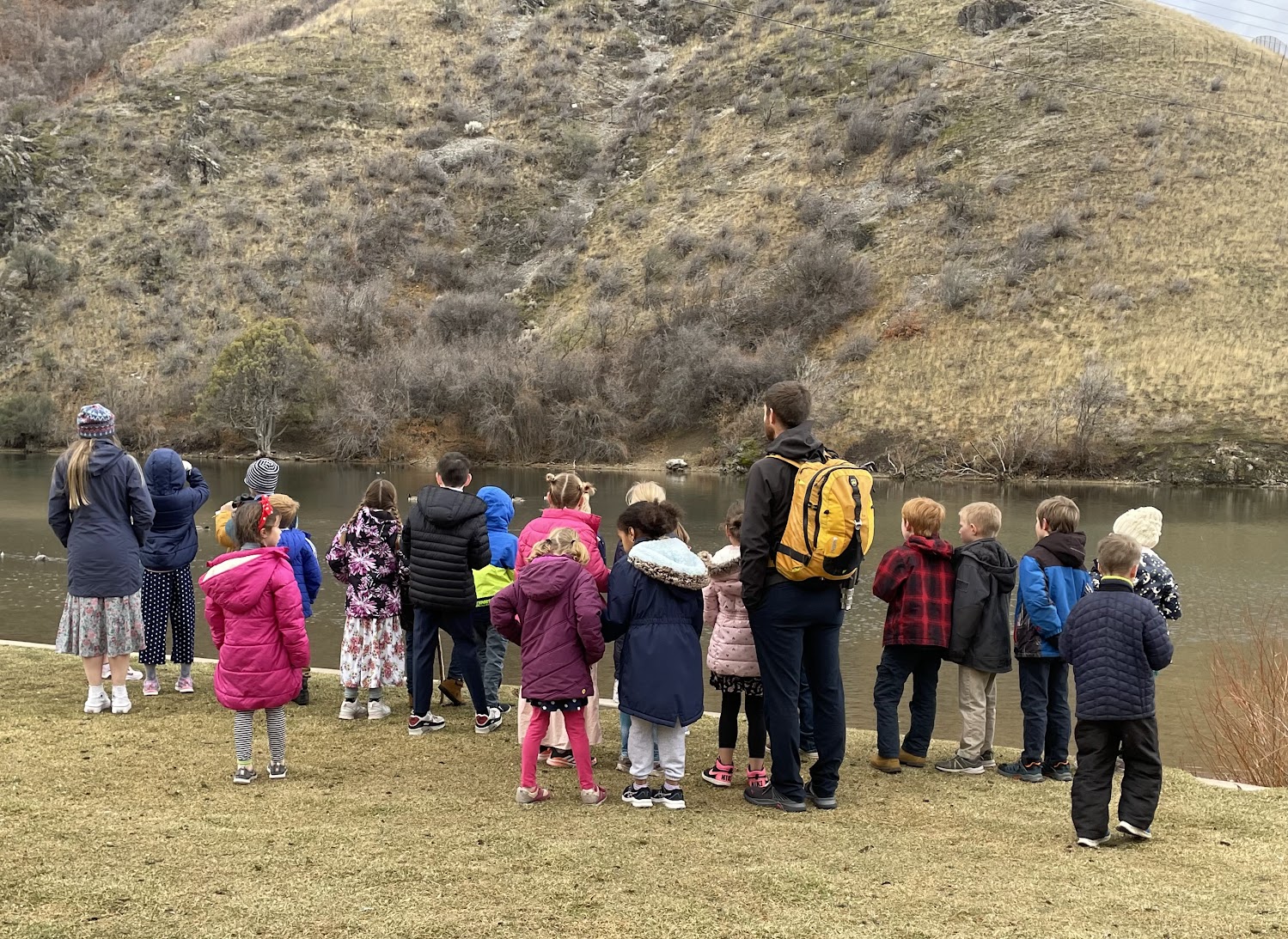
Whole Class at First Dam Courtesy & Copyright Joseph Kozlowski, Photographer
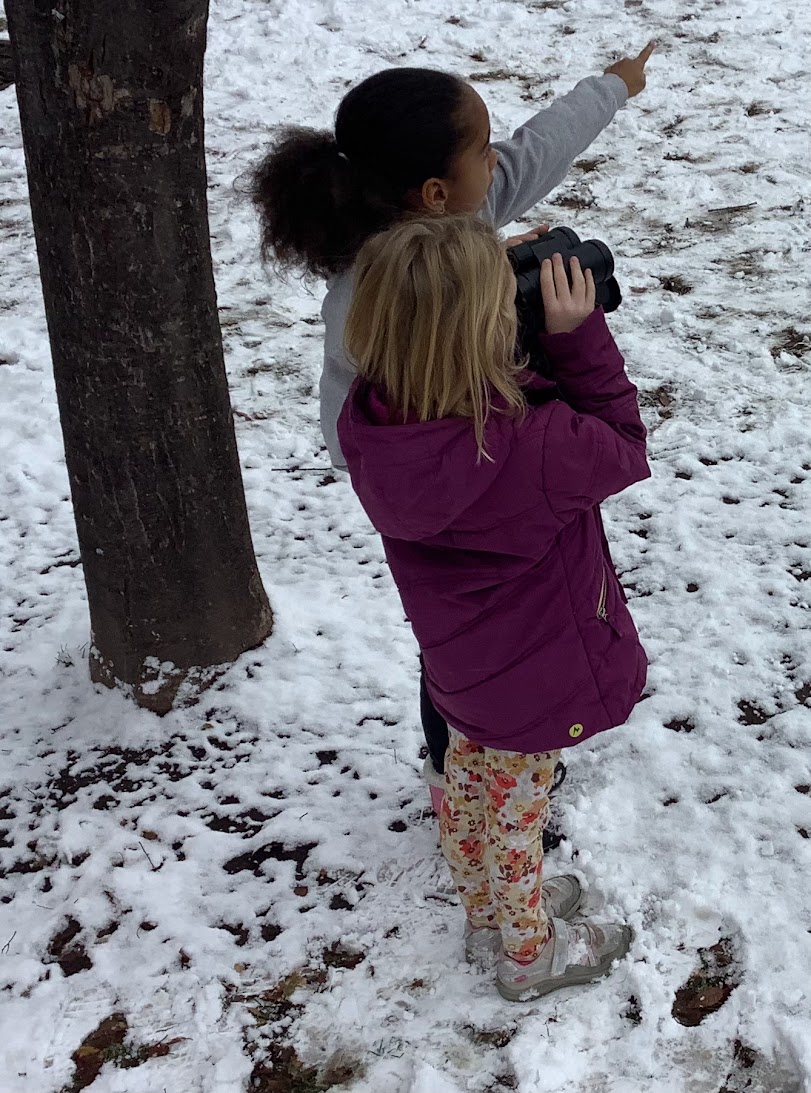
Using Binoculars to Look for Ducks Courtesy & Copyright Joseph Kozlowski, Photographer
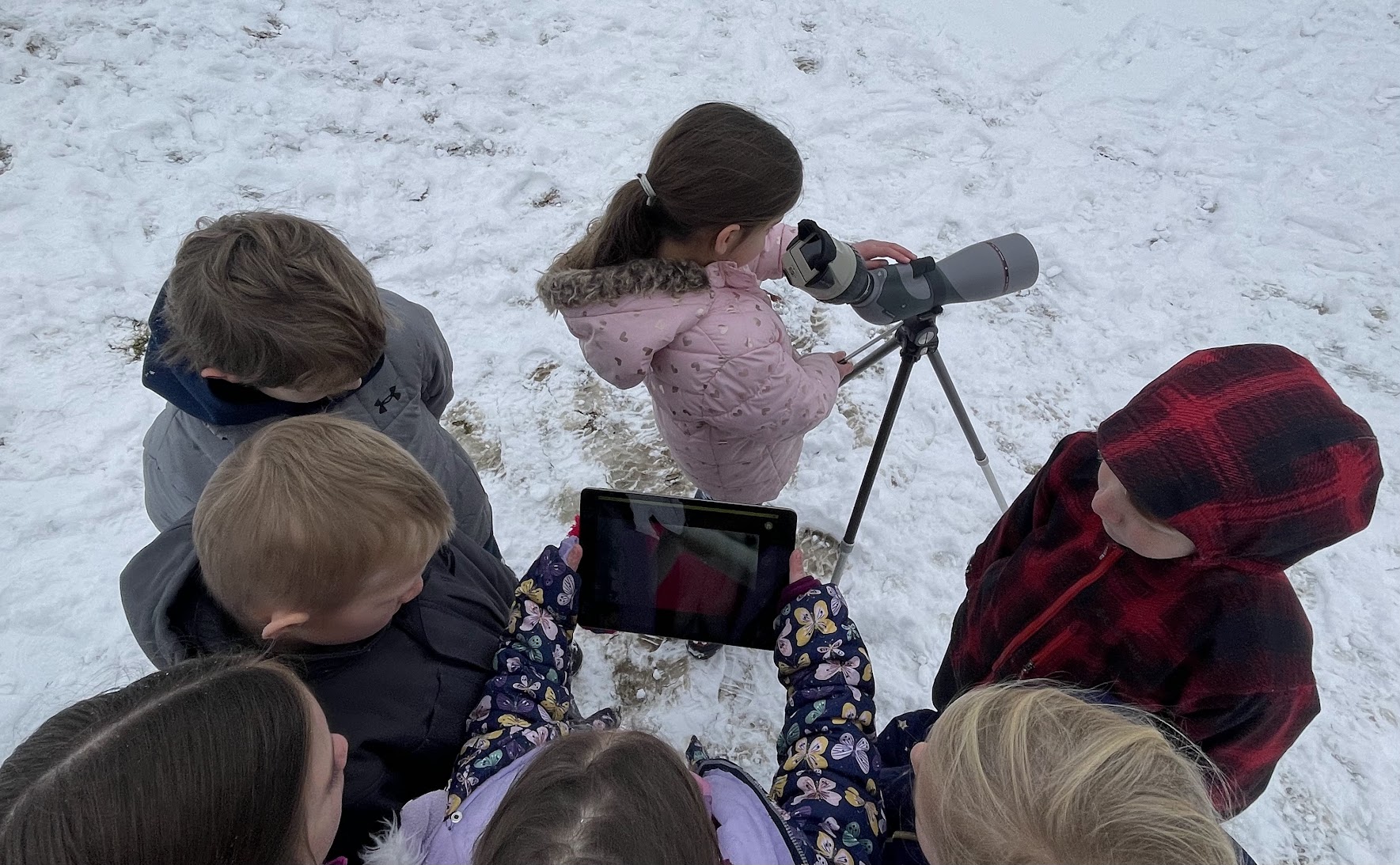
Spotting Scope with Image Transmitter Courtesy & Copyright Joseph Kozlowski, PhotographerOne aspect of experiential learning I love most is how it turns mundane encounters into magical experiences. How many times have your children walked by a pond full of ducks and geese without batting an eye, or shuffled their feet through fallen, Autumn leaves on their way to this or to that? I continue to be astonished by how much there is to appreciate and to learn from our surroundings, but we lend it a bit of our attention and wonder. It’s amazing to see how just a little preparatory investigation can turn fleeting everyday moments into lifelong learning memories.
My 2nd-grade class focuses on learning about birds. I don’t just mean we read a few books and discuss the basics of birds. I mean my students can replicate the sounds of at least 15 local birds, provide detailed descriptions of their body characteristics, and even provide information about their diet, habits, and behaviors. We’ve studied birds all year long, partnered with local bird organizations – Bridgerland Audubon Society, Bear River Migratory Bird Refuge –, been on numerous birding outings, and let’s just say are ALL IN on birding.
With the recent weather systems and cold fronts in Northern Utah, we’ve seen waterfowl migrations come alive; a perfect time to study that classification of birds with my students! Little did I, or my students, realize there was so much to learn about common waterfowl! Did you know some waterfowl dive for food and others dabble? Did you know about preening to keep waterproof, or special down feathers to keep warm? How about your knowledge on a Redhead Duck’s nest parasitism techniques? Well, my students learned about these things, and many more over the span of a few weeks. As a culminating event, we planned a field experience to Logan’s 1st Dam, a local and vibrantly busy park, which surrounds a small reservoir, and is about a 45-minute walk from our school’s front door. Many of my students have been to this park numerous times throughout their lives with their families. Needless to say, there is nothing novel about this location.
Armed with binoculars leant by the Bear River Migratory Bird Refuge, and a spotting scope with an image transmitter granted us by Bridgerland Audubon Society, students began to observe, count, and be astonished by what they saw. It was as if the students had never seen a Canada Goose or Mallard duck in their lives. Their background knowledge on these birds brought to life the mundane place they were experiencing, as kids shouted “Look, it’s dabbling!” or “I saw 15 drakes and 19 hens, that’s 34 total!” or “I bet that Redhead is trying to find someone else’s nest to lay her eggs!” The point here is that, with proper prior investigation and attention to details of place, a mundane park can become a treasured location for observing, questioning, and astonishment. What are some mundane experiences around you that could become inspiring and magical learning opportunities?
This is Dr. Joseph Kozlowski, and I am Wild about Outdoor Education in Utah! Credits: