Nature’s Recyclers

Fungi Decomposing Fall
Leaves Outside the
Stokes Nature Center
Courtesy & © 2011 Andrea Liberatore
Stokes Nature Center


Redworms Eisenia fetida
from Stokes Nature Center’s
vermicomposting system
Courtesy & © 2011 Andrea Liberatore
Stokes Nature Center

On Tuesday, November 15th, our nation celebrates America Recycles Day. While the day itself tends to focus on human recycling activity, I thought we should also give a nod to nature’s recyclers. Worms, maggots, fungi, beetles, and bacteria – it sounds like a list of leftover Halloween horrors. But in reality, we should be more afraid of what our world would look like without these creepy-crawlies, for these are nature’s recyclers. Scientists call these organisms saprophytes, and as important as their role in life is, they are more likely to evoke a shudder than any feeling of gratitude.

What decomposers actually do is break dead things down into smaller and smaller pieces, until all that is left are the basic molecular components that make up all living things such as nitrogen, phosphorous, carbon, and potassium. Once broken down, this material is then free to be taken up again by plants and animals that use them to live and grow. This cycle of nutrients is vital to life on Earth, and our saprophytic friends make it all possible.

While decomposition would occur even without the help of the decomposers, it would take much, much longer. In some landfills, newspapers have been unearthed that are more than 20 years old, and still quite readable. This is because landfills often create anaerobic environments, where oxygen-loving insects, fungi, and bacteria cannot live and therefore cannot aid decomposition. If without decomposers, a newspaper can last 20 years, what would happen to much larger and hardier items such as tree trunks and roadkill? I shudder to think about it.

Did you know that the U.S. throws more than 33 million tons of food waste into landfills each year? This organic material goes to waste there – taking up valuable space and taking longer than normal break down. So this year, celebrate America Recycles Day by employing some of nature’s recyclers in your yard. Consider starting a compost pile where your fall leaves and food scraps can get broken down into nutrient-rich all-natural fertilizer for next year’s garden.

If you’re in Cache Valley and are looking for a way to mark America Recycles Day, please join the Stokes Nature Center for a tour of the Logan landfill to find out what happens to your garbage and how recycling programs ensure there is less of it. This free tour will be held at 4:30pm on Tuesday, November 15th. For details, visit the Stokes Nature Center website at www.logannature.org.

For composting tips and more information about nature’s recyclers, visit Wild About Utah online at www.wildaboututah.org. Thank you to the Rocky Mountain Power Foundation for the research and development of this Wild About Utah topic. For the Stokes Nature Center and Wild About Utah, this is Andrea Liberatore.

For the Stokes Nature Center and Wild About Utah, this is Andrea Liberatore.

Credits:

Photos: Courtesy & © 2011 Andrea Liberatore, https://logannature.org/
Text:    Andrea Liberatore, Stokes Nature Center, logannature.org

Composting Tips & Information:

Farrell-Poe, K. and Koenig, R. (2010) Backyard Composting in Utah. Utah State University Cooperative Extension. https://extension.usu.edu/files/publications/factsheet/HG-Compost-01.pdf

U.S. Environmental Protection Agency: Composting. https://www.epa.gov/epawaste/conserve/rrr/composting/index.htm

Additional Reading:

Fogel, R. (2002) Waste Not, Want Not: Fungi as Decomposers. Utah State University Herbarium. https://utahpests.usu.edu/ipm/ornamental-pest-guide/diseases/wood-decay-fungi

Hoff, M. (2009) Young Naturalists: Nature’s Recyclers. Minnesota Conservation Volunteer Newsletter. July-August 2009. https://files.dnr.state.mn.us/publications/volunteer/young_naturalists/natures_recyclers/natures_recyclers.pdf

U.S. Environmental Protection Agency (2011) Basic Information About Food Waste. https://www.epa.gov/osw/conserve/materials/organics/food/fd-basic.htm

Sphinx Moths

Sphinx Moths; Big Poplar Sphinx, Pachysphinx occidentalis, Courtesy Whitney Cranshaw, Colorado State University, bugwood.org
Big Poplar Sphinx
Pachysphinx occidentalis
Courtesy Whitney Cranshaw
Colorado State University
bugwood.org

White-lined Sphinx
Hyles lineata
Courtesy Whitney Cranshaw
Colorado State University
bugwood.org

White-lined Sphinx Caterpillar
Hyles lineata
Courtesy Whitney Cranshaw
Colorado State University
bugwood.org

I vividly remember the first time I saw one – a small winged creature whirring from flower to flower in the evening light, its long tongue dipping for nectar within tube-shaped blooms. I was mesmerized, and struggled for a closer look.Sphinx Moths

If you’re thinking that I must have seen a hummingbird, you would be making a very common mistake. A mistake, in fact, that has given this critter one of its many nicknames. The winged wonder I saw that summer night was a sphinx moth, also called a hummingbird or hawk moth because of their large size and bird-like characteristics.

In all stages of their life, these insects are large. Caterpillars grow to a robust 4 inches in length and adult wingspans can measure more than 5 inches. Sphinx moths are also some of the fastest insects on earth and have been clocked flying at over 30 miles per hour. Their size, speed, and flying ability reflect those of the hummingbird so closely that they are commonly misidentified.

Sphinx moths are a beloved sight in many Utah gardens. However, they also hold a bit of a devious surprise. The larvae, or caterpillar, of one common species of sphinx moth are well known by vegetable gardeners. They are large and bright green with a distinctive horn near their hind end. Like the adults, these larvae go by many names, the most common being the tomato hornworm. Hornworm caterpillars, unlike their adult counterparts, are not beloved by gardeners. They are voracious beasts with the ability to strip the vegetation off a tomato or pepper plant in one day.

Aside from our garden plants, young hornworms of other species feed on a variety of vegetation including willow, poplar and cottonwood trees. Adult moths rely on a host of flowers such as columbine, honeysuckle, larkspur and evening primrose. Here in Utah you might come across one of a handful of different species in the sphinx moth family including the five-spotted hawk moth and the white-lined sphinx. Look for them in the late summer evenings as daylight begins to fade. But be sure to look twice to avoid mistaking them for something they’re not.

And the next time you find a hornworm on your tomatoes, maybe just relocate the little bugger so that you can enjoy it once metamorphosis changes the beast into a beauty.

For more information and pictures of our native sphinx moths, visit our website at www.wildaboututah.org. Thank you to Rocky Mountain Power Foundation for supporting the research and development of this Wild About Utah topic.

For the Stokes Nature Center and Wild About Utah, this is Andrea Liberatore.
Credits:

Theme: Courtesy & Copyright Don Anderson as performed by Leaping Lulu
Photos: Courtesy Whitney Cranshaw, Colorado State University, Bugwood.org
            Images licensed under Creative Commons Attribution 3.0 License
Text:    Andrea Liberatore, Stokes Nature Center, logannature.org

Additional Reading:

Cranshaw, W.S. 2007. Hornworms and “Hummingbird” Moths. Colorado State University Fact Sheet 5.517. Found online at: https://extension.colostate.edu/resource/hornworms-and-hummingbird-moths/

Buchman, Steve. 2010. Pollinator of the Month: Hawk Moths or Sphinx Moths (Sphingidae). US Forest Service. https://www.fs.usda.gov/wildflowers/pollinators/pollinator-of-the-month/hawk_moths.shtml

The Mud-Daubing Wasp

Female Sceliphron caementarium
completing nest cell
Courtesy and
Copyright © 2011 Jim Cane

Pupa of
Sceliphron caementarium
Courtesy and
Copyright © 2011 Jim Cane

The recession has slowed housing starts, but builders of clay dwellings remain busy. Millions of clay homes are built this and every summer in Utah. These dwellings can disintegrate in a summer cloudburst, so you’ll find them beneath overhangs like rock cliffs, or under bridges and the eaves of your house.

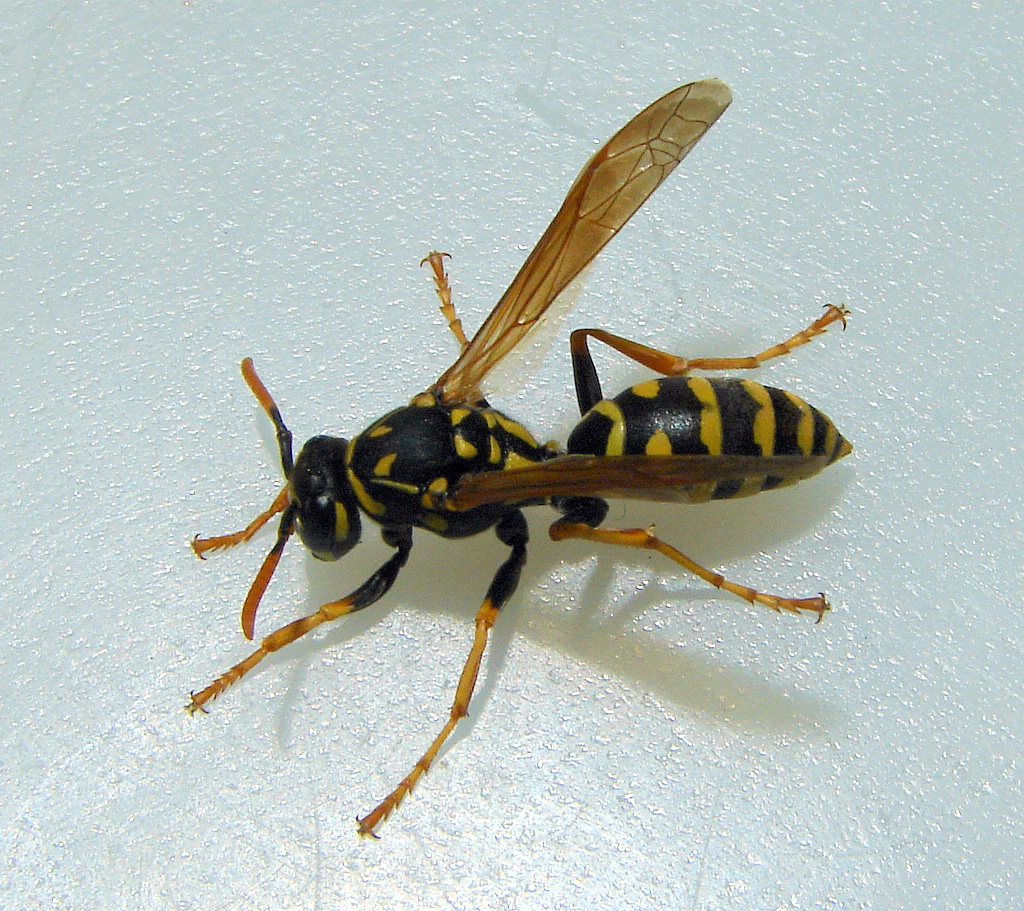
These free-standing mud homes are built by a few dozen species of solitary bees and wasps. Among them is the mud dauber, Sceliphron caementarium, a big leggy wasp found throughout Utah. The female wasp constructs hollow clay units one at a time, each the dimensions of a pitted date. The mother mud dauber gathers the wet clay in pellets. At the nest site, she draws the pellet into a ribbon of clay which becomes the next arch of the tubular nest. While working the clay, she audibly buzzes her flight muscles. This vibration visibly liquefies the clay for a few seconds. This strengthens its bond, much as workers in concrete do using large vibrating probes.

The mother wasp then collects spiders, often plucking them straight from their webs after a pitched battle. She permanently paralyzes each spider using her venomous sting. The venom is not lethal. Rather, it is paralytic, keeping the spider alive and fresh but helplessly immobile, a gruesome spider buffet for her grub-like larva to eat. Each hollow nest is packed with a half dozen spiders, one of which receives her egg. In a few weeks time, the growing wasp larva finishes eating its buffet and pupates, becoming dormant for the winter.

Nest building and provisioning by these wasps is a complex result of heritable instincts tailored to local circumstances by learning. It is also a rare trait among insects, most of whom simply lay their eggs and leave. Through observation and manipulative experiments, students of animal behavior have investigated mud-building wasps for well over a century. If you have mud daubers around your home, grab a cool drink, pull up a chair, and enjoy watching their home-making labors.

This is Linda Kervin for Bridgerland Audubon Society.

Credits:

Images: Courtesy & Copyright Jim Cane, Bridgerland Audubon Society
Text: Jim Cane, Bridgerland Audubon Society

Additional Reading:

“The Wasps”, Evans, Howard E. and Eberhard, Mary Jane West, 1970. Ann Arbor, University of Michigan Press. 265 p. illus. https://www.amazon.com/Wasps-Howard-Evans/dp/0715360604

“Bees, wasps, and ants : the indispensable role of Hymenoptera in gardens”, Grissell, Eric. 2010, 335 p. https://www.amazon.com/Bees-Wasps-Ants-Indispensable-Hymenoptera/dp/0881929883

Stromatolites

Stromatolites in Hamlin Pool
Shark Bay, Austalia
Courtesy Wayne A. Wurtsbaugh

Exposed stromatolites in the
Great Salt Lake
Courtesy
Utah Division of Wildlife Resources
Great Salt Lake Ecosystem Program

Stromatolites in Shark Bay
(Hamlin Pool) during low tide.
Courtesy Linda L’Ai

Hi I’m Holly Strand.

Shark Bay in Northwest Australia is on my “places to see before I die” list. In a section of the bay called Hamelin Pond, colonies of microbes form hard, dome-shaped, deposits. Called stromatolites, these structures embody one of the oldest forms of life on earth. The fossil record of microbes in older stromatolites date back 3.5 billion years. Their antiquity, abundance, and persistence to modern times make stromatolites a fascinating subject for scientific inquiry.

Basically, stromatolites are layered structures formed primarily by cyanobacteria. This photosynthesizing bacteria changes the pH of the water causing calcium carbonate to precipitate over a mat of bacterial filaments. The minerals, along with grains of sediment in the water, are trapped in a layer of goo that surrounds the bacterial colonies. Then the lower layer bacteria grows upward and penetrates the most recent mineral and sediment layer. When this process is repeated over and over, a stromatolite is formed.

For over 2 billion years stromatolites dominated the shallow seas and formed extensive reef tracts rivaling those of modern coral reefs. However, today, stromatolites are relatively rare. You will usually find them growing in extreme environments, such as hypersaline water or thermal springs.

While Shark Bay boasts a stunning example of a modern stromatolite colony, you don’t have to go all the way to Australia. When lake levels are low, you can easily see them in the Great Salt Lake. They span hundreds of square kilometers in shallow shoreline waters. Some say that the Great Salt Lake contains some of the most extensive areal coverage of living stromatolites in the world.

One of the best places to view them is from the shore near Buffalo Point on Antelope Island. When conditions are clear, you can see them underwater at the mouth of the Great Salt Lake Marina.

More than just memorials to ancient life, the stromatolites also play a vital role in Great Salt Lake ecology. They are the principal habitat for the brine fly larvae and pupae. In turn, brine flies are a critical diet for goldeneye ducks, American avocets and many other water birds.

Thanks to Wayne Wurtsbaugh, from Utah State University’s College of Natural Resources for his support in developing this Wild About Utah episode.

For Wild About Utah, I’m Holly Strand.

Credits:

Photos: Courtesy Utah Division of Wildlife Resources, Wayne A. Wurtsbaugh and Linda L’Ai
Text: Holly Strand

Sources & Additional Reading:

National Park Service. Stomatolite Fossils. https://www.nps.gov/care/naturescience/stromatolite.htm [Accessed August 16, 2011]

Schopf, J.William. Anatoliy B Kudryavtsev; Andrew D Czaja; Abhishek B Tripathi. 2007. Evidence of Archean life: Stromatolites and microfossils. Precambian Research, 158. No. 3-4 pp. 141-155.

UNESCO Shark Bay Western Australia https://whc.unesco.org/en/list/578 [Accessed August 16, 2011]

University of California Museum of Paleontology. Cyanobacteria: Fossil Record https://www.ucmp.berkeley.edu/bacteria/cyanofr.html [Accessed August 16, 2011]

Walter, M R. 1983. Archean stromatolites – Evidence of the earth’s earliest benthos
Earth’s earliest biosphere: Its origin and evolution. Princeton, NJ, Princeton University Press.

Wurtsbaugh, W.A. 2009. Biostromes, brine flies, birds and the bioaccumulation of selenium in Great Salt Lake, Utah. Pp. 1-15 In: A. Oren, D. Naftz, P. Palacios & W.A. Wurtsbaugh (eds). Saline Lakes Around the World:Unique Systems with Unique Values. Natural Resources and Environmental Issues, volume XV. S.J. and Jessie Quinney Natural Resources Research Library, Logan , Utah. URL: https://www.cnr.usu.edu/quinney/files/uploads/NREI2009online.pdf