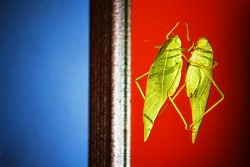
Streptopelia decaocto
Courtesy & © invasivespecies.org/bugwood.org
Joy Viola, Northwestern University, Photographer
 Colorado Potato Beetle Adult
Leptinotarsa decemlineata
Courtesy IPMimages.org/bugwood.org
USDA ARS, Photographer
Hi, I’m Holly Strand from the Quinney College of Natural Resources at Utah State University.
More and more you are likely to hear this sound in Utah yards, parks and fields. [Eurasian Collared Dove, Courtesy Ryan O’Donnell, www.xeno-canto.org/98068] That’s the call of the Eurasian collared dove. Originally from Asia, this dove has been expanding its territory around the world at an incredible rate. The first sighting in Utah was in Orem in 1997. And now the doves are everywhere. So far, it doesn’t look like our native mourning dove is affected. But such rapid population explosions rarely occur without some sort of undesirable ecological consequence.
In America, the Eurasian collared dove is an invasive species. But not all non-native species are invasive. “Invasive” only applies when species spread far beyond the area where they are first introduced. Luckily, not all invasive species turn out to be serious pests. Ecologist Mark Williamson suggested the tens rule. About 10% of introduced species establish lasting populations and 10% of those go on to become problems.
There’s a long list of Eurasian invasives in Utah. Among them is the highly flammable cheat grass that comes from southwestern Asia. Those massive clouds of starlings? They come from Europe. Tamarisk from Eurasian deserts lines the Colorado River and tributaries. The common carp is an unwelcome Eurasian colonist of our lakes and large rivers. And the American west’s iconic tumbleweed is an invader from the Russian steppe.
Why so many invaders from Eurasia? Well for the last 500 years, there has been a net outflow of Eurasians—especially Europeans—to other parts of the world. And this human population carried its biological baggage along with it—in the form of animals, plants and diseases. Some ecologists believe that the physical geography and human history of Eurasia has conditioned its species in such a way that they will consistently outcompete the species of other continents. But that’s debatable. For in the last decades the New World has started to lob some pretty competitive species over to Eurasia.
For example, the American mink was brought to the Eurasian continent in the 1920s for use on fur farms. But–because of deliberate releases and accidental escapes–the mink is now common in the European wild. And it’s a pest. The American mink is taking the place of the European mink which is now threatened with extinction. Furthermore, the American mink is gobbling up populations of many ground-nesting birds.
Unless you are involved in agriculture, you might not have heard of the Colorado potato beetle. But potato growers around the globe know this striped orange and brown beetle from the American southwest very well. It has a voracious appetite for potato leaves and quickly develops resistance to any chemicals used against it.
And a final example: the American bullfrog is considered one of the world’s most damaging invasives. The bullfrog does amazingly well in a variety of habitats –even artificial ones like millponds, irrigation ditches and reservoirs. Its incredible adaptability helps it spread and outcompete native frogs. Moreover, it has been transmitting a deadly fungus to previously unaffected populations of frogs, toads and salamanders.
Thanks to Lyle Bingham for information on the Eurasian collared dove. And to Ryan ODonnell for his audio recording from xeno-canto.org. For more information on the Eurasian collared dove and other invasive species go to www.wildaboututah.org.
For Wild About Utah, and the Quinney College of Natural Resouces, I’m Holly Strand.
Credits:
Theme: Courtesy & Copyright Don Anderson Leaping Lulu
1. Photographer Joy Viola, Northwestern University, Bugwood.org https://www.invasive.org/browse/detail.cfm?imgnum=5413582
2. USDA ARS Photo Unit, USDA Agricultural Research Service, Bugwood. https://www.insectimages.org/browse/detail.cfm?imgnum=1321015
Audio of Eurasian collared dove:
Ryan P. O’Donnell, XC98068. Accessible at www.xeno-canto.org/98068.
Creative Commons Attribution-NonCommercial-NoDerivs 2.5
Text & Voice: Stokes Nature Center: Holly Strand
Sources & Additional Reading:
Bingham, Lyle. 2009. The New Dove in the Neighborhood. Wild About Utah Program https://wildaboututah.org/the-new-dove-in-the-neighborhood/ October 8, 2009.
di Castri F. 1989. History of biological invasions with special emphasis on the Old World. In: Drake JA, Mooney HA, di CastriF, Groves RH, Kruger FJ, Rejma´nek M, Williamson M, eds. Biological invasions: a global perspective. Chichester, UK: John Wiley and Sons.
European Environment Agency, 2012. The impacts of invasive alien species in Europe EEA Technical report No. 16/2012. EEA, Copenhagen.
National Invasive Species Information Center (NISIC): Gateway to invasive species information; covering Federal, State, local, and international sources.
https://www.invasivespeciesinfo.gov/index.shtml
Simberloff, Daniel. 2013. Invasive Species: What Everyone Needs to Know. Oxford University Press