Insect Mimicry

American Hoverfly, Courtesy National Park Service, nps.gov/long/naturescience/insects.htm
American Hoverfly
Courtesy National Park ServicePeach Tree Borer, Courtesy Cooperative Extension, Copyright 2009 Clemson UniversityPeach Tree Borer
Courtesy USDA Cooperative Extension
© 2009 Clemson University

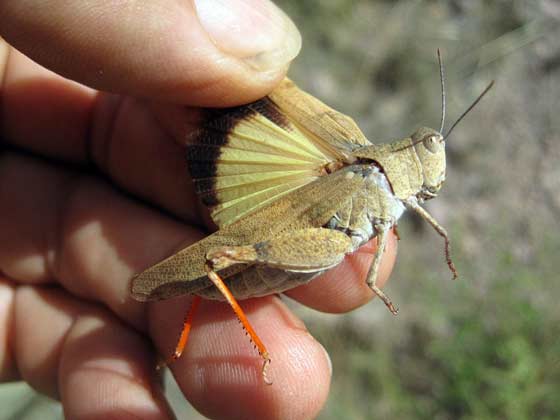
Katydid, Courtesy Stokes Nature Center, Scott Biggs, Photographer Katydid
Courtesy Stokes Nature Center
Scott Biggs, Photographer

Monarch Butterfly, Courtesy Utah Division of Wildlife Resources, J. Kirk Gardner, Photographer Monarch Butterfly
Courtesy Utah Division of Wildlife Resources
J. Kirk Gardner, Photographer
Licensed Under CCL 3.0

Click for a closer view of a Tiger Swallowtail Butterfly, Courtesy Utah Division of Wildlife Resources, J. Kirk Gardner, Photographer Tiger Swallowtail Butterfly
Courtesy Utah Division of Wildlife Resources
J. Kirk Gardner, Photographer
Licensed Under CCL 3.0


Insects are the most diverse class of organisms on earth, with more than 900 thousand known species. With that many different kinds of bugs, it’s no wonder that they take on such a vast array of shapes, sizes, and colors. From Luna moths to fruit flies to millipedes, the diversity of this class of life is immense. Some insects have developed a shape and coloring so deliberate that it’s almost astounding. These insects are mimics – bred to look like something they aren’t, in an attempt to get a leg up on the survival game.

Insects can mimic all kind of things – stick bugs, for example, make such convincing twigs that you’ll never know they’re around until they move. Katydids look just like bright green leaves, and there are some species of caterpillar that in their youngest stages look just like splatters of bird droppings. But the mimics that I find most interesting are those who mimic other insects.

There are two main types of insect-to-insect mimicry. Batesian mimicry occurs when one harmless species mimics another dangerous one. Species that look like something fierce can capitalize on that insect’s dangerous reputation and potentially be safer from predators because of it. A common Utah pest, the peach tree borer, is a moth that very closely resembles a wasp in both its morphology and behavior. Harmless, nectar-eating hoverflies exhibit the black and yellow body stripes of a bee. Apparently, it’s not just humans who want to stay away from the business end of a wasp or a bee – many insect predators, too, give them a wide berth.

Ants also have a fierce reputation in the animal world, and so attract a lot of mimics. A number of spider species not only mimic ants in morphology and behavior, but some also give off ant pheromones, making them smell like friend rather than foe. While many ant-mimicking spiders go undercover as a way to hide from their own predators, some do use their disguise as a way to access the nest of their prey.

Batesian mimicry is a delicate balance. Predators need to catch a wasp or two before they associate that color pattern with dangerous prey. If there are too many tasty mimics around, the predators will stop associating black and yellow stripes with a dangerous object and the mimic’s ploy would fail to work.

A slight variation on Batesian mimicry are insects with false faces and false eyes. Tiger swallowtails – those large yellow and black butterflies – have red and blue spots on each of their hind wings at a place farthest from their body. These spots, combined with the skinny black ‘tails’ from which the species gets its common name, are meant to look like the eyes and antennae of another, possibly larger and more fierce, insect. This imagery is meant to frighten off predators, but also in the case of an attack, to spare the most important part of the butterfly’s body.

The second, less common, form of insect-to-insect mimicry is called Müllerian mimicry. This occurs when two equally distasteful insects come to resemble one another. Most of us are familiar with the monarch butterfly. As caterpillars, they feed exclusively on toxic milkweed. The caterpillars take the toxins into their bodies and retain them as adults, making them not only bad-tasting but also poisonous. Predators have learned to associate that distinct orange and black wing pattern with a bad experience, and therefore leave them alone. Viceroy butterflies look incredibly similar to monarchs – the only difference being an extra line of black on the hindwings of a viceroy. While once thought to be Batesian mimics, recent studies have shown that viceroys are equally unpalatable. Their similarity in looks to monarchs, then, serves to reinforce the distasteful nature of both species.

Mimicry is of course, not restricted to the insect kingdom. Some plants have gotten into the mimicry business in order to trick insects. The hammer orchid, which grows in Australia, has a flower that mimics a female bee. Male bees, in mistakenly trying to mate with the flower, collect pollen that they then carry with them to the next, ensuring pollination of this sneaky plant. So this ingenious tactic some insects use to gain a leg up in the game of survival can also be used against them to the advantage of others. Isn’t life amazing…

For more information and photos of some insect mimics, visit our website at www.wildaboututah.org. For the Stokes Nature Center and Wild About Utah, this is Andrea Liberatore.

Many thanks to Don Viers for his input on this piece.

Credits:

Photos: Courtesy and copyright as marked

Text: Andrea Liberatore, Stokes Nature Center

Additional Reading:

Imes, Rick (1997) Incredible Bugs: The Ultimate Guide to the World of Insects. Barnes & Noble Books. New York, NY

Pyle, Robert Michael (1981) National Audubon Society: Field Guide to Butterflies, North America. Alfred A. Knopf. New York, NY

Viers, Don (2013) Personal conversations

Ritland, David B., Brower, Lincoln P. (1991) The Viceroy butterfly is not a Batesian mimic. Nature, vol. 350, 497-8. Available online at: https://www.nature.com/nature/journal/v350/n6318/abs/350497a0.html

Cushing, Paula E. (2012) Spider-ant associations: An Updated Review of Myrmecomorphy, Myrmecophily, and Myrmecophagy in Spiders. Psyche, vol. 2012. Available online at: https://www.hindawi.com/journals/psyche/2012/151989/

NRCS Partners with Farmers, Ranchers to Aid Monarch Butterflies, Posted by Jason Weller, Chief, Natural Resources Conservation Service, on November 12, 2015, USDA Blog, https://blogs.usda.gov/2015/11/12/nrcs-partners-with-farmers-ranchers-to-aid-monarch-butterflies/

Cicada Songs

Click for a larger view of a Crepitating Cicada. Courtesy and Copyright 2008 Jim Cane, Photographer
Crepitating Cicada
Platypedia putnami
Elko Co., Nevada
June 2008
Courtesy & Copyright 2008
Jim Cane, Photographer

Click for a larger view of a cast nymphal skin of a Crepitating Cicada. Courtesy and Copyright 2008 Jim Cane, PhotographerCast Nymphal Skin of the
Crepitating Cicada
Platypedia putnami
Elko Co., Nevada
June 2008
Courtesy & Copyright 2008
Jim Cane, Photographer

Click for a larger view of an Audiospectrograph of the Crepitating Cicada. Courtesy and Copyright 2008 Jim Cane, PhotographerAudiospectrograph of the
Crepitating Cicada
Platypedia putnami
Made with Raven Software
Elko Co., Nevada
June 2008
Courtesy
Jim Cane, creator

East Coast news reports have been abuzz about this summer’s synchronized emergence of the periodic cicada, last seen in 1996 when their parental generation flew. The incessant loud buzzing of these 17 year cicadas has been the dominant sound of mid-Atlantic forests and towns for some weeks now.

The Great Basin also has cicadas. Our two species from the genus Platypedia produce a more subdued mating call. They use crepitation, from the Latin for a crackling sound. Our crepitating cicadas have received scant research attention; even their means of sound production remains uncertain. Their call consists of a trill of accelerating clicks.

You can see an audio spectrograph of their clicking call on our Wild About Utah website. The wings of crepitating cicadas visibly clap to the tempo, leading some to believe that the sound is that of slapping wings. More likely, the snapping sound is generated by the bending of a wing vein or other semi-rigid surface in the manner of a metal dog training clicker. Listen to the similarity.

As with cicadas everywhere, our crepitating cicadas spend years underground as slow growing, wingless immatures called nymphs. Cicada nymphs feed in a manner similar to their smaller kin the aphids, white flies and scales, piercing the roots of trees and shrubs to suck their sweet sap. When and where adult cicadas are abundant, you can see scattered cast brittle skins from which the adults emerged. Tunneling by cicada nymphs has been shown to alter the morphology of Great Basin soils, but it is their collective daytime clicking that grabs your attention.

En masse, they sound like an orchestra of castanets. At sunset, as if on cue, they all become quiet for the night. After hearing our crepitating cicadas clicking all day long, that evening silence is profound.

Credits:

Images: Courtesy & Copyright 2008 Jim Cane, Photographer
Recording: Courtesy & Copyright Jim Cane
recorded with Raven software: Bioacoustics Research Program. (2011). Raven Pro: Interactive Sound Analysis Software (Version 1.4) [Computer software]. Ithaca, NY: The Cornell Lab of Ornithology. Available from https://www.birds.cornell.edu/raven.
Sound clip of the call of the 17-year periodic cicada, Courtesy Dan Mozgai, from his website, https://www.cicadamania.com/. Copyright Dan Mozgai.
Clicking sound of the crepitating cicada, Platypedia putnami. Logan Utah, June 2013. Copyright Jim Cane
Text: Jim Cane, https://bridgerlandaudubon.org/

Additional Reading:

Cicada Mania, https://www.cicadamania.com/

Aquatic Insects, Harbingers of Health

Aquatic Insects, Harbingers of Health
Skwala (Large Springflies)
Stonefly Nymph
Courtesy & Copyright
Robert Newell
As found on
TroutNut.com

Aquatic Insects, Harbingers of HealthMayfly nymph
Courtesy & Copyright
Leo Kenney, Vernal Pool Association

Aquatic Insects, Harbingers of HealthNorthern caddisfly Larvae

Limnephilidae
Photo Credit:
Howard Ensign Evans,
Colorado State University,
Bugwood.org
Used under
Creative Commons Attribution 3.0
License.

Hi, this is Mark Larese-Casanova from the Utah Master Naturalist Program at Utah State University Extension.

As we officially enter summer, it’s easy to notice nature at its peak. Wildflowers are in bloom, birds are feeding their young, and insects fill the air. Life is especially robust near our wetlands, lakes, and streams.

Our aquatic, or wet, ecosystems provide habitat to abundant plants and animals. Only 1% of Utah is wet, but over 80% of all wildlife in Utah depend on aquatic ecosystems for at least part of their life cycle. However, the quality of Utah’s aquatic habitats is often affected by chemical pollution or excessive nutrients and sediment.

Some organisms, including many aquatic insects, only live in the healthiest of aquatic habitats. Many of the insects we see in summer live in the water when young, during the larval or nymph stage, before becoming adults. Three insects in particular- mayflies, stoneflies, and caddisflies- require especially clean, cold streams low in nutrients and high in dissolved oxygen to survive.

Mayflies are aquatic as nymphs and emerge from the water to live as adults for just a day. The external feather-like gills of the nymphs can be seen fluttering along the sides of their abdomen. They feed by scraping algae from rocks.

Stonefly nymphs are well adapted to living among the rocks of swift-moving streams. Their hooked legs grasp the slick rocks as they shred apart plant litter that falls into the stream.

Caddisfly larvae spin a sort of spider silk to glue rocks or sticks together to form a case in which they live. They will also build webs underwater to collect small particles of food that drift by.

The quality of a stream habitat can be assessed by counting the number of different species, or types, of mayflies, stoneflies, and caddisflies. A greater number of species generally means that habitat and water quality are higher. Dramatic decreases in insect diversity from season to season or year to year can signal a decline in stream health. Monitoring aquatic insects over time gives us an accurate picture of the long-term health of our stream ecosystems.

For more information about monitoring water quality and aquatic insects, visit Utah State University Water Quality Extension’s website. Once there, you’ll find a wealth of information about monitoring Utah’s aquatic ecosystems, including Utah Water Watch, a statewide volunteer citizen science program.

For Wild About Utah, I’m Mark Larese-Casanova.

Credits:
Images: Northern caddisfly larvae, Howard Ensign Evans,
            Colorado State University
            Creative Commons Attribution 3.0 License.
            Stonefly Nymph, © Robert Newell, displayed on Troutnut.com
            Mayfly nymph, © Leo Kenney Vernal Pool Association
Text:     Mark Larese-Casanova, Utah Master Naturalist Program
            at Utah State University Extension.


Additional Reading:

Larese-Casanova, M. Utah Master Naturalist Watersheds Wildlife Field Guide. Utah State University Extension. 2012. https://extension.cart.usu.edu/Details.cfm?ProdID=41&category=0

USU Water Quality Extension. Utah Stream Team Manual. https://extension.usu.edu/waterquality/htm/citizen_monitoring/ust

Voshell, J. R. A Guide to Common Freshwater Invertebrates of North America. The McDonald and Woddward Publishing Company. 2002. https://www.amazon.com/Guide-Common-Freshwater-Invertebrates-America/dp/0939923874

Firefly light

Click for a larger view of a firefly, Courtesy Wikimedia, Bruce Marlin, Photographer, licensed under Creative Commons Attribution-Share Alike 2.5 Generic license
Firefly
Courtesy Wikimedia,
Bruce Marlin, Photographer
Licensed under
Creative Commons Attribution-
Share Alike 2.5 Generic license

Click for a larger view of Nibley Firefly viewing spot Courtesy and copyright Google EarthFirefly viewing spot
Heritage Park, Nibley, UT
2456 S 800 W

Access 800 W from either 2600 S
(from Hwys 165 or 89)
OR 2200 S (Hwy 89 only)
41° 41′ 23″ N 111° 51′ 17″ W

Courtesy Google Earth, Imagery Date 8/11/2011

Hi, I’m Holly Strand.

One of my greatest delights during childhood was to visit my grandmother in North Carolina. For around her farmhouse I could spend endless hours chasing and catching fireflies–we called them lightening bugs back then. As an adult, I am still captivated by the dancing lights that animate the muggy darkness, often with a background chorus of crickets and cicadas.

Flashing in fireflies evolved as a way to identify a mate. The male flashes his invitation while patrolling the local air space. If a female is impressed, she responds, either from the ground or at some perch in a shrub or on tall grass. Different species emit different flash patterns to avoid interspecific mix-ups.

Fireflies are very common in the moister, eastern half of the US. Look for them near ponds, streams, wet meadows and marshes. Many popular science sources will assert that fireflies don’t occur in the arid west. Or they will say that fireflies in the west don’t flash. For while the larvae of all firefly species glow, the adult forms of some species don’t flash. And those non-flashing forms are the species which are documented online and in collections for Utah and surrounding states.

Until recently I felt sorry that Utah kids don’t get to experience these magical bioluminescent displays. But on Monday night just before 10 PM, my family and I stood at the end of the sidewalk behind the soccer fields in Nibley’s Heritage Park. As the sky darkened, tiny amber lights began to wink on and off. An entire field of twinkling lights lay before us. I had to pinch myself to make sure I wasn’t dreaming.

I asked around and discovered that –in the last 10 years or so–there have been several sightings of flashing fireflies here in Utah. In 2002, biologist Jim Cane discovered some in River Heights. Utah State University’s Insect Collection features a 2007 specimen from Heber Valley. In recent years, additional sightings have been reported in Escalante, the Uinta, Spanish Fork and now Nibley.

We don’t know why Utahns are now able to enjoy these insect light displays. Have the flashing fireflies always been here and we just didn’t notice them? Did we notice them, but didn’t document it publicly? Or is the range of this particular species expanding? And if so, why?

To see the Nibley fireflies check our website www.wildaboututah.org. We’ve posted a map. And if you have seen flashing fireflies now or in the recent past here in Utah, let us know and we’ll post it on our website for others who might be nearby.

In general, firefly populations are declining around the world, and they are obviously still rare here. So if you run across them, treat them with respect!

Thanks to Utah State University entomologists Charles Hawkins, Ted Evans and Jim Cane for sharing their firefly expertise.

For Wild About Utah, I’m Holly Strand.

Credits:

Image: Courtesy Wikimedia, Bruce Marlin, Photographer
Map/Satellite Image: Courtesy Google Earth
Theme music: Composed by Don Anderson and performed by Leaping Lulu, https://leapinglulu.com/
Text: Holly Strand

Reported Sightings:

22 June 2013
I just read the article about fireflies and want to say I’ve seen them in Mill Creek Canyon, just out of Moab (not Mill Canyon, which is north of town). I’m familiar with them from being in Missouri as a kid on vacation to see relatives.

Thanks for a great website! CM


24 June 2017
Today while waiting for local city fire works we saw a lighting bug or two. We are in West Haven.


Report your sighting


Sources & Additional Reading

Buschman, Lawrent L., Biology of the Firefly Pyractomena lucifera (Coleoptera: Lampyridae). The Florida Entomologist. 1984. Vol. 67(4):529. DOI: 10.2307/3494462 https://www.jstor.org/stable/3494462?origin=crossref&seq=5

Lloyd, James E., 1964. Notes on Flash Communication in the Firefly Pyractomena dispersa (Coleoptera: Lampyridae) Annals of the Entomological Society of America, Volume 57, Number 2, March 1964 , pp. 260-261. (James Lloyd is a leading authority on fireflies. He retired from academic duty at the University of FL, but here is a web page with some of his wisdom and musings. https://entnemdept.ufl.edu/lloyd/firefly/

(Boston) Museum of Science Firefly Watch
Volunteers help citizen scientists track firefly occurrences.
https://legacy.mos.org/fireflywatch/
https://www.massaudubon.org/programs-events/community-science/firefly-watch/view-explore-data

National Geographic. Firefly (Lightning Bug) Lampyridae
https://animals.nationalgeographic.com/animals/bugs/firefly/

Phys.org news service. Jun 26, 2012. Romancing the firefly: New insights into what goes on when the lights go off. https://phys.org/news/2012-06-romancing-firefly-insights.html#inlRlv

Stanger-Hall, Kathrin F., James E. Lloyd, David M. Hillis. 2007. Phylogeny of North American fireflies (Coleoptera: Lampyridae): Implications for the evolution of light signals. In Molecular Phylogenetics and Evolution 45 (2007) 33-49. http://www.bio-nica.info/biblioteca/stangerhall2007fireflies.pdf

Utah State University Insect Collection has over 117 cabinets housing approximately two million pinned insects and 35,000 microscope slides. Location: Room 240, Biology and Natural Resources Bldg.; Telephone: 435-797-0358
https://www.usu.edu/biology/research/insect-holdings/