An Arizona Road Trip Back Into the Past

Montezuma Castle, Courtesy US NPS
Montezuma Castle
Courtesy US NPS
 
Location of Hubbell Trading Post NHS in the Southern Colorado Plateau Network,  Courtesy US NPSLocation of Hubbell Trading Post NHS in the Southern Colorado Plateau Network
Courtesy US NPS
 
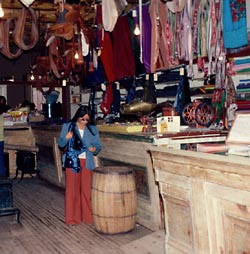
Hubbell Trading Post, Courtesy US NPSHubbell Trading Post Interior
Courtesy US NPS

Arizona is rich in history — from the 1800s all the way back to the Late Triassic Period. You can stitch together a road trip that winds out of Flagstaff to Montezuma Castle National Monument, to Petrified Forest National Park, and ends at Hubbell Trading Post National Historic Site. Along the way you’ll experience fascinating chapters of geologic and cultural history.

At Montezuma Castle, 45 minutes south of Flagstaff and just off Interstate 17 (Exit 289), a short walk places you in front of a 5-story-tall cliff dwelling that offered safety from invaders: it stands 100 feet above the valley floor, nestled into an alcove.

The site was misnamed Montezuma Castle in the late 1800s by whites who thought the structure had been built by the Aztec people. The original owners, members of the Southern Sinagua (seen aug wah) people, called this area home from roughly 1100-1425 A.D.

Stroll the short trail that loops around a vegetated landscape below the “castle,” and you’ll find great views as well of the remains of Castle A. That dwelling once rose 60 feet and was home to about 100 residents.

From Montezuma’s Castle, it’s 95 miles via Arizona 87 to Winslow, and then 34 miles east on Interstate 40 to Holbrook. Finally, another 19 miles southeast on Arizona 180 leads you into Petrified Forest National Park and its unusual landscape.

There’s no lodging within the park, and you have to leave by sundown, so you will need to make some tough decisions if you have just one day. Do you take time to tour the Rainbow Forest Museum with its dinosaur displays, or hike out to Agate House?

A building built of petrified wood is pretty cool, so stretch your legs with a walk to the house. Then head north and deeper into the park to the Crystal Forest Trail. Wander this path and you’ll find yourself surrounded by petrified wood with its hues of yellow, red, and green, black and white.

Blue Mesa is another great stop. There’s a trail that takes you down into another colorful landscape of badlands and chunks, logs, and even slabs of petrified wood in shades of red, blue, yellow and black.

The northern end of the park road is anchored by the Painted Desert, a great place for sunset photos. Here you’ll also see the Painted Desert Inn, which some day could put the Park Service back into the lodging business but today is just a museum piece.

Back on Interstate 40, drive 22 miles east to Chambers, and then north on U.S. 191 for about 38 miles to Ganado and Hubbell Trading Post. This authentic trading post was opened by John Lorenzo Hubbell in 1878 on the Navajo Reservation.

Although it was added to the National Park System in 1967, Hubbell is not a museum piece but an active trading post. As such, it still holds richly woven Navajo rugs, jewelry, and other Native American artworks for purchase.

Schedule your visit to Hubbell Trading Post for May and you just might be able to attend the annual Native American Art Auction. Check with the park (928-755-3475) for the exact date.

If you have a little more free time, you could extend your your trip by heading 39 miles north on 191 to Canyon de Chelly National Monument.

For Wild About Utah and National Parks Traveler, I’m Kurt Repanshek.

Credits:
Image: Courtesy and Copyright Kurt Repanshek, www.nationalparkstraveler.com
Text:     Kurt Repanshek, NationalParksTraveler.com.

Additional Reading:

Montezuma Castle National Monument, NationalParksTraveler.com, https://www.nationalparkstraveler.com/2012/03/visiting-montezuma-castle-national-monument-arizona9636

Montezuma Castle National Monument, US National Park Service, https://www.nps.gov/moca/index.htm

Geographic Area covered by the State of Deseret and Utah Territory, International Society Daughters of Utah Pioneers, https://www.dupinternational.org/dyn_page.php?pageID=54

Fossil Formation

Fossil Formation: Click for a larger view of a fossil, Courtesy and copyright 2008 Stokes Nature Center, logannature.org
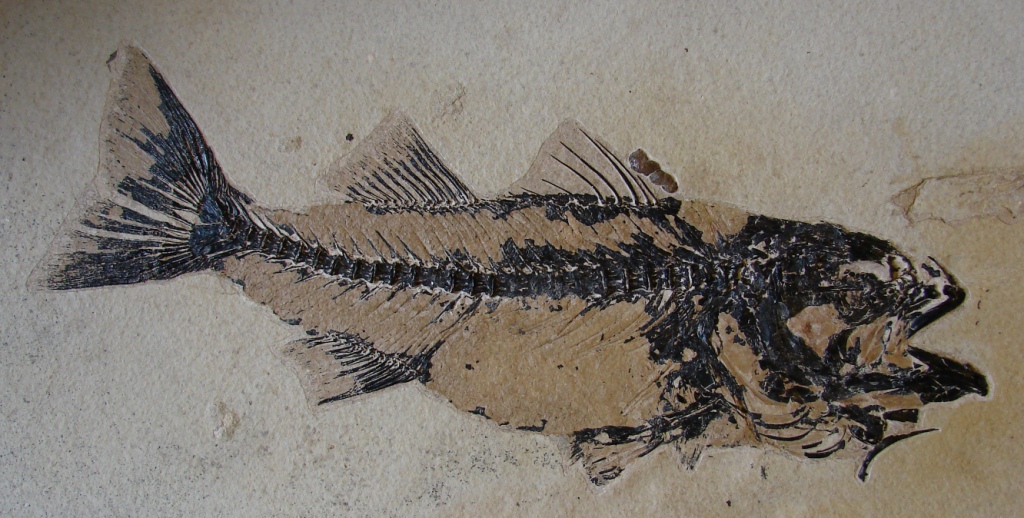
Fossilized fish
Mioplosus labracoides
Copyright 2013 Stokes Nature Center
Andrea Liberatore, Photographer

Fossil Formation: Click for a larger view of a fossil, Courtesy and copyright 2008 Stokes Nature Center, logannature.orgFossilized fish
Copyright 2013 Stokes Nature Center
Andrea Liberatore, Photographer

Fossil Formation: Horn Corals from Logan Canyon, Courtesy and copyright 2008 Stokes Nature Center, logannature.orgHorn Corals from Logan Canyon
Copyright 2013 Stokes Nature Center
Andrea Liberatore, Photographer

Fossilized leaf, Courtesy and copyright 2008 Stokes Nature Center, logannature.orgFossilized leaf
Copyright 2013 Stokes Nature Center
Andrea Liberatore, Photographer

Fossilized shells
Copyright 2013 Stokes Nature Center
Andrea Liberatore, Photographer

Fossil Formation

The most popular school program that the Stokes Nature Center offers is a geology lesson for second grade. I’m not sure what happens between second grade and adulthood to make our general perception of geology go from exciting to boring, but you would be amazed at how excited second graders get over rocks, and especially, over fossils.

Fossils are really quite rare – a very specific set of conditions have to be met in order to create one. Most living things decompose fairly rapidly upon death, leaving no trace of their existence behind. In order to create a fossil, this process of decomposition needs to be halted fairly rapidly, which typically means that the body is quickly covered by some kind of sediment – like sand, or soil or mud. For this reason, most fossils are found embedded in sedimentary rock. If pressure and moisture levels are just right, over the course of millions of years the organism’s molecules will slowly be replaced by minerals from the surrounding sediments – eventually turning bone into stone.

Only somewhere around one in a billion bones will make it through this process. From there the fossil has to remain intact and identifiable through eons of tectonic plate movement, earthquakes, and mountain uplift. Then, in order to be found it has to be located near enough to the earth’s surface, and in such a place where a human might come across it. Some geologists estimate that only 1 in 10,000 species that have ever lived have made it into the known fossil record, which makes me wonder what discoveries still await us.

Fortunately for us, prehistoric Utah was a place where fossilization happened with some regularity, as evidenced by places like Dinosaur National Monument and the Escalante Petrified Forest. Did you know that Utah has a state fossil? That distinction goes to the allosaurus, a predatory dinosaur that thrived during the Late Jurassic period. Numerous skeletons found in east-central Utah range in size from 10 – 40 feet in length, meaning this fearsome creature may have rivaled it’s more famous cousin Tyrannosaurus Rex for top predator status.

With such a rich fossil history, it’s not out of the question that you might stumble onto something truly amazing during a routine hike. Can you keep your find? Well, that depends on two things: the type of fossil, and whose land it was found on. On public lands in Utah, fossils of vertebrates cannot be collected, while fossils of invertebrates and plants can be. Private land owners have full rights to the fossils found on their property. With all fossils, it’s a great idea to report your find to the US Geological Survey so that your discovery can be documented for public or scientific research, display or education.

Fossil creation is an incredible phenomenon that has allowed us to glimpse the earth’s history in ways that would otherwise be completely hidden. Thanks to fossils, we can envision a prehistoric landscape filled with giant ferns, enormous dragonflies, long-necked allosauruses, and flying pterodactyls. Without the evidence in the fossil record, I doubt that even the most imaginative person among us could have envisioned such an amazing array of life.

For the Stokes Nature Center and Wild About Utah, this is Andrea Liberatore.

Fossil Formation-Credits:

Photos: Courtesy & © Stokes Nature Center, logannature.org
Text:    Andrea Liberatore, Stokes Nature Center, logannature.org

Fossil Formation-Additional Reading:

State of Utah, Utah Geological Survey, Dinosaurs & Fossils (2011) https://geology.utah.gov/utahgeo/dinofossil/index.htm

McCalla, Carole and Eldredge, Sandy (2009) What should you do if you find a fossil? Utah Geological Survey. Accessible online at: https://geology.utah.gov/surveynotes/gladasked
/gladfossil_collecting.htm

Trefil, James (1996) 101 Things You Don’t Know About Science and Nobody Else Does Either. Houghton Mifflin Company: New York, NY, https://www.amazon.com/Things-Dont-About-Science-Either/dp/0395877407

Bryson, Bill (2003) A Short History of Nearly Everything. Broadway Books. New York, NY, https://www.amazon.com/Short-History-Nearly-Everything-Illustrated/dp/0307885151

Hylland, Rebecca, What are Igneous, Sedimentary & Metamorphic Rocks?, Glad You Asked, Utah Geological Survey, https://geology.utah.gov/map-pub/survey-notes/glad-you-asked/igneous-sedimentary-metamorphic-rocks/

The Arches Of Zion National Park

>!–Audio:  mp3 Listen to WildAboutUtah–>

Kolob Arch
Zions National Park
Photo Courtesy NPS

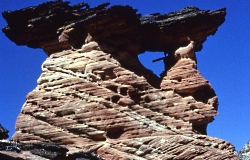
Hoodoo Arch
Zions National Park
Photo Courtesy NPS

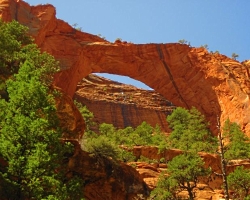
Historic Crawford Arch
Zions National Park
Photo Courtesy NPS

Hidden Arch
Zions National Park
Photo Courtesy NPS


Though another national park in Utah is famous for arches, Zion National Park has more than you might imagine.

Doubt it? Next time you visit the park, take a good look around. All the elements for arch building are readily on hand in Zion.

A natural arch is formed when deep cracks penetrate into a sandstone layer. Erosion wears away the exposed rock layers and the surface cracks expand, isolating narrow sandstone walls, or fins. Water, frost, and the release of tensions in the rock cause crumbling and flaking of the porous sandstone and eventually cut through some of the fins. The resulting holes become enlarged to arch proportions by rockfalls and weathering.

Worldwide, arches number in the tens of thousands, and probably no place is more suited for their creation than the Colorado Plateau, home of Zion National Park. The vast geology of Zion has created environments as widespread and varied as the topography of the park itself.

Hidden in its geologic grandeur are dozens, perhaps hundreds, of freestanding arches of all shapes and sizes. Although freestanding arches may be found in many different types of geologic formations, the Navajo Sandstone formation, which makes up the magnificent cliffs of Zion, provides a fertile setting for the creation of these ribbons of rock.

Among the many arches in Zion, two stand out: Crawford Arch and Kolob Arch. Crawford Arch is the most visible, clinging to the base of Bridge Mountain a thousand feet above the Zion Canyon floor. It’s frequently pointed out to casual observers by an interpretive sign located on the front patio of the Human History Museum.

The other famous arch in Zion is not so easily seen. Located deep in the backcountry of the national park’s Kolob Canyons District — it takes a seven-mile hike in to reach– Kolob Arch is hidden in a small side canyon, perched high on the canyon wall.

For most of the 20th century, many believed that Kolob was in fact the world’s largest freestanding arch, leading to years of debate and the motivation for various parties of adventurous thrill seekers to climb on and around the massive span in hopes of securing a defensible measurement.

The Natural Arch and Bridge Society long has pondered this question, and using lasers and an agreed upon definition of what should be measured says Landscape Arch is the world’s longest stone arch. But don’t be surprised if the debate continues.

The definition used by the society centers on the “maximum horizontal extent of the opening.” That opening beneath Landscape Arch measures right around 290.1 (plus or minus 0.8 feet) feet across.

The opening beneath Zion National Park’sKolob Arch, which long had been in the running for world’s largest, measures 287.4 feet (plus or minus 2 feet), according to the group.

Despite its isolated location, Kolob Arch has become a favorite backcountry destination for thousands of visitors to Zion. They discover what most arch seekers will tell you: while beauty awaits every seeker at the end of the path, the reward begins unfolding at the trailhead.

Anxious to see another arch, but not ready for a 14-mile roundtrip hike? Then head for Double Alcove ARch. A 5-mile roundtrip along the Taylor Creek Trail takes you into a narrow box canyon toward the Double Arch Alcove, where erosion has carved out natural openings in the Navajo sandstone.

For Wild About Utah and National Parks Traveler, I’m Kurt Repanshek.

Credits:
Images: Courtesy and Copyright Kurt Repanshek, www.nationalparkstraveler.com
Text:     Kurt Repanshek/, NationalParksTraveler.com.


Additional Reading:

https://www.nationalparkstraveler.com/browse/Arches%20National%20Park

https://www.nps.gov/zion/index.htm

Capitol Reef

Fruita and the Wingate Cliffs
Capitol Reef National Park
Photo Courtesy US NPS

Orchard
Capitol Reef National Park
Photo Courtesy US NPS

Early settlers to the landscape we know as Capitol Reef National Park in south-central Utah planted cherry, apricot, peach, pear, apple, and walnut trees as a cash crop for survival along the Fremont River bottoms. Visitors today are often surprised by the fruit trees in light of the surrounding desert climate, and campers can pick apples and peaches from their campsites in the orchards. But the green fields and fruit trees also attract deer, marmots, and other small critters, which are easy to spot and are comfortable with humans in their environment.

Though the deer roam free in the tall grass between apple trees, there are other species that are a bit more dangerous lurking nearby. Mountain lions and black bears skillfully stalk around this historic district of Fruita without being seen. Mountain lions have been spotted within a half-mile of the popular campground, yet little is known about the species within the confines of Capitol Reef. With so many questions unanswered about the predator and prey relationship in the unique landscape, the park has received a Disney Nature Impact Grant to enlighten us.

Lori Rome, the park’s chief of interpretation, says, “We are setting up 10-20 infrared motion detected camera traps in surrounding areas. This is a non-invasive way to learn basic information about the species.”

The cameras will provide useful evidence and reveal the patterns of the quiet predators in the park. The public will be engaged through a citizen science project using social media and public interpretive programming, for example helping to survey deer populations.

If you’ve seen Disney Nature’s movie Bears, you, too, helped contribute to the Disney Nature Impact Grants program. Fourteen national parks are receiving funding via proceeds from the movie. Disney Nature has pledged a contribution to the National park Foundation, the official charity of America’s national parks, through the Disney Worldwide Conservation Fund, for each person who saw the film during its first week in theaters.

This type of support helps preserve and protect Capitol Reef and the rest of the National Park System. The Disney Nature Impact Grant enables parks to conduct much-needed conservation projects, such as studying mountain lions at Capitol Reef.

Each park selected to receive a grant through this program had to demonstrate a clear need for the money, and how it would make a profound difference in habitat restoration, wildlife protection or conservation research. With this assistance, we should be able understand predator’s actions in Capitol Reef National Park.

For Wild About Utah and National Parks Traveler, I’m Kurt Repanshek.

Credits:
Image: Courtesy and Copyright Kurt Repanshek, www.nationalparkstraveler.com
Text:     Kurt Repanshek, NationalParksTraveler.com.


Additional Reading:

Capitol Reef And 13 Other National Parks Receive Impact Grants From Disney Nature’s Movie “Bears”, Submitted by Carli Jones, June 26, 2014, NationalParksTraveler.comhttps://www.nationalparkstraveler.com/2014/06/capitol-reef-and-13-other-national-parks-receive-impact-grants-disney-natures-movie-bears25263

Capital Reef National Park, https://www.nationalparkstraveler.com/park/capitol-reef-national-park

Capital Reef National Park, https://www.nps.gov/care/index.htm

Mammals in Capital Reef National Park, https://www.nps.gov/care/naturescience/mammalchecklist.htm
Amphibians in Capital Reef National Park, https://www.nps.gov/care/naturescience/amphibians.htm
Fish in Capital Reef National Park, https://www.nps.gov/care/naturescience/fish.htm
Birds in Capital Reef National Park, https://www.nps.gov/care/naturescience/birds.htm
Reptiles in Capital Reef National Park, https://www.nps.gov/care/naturescience/reptiles.htm