The Arches of Zion National Park

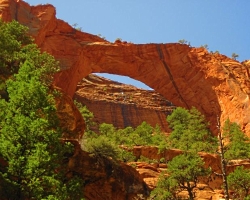
Kolob Arch
Zions National Park
Photo Courtesy NPS

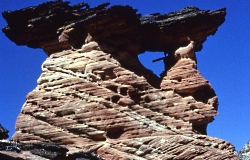
Hoodoo Arch
Zions National Park
Photo Courtesy NPS

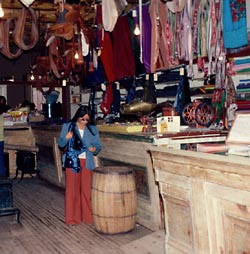
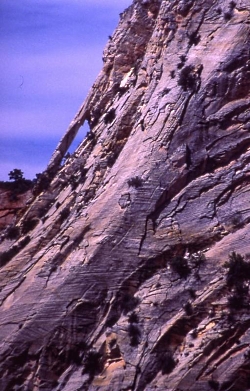
Historic Crawford Arch
Zions National Park
Photo Courtesy NPS

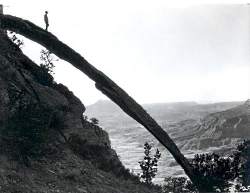
Hidden Arch
Zions National Park
Photo Courtesy NPS


Though another national park in Utah is famous for arches, Zion National Park has more than you might imagine.

Doubt it? Next time you visit the park, take a good look around. All the elements for arch building are readily on hand in Zion.

A natural arch is formed when deep cracks penetrate into a sandstone layer. Erosion wears away the exposed rock layers and the surface cracks expand, isolating narrow sandstone walls, or fins. Water, frost, and the release of tensions in the rock cause crumbling and flaking of the porous sandstone and eventually cut through some of the fins. The resulting holes become enlarged to arch proportions by rockfalls and weathering.

Worldwide, arches number in the tens of thousands, and probably no place is more suited for their creation than the Colorado Plateau, home of Zion National Park. The vast geology of Zion has created environments as widespread and varied as the topography of the park itself.

Hidden in its geologic grandeur are dozens, perhaps hundreds, of freestanding arches of all shapes and sizes. Although freestanding arches may be found in many different types of geologic formations, the Navajo Sandstone formation, which makes up the magnificent cliffs of Zion, provides a fertile setting for the creation of these ribbons of rock.

Among the many arches in Zion, two stand out: Crawford Arch and Kolob Arch. Crawford Arch is the most visible, clinging to the base of Bridge Mountain a thousand feet above the Zion Canyon floor. It’s frequently pointed out to casual observers by an interpretive sign located on the front patio of the Human History Museum.

The other famous arch in Zion is not so easily seen. Located deep in the backcountry of the national park’s Kolob Canyons District — it takes a seven-mile hike in to reach– Kolob Arch is hidden in a small side canyon, perched high on the canyon wall.

For most of the 20th century, many believed that Kolob was in fact the world’s largest freestanding arch, leading to years of debate and the motivation for various parties of adventurous thrill seekers to climb on and around the massive span in hopes of securing a defensible measurement.

The Natural Arch and Bridge Society long has pondered this question, and using lasers and an agreed upon definition of what should be measured says Landscape Arch is the world’s longest stone arch. But don’t be surprised if the debate continues.

The definition used by the society centers on the “maximum horizontal extent of the opening.” That opening beneath Landscape Arch measures right around 290.1 (plus or minus 0.8 feet) feet across.

The opening beneath Zion National Park’sKolob Arch, which long had been in the running for world’s largest, measures 287.4 feet (plus or minus 2 feet), according to the group.

Despite its isolated location, Kolob Arch has become a favorite backcountry destination for thousands of visitors to Zion. They discover what most arch seekers will tell you: while beauty awaits every seeker at the end of the path, the reward begins unfolding at the trailhead.

Anxious to see another arch, but not ready for a 14-mile roundtrip hike? Then head for Double Alcove ARch. A 5-mile roundtrip along the Taylor Creek Trail takes you into a narrow box canyon toward the Double Arch Alcove, where erosion has carved out natural openings in the Navajo sandstone.

For Wild About Utah and National Parks Traveler, I’m Kurt Repanshek.

Credits:
Images: Courtesy and Copyright Kurt Repanshek, www.nationalparkstraveler.com
Text:     Kurt Repanshek/, NationalParksTraveler.com.


Additional Reading:

https://www.nationalparkstraveler.com/browse/Arches%20National%20Park

https://www.nps.gov/zion/index.htm

Utah’s Petroglyph Garden

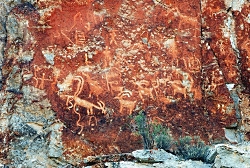
Petroglyph Panel at Fremont Indian State Park & Museum
Photo Courtesy Sevier County
Kreig Rasmussen, Photographer

Hi, I’m Ru Mahoney with Stokes Nature Center in Logan Canyon.

Utah’s culture is rich with vestiges of our pioneer history, and the landscape is accented by visible signs of the European settlers who forged our modern communities. But the tapestry of Utah’s cultural heritage is interwoven with much older threads, as indelible and enduring as the landscape itself.

In the 1980’s, in the southwestern quadrant of central Utah, the construction of interstate 70 unearthed a secret over one thousand years old. The valleys and canyons of what is now Sevier County, already known as a seasonal thoroughfare for the Paiute, had an even older history as home to the largest community of Fremont Indians ever discovered. Influenced by their Anasazi cousins to the southwest, the Fremont culture encompassed a diverse group of tribes that inhabited the western Colorado Plateau and the Great Basin area from roughly 400 to 1350 A.D. Archaeologists tell us they were a people of ingenuity in their engineering, aggression in their social interactions, and lasting creativity in their artistic expression. Divergent theories on their fate suggest they drove the Anasazi out of the Four Corners region and eventually migrated to further landscapes, or that northern groups of Fremont peoples joined with bands of Shoshone and became the Ute Indians of the Uinta. Whatever the truth of their ultimate fate may be, nowhere is their history more tangible than at Fremont Indian State Park just south of Sevier, UT along I-70. This year-round state park offers visitors a treasure trove of artifacts and curated exhibits in an excellent visitor’s center. But the most authentic interaction with these past peoples comes from exploring the surrounding landscape.

Driving the winding road into Clear Creek Canyon, ghostly figures begin to emerge; pictographs painted in shades of ocher and umber, and pale petroglyphs carved into the canyon walls, reveal an archaic and epic account of Utah’s ancestral past. A unique creation story, in which a shrike leads the Fremont people from a dark and cold underworld through the stem of reed into the warm world above, plays out across the canyon walls. A craggy outcrop of rock in the shape of an eagle is said to be watching over the reed to the underworld below to insure nothing wicked escapes into our world. A concentric lunar calendar and an abundance of zoomorphics speak of a cultural identity conceived in relation to the broader astrological world, and a reverence for anthropomorphized neighbors such as bighorn sheep and elk. Spider Woman Rock juxtaposes a powerful figure of Native American mythology with the pedestrian humility of a nursing mother. And Cave of 100 Hands is a visceral exhibition of a humanity simultaneously reminiscent and divergent from our own.

While the Fremont culture is believed to have died out or been absorbed by other modern groups, Clear Creek Canyon and the rock art sites of Fremont Indian State Park are significant among the modern Kanosh and Koosharem Bands of the Paiute who began using the area and leaving their own indelible marks on the canyon walls after the disappearance of the Fremont peoples around 1400 A.D. On the vernal and autumnal equinox (occurring in the third or fourth week of March and September each year) the eagle rock casts its shadow over the reed rock at dawn, breathing life into ancient tales of our ancestral history.

Fremont Indian State Park is a notable destination for those interested in rock art sites, many of which are suited to families of all ages and mobility, including visitors with strollers and wheelchairs. Stop in the visitor’s center to borrow or purchase a guide to the petroglyphs and pictographs for deeper insight into the Fremont culture and an unforgettable glimpse into Utah’s past.

For Wild About Utah and Stokes Nature Center, I’m Ru Mahoney.

Credits:
Images: Courtesy Sevier County, Kreig Rasmussen, Photographer
Text:     Ru Mahoney, Stokes Nature Center in Logan Canyon.


Additional Reading:

https://stateparks.utah.gov/parks/fremont-indian/

https://stateparks.utah.gov/stateparks/wp-content/uploads/sites/26/2015/02/Fremont_IndianBrochure.pdf

https://www.nps.gov/grba/learn/historyculture/fremont-indians.htm

https://www.thefurtrapper.com/fremont_indians.htm

Take the Pledge to Protect the Past, Utah State Historical Preservation Office, Department of Cultural & Community Engagement, State of Utah, https://ushpo.utah.gov/shpo/upan/

Climb Grand Teton…Virtually

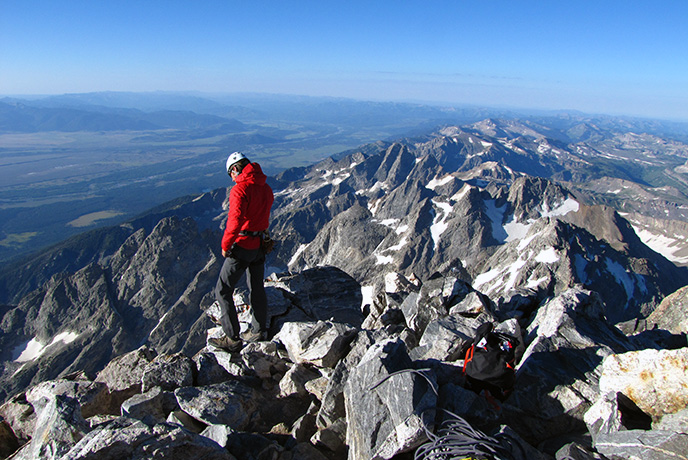
Grand Teton virtual climb

Click to view larger image of Grand Teton virtual climb, Photo Courtesy NPS Photo Courtesy NPS, K Kanes, Photographer
.

Photo Courtesy NPS
K Kanes, Photographer
 
Begin Tour
(Requires Adobe Flash Player)

Scaling “the Grand,” that picturesque mountain that hangs over Jackson, Wyoming, along with its battleship-gray sisters in the Teton Range, was a ridiculous thought that found harbor in the back of my mind in the spring of 1985 when I first glanced up at the peak.

Along with a dozen or so other neighboring peaks that rise above 10,000 feet, the Tetons form a ponderous, jagged stretch of rock that is the Lower 48’s most arresting mountain range. The soul of Grand Teton National Park, the Grand as it’s known harbors world-class climbs.

Some climbers tackle the mountain on their own, while neophytes such as myself are herded ever upward under the watchful guidance of one of Jackson’s two resident climbing outfitters, Exum Mountain Guides and Jackson Hole Mountain Guides.

To me, an Easterner by birth, the 13,770-foot tall Grand Teton is a breathtaking, and incredibly tall, mountain. But climb it? Not only am I usually most comfortable with both feet firmly planted flat on the ground, but the thought of only a thin rope and a precarious hand- or toe-hold between me and an incredible long way down scared the hell out of me, quite frankly.

The view from atop the Grand Teton is incredible. To the west, the Jedediah Smith Wilderness stands. To the north, Yellowstone National Park. To the east, Jackson Hole, with the moraine that is Timbered Island so very well defined.

Now, if you haven’t climbed to the roof of Grand Teton National Park, or can’t, you can still enjoy the view.

A new virtual tour produced by the park staff takes you from the Jackson Hole Valley to the summit from the comfort of your living room or office. No cold or pelting rain, no thunder claps or lightning strikes, just a nice mix of interactive still photos and video cuts that take you to the top.

This virtual mountaineering excursion—or eClimb, as the park dubs it—provides an introduction to the features, geology, history, and excitement of scaling the granite ledges and spires that form the Grand Teton massif: the highest peak in the Teton Range and second highest mountain in Wyoming. This web-based tour introduces viewers to the various elements (rocky terrain, plants and wildlife) that exist in Grand Teton’s forest and alpine communities.

As an eClimber you can control images and sounds at each stop along your virtual tour, and you can activate videos to explore the human and natural history related to each location along the climbing route. By hovering your mouse over a photograph, hidden images will be revealed through the click of a button.

eClimbers can also use videos to imagine scrambling over boulder fields and wedging through rocky alcoves as they experience the thrill of climbing and drama of a mountain rescue in a virtual landscape.

To find this virtual climb, go to Grand Teton’s website (www.nps.gov/grte) and click on  “Grand Teton eClimb” near the bottom of the home page.

For Wild About Utah, this is Kurt Repanshek with National Parks Traveler

Credits:
Image: Courtesy USGS, www.usgs.gov
Image: Courtesy and Copyright Kurt Repanshek, www.nationalparkstraveler.com
Text:     Kurt Repanshek, NationalParksTraveler.com.
 
Additional Reading:

Grand Teton National Park

Grand Teton eClimb

NationalParksTraveler.com

National Parks Traveler: Climb The Grand Teton…Virtually!


The Geology of Canyonlands National Park

Chesler Park
Canyonlands National Park
Photo Courtesy and Copyright Kurt Repanshek, Photographer

Chesler Park
Canyonlands National Park
Photo Courtesy and Copyright Kurt Repanshek, Photographer

Baked by time like some multi-layer geologic tort, Canyonlands National Park in southeastern Utah features a landscape cut by canyons, rumpled by upthrusts, dimpled by grabens, and even pockmarked, some believe, by ancient asteroids.

Just outside of Moab rises a kaleidoscope of tilted and carved geology laid down over the eons. There’s the red and white Cedar Mesa sandstone, the grayish-green Morrison Formation, pinkish Entrada sandstone, and tawny Navajo sandstone, just to name some of the geologic layers. Stacked like pancakes, they help make Canyonlands the most rugged national park in the Southwest and, quite possibly, if you find yourself deep in the park’s Maze District, in the entire Lower 48 states.

In each of the park’s districts — Island in the Sky, Needles, Maze and Horseshoe Canyon — the remarkable effects of geologic time and its endless erosion on this sedimentary landscape rise about you.

If you could turn back the geologic clock, you would see the landscape flooded by oceans, crisscrossed by rivers, covered by mudflats and buried by sand. At various times through the millennia, the climate has resembled a tropical coast, an interior desert, and everything in between.

For hundreds of millions of years, material was deposited. Layer upon layer of sedimentary rock formed as buried materials were cemented by precipitates in the ground water. Each layer contains clues to its origin, such as patterns or fossils, which reveals the environment when it was deposited. For example, the colorful Cedar Mesa Sandstone occurred when periodic floods of iron-rich debris from nearby mountains inundated coastal dunes of white sand.

Along with sedimentation, movements in the earth’s crust altered surface features. The North American continent migrated north from the equator and the local climate and environment here changed dramatically.

Peer into the ragged maw of Canyonlands from the Island in the Sky District on the northern end of the park, and it’s no mystery how the park came by its name.

Spend the night at the Squaw Flat Campground in the Needles District and a morning hike into Chesler Park surrounds you with Creamsicle-hued minarets towering high above, like a king’s crown.

Though Canyonlands covers less than 350,000 acres, which is less than one-seventh the size of Yellowstone National Park, it feels much larger. No doubt it’s the park’s vastness and openness — you won’t find any forests here. Indeed, one old timer said that, “On a clear day, you can see the back of your own head.”

Spend a few minutes contemplating the natural forces, and the hundreds of millions of years that laid down these sediments and compressed these layers of rock. It’s really only recently that these layers have eroded to form the remarkable landscape seen today in Canyonlands National Park.

For Wild About Utah and National Parks Traveler, I’m Kurt Repanshek.

Credits:
Image: Courtesy and Copyright Kurt Repanshek, www.nationalparkstraveler.com
Text:     Kurt Repanshek, NationalParksTraveler.com.


Additional Reading:

Canyonlands National Park, National Parks Service,

Exploring The Parks: Musings From Island In The Sky At Canyonlands National Park, NationalParksTraveler.com Article – Lee Dalton – 06/24/2014

Exploring The Parks: Musings From The Needles District In Canyonlands National Park, NationalParksTraveler.com Article – Lee Dalton – 06/19/2014

Reflections Of Time In Canyonlands, NationalParksTraveler.com Article – Lee Dalton – 06/19/2014

https://www.nationalparkstraveler.com/search/apachesolr_search/canyonlands, NationalParksTraveler.com Canyonlands Articles

Hylland, Rebecca, What are Igneous, Sedimentary & Metamorphic Rocks?, Glad You Asked, Utah Geological Survey, https://geology.utah.gov/map-pub/survey-notes/glad-you-asked/igneous-sedimentary-metamorphic-rocks/