Lytle Ranch

Lytle Ranch
Courtesy and Copyright Marshall Topham, Photographer
Lytle Ranch
Courtesy and Copyright Marshall Topham, Photographer
Earning national recognition as a birding hotspot the “Lytle Ranch” is a destination for birders from across the nation and beyond. But that is only a portion of what this ranch offers to me or anyone else with an interest in nature. When I visit the ranch, located in the extreme Southwest corner of Utah I find myself at an elevation of 2,000 feet. in a riparian environment on the edge of the Beaver Dam River completely surrounded by hills carpeted with Joshua Trees that define the Mojave Desert. Fresh water running through this desert has given rise to an incredible diversity of life.

Dudley Leavitt, Courtesy Marshall Topham
Dudley Leavitt
Courtesy Marshall Topham

Joshua Tree, Courtesy  and Copyright Marshall Topham, Photographer Joshua Tree
Courtesy and Copyright Marshall Topham, Photographer

Phainopepla, Courtesy  and Copyright Marshall Topham, Photographer Phainopepla
Courtesy and Copyright Marshall Topham, Photographer

Desert Iguana, Courtesy  and Copyright Marshall Topham, Photographer Desert Iguana
Courtesy and Copyright Marshall Topham, Photographer

Utah Banded Gecko, Courtesy  and Copyright Marshall Topham, Photographer Utah Banded Gecko
Courtesy and Copyright Marshall Topham, Photographer

The Lytle ranch has an interesting history. It was originally homesteaded in 1870’s by the Dudley Leavitt family in a remote location Southwest of St. George to avoid prosecution for polygamy. In 1889, Dudley’s daughter, Hannah Louisa, the third wife of Thomas Terry took over the ranch. They cultivated hay, cattle, and various crops, including fruit trees. In 1912 Hanna left and her two sons, Ed and Jed Terry, continued to farm and retained ownership of the ranch. In 1928, John Eardley purchased 462 acres of that property. He and his family constructed a ranch house, reservoir, fences, ditches, and cultivated alfalfa, sorghum, melons, and various fruits. Talmage and Eleanor Marie Lytle acquired the ranch from the Eardley’s in 1952. They operated the ranch without modern utilities until 1979.

In 1983, The Nature Conservancy purchased the 462-acre property to preserve its unique natural features and wildlife. In 1985, Brigham Young University (BYU) acquired the ranch, committing to its use as a nature preserve dedicated to education and research.

Public access to Lytle Ranch property, restrooms, potable water make my visits here even more enjoyable. Reservations for primitive campsites can be made on BYU’s website. For many years I have enjoyed birding at the ranch, arriving with the expectation of being greeted by the resident Phainopeplas. During migration season it is not uncommon to identify 50+ species of birds in a day without leaving the ranch. I generally carry along my checklist of anticipated birds, downloaded from the Bean Life Science Museum website at BYU. The list was created by a friend, Merrill Webb. His incredible contributions to the ranch are memorialized with his name on benches around the ranch.

If the birds were the only attraction here it would be well worth my time. but the river and the property surrounding this riparian portion of the ranch provides a home for a wonderful array of unique flora and fauna not typically seen outside Washington County, at least in the state of Utah. There are at least 38 species of reptiles and amphibians on or near the property. My personal life list in this area includes Mojave Desert tortoise, Gila Monster, Chuckwalla, Western Banded Gecko, Desert Iguana, Mojave Rattlesnake, Speckled Rattlesnake, Desert Sidewinder, Western Lyre Snake, Western Blind Snake and Western Ground Snake, Canyon Tree Frog, Pacific Chorus Frog and Tiger Salamander, to name just a few. I have also encountered several species of fish in the river, most notably the endangered Virgin River Chub. The stream through the Mojave Desert attracts a number of mammals, such as Beaver, Mule Deer, Desert Bighorn Sheep, Cougars, Bobcats, Jack Rabbits, Cottontails, Racoons, and Ringtail Cats. Porcupines also, as well as a number, and a variety of rodents.

Every time I visit the ranch, I’m reminded of how few places there are in the state of Utah where one could go and experience such tremendous biodiversity. The diversity of both plant and animal life here is unparalleled. As I enjoy another day wandering in this special place my thoughts turn to the Leavitt’s, Terrys, Eardley’s, and Lytle’s who toiled to eke out a living here. I wonder if they appreciated or even understood how unique the biodiversity on this property was. Somehow it doesn’t seem fair that they may not have enjoyed the biodiversity here as much as I do.

I’m Wild about Lytle Ranch and Utah.
This is Professor Marshall Topham of Utah Tech University.

Credits:

Images Courtesy & Copyright Marshall Topham, Photographer
Featured Audio: Courtesy and Copyright Dr. Kevin Colver, WildSanctuary, Soundscapes, https://wildstore.wildsanctuary.com/collections/special-collections
Text: Marshall Topham, https://ees.utahtech.edu/faculty-staff/
Additional Reading: Lyle Bingham, https://bridgerlandaudubon.org/

Additional Reading

Wild About Utah pieces by Marshall Topham https://wildaboututah.org/author/marshall-topham/

Lytle Nature Preserve, Brigham Young University, https://lytle.byu.edu/

Lytle Ranch Preserve, Life Science Museum, Brigham Young University, https://lsm.byu.edu/lytle-preserve [Locate Merrill Webb Lytle Ranch Bird List on this page]

The Unique Biodiversity of Washington County

The Colorado Plateau Courtesy & Copyright Marshall Topham, Photographer
The Colorado Plateau
Courtesy & Copyright Marshall Topham, Photographer

The Great Basin Courtesy & Copyright Marshall Topham, Photographer The Great Basin
Courtesy & Copyright Marshall Topham, Photographer

Mojave Desert with Joshua Trees Courtesy & Copyright Marshall Topham, Photographer Mojave Desert with Joshua Trees
Courtesy & Copyright Marshall Topham, Photographer

Mojave Desert Courtesy & Copyright Marshall Topham, Photographer Mojave Desert
Courtesy & Copyright Marshall Topham, Photographer

Mojave Desert Tortoises Courtesy & Copyright Marshall Topham, Photographer Mojave Desert Tortoises
Courtesy & Copyright Marshall Topham, Photographer

Mojave Desert Tortoise Courtesy & Copyright Marshall Topham, Photographer Mojave Desert Tortoise
Courtesy & Copyright Marshall Topham, Photographer

Mojave Desert Tortoise in a Burrow Courtesy & Copyright Marshall Topham, Photographer Mojave Desert Tortoise in a Burrow
Courtesy & Copyright Marshall Topham, Photographer

For 44 years I have spent considerable time in the company of the desert creatures that reside outside my home in St. George Utah. That number doesn’t include my frequent visits to this area as a young man growing up in Iron County. Back then I did not appreciate the uniqueness of the environment I was invading. I do now. Washington County is an area of unusual biodiversity. An impressive variety of plants and animals call Utah’s Dixie home. Over 100 species of plants and animals found here don’t exist anywhere else in Utah. This extraordinary biodiversity is the result of several factors working together to create an environment that is uniquely its own. The biologically diverse environment of Washington County can’t be found anywhere else on Earth.

Today on the trail, I pondered the reason for such incredible biodiversity I was experiencing. Three large geophysical features collide and overlap here. The Great Basin Desert invades from the North, and the Mojave Desert from the South. The Colorado Plateau, a semi-desert pushes in from the East. Each of these deserts bring with them their own unique complement of plants and animals, making Washington County a mixing pot of biodiversity. In addition to the merging of these three deserts, the incredible local topography plays a role in the diversity of life here as well. Washington county elevation ranges from 1,800 to 10,365 feet above sea level creating a number of different life zones influenced by elevation change. Erosion has also been a contributing factor by created mesas and canyons that provide additional habitat diversity.

I marvel at this environment as I stand in one place and see around me plants that originated in each of these very different desert environments. This same experience is reflected in the wildlife I encounter as I traverse the trails in the Red Cliffs Desert Reserve. Today I encountered juvenile and adult Chuckwallas, sunning on sandstone outcrops or aggressively dismembering a Desert Marigold plant to feast on its blossoms. Tiger Whiptail Lizards dash back and forth across the trail in front of me, as Side-blotched Lizards casually watch me pass by from the edge of the trail. At one point, I had to alter my path a little to avoid a Desert Horned Lizard lying motionless in the trail. Intentionally watching carefully off trail, I observe the occasional Leopard Lizard in the sand or a Desert Spiney Lizard atop a rock. Today was a good day for Mojave Desert Tortoises, as I observed three along my route. All were foraging not far from the trail. Today was a great day to be in the desert, but I will be back again tomorrow. The desert is an incredible therapist. And the price of therapy is extremely reasonable. Who wouldn’t be wild about that?

I’m Professor Marshall Topham and I’m Wild About Utah.

Credits:

Images Courtesy & Copyright
Courtesy & © Friend Weller, https://www.upr.org/people/friend-wellerCourtesy & Copyright © Anderson, Howe, Wakeman
Text: Marshall Topham,
Additional Reading: Lyle Bingham, https://bridgerlandaudubon.org/

Additional Reading

Wild About Utah pieces by Marshall Topham https://wildaboututah.org/author/marshall-topham/

Washington County Utah https://www.washco.utah.gov/

Snow Canyon State Park, Utah State Parks, https://stateparks.utah.gov/parks/snow-canyon/

Joshua Tree National Landmark, US Bureau of Land Management, https://www.blm.gov/visit/joshua-tree-national-landmark

Red Cliffs Desert Reserve, Washington County & US Bureau of Land Management, http://www.redcliffsdesertreserve.com/

Desert Desserts

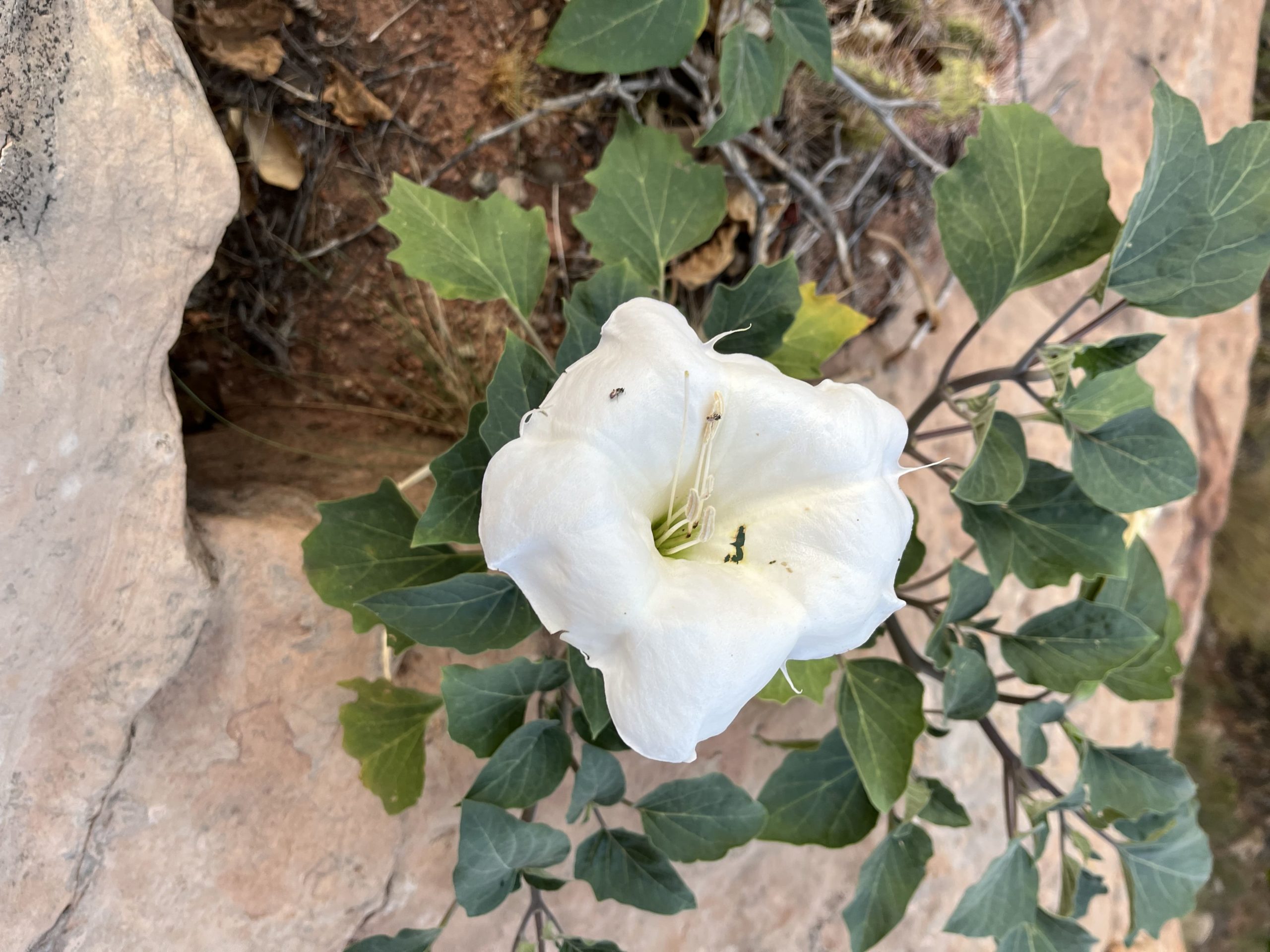
Desert Desserts: Sacred Datura Moon Flower Courtesy & © Shannon Rhodes, Photographer
Sacred Datura Moon Flower
Courtesy & © Shannon Rhodes, Photographer

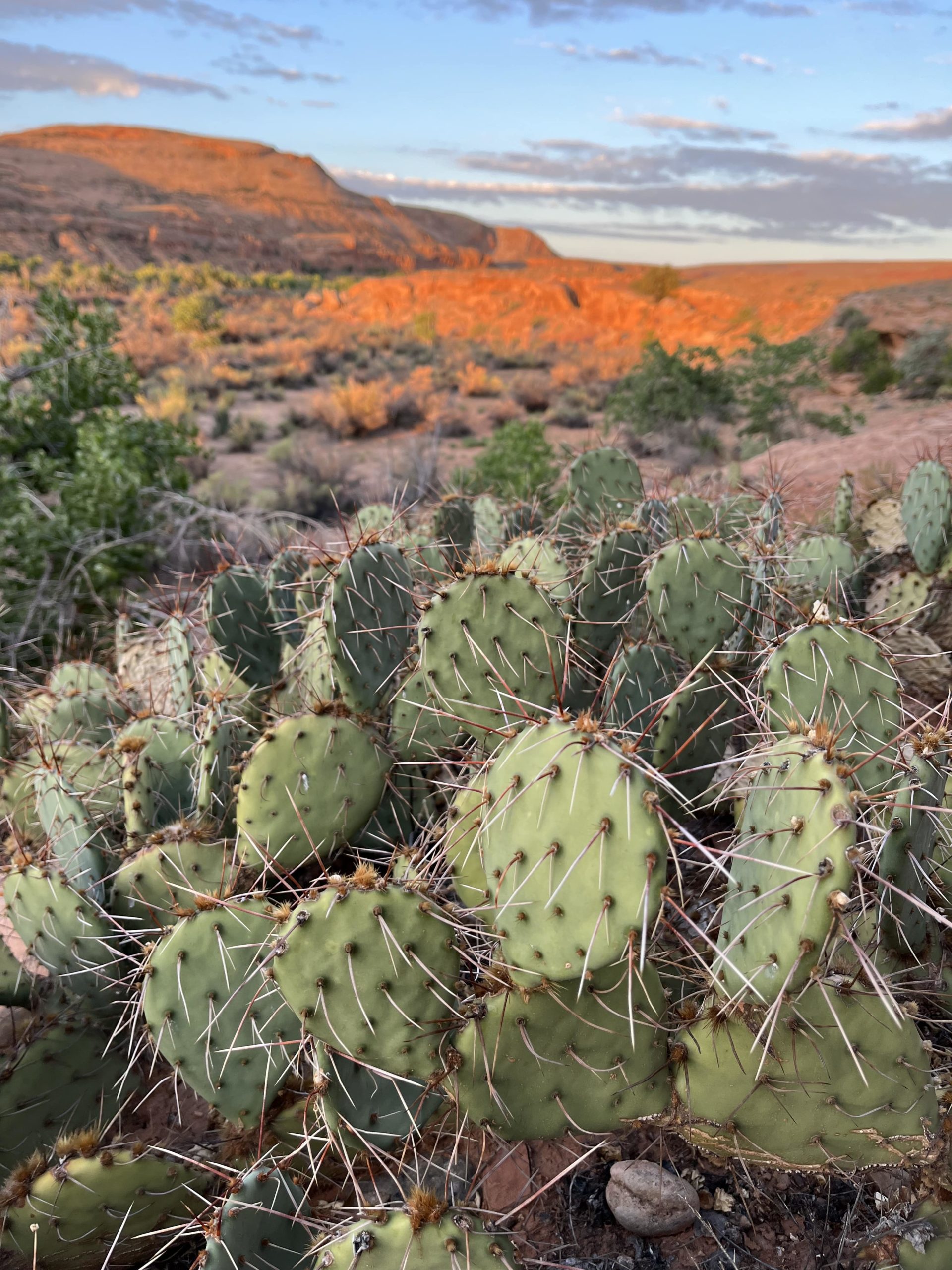
Prickly Pear Cactus Courtesy & © Shannon Rhodes, Photographer Prickly Pear Cactus
Courtesy & © Shannon Rhodes, Photographer

Mormon Tea (Ephedra) From Comb Ridge Courtesy & © Shannon Rhodes, Photographer Mormon Tea (Ephedra) From Comb Ridge
Courtesy & © Shannon Rhodes, Photographer

Limestone Crinoids Courtesy & © Shannon Rhodes, Photographer Limestone Crinoids
Courtesy & © Shannon Rhodes, Photographer

My proofreader’s eye has often spotted “dessert” misspelled as “desert,” and to some, those two concepts couldn’t be more dissimilar. During my three days in and along a short 27-river-mile stretch of Utah’s San Juan River this month though, I marveled at the menu.

Terry Tempest Williams captures what she calls “small devotions of the desert alphabet” in her book “The Illuminated Desert.” She lists lizards languishing in desert heat, ravens and rattlesnakes amid the red rocks. A fascinating one, the Sacred Datura, blooms only at night and attracts pollinators like the hawkmoth with its showy white blossoms in the moonlight. If it is food you are after, however, avoid this poisonous temptation. Instead, try a juicy prickly pear cactus pad once you have removed the long, sharp spines. Some say it tastes like watermelon, but it tastes like a banana to me.

Along the path to San Juan Hill atop Comb Ridge, I also find ephedra, a shrub that carries out photosynthesis in its green branches, that has traditionally been said to have been used medicinally and brewed, hence the common name Mormon tea. Some, like Brock Cheney who has researched the claim that Brigham Young advocated drinking tea made from boiling the stems, argue that Young’s “composition tea” was not made from the Mormon tea plant, and once you try it, the bitterness will tell you why. Having not ever had a sip myself, I can say that the Mormon tea shrub does sprinkle brilliant green to the landscape like a garnish.

“Lie down on your backs and try to feel what is special about this place.” That’s the challenge in Joseph Cornell’s book “Sharing Nature with Children,” but it is equally rewarding to do as an adult. Lounging in the raft as another rows, I look from the sediment-laden river that reminds me of watery chocolate pudding thanks to recent rainstorms, to the great blue heron standing as a guide, flying ahead and waiting for us to catch up, just to fly ahead again. I watch with wonder as the western tanager males, songbirds with yellow bodies and black wings, heads aflame with red-orange, flutter among the salt cedars.

This oasis offers a promise of quiet away from the commotion of my city life as the desert bighorn sheep nod from the coyote willow. Even after studying the scorpions in the sand illuminated by flashlight, I stretch out and nibble at the buffet of constellations above me in the sky.

The crinoids encased in the limestone boulders along the riverbank the next morning remind me that this place was once for millions of years, actually, an ancient inland sea. I find deliciousness here in the dry heat, the muddy grit, as a guest who will return, hungry for more.

For Wild About Utah, I’m Shannon Rhodes.

Credits:
Images: Courtesy & Copyright Shannon Rhodes, Photographer
Audio: Courtesy & © Kevin Colver https://wildstore.wildsanctuary.com/
Text:     Shannon Rhodes, Edith Bowen Laboratory School, Utah State University https://edithbowen.usu.edu/
Additional Reading Links: Shannon Rhodes

Additional Reading:

Cheney, Brock. 2009. Mormon Tea! Plain but Wholesome: Adventures in Mormon Pioneer Food. https://pioneerfoodie.blogspot.com/2009/02/in-news-mormon-tea.html

Cornell, Joseph. 1998. Sharing Nature With Children. DAWN Publications. https://www.sharingnature.com/sharing-nature.html

Eldredge, Sandra. 1992. Geologic Resources of San Juan County. Department of Natural Resources Utah Geologic Survey. https://ugspub.nr.utah.gov/publications/public_information/PI-14.pdf

Larese-Casanova, Mark. 2011. Amazing Adaptations of Utah’s Desert Plants. https://wildaboututah.org/amazing-adaptations-of-utahs-desert-plants/

U.S. Forest Service. Sacred Datura. https://www.fs.usda.gov/wildflowers/beauty/Sky_Islands/plants/Datura_wrightii/index.shtml

https://www.fs.usda.gov/wildflowers/ethnobotany/Mind_and_Spirit/datura.shtml

Utah State University Extension. Salt cedar and coyote willow. https://extension.usu.edu/rangeplants/shrubs-and-trees/Saltcedar

https://extension.usu.edu/rangeplants/shrubs-and-trees/CoyoteWillow

Williams, Terry Tempest. 2008. The Illuminated Desert. Canyonlands Natural History Association. https://www.amazon.com/Illuminated-Desert-Terry-Tempest-Williams/dp/0937407119

Imaginary Wanderings

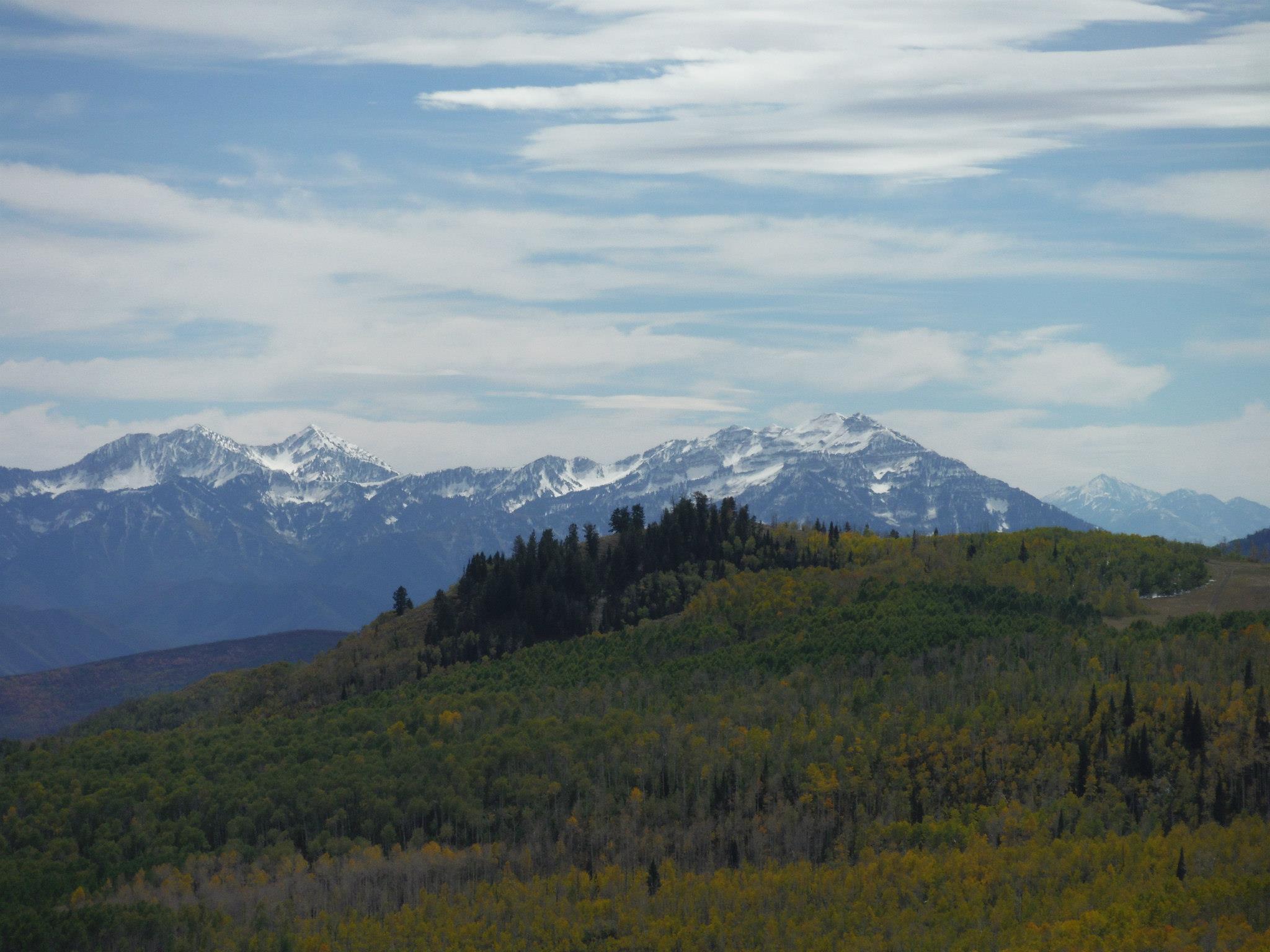
Imaginary Wanderings: The edge of the Great Basin, top of the Bear River Range Courtesy & Copyright Josh Boling, Photographer
The edge of the Great Basin, top of the Bear River Range
Courtesy & Copyright Josh Boling, Photographer
I’ve fancied a certain type of wandering lately—to grab my pack and boots and walk the lines of Utah’s political border—a trail made not of dirt and stone, but of imaginary lines of latitude and longitude. But, as of yet, I haven’t found the time or resources to do so beyond my own imagination and the 3 or 4 minutes I have with you now. Come join me in a stroll around Utah, at least the way I’ve imagined it.

Walking north out of Logan, I’ll wander through the grid-patterned neighborhoods that pepper the flanks of the Bear River Range, the still-snowy peaks that serve as sentinels over my daily commute and the adventure on which I embark now. They serve another, greater purpose, too, though. Without the Bear Rivers, the Rocky Mountains would be otherwise dissected. The snowy peaks I adore and which now pass in slow motion over my right shoulder form the only range of mountains that connect the northern and southern Rockies. Though they only measure about 70 miles in length, they provide a critical ecological thoroughfare from the south end of Cache Valley, Utah, north to Soda Springs, Idaho.

I won’t follow them that far, though. I’ll turn left (west) at the Idaho border toward the Great Basin.

I’m technically already there. We all are if we live along the Wasatch Front. And there are just a few minor ranges—the Clarkston Range, Blue Spring Hills, and the northern fingerling ridges of the Promontory Mountains—to wander across before reaching the Great Basin proper.

My favorite hidden gem of this often-overlooked portion of Utah are the Raft River Mountains. Like the mighty Uintas to the east, the Raft Rivers run East-to-West. So, despite being a stone’s throw from the Great Salt Lake, the tributaries running off their northern flanks drain not into the Great Basin and the Great Salt Lake, but north onto the Snake River Plain toward the Columbia River and, eventually, the Pacific Ocean.

The Tri Corners Landmark is a simple granite pillar sticking 3 or 4 feet out of the sand amongst wind-whipped sage brush. It’s easy to miss, but marks some interesting irregularities. Utah’s political border is not, in fact, made up of straight lines. According to cartographer Dave Cook, surveyors who created the state’s initial boundaries hastily covered ground with their crude survey instruments. They were paid by the mile, so they were more interested in finishing quickly than correcting any errors they made along the way.

The border wiggles at least four times by my calculations—one of which comprises two right angles—as it wanders across ridgelines and through the dusty draws of the basin and range mountains toward the Mojave Desert of southwest Utah.

Imaginary Wanderings: The wrinkled topography if the Colorado Plateau Courtesy & Copyright Josh Boling, Photographer
The wrinkled topography if the Colorado Plateau
Courtesy & Copyright Josh Boling, Photographer
I won’t be there for long, though. The border only runs for roughly 50 miles along the two legs of the right triangle that constitutes Utah’s allotment of the Mojave Desert before it climbs up onto the Colorado plateau. Ed Abbey famously compared the wrinkled topography of Utah, particularly his beloved canyon country of the Colorado Plateau, to the two largest of our states. “Alaska is our biggest, buggiest, boggiest state,” Abbey wrote. “Texas remains our largest unfrozen state. But mountainous Utah, if ironed out flat, would take up more space on a map than either.” Ropes, technical climbing and canyoneering gear, and a fair amount of fortitude would be required here.

The eastern border we share with Colorado is a varied expanse of high desert plateaus, rugged cliffs, out-of-place riparian zones, and a few spectacular snow-capped mountain ranges leading through some of the most beautiful and gloriously desolate places on the planet. The Book Cliffs, Dinosaur National Monument, and the La Sal Mountains come to mind.

A short walk distance-wise would require heaps of route finding across the Green River’s Flaming Gorge and along the northern toes of the Uinta Mountains. Here is perhaps the greatest of Utah’s geologic juxtapositions. Low basins adjacent the Intermountain West’s highest peaks.

Imaginary Wanderings: A view of the high Uintas from their northern foothills Courtesy & Copyright Josh Boling, Photographer
A view of the high Uintas from their northern foothills Courtesy & Copyright Josh Boling, Photographer
I’ll take my first right turn at the western edge of the Uinta foothills. Here I might skip the formalities of a longitudinal walk—stick my thumb out instead, and make a bee-line for Bear Lake, Logan Canyon, and home: the walks I’ve already known for some time.

Perhaps you’re inspired now to know parts of this walk better yourself.

I’m Josh Boling, and I’m Wild About Utah!

Credits:

Imaginary Wanderings:
Photos: Courtesy and Copyright Josh Boling, Photographer
Audio: Includes audio from
Text: Josh Boling, 2020, Edith Bowen Laboratory School, Utah State University

Sources & Additional Reading

Boling, Josh, Why I Teach Outside, Wild About Utah, November 11, 2019, https://wildaboututah.org/why-i-teach-outside/

Kiffel-Alcheh, Utah, National Geographic Kids, https://kids.nationalgeographic.com/explore/states/utah/

The Geography of Utah, NSTATE LLC, https://www.netstate.com/states/geography/ut_geography.htm

Fisher, Albert L, Physical Geography of Utah, History to Go, Utah Division of State History, https://historytogo.utah.gov/physical-geography-utah/