Sandhill Crane Days

Sandhill Crane Pair (Grus canadensis) Courtesy US FWS, Justine Belson, Photographer
Sandhill Crane Pair
Grus canadensis
Courtesy US FWS,
Justine Belson, Photographer

George Archibald, who danced daily with a captive female whooping crane named Tex, provided a remarkable example of the biological significance of dancing cranes. George even slept beside Tex, huddled in a down sleeping bag through cold Wisconsin nights, to stimulate her egg laying activity. With the help of some sperm from a donor male crane, this technique proved successful, and George eventually became the proud godfather of a baby Whooper, which he appropriately named “Gee-whiz!”

I first became enamored with cranes while attending a lecture in the U.S. Library of Congress by author-naturalist Peter Mathieson. Cranes are ubiquitous in the earliest legends of the world’s peoples, where they often figure as harbingers of heaven and omens of longevity and good fortune.
Peter was a masterful story teller and soon had my students and I helplessly captivated. Our emotions vacillated from euphoric highs to abysmal lows with his elegant words describing this revered bird, the highs then snatched away as we learned of their tenuous existence. Of the 15 world species, 12 are in serious decline, primarily from habitat loss and overharvesting.

My appreciation for the magnificent avian species was accentuated last year when we had a guest presentation at our inaugural Cache Valley Sandhill crane festival in Logan. We soon realized that our guest speaker Paul Tebbel from Sacramento was more crane than human. Paul has spent much of his life both doing research as an advocate for the protection and enjoyment of this bird. From Paul we learned that the cranes elegant dance appears to go beyond mating to what can only be interpreted as a joyful expression of exuberance. Their dance continues in sporadic fashion throughout the year.

We also learned their read crown is not feathers, but skin which glows brighter with as its emotions escalate, a human trait. Another stunner came from discovering the lovely red earthen color of their feathers is actually a form of body art. The cranes will locate a reddish colored soil which they will use to preen with, transforming their natural gray plumage to an auburn glow.

On our field trip the following morning, we viewed several colts (crane youngsters) in the wet meadows and hayfields. Nesting begins early April to late May. Nests are usually low mounds of vegetation located in wetlands, but are occasionally located in uplands. The female typically lays two eggs, with incubation lasting 29 – 32 days.

Cranes are omnivorous and their diet varies depending on the season and where they are. Seeds, fleshy tubers of plants, grubs, earth worms, snails, amphibians, small reptiles and small rodents are all fair game.

Cranes typically travel 200 – 300 miles in a day during migration at speeds averaging 25 – 35 mph but can reach 500 miles with a good tail wind.
Among the oldest living birds on the planet a crane fossil found in northeast Nebraska is estimated to be about 10 million years old.

Fortunately, Sandhill Crane populations are stable to increasing. The total for the 5 subspecies numbers between 600,000 – 800,000, with Lesser Sandhill Cranes being the most abundant. Join us at our Sandhill Crane Festival in Logan June 10th & 11th to continue our celebration of these “Birds of Heaven” as described by Peter Mathieson.

This is Jack Greene reading for Wild About Utah.

Credits:
Image: Courtesy U.S. of the Interior, U.S. FWS, www.FWS.gov
Text:     Jack Greene, Bridgerland Audubon Society & USU Office of Sustainability
Additional Reading:

Stillwell, Cindy, Mating for Life, https://cindystillwell.com/matingforlife/

A leading naturalist and writer travels the globe in search of a prized-and vanishing-bird
Cranes are ubiquitous in the earliest legends of the world’s peoples, where they often figure as harbingers of heaven and omens of longevity and good fortune. They are still held sacred in many places, and for good reason. Their large size and need for wilderness habitat makes them an “umbrella species” whose well being assures that of other creatures and of the ecosystem at large. Moreover, the enormous spans of their migrations are a symbol of, and stimulus to, international efforts at conservation.

In The Birds of Heaven, Peter Matthiessen has woven together journeys in search of the fifteen species of cranes in Asia, Africa, Europe, North America, and Australia. As he tracks them (and their declining numbers) in the company of scientists, conservationists, and regional people encountered along the way, he captures the dilemmas of a planet in ecological crisis, and the deeper loss to humankind if these beautiful and imposing creatures are allowed to disappear. The book includes color plates by renowned wildlife artist Robert Bateman.

https://www.savingcranes.org/george-archibald/

https://www.savingcranes.org/category/travels-with-george/

Ebersole, Rene, The Man Who Saves Cranes, Audubon.org, January 18, 2013, https://www.audubon.org/news/the-man-who-saves-cranes

Matthiessen, Peter(Author), Bateman,Robert, The Birds of Heaven: Travels with Cranes, North Point Press, 2001, https://www.amazon.com/Birds-Heaven-Travels-Cranes/dp/0374199442

https://www.fws.gov/uploadedFiles/Region_5/NWRS/Central_Zone/Montezuma/SandhillCraneFacts.pdf
https://www.fws.gov/refuge/Columbia/Wildlife_Habitat/Sandhill_Cranes.html
https://www.fws.gov/uploadedFiles/Region_1/NWRS/Zone_2/Mid-Columbia_River_Complex/Columbia/Documents/sandhill-crane-facts.pdf
https://www.fws.gov/news/ShowNews.cfm?ID=35C68BA1-DB0A-B16D-9BD2623AAD48D3FD

The Great Salt Lake

The Great Salt Lake Breach
Courtesy U.S. Geological Survey
Department of the Interior/USGS
Mike Freeman, Photographer
10 Nov 2015
Water flowing through the Great Salt Lake breach in 2011, when lake levels were high due to above average snowfall in the Wasatch and Uinta Mountains. The Great Salt Lake breach is an area that allows water to travel between the southern and northern parts of the lake.
There is a giant among us with a profound influence on our past, present, and future. My first encounter with this giant was both buoyant and delightful as I floated in the brine on a lovely summer day. But I was oblivious to the Great Salt Lake’s immense value as an environmental, cultural, and economic resource.

Much of what follows is taken from a very recently released collaborative study titled “Impacts of Water Development on Great Salt Lake and the Wasatch Front” which was a collaborative effort from four institutions(Utah State University, Utah Division of Water Resources, Salt Lake Community College, and the Utah Division of Wildlife Resources.)

A 2012 analysis by Bioeconomics estimated the economic value of the lake at $1.32 billion per year for mineral extraction, brine shrimp cyst production, and recreation. The abundant food and wetlands of the lake attract 3 million shorebirds, as many as 1.7 million eared grebes, and hundreds of thousands of waterfowl during spring and fall migrations. Because of this, it has been designated as a Western Hemisphere Shorebird Reserve Network Site. Due to its enormous surface area, it produces the “lake affect” which enhances our snow pack by an estimated 8%, a significant amount for both skiers and our available water. But our giant is shrinking.

Since the arrival of 19th Century pioneers water diversions for irrigation have decreased its elevation by 11 feet exposing much of the lake bed. Natural fluctuations in rainfall and river flow cause the lake level to rise and fall, but there has been no significant long‐term change in precipitation and water supply from the main tributaries since their coming in 1847.

The Great Salt Lake Breach 2015
The Great Salt Lake Breach
Credit: U.S. Geological Survey
Department of the Interior/USGS
Mike Freeman, Photographer
10 Nov 2015

For the first time since it was opened in 1984, water has stopped flowing through the Great Salt Lake causeway breach, an area that allows water to travel between the southern and northern parts of the lake.
To significantly reduce water use, a balanced conservation ethic needs to consider all uses, including agriculture, which consumes 63 percent of the water in the Great Salt Lake Basin. There are no water rights to protect our Great Lake, so water development currently focuses solely on whether there is water upstream to divert. If future water projects reduce the supply of water to the lake, (such as the Bear River Development Project, its level will (most likely) continue to drop.

We must look beyond the next few decades and decide how we value the lake for future generations. Lower lake levels will increase dust pollution and related human health impacts, and reduce industrial and environmental function of Great Salt Lake. We must be willing to make decisions now that preserve Great Salt Lake’s benefits and mitigate its negative impacts into the coming centuries.

John Muir, one of my favorite early American naturalists would most certainly agree with me. From his baptismal plunge into the Great Salt Lake. “I found myself undressed as someone else had taken me in hand and got myself into right lusty relationship with the brave old lake. I was conscious only of a joyous exhilaration….”
And where else could John and I have such a wonderfully buoyant experience?

This is Jack Greene reading for Wild About Utah.

2015 Great Salt Lake Breach at Lakeside, Utah
Gauge near the Great Salt Lake Breach
Credit: U.S. Geological Survey
Department of the Interior/USGS
Mike Freeman, Photographer
10 Nov 2015
A gauge to measure lake water levels stands dry in the lake bed of the Great Salt Lake. For the first time since it was opened in 1984, water has stopped flowing through the Great Salt Lake causeway breach, an area that allows water to travel between the southern and northern parts of the lake.
Credits:
Image: Courtesy U.S. Department of the Interior, U.S. Geological Survey(USGS), gallery.usgs.gov
Text:     Jack Greene, Bridgerland Audubon Society & USU Office of Sustainability
Additional Reading:

Great Salt Lake, Utah, Stephens, Doyle W. and Gardner, Joe, USGS Science for a Changing World, https://pubs.usgs.gov/wri/wri994189/PDF/WRI99-4189.pdf

Salt Lake Brine Shrimp, https://saltlakebrineshrimp.com/harvest/

Great Salt Lake Footprint 2001 vs 2003 Comparison
Great Salt Lake Footprint Comparison
2001 vs 2003
Images Courtesy NASA
NASA’s Earth Observatory

Utah’s Stunning Landscapes and America’s Celebration

Utah's Stunning Landscapes and America's Celebration: National Park Service - Find Your Park
Find Your Park
Courtesy US NPS
Utah is arguably blessed with the most stunning landscapes on the planet. Many have been preserved for posterity in our National Parks & Monuments. This is the BIG YEAR- the 100 year anniversary of the National Park Service! I’ve sampled and worked in many of them- from Alaska to Florida, from S. California to New England. As many would suggest- our National Parks are one of America’s greatest achievements which has gone global, now found on all continents except Antarctica (or am I missing one!).

Much of my work in the Parks has been assisting with the launch of the “Climate Friendly Parks” program which began in 2006. The program provides parks with the tools and resources to address climate change and ensure the most sustainable operations across the agency.

National parks, because of their location and unique, protected resources, are places where the effects of climate change are particularly noticeable. With the establishment of the National Park Service in 1916, responsibility was given to the Service to preserve and protect the significant resources within parks for the enjoyment of current and future generations. Today, as knowledge about climate change and its effects increase and potential impacts are better understood, the need to practice good stewardship and develop forward thinking resource management plans is more relevant than ever.

I began in Zion N.P. then moved on to several others including Mt. Rainier, Olympic, Rocky Mountain, and Denali in Alaska. Zion N.P. will always be at or near the top for its amazing landforms, shear grandeur, hidden canyons, and rich diversity of life- the highest in Utah.
It was here that I first met the ringtail cat and Mexican Spotted Owl- two illusive, iconic critters. Both appeared in broad daylight in Hidden Canyon on the west face of the Great White Throne. There is no season less than spectacular here. Perhaps the most dramatic accompanies the seasonal monster thunder storms amplified by massive sandstone cliffs which begin spouting 2000 foot blood red waterfalls. It’s all too surreal, too ethereal for one’s senses to fully grasp.
And yet another proposed stunning Utah landscape containing thousands of ancient ruins is receiving wide citizen support including many native tribes, that being the Bears Ears NationalMonument.

Find Your Park
Find Your Park
Courtesy US NPS
This area of South Eastern Utah offers a unique opportunity to include the “real Americans”, the people that have over 10,000 years of Utah history, who continue to honor and worship this ancient landscape of their ancestors. These tribes have been invited to participate in its planning and management to assure their rituals and subsistence ways may continue, and that its pristine nature would be preserved in perpetuity.

Designation of the Bears Ears NM would be a marvelous celebratory note for this epic year to honor America’s grandest idea!

This is Jack Greene for Wild About Utah.

Credits:
Image: Courtesy National Park Service for Find Your Park
Courtesy BearsEarsCoalition.org for the map of the proposed Bears Ears National Monument.
Text:     Jack Greene, Bridgerland Audubon Society & USU Office of Sustainability
Additional Reading:

Jack Greene’s Postings on Wild About Utah, https://wildaboututah.org/author/jack/

Utah National Parks, Google Search, Utah’s National Parks

Bears Ears National Monument, Google Search, Bears Ears National Monument

Secretaries Jewell, Vilsack Applaud President’s Designation of New National Monuments in Utah and Nevada, Dec 28, 2016, https://www.doi.gov/pressreleases/secretaries-jewell-vilsack-applaud-presidents-designation-new-national-monuments-utah

Statement by the President on the Designation of Bears Ears National Monument and Gold Butte National Monument, The White House, Office of the Press Secretary, Dec 28, 2016, https://obamawhitehouse.archives.gov/the-press-office/2016/12/28/statement-president-designation-bears-ears-national-monument-and-gold

FACT SHEET: President Obama to Designate New National Monuments Protecting Significant Natural and Cultural Resources in Utah and Nevada, The White House, Office of the Press Secretary, Dec 28, 2016, https://obamawhitehouse.archives.gov/the-press-office/2016/12/28/fact-sheet-president-obama-designate-new-national-monuments-protecting

Gayle, Riana, Planning For The Future, A Bioregional Approach, UPR Utah Public Radio, Nov 19, 2018, https://www.upr.org/post/planning-future-bioregional-approach

Conservation: North and South

St George Winter Bird Festival, Courtesy St. George City
St. George Winter Bird Festival
Courtesy St. George City
I spent 2 gloriously warm days in Dixie where I attended the Winter Bird Festival, a grand event by any measure! I also had the good fortune of discovering “Citizens for Dixie’s Future” (henceforth CDF) which has taken on the onerous task of brokering piece between a surging population and the regions limited natural resources. Water topped the list, especially the Lake Powell Pipeline proposal. So I did a bit of reading from CDF’s well stocked library.

It soon became apparent that this multi-billion dollar project needs closer inspection on cost vs benefits. The costs must include not only dollars, but some unintended consequences such as continued urban sprawl in a super sensitive Mojave Desert ecosystem with an abundance of plant and animal life that I became more aware of through an excellent WBF presentation by naturalist educator Marshall Topham on the biodiversity of Washington County.

Citizens for Dixie’s Future
Courtesy Citizens for Dixie’s Future

Located at the confluence of 3 major biomes- Great Basin Desert, Mojave desert, and the Colorado Plateau intersected by numerous rivers and the towering Pine Valley Mountains, Washington County is a wildlife mecca with over 350 species of birds listed, an excellent indicator of its natural wealth.

So my naturalist instincts and a propensity towards frugality led me to look for pipeline alternatives.

I found conservation to be the most obvious and least expensive alternative. In 2009, Washington County was at or near the top in the West for per capita water use at 294 gallons per day. In dramatic contrast Tucson was 161 and golf course and fountain studded Vegas at 222. If the county was to set a goal for 1% reduction in water use per annum, it would negate the need for the pipeline according to CDF.

We notherners in Cache County are being threatened with a similar situation. Our Bear River which supplies 60% of the surface flow into the Great Salt Lake and is the primary source for the Bear River Migratory Bird Refuge is under scrutiny for multibillion dollar reservoir development to serve the Wasatch Front. In addition to the hefty price tag, this has very serious implications for loss of prime agriculture land and high value wildlife habitat.

The following conservation practices are taken from the CDF.

• Providing rebates for efficient indoor water fixtures and outdoor landscape conversion
• Adding native, drought tolerant landscaping in new developments (and converting old)
• Implementing an increasing rate structure to signal conservation to the customer
• Conservation programs must include numeric targets and performance measures
• Updating building codes with more aggressive plumbing and appliance standards
• Increasing education and awareness about reducing peak water use.
• Implementing smart growth principals and preventing sprawl

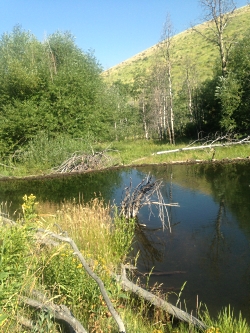
An additional conservation possibility being explored by some USU folks is restoring healthy populations of beaver to the Bear River Watershed. This has potential for water storage rivaling planned reservoirs not to mention the supurb wildlife habitat created as a bonus. A question for the Dixie folks- how are the beaver populations in the Beaver Dam and Pine Valley mountains fairing?

This is Jack Greene for Wild About Utah.

Credits:
Image: Courtesy St George Bird Festival, St. George City and Citizens for Dixie’s Future
Text:     Jack Greene, Bridgerland Audubon Society
Additional Reading:

Citizens for Dixie’s Future, https://citizensfordixie.org/

Big Bend Habitat Restoration Project: A Natural Work of Heart, Open Spaces-A Talk on the Wild Side, US FWS, https://www.fws.gov/news/blog/index.cfm/2016/3/25/Big-Bend-Habitat-Restoration-Project-A-Natural-Work-of-Heart [Accessed March 31, 2016]