Intelligent Tree Squirrels

Intelligent Squirrels: Squirrel Courtesy Pixabay
Squirrel
Courtesy Pixabay
Primates of the northlands. I consider tree squirrels to be on par with many primates for intelligence and agility. Those who have bird feeders may agree with me as they vainly attempt to thwart squirrel’s from invading their feeders. We have red squirrels visiting our bird feeder regularly. I’ve outsmarted them for the moment, but they continue to work on the problem I’ve presented them and feel a failure coming my way!

I’ve watched red squirrels manipulate fir cones with their front paws with amazing dexterity. Like myself eating a cob of corn, it spun the cone rapidly while shredding the cone scales to access the seed. Their tiny toes grip the cone identically to my fingers gripping the cob of corn. I’m amazed how they can unerringly navigate their way from tree to tree through our forest. There are many examples of squirrel intelligence witnessed by animal behaviorists.

Arboreal squirrels often build dreys that look like bird nests. Dreys are made up of twigs , moss, feathers and grass. All the items surrounding the dreys provide support and insulation. Chimpanzees exhibit very similar behavior.

Squirrels make use of several vocalizations to communicate with each other, they also create scents to attract opposite sex or communicate. They can create signals with their tails as well, by twitching it to alert other squirrels on the presence of a potential danger.

Tree squirrels display fantastically acrobatic movements, phenomenal adaptability to urban environments, and possess very cute little faces to boot. The 7th International Colloquium on Arboreal Squirrels was held 2018 in Helsinki, Finland. Studies routinely come discover new, amazing behaviors, especially involving the squirrel’s signature behavior, that it buries caches of its food to access later. One experiment found that they’ll try multiple tactics to open a locked box. Another found that squirrels remember the location of their caches without using their keen noses to locate them. Another found that they’re able to quickly learn from their peers.

A 2010 study found that squirrels actually engage in deceptive, or paranoid, behavior. When squirrels are being watched, they’ll construct fake caches, pretending to bury a nut by digging a hole, patting it down with their front teeth, and scraping dirt or grass over the top of it while concealing the nut in a pocket near their armpit, and will make the real cache somewhere else. Even while watching, it can be difficult to tell when a squirrel is making a fake or a real cache. How smart is that?

A study was conducted at UC Berkley in which students were placed in a competitive game to act like squirrels. They hid caches of plastic eggs, and then 15 minutes later returned to find them. This is a very squirrel-like test: memory, deception, location, observation, paranoia. Most students couldn’t remember their own hiding places. Squirrels bury about 10,000 nuts per year, making many different caches, and may not uncover them for months. They may dig up a cache and bury it somewhere else, and do that up to five times. Squirrels, unlike UC Berkeley students, are engaged in this intellectually draining activity while also avoiding predators and braving the elements.

This is Jack Greene for Bridgerland Audubon. I’m Wild About Utah and its amazing squirrels!

Credits:

Picture: Courtesy Pixabay, Alexas Fotos, Photographer, https://pixabay.com/photos/squirrel-rodent-animal-cute-nature-5158715/
Audio: Courtesy UPR
Text: Jack Greene, Bridgerland Audubon, https://bridgerlandaudubon.org/
Additional Reading: Lyle W Bingham, Webmaster, and Jack Greene, Author, Bridgerland Audubon, https://bridgerlandaudubon.org/

Additional Reading:

Jack Greene’s Postings on Wild About Utah, https://wildaboututah.org/author/jack/

Utah Fox Squirrels, NHMU is studying Fox Squirrels, and we need your help!, Natural History Museum of Utah, https://nhmu.utah.edu/citizen-science/utah-fox-squirrels

Types of Squirrels in Utah! (3 species w/ pictures), Bird Watching HQ, https://birdwatchinghq.com/squirrels-in-utah/


Berries

Berries: Oregon Grape  <i>Mahonia repens</i> Producing Blue Berries in the Grand Tetons Park Courtesy Pixabay, Mike Goad, Photographer
Oregon Grape
Mahonia repens
Producing Blue Berries in the Grand Tetons
Courtesy Pixabay, Mike Goad, Photographer,

Red Raspberry Rubus idaeus var. strigosus Courtesy NPS, Yellowstone's Photo Collection, JW Stockert Photographer, 1972 Red Raspberry
Rubus idaeus var. strigosus
Courtesy NPS, Yellowstone’s Photo Collection, JW Stockert Photographer, 1972

Thimbleberry Rubus parviflorus Courtesy NPS, Yellowstone's Photo Collection, JW Stockert, Photographer Thimbleberry
Rubus parviflorus
Courtesy NPS, Yellowstone’s Photo Collection, JW Stockert, Photographer

Utah-Serviceberry Rosaceae Amelanchier utahensis Courtesy National Park Service, Lee Ferguson, Photographer Utah-Serviceberry
Rosaceae Amelanchier utahensis
Courtesy National Park Service, Lee Ferguson, Photographer

Rose Hips Wood's rose Rosa woodsii Courtesy NPS, Yellowstone's Photo Collection, J Schmidt, Photographer, 1977 Rose Hips
Wood’s rose Rosa woodsii
Courtesy NPS, Yellowstone’s Photo Collection, J Schmidt, Photographer, 1977

The berry season is upon us- huckleberries, raspberries, gooseberries, chokecherries (not a berry but close enough), elderberries, bearberries, while early berries have faded- golden current, serviceberries, thimble berries are now fruit leather.

Berry picking during my youth in the North woods of Wisconsin was a wonderful tradition that I, and our black bear neighbors, looked forward to with great anticipation. We often shared the same patch evident by fresh bear scat and tracks. Those rare occasions where brother and sister bear were with us are frozen in time. “Just keep picking and talking- they won’t bother us.” My grandmother’s refrain. I was enthralled, watching every move and sound they made, with an occasional “woof” from mother bear alerting the youngsters.

Now, so many years later, I take my students to the Tetons hoping for a glimpse of bruins harvesting berries, rose hips, and thorn apples along streams and roadsides. Black bears are efficient berry-eaters, consuming up to 30,000 berries a day in a good year. They gather berries quickly, using their sensitive, mobile lips swallowing them whole. The berries enter a two-part stomach, which grinds the pulp off the seeds which pass through unbroken and are able to germinate, making black bears important seed dispersers.

Our Bear River Range here in Northern Utah was once a stronghold for the bruin. Overharvesting by hunters and the government has left it wanting, but the berries remain. One berry favored by bears is the white snowberry. Don’t copy the bears on this one as it’s toxic, but a great medicinal. Another that I avoid is the buffalo berry, called soapberry in the northwest. It contains saponin, the active ingredient in most soaps. It’s much like biting into a bar of soap, applied in my younger years for mouth cleansing. And please avoid the voluptuous red and white fruit of the bane berry, and cute little mini tomatoes of deadly night shade. You will be all the better for it.

“Harvesting berries can be a powerful meditation, centering us in the power of “now,” and is one of the oldest human experiences. This simple action can be an opportunity to revel in the abundance of nature. Tangibly interacting with food that is so wired into its life source is otherworldly, and it reminds us of a time when humans were more directly connected to the origins of our food. It is a grounding experience that demands every cell in your body resonate with the source of our food, catalyzing our connections to the universe.” Valerie Segrest quote

I strongly recommend “Blueberries for Sal” for younger generations. A delightful 1948 children’s book by renowned author Robert McCloskey. I recently visited the Blueberry Hill in Main’s Acadian N.P., the location for this story, and picked a few myself. Unfortunately, the bears had been replaced swarms of tourists!

Jack Greene for Bridgerland Audubon Society, and yes, I’m wild about Utah’s bears and wild berries!

Credits:

Pictures:
Oregon Grape Producing Blue Berries in the Grand Tetons, Courtesy Pixabay, Mike Goad, Photographer, https://pixabay.com/photos/blue-wild-berries-in-the-tetons-blue-3842367/
Red raspberry (Rubus idaeus var. strigosus); JW Stockert; 1972, Courtesy NPS, Yellowstone’s Photo Collection, https://www.nps.gov/features/yell/slidefile/plants/rosefamily/Images/08720.jpg
Wood’s rose (Rosa woodsii) hips; J Schmidt; 1977, Courtesy NPS, Yellowstone’s Photo Collection, https://www.nps.gov/features/yell/slidefile/plants/rosefamily/Images/06964.jpg
Thimbleberry (Rubus parviflorus); JW Stockert; 1973, Courtesy NPS, Yellowstone’s Photo Collection, https://www.nps.gov/features/yell/slidefile/plants/rosefamily/Images/08718.jpg
Utah Serviceberry, Rosaceae_Amelanchier_utahensis, Courtesy US NPS, Lee Ferguson, Photographer, https://www.nps.gov/arch/learn/nature/images/Rosaceae_Amelanchier_utahensis.jpg
Audio: Courtesy & © Friend Weller, https://upr.org
Text: Jack Greene, Bridgerland Audubon, https://bridgerlandaudubon.org/
Additional Reading: Lyle W Bingham, Webmaster, and Jack Greene, Author, Bridgerland Audubon, https://bridgerlandaudubon.org/

Additional Reading:

Jack Greene’s Postings on Wild About Utah, https://wildaboututah.org/author/jack/

Valerie Segrest, Foods Still Matter: The Muckleshoot Food Sovereignty Project, National Museum of the American Indian, The Smithsonian Institution, 2018, https://americanindian.si.edu/nk360/pnw-history-culture/muckleshoot

Valerie Segrest, Food sovereignty, TEDxRainier, TEDxSeattle, https://tedxseattle.com/talks/food-sovereignty/

McCloskey, Robert(Author), Blueberries for Sal, Puffin Books, September 30, 1976 https://www.amazon.com/Blueberries-Sal-Robert-McCloskey/dp/014050169X

A Bear’s Menu, Student Activities, Educator Resources, Yellowstone National Park, https://www.nps.gov/teachers/classrooms/a-bears-menu.htm

John Muir and Wilderness

John Muir and Wilderness: John Muir at Glacier Bay Courtesy US NPS, Glacier Bay National Park & Preserve
John Muir at Glacier Bay
Courtesy US NPS, Glacier Bay National Park & Preserve

John Muir and Wilderness: Roosevelt and Muir at Glacier Point President Teddy Roosevelt and John Muir standing on rock at Glacier Point, Yosemite, May 1903; Yosemite Falls and cliffs of Yosemite Valley in distance. [RL012904] Courtesy US NPS Roosevelt and Muir at Glacier Point,
President Teddy Roosevelt and John Muir standing on rock at Glacier Point, Yosemite, May 1903; Yosemite Falls and cliffs of Yosemite Valley in distance.
Note: Muir visited Glacier Bay in Alaska and the Unita mountains in Utah to explore how glaciers formed Yosemite valley. [RL012904]
Courtesy US NPS

An aerial view of Margerie Glacier. The glacier begins high in the mountains and meanders down the valleys like a river of ice.  Courtesy US NPS, Glacier Bay National Park & Preserve An aerial view of Margerie Glacier. The glacier begins high in the mountains and meanders down the valleys like a river of ice.
Courtesy US NPS, Glacier Bay National Park & Preserve

John Muir at Muir Glacier Courtesy US NPS, Glacier Bay National Park & Preserve John Muir at Muir Glacier
Courtesy US NPS, Glacier Bay National Park & Preserve

I’ve known of John Muir much of my life. A recent kayaking trip to Glacier Bay in Alaska added to my appreciation for this remarkable early American naturalist, author, and Wilderness advocate. Muir first visited Glacier Bay in 1879, where he witnessed firsthand how glaciers transform the landscape, bolstering his prescient theory of glaciology. Upon returning home, I did a bit of research on his 1877 visit to Utah. Muir was taken by the wild beauty of the Wasatch Mountains as he so eloquently expressed.

“The glacial developments of these superb ranges are sharply sculptured peaks and rests, with ample wombs between them, where the ancient snows of the glacial period were collected and transformed into ice and ranks of profound shadowy canyons, while moraines commensurate with the lofty fountains extend into the valleys forming far the grandest series of glacial monuments I have yet seen this side of the Sierra.”

In addition to Muir’s contributions to understanding how glaciers sculpt landscapes, he used his political acumen to initiate the Wilderness movement, culminating with the 1964 Wilderness Act approved by the U.S. Congress. “A wilderness, in contrast with those areas where man and his own works dominate the landscape, is hereby recognized as an area where the earth and its community of life are untrammeled by man, where man himself is a visitor who does not remain.” – written by Howard Zahniser, the principle author of the Act.

The U.S. Congress has preserved 110 million acres of the fifty states since the Wilderness Act, 1.16 million of which are found in Utah. About half are on National Forest lands, the remaining residing with the Bureau of Land Management agency. Another 3.2 million acres are managed as Roadless lands titled Wilderness Study Areas.

Other Muir quotes which champion wilderness- “Thousands of tired, nerve-shaken, over-civilized people are beginning to find out that going to the mountains is going home; that wildness is a necessity.” and “Wilderness is a necessity… there must be places for human beings to satisfy their souls.”

I’ve spent many years as a seasonal Wilderness ranger and Wilderness advocate here in N. Utah in the Naomi and Wellsville Wilderness. Managing these precious spaces to retain its wilderness character has become ever more challenging with a warmer, dryer climate enhancing wildfire, flooding, and loss to massive insect outbreaks. As Glacier Bay and Glacier National park glaciers retreat ever deeper into bays and meadows, their names may become a misnomer.

Although John Muir’s famous “Muir Glacier” had receded several miles away from where it once met the ocean, I feel blessed the few tidewater glaciers we encountered yet remain. And I feel further blessed that the U.S. Congress has seen fit to protect Utah’s wildlands by deploying the Wilderness Act- “…where the Earth and its Community of Life will remain untrammeled by man…”

Jack Greene for the Bridgerland Audubon Society, and I’m wild about Utah!

Credits:

Picture:
Audio: Courtesy & © J. Chase and K.W. Baldwin https://upr.org
Text: Jack Greene, Bridgerland Audubon, https://bridgerlandaudubon.org/
Additional Reading: Lyle W Bingham, Webmaster, and Jack Greene, Author, Bridgerland Audubon, https://bridgerlandaudubon.org/

Additional Reading:

Jack Greene’s Postings on Wild About Utah, https://wildaboututah.org/author/jack/

Glacier Bay From Above(Video), John Hopkins Inlet, Glacier Bay National Park & Preserve, US National Park Service, https://www.nps.gov/media/video/view.htm?id=C16C2BB8-1DD8-B71C-0783F58C054561C2

Fields, Lauren, Here’s what John Muir — the father of national parks —thought about early Utah, The Deseret News, Apr 20, 2018, https://www.deseret.com/2018/4/21/20643789/here-s-what-john-muir-the-father-of-national-parks-thought-about-early-utah

John Muir in Utah, Utah Stories from the Beehive Archive, Utah Humanities, https://www.utahhumanities.org/stories/items/show/180

Public Law 88-577 a.k.a. Wilderness Act, Sept 3, 1964, U.S. Government Publishing Office: https://www.govinfo.gov/content/pkg/STATUTE-78/pdf/STATUTE-78-Pg890.pdf

Biek, Bob, Willis, & Ehler, Buck, Utah’s Glacial Geology, Survey Notes, Utah Geological Survey, Utah Department of Natural Resources, September 2010, https://geology.utah.gov/map-pub/survey-notes/utahs-glacial-geology/

Hansen, Wallace R, The Geologic Story of the Uinta Mountains, Geological Survey(USGS), US Department of the Interior, 1969, 1975, 1983, https://pubs.usgs.gov/bul/1291/report.pdf

The Great Salt Lake: Important for Birds

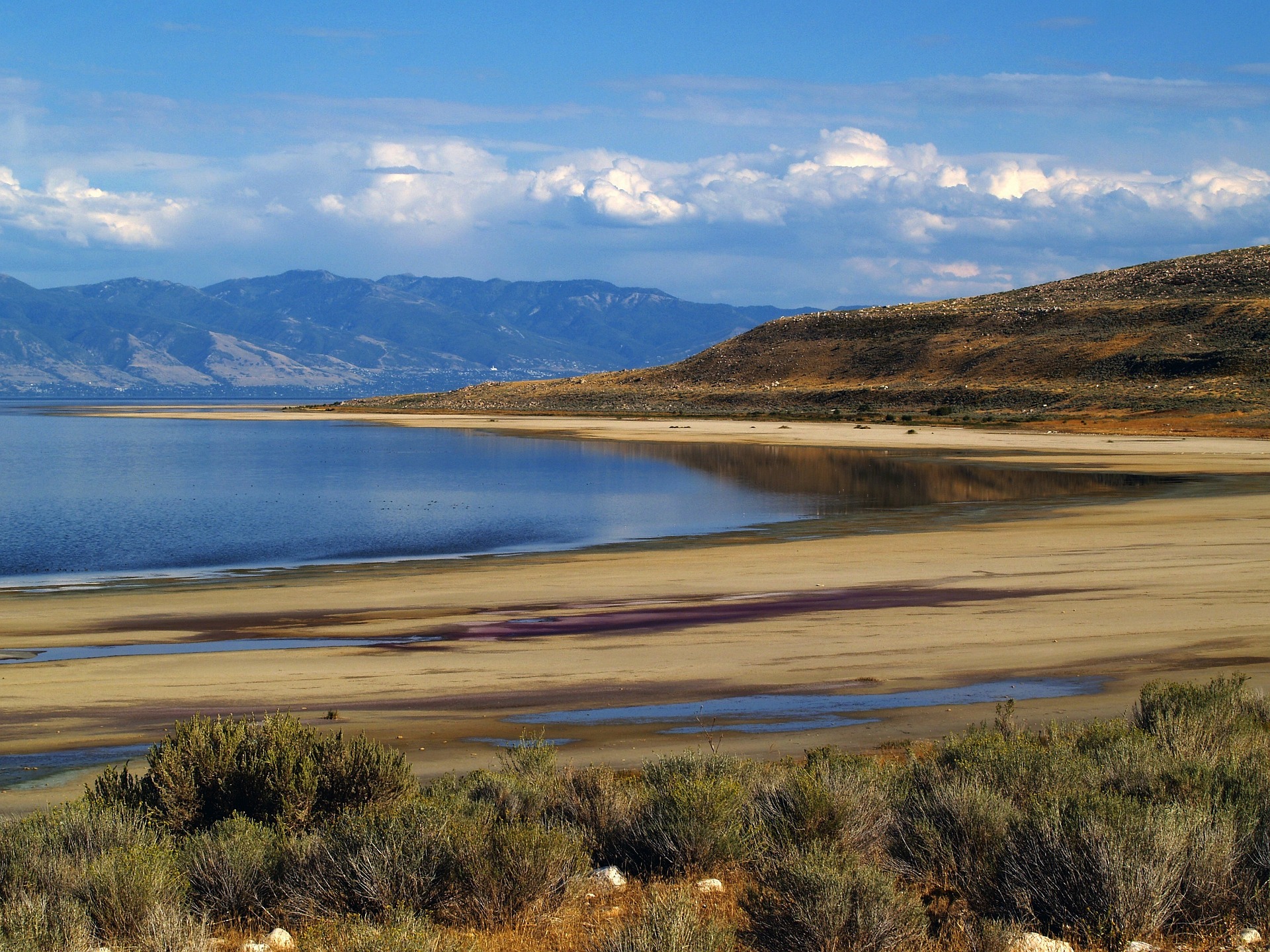
Decreasing water levels in the southern arm of the Great Salt Lake expose microbialite communities that are normally underwater. Courtesy USGS, Hannah McIlwain, Photographer
Decreasing water levels in the southern arm of the Great Salt Lake expose microbialite communities that are normally underwater.
Courtesy USGS, Hannah McIlwain, Photographer
I first met the Great Salt Lake in 1964 with two Central Michigan University college buddies on our way to Los Angeles. We heard you could float in its magical waters. Sure enough- it worked and we bobbed in its gentle waves oblivious to the many other virtues of this extraordinary water body.

This saltwater marvel is the largest wetland area in the American West. Its 400,000 acres of wetlands provide habitat for over 230 bird species traveling from the tip of South America, north to Canada’s Northwest Territories and as far west as Siberia. These wetlands and surrounding mudflats are vital habitat for 8-10 million individual migratory birds with many species gathering at the Lake in larger populations than anywhere else on the planet.

In 1991 the Great Salt Lake was declared a site of “hemispheric importance,” the highest level of designation given to a site by the Western Hemisphere Shorebird Reserve Network. The Reserve conserves shorebird habitat through a network of key sites across the Americas. Salt Lake receives the largest percentage of the world’s population of migrating Eared Grebes, nearly one-third of Wilson’s Phalaropes, more than half of American Avocets, and 37 percent of Black-necked Stilts. The lake’s shoreline, playas and mudflats also support 21 percent of the North American breeding population of Snowy Plovers, a species identified as one of greatest conservation needs by Utah’s Wildlife Action Plan.

These shorebirds are among nature’s most ambitious, long-distance migrants. But their numbers are dropping quickly. Shorebirds are showing the most dramatic declines among all bird groups. Species that undertake hemispheric migrations rely on specific habitats and food sources to survive, but these resources are increasingly under threat from human disturbance including habitat loss and degradation, over-harvesting, increasing predation, and climate change. As humans have continued to alter the landscape, shorebird populations continue to drop, with accelerated declines in recent decades.

Of 52 shorebird species that regularly breed in North America, 90% are predicted to experience an increase in risk of extinction. This includes 28 species already considered at high risk, and 10 imperiled species that face even greater risk.

At the base of Salt Lake’s food chain are microbialites, underwater reef-like rock mounds created by millions of microbes. These structures and their microbial mats form the base of the entire Great Salt Lake ecosystem, serving as a primary food source for brine shrimp and brine flies, which are the main food source for these aquatic birds. Falling water levels exposing the microbialites to air could trigger a collapse in the lake’s food chain according to a July study by the Utah Geological Survey.

So we humans aren’t the only one’s suffering from our disappearing Lake. Thank goodness we have awakened to this extraordinary resource found on our doorstep with many organizations and agencies attempting to save what remains for our health, wealth, and for the millions of threatened feathered friends that grace our skies, and our lives. Last May, Utah Governor Cox declared 2021 the year honoring shorebirds. We can do our part by taking action on conserving water and energy.

Jack Greene for Bridgerland Audubon Society and I’m wild about Utah and its magnificent great lake.

https://youtu.be/xv07VnQnlOY

Credits:

Picture:
Audio: Courtesy & © Kevin Colver https://wildstore.wildsanctuary.com/
Text: Jack Greene, Bridgerland Audubon, https://bridgerlandaudubon.org/
Additional Reading: Lyle W Bingham, Webmaster, and Jack Greene, Author, Bridgerland Audubon, https://bridgerlandaudubon.org/

Additional Reading:

Jack Greene’s Postings on Wild About Utah, https://wildaboututah.org/author/jack/

Strand, Holly, Important Bird Areas, Wild About Utah, October 21, 2008, https://wildaboututah.org/important-bird-areas/

Strand, Holly, One of the World’s Largest Shrimp Buffets, Wild About Utah, June 3, 2008, https://wildaboututah.org/one-of-the-worlds-largest-shrimp-buffets/

Chambless, Ross, When the Great Salt Lake we know is gone, what shall we name it?, Commentary, The Salt Lake Tribune, August 19, 2021, https://www.sltrib.com/opinion/commentary/2021/08/19/ross-chambless-when-great/ [Accessed September 19, 2021]

Shorebirds are among nature’s most ambitious, long-distance migrants. Western Hemisphere Shorebird Reserve Network (WHSRN), https://whsrn.org/about-shorebirds/shorebird-status/

Drought Negatively Impacting Great Salt Lake Microbialites and Ecosystem, Utah Geological Survey (UGS), Utah Department of Natural Resources, State of Utah, July 15, 2021, https://geology.utah.gov/drought-negatively-impacting-great-salt-lake-microbialites-and-ecosystem/

Chidsey, T.C., Jr., Eby, D.E., Vanden Berg, M.D., and Sprinkel, D.A., 2021, Microbial carbonate reservoirs and analogs
from Utah: Utah Geological Survey Special Study 168, 112 p., 14 plates, 1 appendix, https://doi.org/10.34191/SS-168

Riding, Robert, Definition: Microbialites, Stromatolites, and Thrombolites, Encyclopedia of Geobiology, SpringerLink, Springer Nature Switzerland AG. Part of Springer Nature., https://link.springer.com/referenceworkentry/10.1007%2F978-1-4020-9212-1_196

Romero, Simon, Booming Utah’s Weak Link: Surging Air Pollution, The New York Times, Sept. 7, 2021, https://www.nytimes.com/2021/09/07/us/great-salt-lake-utah-air-quality.html

2015–2025 Wildlife Action Plan, Division of Wildlife Resources, Department of Natural Resources, State of Utah, July 1 2015, https://wildlife.utah.gov/discover/wildlife-action-plan.html

Governor Cox Declares 2021 as Year of the Shorebird at Great Salt Lake, Declaration celebrates 30th anniversary of Great Salt Lake as a Western Hemisphere Shorebird Reserve Network Site, Western Water News, National Audubon, May 12, 2021, https://www.audubon.org/news/governor-cox-declares-2021-year-shorebird-great-salt-lake
See also: https://wildlife.utah.gov/news/utah-wildlife-news/1182-cox-declares-2021-year-of-shorebird-great-salt-lake.html

Gov. Cox Issues Drought Executive Order, Governor.utah.gov, March 17, 2021, https://governor.utah.gov/2021/03/17/gov-cox-issues-drought-executive-order/


Written by Hall Crimmel & Dan Bedford, Filmed and Edited by Isaac Goeckeritz, iUtah EPSCor, Rachel Carsen Center Environment & Society,
Based on the book Desert Water; The Future of Utah’s Water Resources edited by Hall Crimmel and published by University of Utah Press, 2014

Carney, Stephanie, Vanden Berg, Michael D., GeoSights: Microbialites of Bridger Bay, Antelope Island, Great Salt Lake, Survey Notes, Utah Geological Survey, State of Utah, January 1, 2022, https://geology.utah.gov/map-pub/survey-notes/geosights/geosights-microbialites-of-bridger-bay-antelope-island-great-salt-lake/

Salt Lake Brine Shrimp, https://saltlakebrineshrimp.com/harvest/

Williams, Terry tempest, Opinion, I Am Haunted by What I Have Seen at Great Salt Lake, The New York Times,, March 25, 2023, https://www.nytimes.com/2023/03/25/opinion/great-salt-lake-drought-utah-climate-change.html

Williams, Terry tempest, Opinion, I Am Haunted by What I Have Seen at Great Salt Lake, The New York Times,, March 25, 2023, https://www.nytimes.com/2023/03/25/opinion/great-salt-lake-drought-utah-climate-change.html