Ponderosa Pine

Ponderosa Pine Courtesy USDA Forest Service

Ponderosa Pine
Western Yellow Pine
Pinus ponderosa
Courtesy USDA Forest Service

Ponderosa Pine Needles Courtesy US NPS from a US BLM Photo
Ponderosa Pine Needles
Courtesy US NPS from a US BLM Photo

Ponderosa Pine Bark Courtesy USDA Forest Service
Ponderosa Pine Bark
Courtesy USDA Forest Service

Ponderosa Pine Distribution Courtesy US National Parks Service, Bryce Canyon National Park,
Ponderosa Pine Distribution
Courtesy US National Parks Service, Bryce Canyon National Park

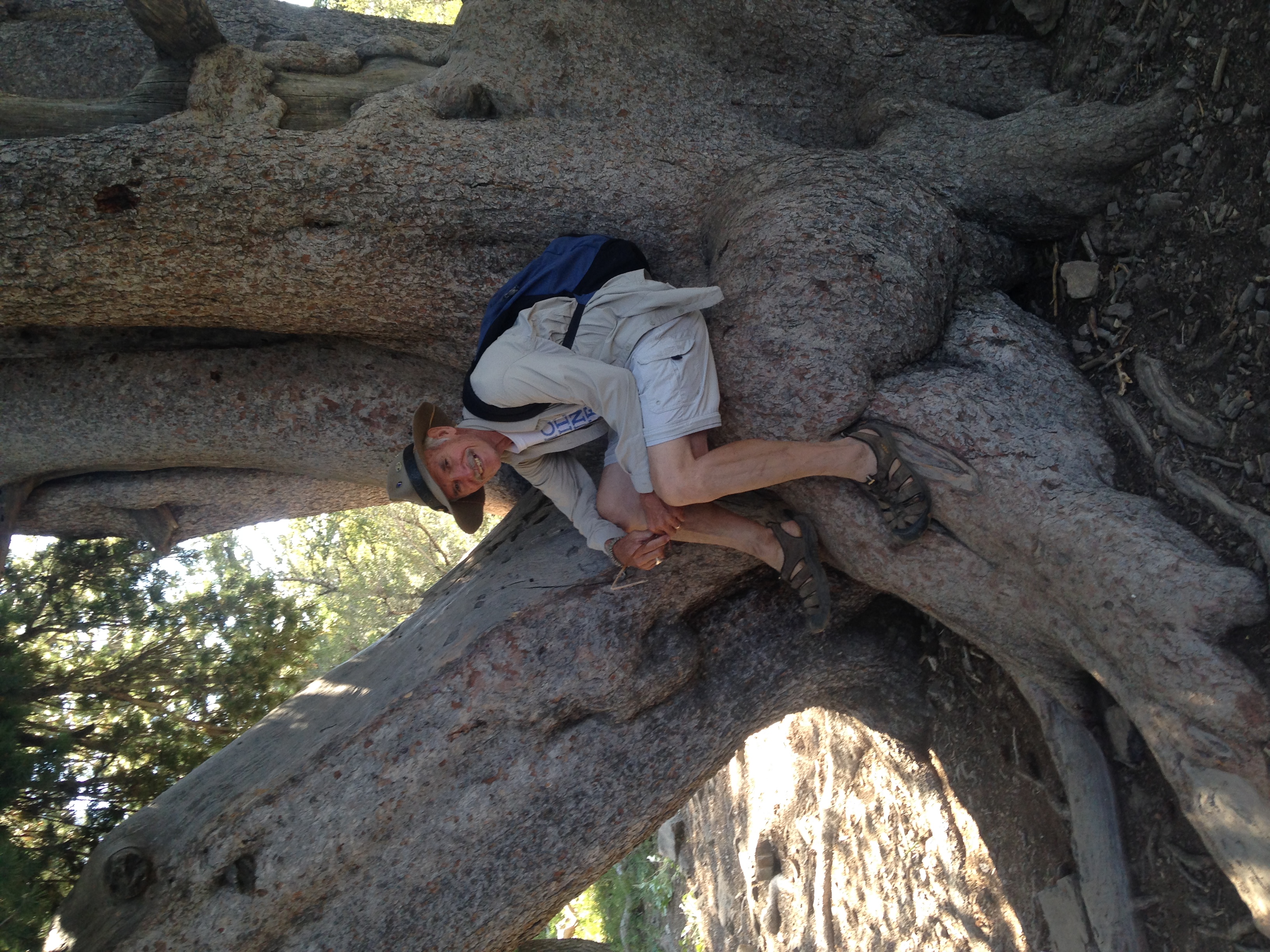
I’ve been accused of being a tree hugger over the years, a title I welcome! I’ve hugged many trees, as I’ve hugged many people, especially on Valentine’s Day! One tree that I’m particularly fond of hugging is the ponderosa pine- with its sweet butterscotch aroma meeting my nostrils!

A few weeks ago, I was skiing with friends through a lovely ponderosa forest in Bryce Canyon National Park. The trees had a special beauty with their fresh cover of snow and frost crystal. As my skis and I worked our way through the forest, many questions regarding these magnificent trees arose- how were they being managed by the park, other than controlled burns? It appeared to be a well-structured forest, a multi-aged stand from seedlings to much older members of “yellow bellies”, a name given to mature, older pines whose bark wore a yellowish-gold cast. When was the last fire where I skied?

This dry-land forest loves a good, cleansing burn every so often to keep it healthy and fecund, reducing the fuel load to prevent catastrophic fires that may kill the trees. Often occurring at higher elevation and towering over their lesser neighbors of limber pine, Douglas fir, subalpine fir, and juniper, they serve as highly effective lightning rods. More than 100 feet heights are common for these monarchs. Under ideal growth conditions, they may pierce the sky at 200 feet and over five feet in diameter! The oldest recorded ponderosa is 933 years although they average 300-400 years.

Ponderosa’s are among the highest valued lumber trees in the west. Most of the old growth ponderosas have been cut unless they’ve had special protection in parks and preserves. I’ve found small patches of trees well over 200 years in age, living long before the axes and saws appeared in the western US.

Native Americans ate the seeds either raw or made into a bread and the sweet, edible phloem in the inner bark. They used the pitch as adhesive and waterproofing agent for canoes, baskets and tents. Blue dye was produced from a root extract. The long needles were woven into baskets.

Many species of wildlife are found in these marvelous forests, some completely dependent on them, like the Abert’s squirrel. This squirrel species truffle feeding behavior has a symbiotic relationship with the ponderosa by spreading truffle spores through defecating and burying them, which form mycorrhiza with ponderosa tree roots allowing them to thrive.

There is less canopy cover in a ponderosa pine community compared to lodgepole pine and spruce/fir communities, resulting in more grasses, forbs, and shrubs. The high species richness of the understory makes it preferred by grazing animals such as elk, deer, and moose. A ponderosa forest bird I’m particularly fond of is the communal pigmy nuthatch. Their busy, constant chatter always brightens my day-including winter days in Bryce.

I recently read a delightful book on the ponderosa “Graced by Pines” by Alexandra Murphy, a wonderful read to pass these long winter nights.

Jack Green for Bridgerland Audubon Society and I’m Wild About Utah!

Credits:
Ponderosa Pine Pictures: Courtesy US NPS,
Bark Picture Courtesy US NPS, Rocky Mountain National Park, https://www.nps.gov/romo/ponderosa_pine_bark.htm
Audio: Courtesy & © Friend Weller, https://npr.org/
Text: Jack Greene, Bridgerland Audubon, https://bridgerlandaudubon.org/
Additional Reading: Lyle W Bingham, Webmaster, and Jack Greene, Author, Bridgerland Audubon, https://bridgerlandaudubon.org/

Additional Reading:

Jack Greene’s Postings on Wild About Utah, https://wildaboututah.org/author/jack/

Ponderosa Pine, Bryce Canyon National Park-Utah, US National Park Service, Department of the Interior, https://www.nps.gov/brca/learn/nature/ponderosapine.htm

“The Cheyenne Indians of Montana applied ponderosa pine pitch inside whistles and flutes to improve the instruments’ tone. The Nez Pierce used the pitch as a torch fuel; the Nez Pierce and Crow also used pitch as glue.”
Ponderosa Pine, Range Plants of Utah, USU Cooperative Extension, Utah State University, 2017, https://extension.usu.edu/rangeplants/shrubs-and-trees/PonderosaPine

“Ponderosa pine is unpalatable to domestic livestock but it may browse enough to slow or stop seedling recruitment. Pregnant cows that consume large amounts of ponderosa pine needles show an increased incidence of abortion and other reproductive anomalies.”
Ponderosa Pine (Pinus ponderosa), Poisonous Plant Research: Logan, UT, Agricultural Research Service(ARS), US Department of Agriculture, https://www.ars.usda.gov/pacific-west-area/logan-ut/poisonous-plant-research/docs/ponderosa-pine-pinus-ponderosa/

World’s Oldest Ponderosa Pine Found in Utah Fire Study, Utah Forest Landowner Education Newsletter, USU Extension, Utah State University, Volume 12, No 1, Winter 2008, https://www.fs.usda.gov/Internet/FSE_DOCUMENTS/fsbdev7_016042.pdf

Rocky Mountain Elk

Rocky Mountain Elk: Canada Elk Cervus canadensis Courtesy William(13222272) and Pixabay
Canada Elk
Cervus canadensis
Courtesy William(13222272) and Pixabay

Bull Elk in Profile Courtesy US FWS, Ryan Hagerty, Photographer Bull Elk in Profile
Courtesy US FWS, Ryan Hagerty, Photographer

Jackson Elk Herd Courtesy US FWS, Lori Iverson, Photographer Jackson Elk Herd
Courtesy US FWS, Lori Iverson, Photographer

Bull Elk and Herd at National Elk Refuge Courtesy US FWS, Kari Cieszkiewicz, Photographer Bull Elk and Herd at National Elk Refuge
Courtesy US FWS, Kari Cieszkiewicz, Photographer

The Rocky Mountain elk is Utah’s state mammal for good reason. No one can deny its majesty and uncanny intelligence while being hunted, and the spine tingling bugle released in fall mountain splendor.

My introductory encounter with Rocky Mountain elk came during my first deer hunt in Utah on the east side of Mt. Nebo. I was nearly trampled by a large bull and herd of cows that leaped over me as I cowered behind large boulders. What magnificent beings they were, dwarfing the whitetail deer I had grown up with in Michigan.

Since that time, I’ve led countless groups of students and others to view elk during the rut in Grand Teton National Park. On one occasion, we were sleeping under the stars on a warm fall evening, awakened by a minor earth quake as a herd ran through us, a wakeup call I’ll never forget!

A matriarchal society, the cow elk rules the herd other than during the fall rut. Bulls will often separate to avoid this embarrassing situation. If you’ve had the pleasure of holding a large set of elk antlers, you will appreciate the physiology that allows this amount of annual growth to produce such weapons and status symbols. Cows generally outlive the bulls by several years. Prime bulls exhaust themselves, during the rut, and face the harsh winter months in a depleted condition. Some won’t make it providing a feast for waiting predators and scavengers come spring.

Elk are a sacred animal for many Native Americans. “Elk Medicine is a powerful totem animal of stamina, strength, sensual passion, nobility, pride, respect, and survival. Elk are also known as Spirit Messengers. Their antlers connect to the medicine of lightening, and channel that energy to earth. With this medicine comes instant knowing and messages from Spirit with great clarity.” Animal Spirit Medicine Elk by Beverly Two Feathers

My spiritual encounter came on a full moon vernal evening on a ridge in Birch Canyon near Smithfield. It was unusually warm so decided to take a moonlit stroll. Once on the ridge, large, gray forms emerged. I soon found myself surrounded by an elk herd. I moved slowly for safety, and not to startle the animals. A euphoric moment. Another came last fall when I had a large group of USU international students with me. It was after dark at the base of Teewinot. I hushed their chatter. Soon after came the hauntingly beautiful sound sliding down the slope above, bugling of bull elk. They were transfixed as was I.

A favorite book is Wapiti Wilderness, coauthored by Olaus and wife Margaret Murie, capturing their lives in the Yellowstone and Teton wilderness tracking elk herds over many years, often with their young children. A revealing and enduring read I highly recommend.

This weekend I will be taking 24 international students to Hardware Ranch for a sleigh ride among the wintering pasturing elk. Here they are fed hay to replace their lower winter range, which has been replaced by human activity. Yet another spiritual experience!

This is Jack Greene for Bridgerland Audubon and I’m Wild About Utah and its elk.

Credits:
The Wonders of Bird Migration
Picture: Courtesy Pixabay William(), Photographer, https://pixabay.com/photos/elk-canada-deer-wildlife-nature-4825105/
Image: Bull Elk in Profile, Courtesy US FWS, Ryan Hagerty, Photographer, https://digitalmedia.fws.gov/digital/collection/natdiglib/id/20291/rec/19
Image: Bull elk and herd at National Elk Refuge, Courtesy US FWS, Kari Cieszkiewicz, Photographer, https://digitalmedia.fws.gov/digital/collection/natdiglib/id/33128/rec/5
Image: Jackson Elk Herd, Courtesy US FWS, Lori Iverson, Photographer, https://digitalmedia.fws.gov/digital/collection/natdiglib/id/18432/rec/2
Audio: Courtesy & © Kevin Colver https://wildstore.wildsanctuary.com/
Text: Jack Greene, Bridgerland Audubon, https://bridgerlandaudubon.org/
Additional Reading: Lyle W Bingham, Webmaster, and Jack Greene, Author, Bridgerland Audubon, https://bridgerlandaudubon.org/

Additional Reading:

Jack Greene’s Postings on Wild About Utah, https://wildaboututah.org/author/jack/

Murie, Margaret, Murie, Olaus, Wapiti Wilderness, University Press of Colorado, December 15, 1987, https://www.amazon.com/Wapiti-Wilderness-Margaret-Murie/dp/087081155X

National Elk Refuge, US Fish & Wildlife Service, US Department of the Interior, https://www.fws.gov/refuge/national-elk

Visiting Hardware WMA-Education Center, Utah Division of Wildlife Resources, Department of Natural Resources, State of Utah, https://wildlife.utah.gov/hardware-visit.html

Owens, Beverly, a.k.a. Beverly Two Feathers, Native American Totems, https://native-american-totems.com/author/bevspaper/page/13/

Teewinot, NPS History, US National Park Service, Autumn 2004, https://npshistory.com/publications/grte/newspaper/fall-2004.pdf

I’m a Beaver Believer

I'm a Beaver Believer: North American Beaver (Castor canadensis) Courtesy US FWS, Larry Palmer, Photographer
North American Beaver (Castor canadensis)
Courtesy US FWS, Larry Palmer, Photographer

Beaver-Chewed Tree Courtesy US FWS, Brett Billings, Photographer Beaver-Chewed Tree
Courtesy US FWS, Brett Billings, Photographer

Beaver-Chewed Tree Courtesy US FWS, Brett Billings, Photographer Beaver-Chewed Tree
Courtesy US FWS, Brett Billings, Photographer

I’m a beaver believer. These remarkable rodents are a critical part of the ecosystem, a keystone species. The beaver’s role in creating wildlife and fisheries habitat, filtering and cooling water, and adding new water storage capacity, is essential for our prolonged drought in a warming climate.
When I had a neighbor call a few weeks ago to report he thought a beaver might be cutting down his aspen trees. I was in disbelief. Right here in our little city of Smithfield no less! John invited me over to confirm his suspicions.

After inspecting the tree stumps, teeth marks were undoubtedly those of beaver. We discussed on how to address the situation. John had lost several thousand dollars-worth of trees, and was quite desperate to remediate the situation. I suggested reporting the rogue beaver to animal control or UDWR. Perhaps they could live trap and transport the animal to a more favorable location, while dreading the possibility of having to destroy my iconic, heroic mammal friend. In the interim, I suggested he use chicken wire to save what remained. Another personal conflict arose from my position as Smithfield Tree Committee chair. I was fully aware of the many values urban forests offer to our local environment and quality of life. It was my mission to protect our trees.

I inquired as to where the beaver was setting up shop. There must be a tangle of aspen leavings nearby. John hadn’t noticed any. I began searching the stream to find the missing trees, never expecting to see a beaver. Not more than 20 yards upstream from his property boundary, there it was. I quickly took a picture before it slid into the water disappearing beneath the ice.

I returned to my neighbor who was busy installing chicken wire around his remaining aspen. He too was not wishing to exterminate the animal, but there were homes with aspen, willow, and cottonwood both up and downstream from our location, a veritable feast for this wanderer. I mentioned that I had some acquaintances at USU who worked with beaver reintroduction, and may offer some solutions as well.

Given its small size and unexpected location, this was most likely a two-year-old juvenile who had been forced from its family, similar to how we gently nudge our young adults out the door. I was well acquainted with our mountain landscape and quite certain this beaver had traveled a distance of many miles to end up in Smithfield.

After consulting my USU friends, it did not bode well for poor beaver. To catch and release this animal during the winter offered little hope for its survival. Further, it would not fare well in several months of captivity, being alone in a high stress environment.

I’m now waiting to hear from my neighbor for the rest of the story. May it be favorable for this remarkable aquatic mammal, so essential for creating healthy watersheds, which equals abundant, high quality water!

Jack Greene for Bridgerland Audubon, and I’m wild about Utah’s wild beaver!

Credits:
Picture: Courtesy US FWS, Larry Palmer & Brett Billings, Photographers https://images.fws.gov/
Audio: Courtesy & © Friend Weller, https://npr.org/
Text: Jack Greene, Bridgerland Audubon, https://bridgerlandaudubon.org/
Additional Reading: Lyle W Bingham, Webmaster, and Jack Greene, Author, Bridgerland Audubon, https://bridgerlandaudubon.org/

Additional Reading:

Jack Greene’s Postings on Wild About Utah, https://wildaboututah.org/author/jack/

Bingham, Lyle, Welcoming Rodent Engineers, Wild About Utah, February 7, 2022, https://wildaboututah.org/welcoming-rodent-engineers/

Heers, Mary, Beaver Tail Slap, Wild About Utah, October 12, 2020, https://wildaboututah.org/beaver-tail-slap/

Heers, Mary, Birch Creek Beaver Restoration, Wild About Utah, June 20, 2022, https://wildaboututah.org/birch-creek-beaver-restoration/

Hellstern, Ron, Leave it to Beaver, Wild About Utah, July 30, 2018, https://wildaboututah.org/leave-it-to-beaver/

Leavitt, Shauna, Beaver–Helping Keep Water on Drying Lands, Wild About Utah, April 17, 2017, https://wildaboututah.org/the-beaver-helping-keep-water-on-drying-lands/

Leavitt, Shauna, Beaver in Utah’s Desert Rivers, Wild About Utah, July 6, 2020, https://wildaboututah.org/beaver-in-utahs-desert-rivers/

Leavitt, Shauna, Proposed Beaver Holding Facility in Millville, Utah, Wild About Utah, September 3, 2018, https://wildaboututah.org/proposed-beaver-holding-facility-in-millville-utah/

Leavitt, Shauna, Sixty In-stream Habitat Structures in Four Days: Demonstrating Creek Restoration Techniques, Wild About Utah, December 18, 2017, https://wildaboututah.org/sixty-instream-habitat-structures-in-four-days-demonstrating-creek-restoration-techniques/

Strand, Holly, Beavers: The Original Army Corps of Engineers, Wild About Utah, April 29, 2010, https://wildaboututah.org/beavers-the-original-army-corps-of-engineers/

Goldfarb, Ben, Eager: The Surprising, Secret Life of Beavers and Why They Matter, Chelsea Green Publishing, March 8, 2019, https://www.amazon.com/Eager-Surprising-Secret-Beavers-Matter/dp/1603589082/ref=asc_df_1603589082/

Lee, David, Practiced in the art of deception, Wildlife Blog, Utah Division of Wildlife Resources, November 10, 2016, https://wildlife.utah.gov/news/wildlife-blog/683-practiced-in-the-art-of-deception.html

A Wild Utah Thanksgiving

Box Elder Bug on Milkweed Courtesy US FWS, Chelsi Burns, Photographer
Box Elder Bug on Milkweed
Courtesy US FWS, Chelsi Burns, Photographer

Perigrine Falcon Courtesy US FWS, Alan Schmierer, Photographer Perigrine Falcon
Courtesy US FWS, Alan Schmierer, Photographer

Northern Shrike Courtesy US FWS, Dave Menke, Photographer Northern Shrike
Courtesy US FWS, Dave Menke, Photographer

Robin with Chicks in Nest Courtesy US FWS, images.fws.gov James C. Leopold, Photographer Robin with Chicks in Nest
Courtesy US FWS, images.fws.gov
James C. Leopold, Photographer

Jerusalem Cricket Orthoptera: Stenopelmatidae Copyright 2013 Holly Strand Jerusalem Cricket
Orthoptera: Stenopelmatidae
Copyright 2013 Holly Strand

A Wild Utah Thanksgiving: Wild Turkeys
Courtesy Pixabay, Public Domain Images Wild Turkeys
Courtesy Pixabay, Public Domain Images

Wild Turkeys: Wild Turkey Tom Courtesy Pixabay, Biggles55 Contributor & Photographer Wild Turkey Tom
Courtesy Pixabay
Biggles55 Contributor & Photographer

Wild Turkeys: Rio Grande Turkey Tom, Meleagris gallopavo, Courtesy US FWS, Robert H. Burton, Photographer, images.fws.gov Rio Grande Turkey Tom
Meleagris gallopavo
Courtesy US FWS
Robert H. Burton, Photographer
https://images.fws.gov

I’m Giving thanks for a Wild Utah, which is all around us- in our yards, downtown, and even in our homes. I will make my case with the following vignettes.

Box elder bugs are my nemesis, reproducing numbers far beyond what their predators can control. But my grandkids adore them. Calling them “Boxies”, they are enthralled with their “cute” little friends. They will make a home for them in a jar, making sure they’re comfortable and well fed with collected leaves.

While sauntering through Temple Square on a lovely June day, I was startled by the kee-kee-kee call of peregrine falcons. One lit atop Moroni’s head, which adorns the temple, soon to be joined by another. The elder missionary who had begun his missionary pitch to me was aghast as I explained the peregrine coupling on their sacred figure.

My grandkids and I were keeping track of a robins nest which had been built over our front door facing. Checking the eggs, which were near hatching, we discovered a great basin gopher snake had crawled up the vertical house wall for egg soufflé, devouring all four eggs. How in the world did this reptile even know there was a nest with eggs in this unusual location, and make the vertical climb to eat them? A natural wonder!

Our bird feeder is quite popular with predatory birds. We noticed a darling little saw-whet owl sitting in the tree where the feeder hung with a junco in its beak. On another occasion, my wife alerted me to a stellar jay sitting on a limb outside the kitchen window with a fat meadow vole dangling from its mouth.

A few weeks ago, my daughter texted me a photo of a mystery bird that had slammed into their window. What is this bird? A northern shrike was the victim- a rarity indeed. Fortunately, it recovered, hopefully without serious injury, to hunt her birds another day.

When our children were young, a Jerusalem cricket was discovered in the basement. These Tonka Toy-like insects are marvels- and very scary. It kept our children occupied for hours. On another occasion, we came home to find baby skunks had invaded us. One of our sons had found them near their road-killed mother and adopted them. These cute little critters soon adapted to our presence, and no one was sprayed, but they did harbor a skunky odor for some time, probably from their deceased mother.

Given the Thanks Giving season, I’ll wrap this up with turkeys. Downtown Logan had four tom turkeys who were causing mayhem with traffic at the Center and Main intersection. Our fearless law officer were called out to remediate the situation. Following an hour of frantic scramble, the officers were defeated, as were the turkeys, who found an open door for refuge in a butcher shop. True story.

Wishing you a Wild Utah Thanksgiving!

This is Jack Greene for Bridgerland Audubon Society, and I’m wild about this Utah!

Credits:
Picture: Peregrine Falcon, Courtesy US FWS, Alan Schmierer, Photographer
Picture: Northern Shrike, Courtesy US FWS Dave Menke, Photographer
Picture: Robin with Chicks, Courtesy US FWS, James C. Leopold, Photographer
Picture: Jerusalem Cricket, Copyright 2013 Holly Strand
Picture: Courtesy Pixabay, PublicDomainImages AND https://pixabay.com/photos/autumn-woodland-through-walking-387109/
Picture: Courtesy Pixabay, Biggles55 Contributor & Photographer,
Picture: Courtesy US FWS, Robert H Burton, Photographer https://images.fws.gov/
Audio: Courtesy & © Vince Guaraldi
Text: Jack Greene, Bridgerland Audubon, https://bridgerlandaudubon.org/
Additional Reading: Lyle W Bingham, Webmaster, and Jack Greene, Author, Bridgerland Audubon, https://bridgerlandaudubon.org/

Additional Reading:

Jack Greene’s Postings on Wild About Utah, https://wildaboututah.org/author/jack/

Greene, Jack, Wild Turkeys, Wild About Utah, November 22, 2021, https://wildaboututah.org/wild-turkeys/

Bingham, Lyle, Read by Linda Kervin, Wild Turkeys – Recently Moved to Utah, Wild About Utah, November 19, 2009, https://wildaboututah.org/wild-turkeys-recently-moved-to-utah/

Strand, Holly, Boxelder Bug Poetry, Wild About Utah, March 3, 2009, https://wildaboututah.org/boxelder-bug-poetry/

Kervin, Linda, Shrikes, Wild About Utah, October 31, 2013, https://wildaboututah.org/shrikes/