Ski Resorts and Utah Wild Lands

Ski Resorts and Utah Wild Lands: Ski Run
Courtesy Pixabay, Michael Haderer a.k.a. haderer17, contributor
Ski Run
Courtesy Pixabay, Michael Haderer a.k.a. haderer17, contributor
Several years ago, we placed a bird feeder near the lodge at Beaver Mountain Ski Area in Logan Canyon thinking it would attract some interest by the many thousands of skiers passing through. Later, we added another bird feeder nearby for the Sageland Collaborative project on the black crown rosy finch in a less disturbed location. All of Utah’s ski resorts reside on high value wildlife habitats and watersheds, mostly on or surrounded by US Forest Service land.

Black Rosy-Finch Leucosticte atrata Courtesy & Copyright Jack Binch, Photographer
Black Rosy-Finch
Leucosticte atrata
Courtesy & Copyright Jack Binch, Photographer

Gray-crowned Rosy-Finch Leucosticte tephrocotis Courtesy & Copyright Jack Binch, Photographer Gray-crowned Rosy-Finch
Leucosticte tephrocotis
Courtesy & Copyright Jack Binch, Photographer

Ski resorts often considered “sacrifice areas”, having replaced natural landscapes with service roads, power lines, lift lines, waste disposal sites, and building structures. Artificial lighting and sound produce additional impacts.

A number of resorts have implemented management plans to reduce their imprints on our watersheds and wildlife habitat, viewsheds (aesthetics), and reducing their carbon emissions to mitigate climate change. Ski resorts and the National Ski Areas Association (NSAA) have sponsored the Sustainable Slopes Initiative, implementing water and energy saving measures, providing public transportation to the ski hill, and much more. In the U.S., over 200 ski areas are committed to the Sustainable Slopes certification designed by the NSSA, including Beaver Mountain, Brian Head, and most other Utah ski resorts.

Many resorts have partnered with groups to create innovative programs that restore public lands surrounding resorts making a positive impact on the natural world by conserving and dedicating areas for wildlife and conservation. Conservation measures may include the restoration and construction of natural habitats, investing in tree planting regimes as carbon sinks for CO2 emissions, designing facilities and trails to minimize human impact on the natural landscapes, and giving special consideration to sensitive animal species.

Demonstrating the successful implementation of this initiative is Alta Ski Area. The Alta Environmental Center (AEC) has effectively planted native trees to counter deforestation, while also reclaiming wetlands to offset the impact of the resort’s ski lift. Alta runs unique programs for guests, including opportunities like Birding on Skis and Snowshoe with a Naturalist.
Brian Head resort recently initiated a “Ski with a Ranger” program where a Dixie National Forest ranger will lead skiers on discussing a Forest Service conservation project. I did the same at Beaver Mountain when working as a Wilderness Ranger. My talks included interpreting the local natural history and ecology of the area where I patrolled in the Naomi Wilderness Area. The Wilderness Act and what it entailed was also included.

Beaver Mountain has just opened their new lodge using green building materials, day lighting and energy efficient HVAC systems. It includes a gift shop, where I suggested they include a Beaver Book Nook with books on the natural and human history of the area, and books on beaver and winter wildlife for children.

Brian Head is tripling the size of its footprint in a major expansion on US Forest Service land which requires complying with the NEPA process which mandates they minimize their disturbance on the land.

This is Jack Greene for Bridgerland Audubon Society and I’m Wild about Utah’s ski resorts keeping Utah Wild.

Credits:

Images: Courtesy Pixabay, Michael Haderer a.k.a. haderer17, contributor
Featured Audio: Courtesy & Copyright Kevin Colver, https://wildstore.wildsanctuary.com/collections/special-collections and
Anderson, Howe, and Wakeman..
Text & Voice: Jack Greene, Bridgerland Audubon, https://bridgerlandaudubon.org/
Additional Reading Links: Jack Greene & Lyle Bingham, https://bridgerlandaudubon.org/

Additional Reading:

Wild About Utah Pieces by Jack Greene, https://wildaboututah.org/author/jack/

Environment, Alta Ski Area, https://www.alta.com/environment

Sustainability, Brian Head Resort, https://www.brianhead.com/sustainability/

Gillman, Andrew Dash, The Legacy of Beaver Mountain Ski Resort, Utah Office of Tourism, https://www.visitutah.com/articles/legacy-of-beaver-mountain

Peters, Greg M., The Future of Ski Resorts on Public Lands, National Forests Foundation, Winter/Spring 2014, https://www.nationalforests.org/our-forests/light-and-seed-magazine/the-future-of-ski-resorts-on-public-lands

FIS Sustainability Guide for Ski Resorts (.pdf), FIS, the “Fédération Internationale de Ski et de Snowboard” or the “International Ski and Snowboard Federation”, https://assets.fis-ski.com/f/252177/x/93a1eb34fa/sustainability_skiguide_final.pdf

Sustainable Slopes, The National Ski Areas Association, https://www.nsaa.org/NSAA/Sustainability/Sustainable_Slopes/NSAA/Sustainability/Sustainable_Slopes.aspx?hkey=3d832557-06a2-4183-84cb-c7ee7e12ac4a
Finding the Black Rosy-Finch

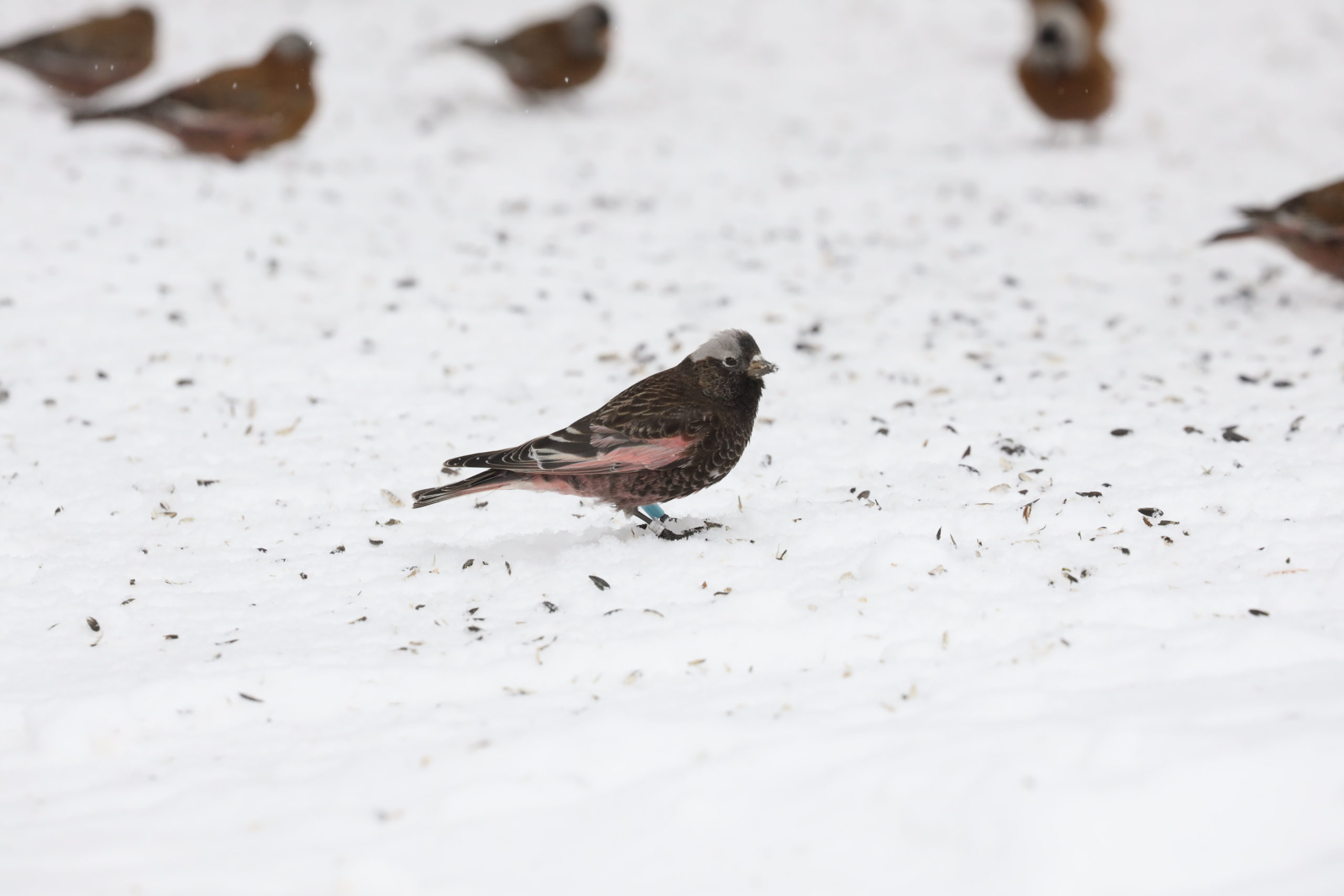
Black Rosy-Finch Courtesy & © Janice Gardner, Photographer
Black Rosy-Finch (cropped)
Courtesy & © Janice Gardner, Photographer

Newly Banded Adult Male Black Rosy-Finch Courtesy & © Kim Savides Newly Banded Adult Male
Black Rosy-Finch
Courtesy & © Kim Savides

Rosy Finch Study Wild Utah ProjectRosy-Finch Study, Wild Utah Project

High in the snow-covered mountains of Northern Utah, Kim Savides, a graduate student in the Department of Wildland Resources at Utah State University waits for the daily avalanche report during winter months. If favorable, she ventures out to remote bird feeders in hopes of finding black rosy-finches.

The finches thrive in bad weather. When it’s a clear, sunny day Savides knows her likelihood of seeing a finch is slim. But on nasty, snowy, windy days she can count on seeing hundreds of the finches around the feeders.

Most of the bird feeders are on Utah’s beautiful ski resorts such as Alta and Powder Mountain. On blizzard-like days when skiers are choosing to staying home, Savides is heading up the slopes.

Clark Rushing, assistant professor in Department of Wildland Resources in the Quinney College of Natural Resources and principal investigator on the project explains, “To catch these black rosy-finches, we’re travelling to locations when the weather is at its worst. They are extremely hardy birds, how they survive in those conditions is pretty astounding. They are small birds weighing only a few ounces.”

Due to the warming temperatures, the black rosy-finch populations may be at risk.

Scientists fear the finch numbers may be decreasing, based on the reports from bird watchers who say they are seeing much less of the attractive bird. Researchers are concerned it may be a result of climate change.

Rushing explains, “The black rosy-finch has a small breeding distribution confined to very high elevation sites. Climate change may drive this species to smaller and smaller population sizes and possible extinction because as climate warms these sites, where the finches can breed, they will get smaller and smaller. The birds could eventually get pushed off the tops of the mountains with nowhere to go.”

According to the Wild Utah Project, “The black rosy-finch is one of the least-understood birds in North America. We understand little about its reproduction, population status, survival rates, or migratory tendencies.” Without this information wildlife managers can do little to help conserve its population.

Savides’ goal is to assist in gathering enough data so wildlife managers may begin to understand the life cycle of the finch and plan for conservation efforts.

Her project began by setting up mist nets around the feeders to catch the birds. Once caught, the finches were gently held while a micro-chip bracelet was attached to their legs.

Each time one of the tagged finches approaches a feeder, equipped with a radio frequency reader, the bird’s visit is logged.

The finches tagged last year are now returning. The data is beginning to be gathered.

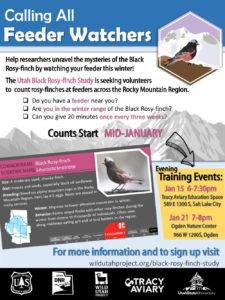
Recognizing the amount of data needed, researchers have expanded the data gathering to include citizen scientists. These are residents of Utah who volunteer to be trained to identify the black rosy-finches. In the winter when the birds come down to lower elevations, in certain parts of the state, residents can report when they see the finches.

Any resident interested in becoming a citizen scientist can go to the Wild Utah Project website and receive more information.

As more and more data are gathered, researchers and wildlife managers can begin understanding the phenology of when the finches come down to lower elevations, when they return to higher elevations to breed, and how likely they are to survive from one year to the next. This knowledge could help with conservation efforts.

This is Shauna Leavitt and I’m Wild About Utah.

Credits:
Photos: Courtesy & © Janice Gardner
      Courtesy & Copyright © Kim Savides,
      Courtesy & Copyright © Wild Utah Project
Lead Audio: Courtesy and © Kevin Colver
Text: Shauna Leavitt, Utah Cooperative Fish and Wildlife Research Unit, Quinney College of Natural Resources, Utah State University

Sources & Additional Reading

Greene, Jack, Rosy Finches, Wild About Utah, March 11, 2019, https://wildaboututah.org/rosy-finches/

Gardner, Janice, Rosy Finch Study, Wild Utah Project, Fall/Winter 2019/2020, https://sagelandcollaborative.org/rosy-finch/ [link updated January 2024 – note WildUtahProject.org transformed to SagelandCollaborative.org]

Strand, Holly, A Big Year in Utah, Wild About Utah, October 27, 2011, https://wildaboututah.org/a-big-year-in-utah/

Black Rosy-Finch Identification, All About Birds, Cornell Lab of Ornithology, Cornell University, https://www.allaboutbirds.org/guide/Black_Rosy-Finch/id

Gray-Crowned Rosy-Finch Identification, All About Birds, Cornell Lab of Ornithology, Cornell University, https://www.allaboutbirds.org/guide/Gray-crowned_Rosy-Finch/id

Black Rosy Finches, Utah Division of Wildlife Resources, Utah Department of Natural Resources, https://fieldguide.wildlife.utah.gov/?species=leucosticte%20atrata

Gray-crowned Rosy Finches, Utah Division of Wildlife Resources, Utah Department of Natural Resources, https://fieldguide.wildlife.utah.gov/?Species=Leucosticte%20tephrocotis

Black Rosy Finches, UtahBirds.org, https://www.utahbirds.org/birdsofutah/Profiles/BlackRosyFinch.htm

Gray-crowned Rosy Finches, UtahBirds.org, https://www.utahbirds.org/birdsofutah/ProfilesD-K/GrayCrownedRosyFinch.htm

Black & Gray Rosy Finches, Tim Avery Birding, http://www.timaverybirding.com/photos/thumbnails.php?search=black+Rosy-Finches&album=search&title=on [Link updated January 2024]

Phenology Tools for Community Science
USA National Phenology Network, https://www.usanpn.org/
Nature’s Notebook Education Program, US National Phenology Network, https://www.usanpn.org/nn/education

North American Bird Phenology Program, USGS Patuxent Wildlife Research Center, https://www.pwrc.usgs.gov/bpp/BecomeAParticipant.cfm

eBird, https://www.ebird.org/

iNaturalist, https://www.inaturalist.org/