Beaver Creek Greenback Cutthroat Trout

Beaver Creek Greenback Cutthroat Trout Courtesy US FWS Bruce Roselund, Photographer
Greenback Cutthroat Trout
Courtesy US FWS
Bruce Roselund, Photographer
In 2009, officials from the US Division of Wildlife Resources who were out searching for isolated populations of Colorado River Cutthroat Trout found something better—and far more perplexing. Within a 1.2-mile stretch of Beaver Creek, which runs down the eastern flank of the La Sal Mountains near Moab, Utah, surveyors discovered a small, but genetically pure population of a subspecies of Cutthroat Trout known as the Greenback. The fish is not only rare among its fellow Cutthroats; it was heretofore unknown to Utah waters.

The natural history of the Greenback Cutthroat is fascinating! As a member of the genus Oncorhynchus, Greenback Cutthroat Trout trace their lineage back about 2 million years to Salmonid ancestors that chose to forego their return to the Pacific Ocean and instead pursued habitat further and further up the Columbia and Snake River drainages into the Green and Yellowstone River Basins. From here, cutthroat predecessors diversified into subspecies we know today: the Alvord, Bonneville, Humboldt, Lahontan, Yellowfin, Yellowstone, Colorado River, and, among others, the Greenback Cutthroat.

Greenbacks took a particularly arduous path to what is now their native home range. About 20,000 years ago, during the Pleistocene Epoch’s glacial maximum, Greenbacks hitched a ride via advancing ice sheets and their runoff, crossing eastward over the Continental Divide. And, historically, that’s where they’ve been found—east of the continental divide. However, in a 2014 summary report of a meeting among experts on the Greenback Cutthroat Trout’s whereabouts in Colorado, the US Fish and Wildlife Service says this about the fish’s home range: “Until recently, delineations of subspecies of cutthroat trout in Colorado were believed to follow geographic boundaries within the state, with greenback cutthroat trout on the eastern side of the Continental Divide and Colorado River cutthroat trout on the western side.” That seems to have changed.

Beaver Creek Greenback Cutthroat Trout were found in Beaver Creek in the La Sal Mountains
Greenback Cutthroat Trout
were found in Beaver Creek
in the La Sal Mountains
Experts are at a loss as to how Greenbacks came to occupy the waters of Utah. Speculations abound from rogue fishermen stocking their favorite backwaters with favorite species from the Colorado Front Range to a remnant population of an ancient strand that may have ridden the glaciers all the way to La Sal runoffs. What’s even more perplexing is the population’s pure genetic makeup. Cutthroat Trout hybridize easily with other fish; but the Beaver Creek population hasn’t. One reason may be the creek’s inaccessibility. Disease and non-native trout haven’t threatened the resident Greenbacks; and so they have lived on undisturbed, unadulterated, and, until about a decade ago, unknown to their human counterparts. This gives the wildlife conservation community some hope for the fish’s viability moving forward.

Greenbacks currently only occupy roughly 1% of their historic native range and were once thought to be extinct altogether. This hardy and adventurous fish refuses to call it quits, though. Who knows, maybe the valiant reclamation of its old territory has already begun along so many other inaccessible and unadulterated creek beds.

I’m Josh Boling, and I’m Wild About Utah!

Credits:

Images:
Greenback Cutthroat Trout, Courtesy Fish and Wildlife Service, US Department of the Interior, Bruce Roselund, Photographer
Beaver Creek, LaSal Mountains, Courtesy Utah Division of Wildlife Resources,
Audio: Includes audio provided by Friend Weller, UPR
Text: Josh Boling, 2018

Sources & Additional Reading

Georg, Ron, Rare trout found in La Sal Mountains, The Times Independent, Moab, UT, May 14, 2009, https://moabtimes.com/bookmark/2560140-Rare-trout-found-in-La-Sal-Mountains

Prettyman, Brett, Greenback or not wildlife officials work to expand cutthroat population, The Salt Lake Tribune, Nov. 19, 2010, https://archive.sltrib.com/article.php?id=50632061&itype=cmsid#gallery-carousel-446996

Thompson, Paul, A lifelong passion for native cutthroat trout, Wildlife Blog, Utah Division of Wildlife Resources, April 10, 2017, https://wildlife.utah.gov/blog/2017/a-lifelong-passion-for-native-cutthroat-trout/

Greenback Cutthroat Trout, Western Native Trout Initiative, https://westernnativetrout.org/greenback-cutthroat-trout/

Greenback cutthroat found in Utah for first time, KSL/The Salt Lake Tribune/The Associated Press, May 1, 2009, https://www.ksl.com/?nid=148&sid=6338134

Spring Testosterone

Spring Testosterone: Male House Finch Courtesy US FWS Gary Kramer, Photographer
Male House Finch
Courtesy US FWS
Gary Kramer, Photographer
Love is in the air! While shoveling snow, it seems a bit ludicrous to say “spring has arrived”, but here it is! I first noticed it 3 weeks ago when a burst of house finch tumbling notes filled the vapors. That was followed by a robin dusting of some rusty phrases which will soon be heard across the mid-latitudes of N. America.

What is one to think of such outrageous behavior as the snow continues to fall and the thermometer dips well below freezing? In one word-testosterone! This magical chemical is surging once again entirely dependent on the ratio of daylight to dark which has changed to such a degree that life helplessly submits to the urge for love.

Boxelder at Court of the Patriarchs,  Zions National Park Courtesy NPS Amy Gaiennie, Photographer
Boxelder at Court of the Patriarchs,
Zions National Park
Courtesy NPS
Amy Gaiennie, Photographer

Even plants are getting in the mood due to hormonal change in response to increasing length of daylight. If I were still teaching science at Logan High we would be tapping a spile into a box elder tree to catch the dripping sap and boil down on the Bunsen burner to delicious maple syrup. When we began this activity 32 years ago March was the month. It gradually changed to mid-February as the winter season shortened.

Death Camas Bryce National Park Courtesy US NPS
Death Camas
Bryce National Park
Courtesy US NPS
I’m guessing the tiny pink flower of stork’s bill geranium and yellow of biscuit root is already blooming beneath the snow on south facing slopes. Death camas leaves are beginning to poke through moist soil.
Snow geese and tundra swans are beginning to populate our open waters with sandhill cranes and many other species of waterfowl soon to follow.

Mountain Bluebird Pair Courtesy & Copyright Milt Moody, Photographer Utahbirds.org
Mountain Bluebird Pair
Courtesy & Copyright Milt Moody, Photographer
Utahbirds.org
In the heavens you may see golden eagles performing their talon locked tumbling courtship death plunge, and paired ravens cavorting in mid-air. Outrageously beautiful Mountain bluebirds begin decorating fence posts in the countryside. Clark’s nutcrackers are beginning their migration to ridgetops for nesting activities.

Great horned owls present a special case. Their hoots reached a fevered pitch during their January courtship period. Nesting begins in February but no nest building needed. They take the easy out by occupying other raptor nests, especially red tail hawks, crows, or a handy ledge. They are fierce defenders of their young and have caused injure to clueless humans who approach to near. The family unit will remain together into the fall season.
Coyotes and fox are in full courtship mode showing overt affection. Parents of both of these wily canids help with den preparation and rearing pups born a few months later. Both are common in native legends for the cunning and trickery.

“If the day should ever come when one may camp and hear not a note of the coyotes joyous stirring song, I hope that I shall long before have passed away, gone over the Great Divide.” Earnest T. Seton, American naturalist, author, activist and father of the Rocky Mountain N.P.

This is Jack Greene and I’m Wild about Wild Utah!

Credits:

Images:
    Male House Finch, Courtesy US FWS, Gary Kramer, Photographer
    Boxelder at Court of the Patriarchs, Zions National Park, Courtesy NPS, Amy Gaiennie, Photographer
    Death Camas, Bryce National Park, Courtesy US NPS
    Mountain Bluebird Pair, Courtesy & Copyright Milt Moody, UtahBirds.org
Audio: Contains Audio Courtesy and Copyright Kevin Colver
Text:     Jack Greene

Sources & Additional Reading:

Körner, Christian, Plant adaptation to cold climates, National Center for Biotechnology Information, U.S. National Library of Medicine, https://www.ncbi.nlm.nih.gov/pmc/articles/PMC5130066/

Have BoxElder Maple Trees? Make BoxElder Syrup! Quirky Science, https://www.quirkyscience.com/make-boxelder-syrup/

How to find Wolves in Yellowstone

Yellowstone wolf running in snow in Crystal Creek pen; January 1996; Accession No. 15606 Courtesy US National Park Service
Yellowstone wolf running in snow in Crystal Creek pen; January 1996; Accession No. 15606
Courtesy US National Park Service
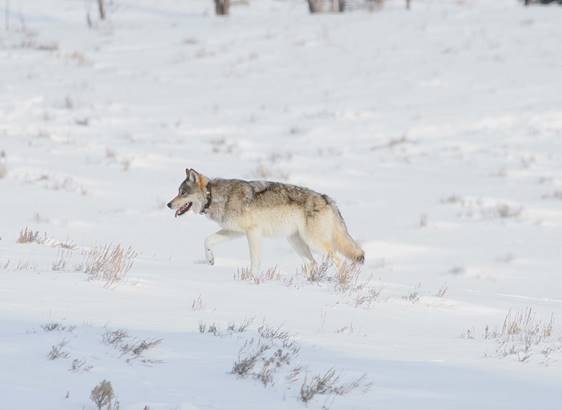
Outlying wolves of the Northern Rocky Mountain population occasionally wander into Utah, but seeing one is rare. If you want to increase your chances of viewing one of these majestic beasts, the best place to go is the northeast corner of Yellowstone National Park.How to find Wolves in Yellowstone

Wolf standing in water, in Grand Teton National Park, close to Yellowstone. Courtesy US National Park Service.
Wolf standing in water,
in Grand Teton National Park,
close to Yellowstone.
Courtesy US National Park Service.

For over six decades, wolves were missing from Yellowstone’s ecosystem. But on a cold January day in 1995, eight gray wolves from Canada were released in the park in an effort to restore the predator to this native habitat.

Before their release, wolves were the only indigenous mammal missing from the Park. The last pack of wolves were killed in the 1920s.

The Park is now one of the few ecosystems in the temperate world to have the same mammals wandering around, as it had hundreds of years ago.

A mother wolf nursing her pups outside their den. 7-16-2010 Courtesy US National Park Service
A mother wolf nursing her pups outside their den. 7-16-2010
Courtesy US National Park Service

Today, approximately 88 wolves live in Yellowstone.

Finding one of these gray wolves is challenging, but if a person knows where to look, with the right equipment, the chances increase considerably.

Nathan Varley, a naturalist guide with Yellowstone Wolf Tracker says, “Wolves are usually spotted from long distances, using high quality optics. Recently, I guided a group that had their first wolf sighting over two miles away. We patiently watched the pack of 11 wolves move until they were less than a mile away.”

Leopold wolf following grizzly bear Courtesy US National Park Service, Doug Smith Photographer, April 2005
Leopold wolf following grizzly bear
Courtesy US National Park Service,
Doug Smith Photographer, April 2005

“The pack encountered a bison herd and attempted to single out a calf. The herd rallied, surrounding the calf so the wolves couldn’t get to it. Snow began to fall so we lost sight of the hunt, but learned later the pack was unsuccessful. We found them the next day, many miles away.”

Before arriving in Yellowstone, visitors may want to learn how to distinguish coyotes from wolves.

Two wolf pups gnaw on bison bones Courtesy US National Park Service
Two wolf pups gnaw on bison bones
Courtesy US National Park Service

Rick McIntire, who researched Yellowstone wolves with the U.S. Park Service since 1995, explains, “In a given wolf pack territory which may be 300 square miles, there could be 10 coyote packs. So the chances of visitors seeing coyotes before wolves is high.

McIntire gives the following tips for identifying coyotes and wolves:

“It may be hard to tell smaller wolves from bigger coyotes. One thing to look for is coyotes have big ears and narrow jawlines like a fox, whereas wolves have ears that are proportional to the size of their heads, and strong stout jaws.

Their vocalizations are also different. Wolves have a deep howl, while coyote’s howl has a high pitched tone.

The wolves color may also help. Roughly half of Yellowstone wolves are black and since coyotes are never that dark, if you see a group of canines and one of them is black you have found a wolf pack.

The best place to begin the search is the northeast corner of the park at Lamar Valley – the “Serengeti” of the Yellowstone. Many prey gather here, which attract the large predators like bears and wolves.

Once you arrive, find an appropriate place to park, set up your viewing equipment close to your car, then settle down for a relaxing couple hours of observation. Patience often pays off, so be alert.

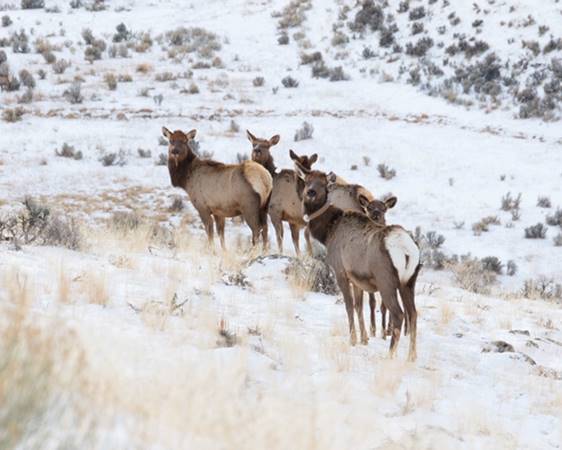
Daniel MacNulty, associate professor in the Quinney College of Natural Resource at USU, who has been studying the Yellowstone wolves for the past two decades said, “Watch for prey standing alert looking at something, follow their gaze, they may point you directly to a wolf pack.”

So if you’re ready to find one of these majestic beasts, gather some family or friends, your high quality optics – and head north. The northern road in Yellowstone which passes Lamar Valley is open all year long, so you won’t have to wait till spring.

This is Shauna Leavitt and I’m Wild About Utah.

How to find Wolves in Yellowstone-Credits:

Images: Courtesy US National Park Service:

Audio: Contains audio Courtesy & Copyright Friend Weller, Utah Public Radio
Included Links: Lyle Bingham, Webmaster, WildAboutUtah.org
Text: Shauna Leavitt, Utah Cooperative Fish and Wildlife Research Unit, Quinney College of Natural Resources, Utah State University

How to find Wolves in Yellowstone-Additional Reading

Wildlife Viewing, Yellowstone National Park, US National Park Service, US Department of the Interior, https://www.nps.gov/yell/planyourvisit/viewanim.htm

Yellowstone National Park, US National Park Service, US Department of the Interior, https://www.nps.gov/yell/index.htm

Inside Yellowstone Videos – Lamar Valley and Wolves, Yellowstone National Park, US National Park Service, US Department of the Interior, https://www.nps.gov/yell/learn/photosmultimedia/0031lamarvalley-iy.htm

Wolves, Yellowstone National Park, US National Park Service, US Department of the Interior, https://www.nps.gov/yell/learn/nature/wolves.htm

Maps, Yellowstone National Park, US National Park Service, US Department of the Interior, https://www.nps.gov/yell/planyourvisit/maps.htm

Blakeslee, Nate, American Wolf: A True Story of Survival and Obsession in the West, Crown; First Edition edition (October 17, 2017), https://www.amazon.com/American-Wolf-Story-Survival-Obsession/dp/1101902787

Lamplugh, Rick, Deep into Yellowstone: A Year’s Immersion in Grandeur and Controversy, https://www.amazon.com/Deep-into-Yellowstone-Immersion-Controversy/dp/1546448322

Allphin, Don, Not crying wolf: There really are wolves in Utah, Herald Extra, Logan, Jan 9, 2015, https://www.heraldextra.com/print-specific/columnists/not-crying-wolf-there-really-are-wolves-in-utah/article_4c19beea-06c2-59d4-b963-49fe2fd48136.html

Wolves in Utah, Utah Division of Wildlife Resources, https://wildlife.utah.gov/wolf/

Utah Wolves, Sierra Club Utah Chapter, https://utah.sierraclub.org/content/utah-wolves

Utah Wolves, The Wildlife News, https://www.thewildlifenews.com/category/wolves/utah-wolves/
See also:
https://www.thewildlifenews.com/about/
How to find Wolves in Yellowstone

Seventh Generation

Seventh Generation: Pando, the worlds largest known organism at Fishlake in central Utah Image courtesy USDA Forest Service J Zapell, Photographer
Pando, the worlds largest known organism at Fishlake in central Utah
Image courtesy USDA Forest Service
J Zapell, Photographer
There are some people who think that trees are merely green things that stand in their way. And there are some people who believe that life should be lived to its fullest without regards to future generations, or even their neighbors. They are mostly concerned with the Rule of Threes, which basically means a person can survive for 3 minutes without oxygen, 3 hours without shelter in a harsh environment, 3 days without water, and 3 weeks without food. They take care of their own needs.

But consider the words of a philosophy generally attributed to the Native American Iroquois Confederacy dated around 1500 AD: That decisions we make regarding resources today should result in a sustainable world seven generations into the future. If you prefer, you can consider how the modern United Nations describes sustainable development which is: “Development that meets the needs of the present without compromising the ability of future generations to meet their own needs.”

Here is a short list of 12 things you can do to help protect our resources for the future:

    1. Conserve energy inside your home in winter by turning down the heat and dressing warmer indoors. In summer, close the window blinds facing direct sunlight. (Utah Clean Energy)
    2. Walk wherever possible for good health and saving fuels. ()
    3. Last year Americans used 50 billion plastic water bottles. Fill reusable water bottles at home and take it with you. Most of the bottled water today is filtered tap water. (Mathematics for Sustainability: Fall 2017)
    4. Turn off the lights in unoccupied rooms. That means in your homes, schools, churches and work places. (When to Turn Off Your Lights (US Dept of Energy))
    5. Try using things more than once. Padded envelopes are just one example. (US EPA: Reduce, Reuse, Recycle)
    6. Reduce landfill waste. The average American uses 350 bags each year. Instead of plastic or paper, use strong canvas or cloth bags which can be reused for many years. (15 Easy Ways To Reduce Landfill Waste)
    7. Contact the companies that send junk mail to your home and discontinue those mailings. Or you’ll have extra papers to recycle…with your name and address on them. (National Do Not Mail List)
    8. If your community doesn’t recycle, find local retailers who will take used oil, batteries, ink cartridges, and light bulbs. Don’t throw them into the trash. (Logan City Recycling)
    9. Plant trees wherever you can. They help wildlife, help purify the air, protect the soil, and provide shade in hot summer months. (Everyone Can Plant a Tree and Help Fight Climate Change (Arbor Day Foundation))
    10. Plant nectar gardens for our declining species of butterflies and bees. Their health and success directly affects our food supplies. (5 Spring Plants That Could Save Monarch Butterflies)
    11. Never throw waste products into our streams, rivers, lakes or oceans. (Utah Clean Water Partnership)
    12. Learn how to compost your food waste into usable soils for the future. (USU Extension Hosting)

This is Ron Hellstern, and I am Wild About Utah.
 
Credits:

Images: Courtesy USDA Forest Service J Zapell, Photographer
Audio: Contains audio Courtesy & Copyright Friend Weller, Utah Public Radio
Text:    Ron Hellstern, Cache Valley Wildlife Association
Included Links: Lyle Bingham, Webmaster, WildAboutUtah.org

Additional Reading

6 Ways You Can Help Keep Our Water Clean (Natural Resources Defense Council)

30 Practical Ways To Cut Fuel And Energy Use And Allow The Natural Environment To Grow Again

The Sweet Song Of The Largest Tree On Earth, Science Friday, National Public Radio, May 12, 2023, https://www.sciencefriday.com/segments/listen-to-the-pando-largest-tree/