A Utah Public Radio production featuring contributors who share a love of nature, preservation and education
Podcast: Wild About Utah
Wild About Utah is a Utah Public Radio production featuring contributors who share a love of nature, preservation and education. Contributors include Bridgerland Audubon Society, Utah Public Radio, Stokes Nature Center, the Edith Bowen Laboratory School (EBLS) at USU and many other nature-related individuals and institutions. See WildAboutUtah.org for a list of authors, voices and contributors.
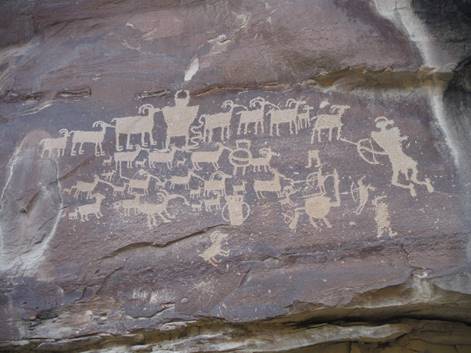
Fremont Petroglyphs in Nine Mile Canyon, UT: Courtesy & Copyright Josh Boling, PhotographerWhat did we do before radio—before cell phones, television, newspapers, and books? How did we tell stories, share news, warn of danger, or otherwise communicate with anyone beyond those around us? What did we do with words and thoughts when there was no one with whom we could immediately share them? The wilds of southern Utah can provide one answer—if you’re willing to look.
The Great Gallery Pictograph Panel in Horseshoe Canyon, UT; Courtesy & Copyright Josh Boling, PhotographerAs far as pictograph panels go, Horseshoe Canyon’s Great Gallery isn’t terribly difficult to find. It’s also one of the most spectacular and well preserved panels of rock art in the state. Naturally, then, it’s fairly well-known and has seen an increasing number of visitors in recent years despite its remote location. Incidentally, I happened upon it by accident—had no idea it was there and would have passed right by if not for a chance glimpse of a ghostly set of eyes peering at me through cottonwood boughs. The Great Gallery’s ‘Barrier Canyon’ style of rock art is characterized by haunting silhouettes of human, semi-human, and animal figures painted on and pecked into the canyon walls of the Colorado Plateau. They are surviving remnants of an unnamed and unknown culture of hunter/gatherers that roamed Utah’s canyon country between 7,000 and 1,500 years ago—pieces of information whose meaning is lost to us now. We may never know why these people painted the “Holy Ghost”—the 8-foot-tall figure with empty, gaping eyes that startled me out of my hiking stupor.
Newer panels of rock art produced by more familiar cultures are a bit more discernible, though. The nameless wanderers who produced the Barrier Canyon style were followed first by the Fremont whose artwork appeared around 1,500 and 2,000 years ago and then by the Pueblo peoples we now refer to as the Anasazi. Both the Fremont and Pueblo styles portray relatively clearer themes—stories of hunting parties and the game to which they gave chase; spirals and directional glyphs which indicate water; people, animals, and the elements whose interactions are now carved into the canyon walls for us to find, decipher, and celebrate.
The author, adventurer, and local rock art expert Jonathan Bailey refers to rock art as “a vision of a…cultural landscape”—a story continuously told by people who lived close to the land long after they’ve passed. Some stories are secret, hidden away in forgotten crevices of the Colorado Plateau, meant only for those who already knew their meaning. Others are more democratic: a water glyph is meant for me as much as the hunter/gatherer that pecked it into the sandstone. It beckons every traveler to come and sate his or her thirst.
Einstein said time is relative. Looking up at the Holy Ghost, the artistic center of the Great Gallery, I felt I could reach through time and connect with the people who wandered this landscape before me—to see it and experience it the way they did.
Mushrooms in the Grass Courtesy MW at PixabayYes, trees are the answer. But they owe their magnificence to a less known life form that has long intrigued me. Long before trees overtook the land, Earth was covered by giant mushrooms 24 feet tall and three feet wide. And consider Utah’s Pando aspen clone, one of the largest and oldest, mycorrhizal-dependent, living organisms
Mushrooms are actually the reproductive manifestation of a much larger organism, a brief glimpse of the wonders that reside beneath the ground. Called mycorrhizal fungi, they form a mutually beneficial relationship with tree roots and other plants. They vastly increase the absorption capacity for water and minerals. Many trees and other plants cannot live without these fungal partners. It also makes the plant less susceptible to soil borne pathogens and other environmental stresses such as drought and salinity.
Regarding climate protection, mycelium make up the bulk of carbon storage in forests. Scientists in Sweden were surprised by this; they were expecting dead tree matter to shoulder the carbon burden. But as mycologist Paul Stamets states, “dead mycelium can store carbon for hundreds of thousands of years.
Remarkably, recent research has shown that plants connected by mycorrihzal fungi can use these underground connections to produce and receive warning signals. When a host plant is attacked, the plant signals surrounding plants of its condition. The host plant releases volatile organic compounds (VOCs) that attract the insect’s predators, as do the plants connected by the fungi network.
Further, fungi have been found to have a protective role for plants rooted in soils with high toxic metal concentrations. This is likely due to the metal binding to fungal mycelium.
Taking a broader view, recent research indicates mushrooms possess curative properties for many diseases, including neurological. Add to this bioremediation through cleaning up industrial waste and oil spills, and applications for reducing loss of our pollinators. Critical to soil function as decomposers and providing nutrients, mushrooms also play a major role in soil structure through hyphae networking and glomalin (that is biological glue) production.
The idea that a universal web of dark matter, plus our more familiar World Wide Web, plus the neurological networking in the human brain, all mimicking the mycelial networks of mushrooms under our feet that bind and feed all of Earth’s soil. The idea that this network, an enormous mass of fungus that branches and communicates underground, is in some way sentient. The idea that human brains went through an evolutionary growth spurt after we encountered “magic” mushrooms on the savannah of Africa- all worthy of serious rumination.
Fall has arrived, and with it mushrooms to titillate the imagination- and gastric juices.
This is Jack Greene and boy am I wild about Utah and Pando’s mycelium!
Credits:
Pictures: M W from Pixabay
Sound: Courtesy Kevin Colver
Text: Jack Greene, Bridgerland Audubon Society
Pocking for Cottonwood-Wilberg mine reclamation Courtesy & Copyright Chris BrownIn Utah, when a coal mine closes, the Utah Division of Oil, Gas and Mining (OGM) is the agency responsible for overseeing the reclamation.
PacifiCorp is a mining company that provides electrical utility to one million customers in Utah, Idaho and Wyoming via Rocky Mountain Power. When it submitted the Cottonwood-Wilberg mine reclamation proposal, it claimed a sedimentation pond which catches run off, would not be needed. OGM was skeptical and initially rejected the plan.
Dennis Oakley, senior mine engineer at PacifiCorp said, “We explored the state and federal regulations and found there was some latitude if we could show we were using the best technology currently available.”
Tom Thompson, GIS Manager at OGM said, “Technology has come a long way, if we leverage it correctly we could do a lot better for our environment.”
The method PacifiCorp claimed as the best technology available was deep gouging, or “pocking”; a technique used to prevent erosion and stimulate vegetation growth on steep sloped landscapes.
To use pocking, the natural canyon slopes are first restored, then pocks three feet in diameter and one-and-a-half feet deep are dug into the slopes next to each other in a random and discontinuous fashion. The landscape soon resembles the surface of a golf ball with thousands of dimples.
Green dyed hydro-mulching, which contains native seeds, moisture and a protective layer of mulch is then sprayed over the entire pocked landscape.
When it rains the pocks capture the water, forming mini ponds. The moisture is slowly absorbed into the ground, preventing run off and giving the seeds a moist environment for growth.
Each year the sides of the pocks slowly erode into themselves, and the vegetation becomes established and spreads. Eventually the pocks fill with sediment and fade into a natural looking stable slope.
If pocking is the best technology currently available – then OGM wanted to know.
With the help of PacifiCorp, OGM set up the Cottonwood-Wilberg mine as a research site to determine the efficiency of pocking.
To add additional expertise to the research, OGM applied for Utah Legislature appropriated funds, to access to the knowledge of Doug Ramsey, the director of the Remote Sensing and GIS Laboratory, in the Quinney College of Natural Resources at Utah State University, and his graduate student Chris Brown.
Ramsey and Brown explain, The RS/GIS lab is evaluating the pocks by using drone imagery of the entire landscape to create 3D models and topographic maps that identify where the vegetation is growing, and the depth of each pock across multiple seasons and years to show if the pocks are eroding as expected.
PacifiCorp installed monitoring devices around the reclaimed site so it could measure the amount of precipitation, the vegetation growth over time, and the sediment load of the runoff above and below the disturbed areas.
Oakley explains, “It’s our theory that the sediment levels of the background runoff will be equal to, or less than the runoff at the bottom of the disturbed area.”
Ramsey visited the site in June 2019 and found vegetation was already growing in the bottom of the pocks.
Data from the site will be gathered and analyzed over the next few years. A key part of this monitoring work will be a manual describing the drone data collection and analysis methods so OGM can establish a monitoring protocol for other reclamation sites.
Keenan Storrar, hydrologist from OGM, said, “We hope this research on the pocking technique, which PacifiCorp helped develop, will be published for future operators use.”
The Hidden Life of Trees – The Illustrated Edition Peter Wohlleben, Author, Jane Billinghurst, Translator Greystone Books Ltd. Courtesy Greystone Books Ltd.Occasionally, we run across a piece of art, music, or literature that we want to share with others. That isn’t always the case with beautiful scenery. Sometimes we want to keep that place as a private haven of serenity. And for good reasons.
Today, I will describe something that has opened my eyes to a world that few people know about. I refer to the research revealed in a book titled “The Hidden Life of Trees”, an International Bestseller, by Peter Wohlleben. He is a Forester-Scientist in Germany who has connected with others in his profession for over 20 years to reveal things about trees that most of us would never have expected. Here is Part One:
You may recall the basic photosynthesis functions related to the lives of trees. Roots carry water and minerals from the soil through the xylem tissues of the trunk up to the leaves. The leaves, with the help of chlorophyll, capture Sunlight Energy and Carbon Dioxide from the atmosphere, and release Oxygen into the air. Sugars are also produced and go downward through the phloem tissues to the trunk and roots. The way I remembered this process in biology classes was that the X in xylem has its upper lines reaching skyward, and things Flow downhill.
The scientists knew that most individual trees of the same species growing in the same forest stand are connected to each other through their root systems. Nutrient exchanges revealed that forests are superorganisms with interconnections much like ant colonies. This indicated a sort of social system where trees will share food with their own species and sometimes even nourish their competitors. Why are they considered social beings? Because there are advantages in working together.
It seems that single trees, much like hermits, have greater difficulties in having a successful life. It can be done, but it’s tough. A single tree cannot establish a consistent local climate and must battle weather conditions. Whereas a forest often creates an ecosystem that can somewhat modify extreme temperatures, store a lot of water, and generate a lot of humidity. These kind of living conditions can provide trees with great longevity. But for this success the forest must remain intact. Tree removal, or fatalities, would result in gaps in the tree canopy, which would then allow for greater deviations in temperatures, make trees more vulnerable to uprooting from storms, and allow greater summer heat to dry out the forest floor. Every tree would then suffer.
Wohlleben continues to say that social connections can also be seen in the forest canopy. Most trees grow their branches out until they encounter the branch tips of a neighboring tree of the same height. Growth usually stops there because the air and better light in that space is already being used, and the trees don’t want to take anything away from each other.
But, as a rule, those planted in forests can live much like single wild trees and react by suffering from isolation. And remember that he is writing about forests, not single trees planted in a well-kept yard or for landscaping.
I’ll continue referencing “The Hidden Life of Trees” in future shows and talk about Why Forests are Green; How they act as a Water Pump, and are Carbon Dioxide Vacuums.
This is Ron Hellstern, and I am Wild About Utah.
Credits:
Images: Courtesy & Copyright Greystone Books, LTD,
Lead Audio: Courtesy and Copyright
Text: Ron Hellstern, Cache Valley Wildlife Association