A Utah Public Radio production featuring contributors who share a love of nature, preservation and education
Podcast: Wild About Utah
Wild About Utah is a Utah Public Radio production featuring contributors who share a love of nature, preservation and education. Contributors include Bridgerland Audubon Society, Utah Public Radio, Stokes Nature Center, the Edith Bowen Laboratory School (EBLS) at USU and many other nature-related individuals and institutions. See WildAboutUtah.org for a list of authors, voices and contributors.
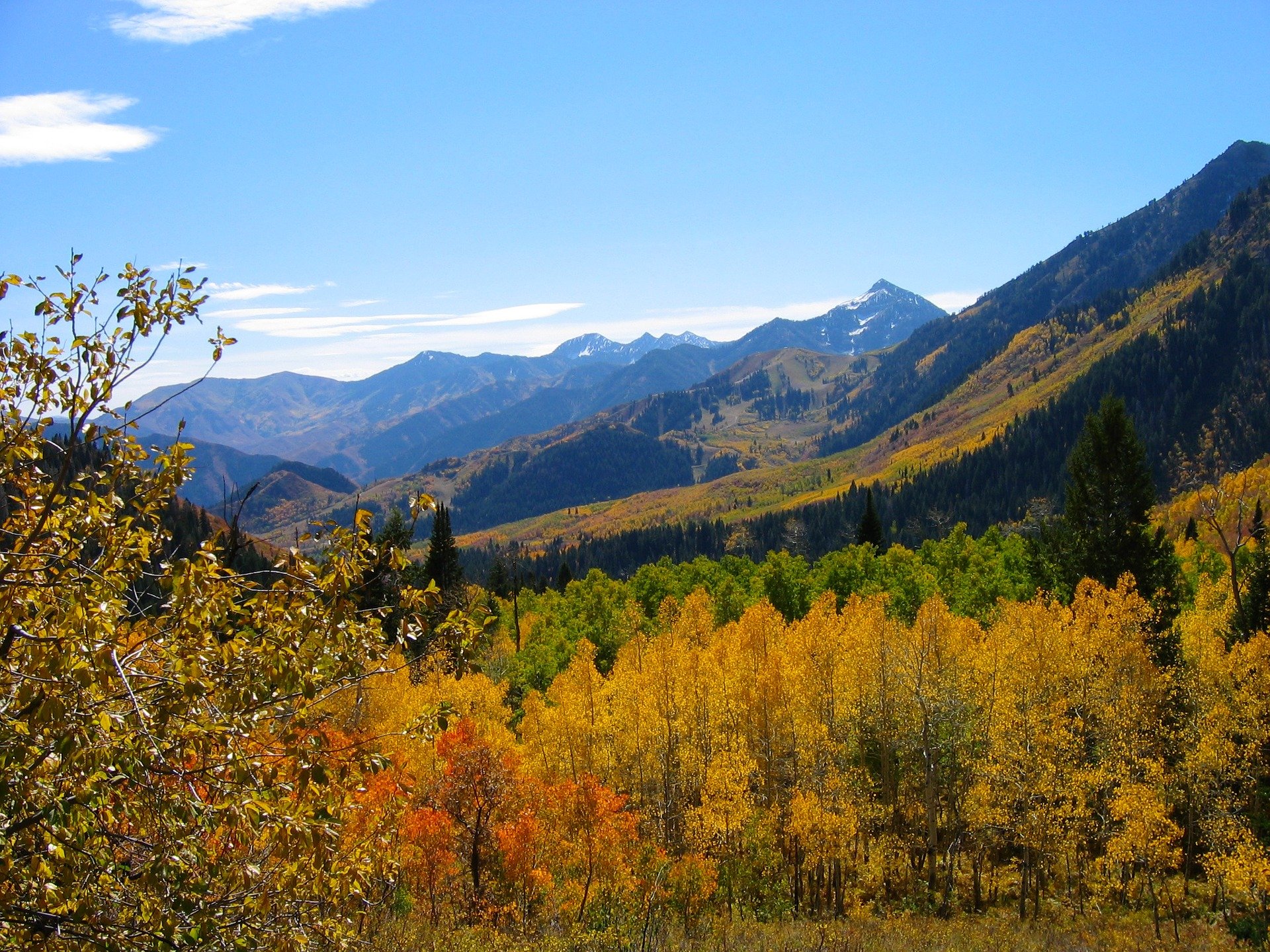
Forest in Autumn Courtesy Pixabay.com, HmsFree, PhotographerThere is a story I like of an old Zen master who one day was asked to speak wisdom to his acolytes as they were sitting outside. He obliged. He rose and walked to the front of the students. He waited a moment to think carefully about his words, opened his mouth, and then just as he was about to speak, a bird in a nearby tree sang its beautiful warbling song. The master did not interrupt but instead simply listened and waited until the song finished, and the bird had flown away. When it had, he finally spoke: “The sermon has been delivered,” he acknowledged, and took his seat once more.
I think about this story often and dwell on its themes. The true master who is the truest student. The songbird who speaks truth without language. The wisdom elevated by listening to the world without ego.
This time of year, I try to take the lesson of the Zen master and listen to the autumn world around me, the softening sounds of my time on earth. I take pause and hear the breeze which rustles box elders scarlet and shivers aspens gold. The wind which blankets the land and grows it rosy before winter’s snowy slumber.
The birds’ notes, the bearers of great truths, have shifted from their summer selves, too. No longer do they sing for love, but instead call for companions as they find flocks to blunder between fermented crabapple trees with, and telegraph where the good black oil seed is for the benefit of all who husk germ.
I find solidarity with their industry, for I believe we all come from the same inner place. They, doing what is good and right, and I as well. I, too, likely like you, get a hankering, a reckoning to winterize, to preserve, to stock up like a tree’s fattening roots, swollen full with the liquor of next spring’s buds and blossoms. I do it through crisp cider, hot corn chowder, steamed cans, jammed jars, strong mulled toddies, and wool. These are my fruits and fat stores. These are my natural inclinations.
I take from the story of the Zen master, too, that we are all on the same team. Just as the master understood to defer a message of truth to the birds, we can all recognize the truth in what autumn fills us all with: that drive of readiness for spring by ways of winter. That our season of without only can be because of seasons of with, and that our seasons of bounty can only be through the rest with which we are pulled in winter.
So this autumn, I encourage you to listen like the Zen master to the world around you. When it whispers, “put on a sweater and sip hot drinks by the hearth,” do so. When it bellows, “can and jam all of the things for winter is coming and the taste of summer is that season’s delight,” do so as well.
And when the world says, “listen,” in beautiful birdsong, do so, and know that you sing, too, by being who you are to your core.
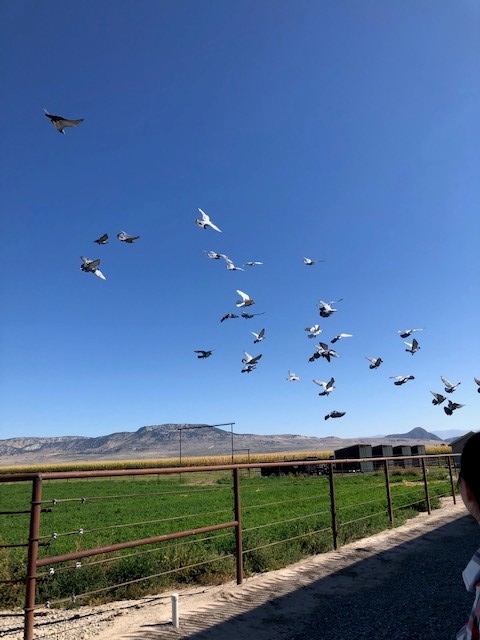
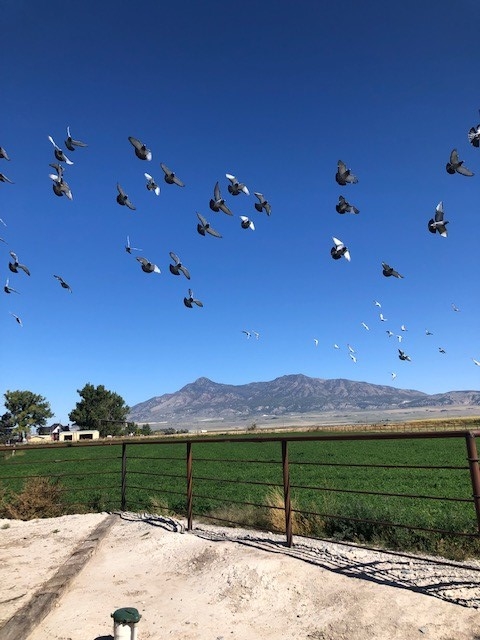
“Here they come!” Derek spotted the lead group of 40 as they flew into view, just over the tops of two trees a few hundred yards away. When the first bird entered the loft, the computer chip in its leg band sent a message to the loft computer. We heard the ping, It was 11:19. The lead group had flown 180 miles in three hours and 19 minutes. That made the average speed close to 55 mph.
I had begun my own journey into this world of avian athletes last summer at the Cache County Fair. I had gone to cheer on my neighbor’s kids who were showing their pigs, and ducked into the bird barn on the way out. I was expecting chickens, but found my self surrounded by pigeons. This encounter soon led me to Hyrum to meet the main exhibitor, Randy Balls. He met me at the door to his house with a big smile. “Do you want to see them fly?” he asked. We spent the next hour sitting on a bench in his backyard, watching his pigeons as they circled and swooped overhead Randy’s love for his birds was contagious, and I guess I shouldn’t be surprised that I now find myself with four homing pigeons of my own in an improvised coop in my backyard.
A desperate message was written and placed in the small canister tied to Cher Ami’s leg. “We are along the road parallel to 276.4 Our own artillery is dropping a barrage directly on us. For heaven’s sake, stop it.” Cher Ami took off. She was hit by bullets that blinded one eye and shot off part of her right leg. But she kept going. She delivered the message to army headquarters, and was credited with saving the lives of one hundred and ninety four American soldiers.
We know the messaging partnership between homing pigeons and humans can be traced all the way back to the pharaohs of ancient Egypt. What we don’t know is exactly how pigeons do it. Somehow they are attuned to the earth’s gravitational fields in ways that humans are not. I like the mystery of it. I like keeping alive the flame of wonder and awe as we continue to learn and interact with the natural world
Decreasing water levels in the southern arm of the Great Salt Lake expose microbialite communities that are normally underwater. Courtesy USGS, Hannah McIlwain, PhotographerI first met the Great Salt Lake in 1964 with two Central Michigan University college buddies on our way to Los Angeles. We heard you could float in its magical waters. Sure enough- it worked and we bobbed in its gentle waves oblivious to the many other virtues of this extraordinary water body. The Great Salt Lake’s Importance
This saltwater marvel is the largest wetland area in the American West. Its 400,000 acres of wetlands provide habitat for over 230 bird species traveling from the tip of South America, north to Canada’s Northwest Territories and as far west as Siberia. These wetlands and surrounding mudflats are vital habitat for 8-10 million individual migratory birds with many species gathering at the Lake in larger populations than anywhere else on the planet.
In 1991 the Great Salt Lake was declared a site of “hemispheric importance,” the highest level of designation given to a site by the Western Hemisphere Shorebird Reserve Network. The Reserve conserves shorebird habitat through a network of key sites across the Americas. Salt Lake receives the largest percentage of the world’s population of migrating Eared Grebes, nearly one-third of Wilson’s Phalaropes, more than half of American Avocets, and 37 percent of Black-necked Stilts. The lake’s shoreline, playas and mudflats also support 21 percent of the North American breeding population of Snowy Plovers, a species identified as one of greatest conservation needs by Utah’s Wildlife Action Plan.
These shorebirds are among nature’s most ambitious, long-distance migrants. But their numbers are dropping quickly. Shorebirds are showing the most dramatic declines among all bird groups. Species that undertake hemispheric migrations rely on specific habitats and food sources to survive, but these resources are increasingly under threat from human disturbance including habitat loss and degradation, over-harvesting, increasing predation, and climate change. As humans have continued to alter the landscape, shorebird populations continue to drop, with accelerated declines in recent decades.
Of 52 shorebird species that regularly breed in North America, 90% are predicted to experience an increase in risk of extinction. This includes 28 species already considered at high risk, and 10 imperiled species that face even greater risk.
At the base of Salt Lake’s food chain are microbialites, underwater reef-like rock mounds created by millions of microbes. These structures and their microbial mats form the base of the entire Great Salt Lake ecosystem, serving as a primary food source for brine shrimp and brine flies, which are the main food source for these aquatic birds. Falling water levels exposing the microbialites to air could trigger a collapse in the lake’s food chain according to a July study by the Utah Geological Survey.
So we humans aren’t the only one’s suffering from our disappearing Lake. Thank goodness we have awakened to this extraordinary resource found on our doorstep with many organizations and agencies attempting to save what remains for our health, wealth, and for the millions of threatened feathered friends that grace our skies, and our lives. Last May, Utah Governor Cox declared 2021 the year honoring shorebirds. We can do our part by taking action on conserving water and energy.
Jack Greene for Bridgerland Audubon Society and I’m wild about Utah and its magnificent great lake.
Written by Hall Crimmel & Dan Bedford, Filmed and Edited by Isaac Goeckeritz, iUtah EPSCor, Rachel Carsen Center Environment & Society,
Based on the book Desert Water; The Future of Utah’s Water Resources edited by Hall Crimmel and published by University of Utah Press, 2014
Indian Ricegrass Achnatherum hymenoides Courtesy Wikimedia & US NRCSIn recent years, there has been an emphasis on ornamental landscape plants that provide bee and butterfly habitat. But did you know that you can also choose landscape plants to support Utah birds and other wildlife? In particular, ornamental grasses can provide both food and cover for birds and other wildlife and also materials for nest building.
A few ornamental grasses that you might consider planting in your landscape are Indian rice grass, blue grama grass, little bluestem, Indiangrass, and Miscanthus.
One of the most attractive native grasses, and the state grass of Utah, is Indian rice grass. This native, cool-season grass grows from 1 to 2 ½ feet tall. Widely adapted in Utah, it is important in foothill and semi-desert areas of the state, providing forage for both livestock and wildlife throughout the year. It has a lovely, airy texture and the seeds are an important food source for many birds and small mammals.
Blue grama grass, also native to Utah, is a warm-season grass with seed stalks standing 6 to 20 inches tall. In the wild areas of Utah, blue grama grass grows on plains, foothills and woodlands and tolerates a variety of soil conditions. In home landscapes, the distinctive seed heads of blue grama are very attractive and are sometimes described as resembling eyebrows.
Little bluestem, a warm-season perennial grass, grows from 1 to 2 feet tall. This drought-tolerant, native grass grows in many Utah plant communities including desert shrub, ponderosa pine, and pinyon-juniper. In ornamental landscapes, little bluestem transitions from blue/green colored grass blades during the growing season to a reddish color after the first frost, providing lots of winter interest in the landscape as well as food and cover for birds.
Indiangrass is a native, warm-season perennial grass with tufted stems reaching up to 5 feet tall. This grass is found in the hanging garden plant communities of southern Utah where annual rainfall is low but flooding from runoff water is common. It may also be associated with other riparian plants such as sedges, rushes, and willows. A tall, upright grass, Indiangrass has showy, golden bronze seed heads in the fall that provide seed for songbirds.
Though not native to Utah, Miscanthus is another ornamental grass that provides food for birds. This large grass, growing up to 6 feet tall, has flower plumes above the foliage in the fall and you may see birds searching the ground underneath throughout the winter looking for leftover seeds.
Hopefully you have one or more of these grasses in your landscape already, but if not, fall is still a good time to plant them. And don’t cut these grasses back as we head into the colder months of the year. They provide a great deal of color and interest to the winter landscape and will continue to provide food and cover for birds and wildlife throughout the season.
As our weather warms into spring, birds will be particularly focused on the dried-out grass blades that remain, using coarse blades for the main wall of nests and finer blades as part of the softer, inner lining.
So, go ahead and try some ornamental grasses in your home landscape or maybe plant more. You’ll be well on your way to attracting and supporting birds and other wildlife.
I’m Kelly Kopp with USU Extension’s Center for Water Efficient Landscaping and I’m Wild About Utah.