Squash Bees

Audio:  mp3 Listen to WildAboutUtah

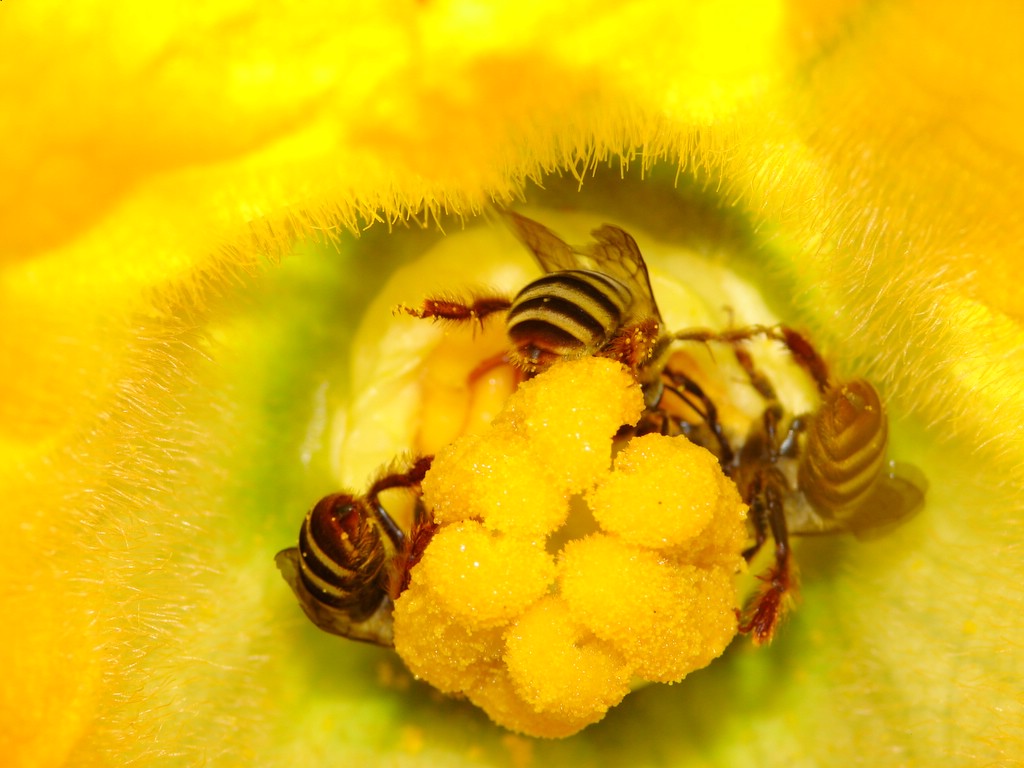
Three Squash Bees
Peponapis pruinosa
Copyright © 2009 Jim Cane

At long last we are enjoying full summer, and with it, the bounty of our gardens. Last August on this program, you learned about our native squash bees. Unlike honeybees and bumblebees, Squash bees are not social. Each female excavates a simple vertical tunnel in the dirt the diameter of a pencil. Lateral tunnels terminate in tiny chambers where she caches pollen and nectar to feed her progeny. She lays one egg per chamber. These nests are well concealed.

But you can readily see the feverish activity of males and females at squash, pumpkin and gourd flowers soon after sunrise, often before honeybee activity. Squash bees are the size of honey bees, but earlier, faster and more deliberate in their flight. Males have a yellow spot on the face. Unlike honeybees, female squash bees carry squash pollen dry in a brush of hairs on their hind legs.

Both sexes of squash bee are valuable pollinators, indeed they are the unheralded pollinators of most of the nations squash and pumpkins. But there is more to their story in Utah. Their native hosts, the wild gourds, only grow in the hot low deserts. Native Americans domesticated and cultivated squashes and gourds, but the practice did not spread north of the red rock country. Across most of Utah and the northern US in general, we have squash bees because we grow squash. In Utah, European settlers first grew squashes only 150 years ago. Each annual generation of squash bees spread further north, hopscotching from homestead to homestead, reaching as far north today as Boise Idaho. As you pick your zucchinis, butternuts and pumpkins, realize that your squash’s flowers also fed the descendants of our squash bee pioneers.

This is Linda Kervin for Bridgerland Audubon Society.

Credits:

Photo: Courtesy and © Copyright 2009 Jim Cane

Text: Jim Cane, Bridgerland Audubon Society

Additional Reading:

Our Native Squash Bees, Wild About Utah, 12 August 2008, https://wildaboututah.org/squash-bees/

Squash Pollinators of the Americas Survey (SPAS), James Cane, USDA Pollinating Insect Research Unit, Utah State University

2009: https://www.ars.usda.gov/Research/docs.htm?docid=16595

2005: https://www.ars.usda.gov/Research/docs.htm?docid=12041

Perfect Pumpkin Pollinators: The Squash Bees!, James Cane, Frank A. Eischen, Blair J. Sampson, USDA-ARS, https://www.ars.usda.gov/is/AR/archive/nov08/bees1108.htm Also published in Agricultural Research magazine Nov/Dec 2008 https://www.ars.usda.gov/is/AR/archive/nov08/

Across the Americas, Squash and Gourd Bees Are Superb Pollinators, Marcia Wood, Dec 30, 2008, https://www.ars.usda.gov/is/pr/2008/081230.htm

Celebrating Wildflowers, Pollinator of the Month, Squash Bees, Jim Cane, USDA ARS, Bee Biology & Systematics Lab, Logan, Utah https://www.fs.usda.gov/wildflowers/pollinators/pollinator-of-the-month/squash_bees.shtml (updated 8/22/2024)

Crop domestication facilitated rapid geographical expansion of a specialist pollinator, the squash bee Peponapis pruinosa, Margarita M. López-Uribe, James H. Cane, Robert L. Minckley, Bryan N. Danforth
Proc. R. Soc. B 2016 283 20160443; DOI: 10.1098/rspb.2016.0443. Published 22 June 2016, https://rspb.royalsocietypublishing.org/content/283/1833/20160443.abstract
The Migratory Locust in North America; a post mortem

The Migratory Locust in North America; a post mortem
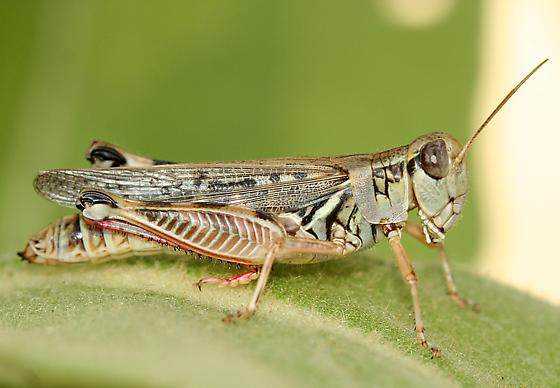
Rocky Mountain Locust were similar
to this Large Grasshopper
Melanoplus sanguinipes
Photo#215400
Copyright © 2008 Lynette Schimming
As found on www.bugguide.net

Vast migratory swarms of flying grasshoppers, or locusts, have periodically scoured arid parts of Africa and the Middle East since Biblical times, devastating crops and causing famine. But did you know that during the 19th century, American homesteaders were likewise plagued by migratory swarms of grasshoppers? The largest swarm passed through Nebraska in June of 1875; it was 110 miles wide, 1800 miles long and more than a 1/4 mile thick, taking five days to pass overhead. It remains the world’s largest recorded insect outbreak.

Here in Utah, at the time of the transcontinental railroad, migratory locusts periodically descended on the homesteads of Mormon settlers, laying up to 1 billion eggs per acre. These ravenous swarms devoured crops, vegetation, even laundry hung out to dry. Around the Great Salt Lake, drowned pickled grasshoppers would wash ahore in vast drifts. Native peoples gathered these salty, sun-dried hoppers for food, a rich source of protein and fat.

Why are we no longer plagued by locust swarms? It appears that the Rocky Mountain locust, went extinct at the turn of the 20th century. Entomologist Jeffrey Lockwood reports that the DNA of specimens preserved in the ice of glaciers in the Wind River Range are like no other grasshopper alive today. The cause of the locust’s abrupt extinction may never be known with certainty, but Lockwood believes that these outbreaks originated in the mountain meadows of the northern Rockies. By the 1880s, these public lands were packed with cattle and sheep, far more than the land could sustain. In a few short years, livestock stripped bare the very core habitats needed by the Rocky Mountain locust, leading to its abrupt extinction and the end of locust swarms in North America.

This is Linda Kervin for Bridgerland Audubon Society.

Credits:

Photo: Courtesy & Copyright © 2008 Lynette Schimming (As found on www.bugguide.net)

Text: Jim Cane, Bridgerland Audubon Society
Additional Reading:

Locust: The Devastating Rise and Mysterious Disappearance of the Insect that Shaped the American Frontier, Jeffrey Lockwood, Basic Books, 2004,ISBN:9780738208947, https://www.amazon.com/Locust-Devastating-Mysterious-Disappearance-American/dp/0465041671

Read more: 1. https://historyphilosophybooks.suite101.com/article.cfm/locust_by_jeffrey_lockwood#ixzz0IVh4qXFR&C

First and annual report of the United States Entomological commission for the year 1877 relating to the Rocky Mountain locust and the best methods of preventing its injuries and of guarding against its invasions Digitized by Google Books from Harvard University

https://en.wikipedia.org/wiki/Locust

Pestiferous Ironclads: The Grasshopper Problem in Pioneer Utah, Davis Bitton and Linda P Wilcox, Utah Historical Quarterly, 46 #4 as found on “Utah History to Go” https://historytogo.utah.gov/utah_chapters/pioneers_and_cowboys/pestiferousironclads.html

Andersen, Rebecca, Miracle of the Crickets, Utah Stories from the Beehive Archive, 2011, accessed June 9, 2024, https://www.utahhumanities.org/stories/items/show/223

A Grand Old River

A Grand Old River: The Island Acres Part of James M. Robb Colorado River State Park Fruita, CO, Courtesy Daniel Smith, Photographer
The Island Acres Part of
James M. Robb Colorado River State Park
Fruita, CO
Courtesy Daniel Smith, Photographer
Hi, I’m Holly Strand of Stokes Nature Center in beautiful Logan Canyon.A Grand Old River

The Colorado River is the largest waterway in the southwest. 1,450 miles long, the Colorado River basin drains 248,000 square miles in 7 large states. In Utah, the river enters near Cisco south of I-70, winds its way through Arches and Canyonlands National Parks, then flows through Glen Canyon and exits south into Arizona.

Less than 100 years ago, the Colorado River wasn’t in Utah or even in Colorado. Until 1920, “Colorado River” referred only to the river section downstream from Glen and Grand Canyons. Upstream, it was called the Grand River all the way up the headwaters in the Colorado Rockies. Thus we have Grand County in Utah and the town of Grand Junction in Colorado.

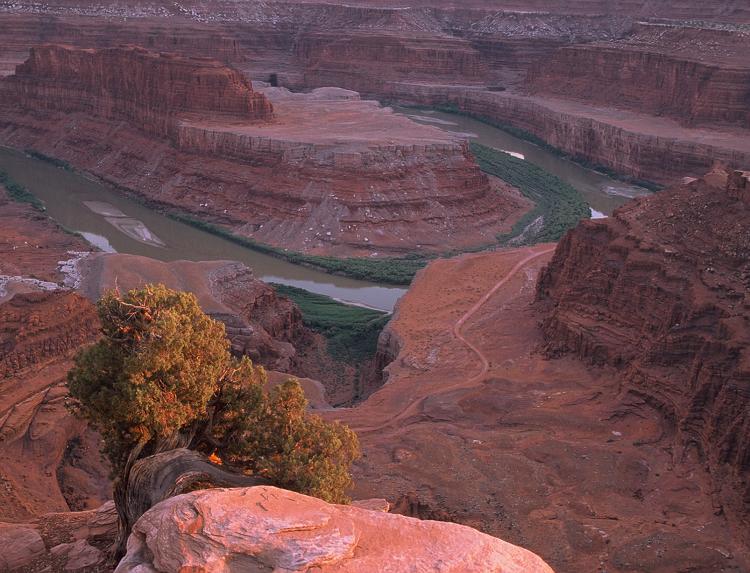
The Colorado River from
Dead Horse Point State Park,
near Moab,Utah, USA
Courtesy Phil Armitage, Photographer

According to Jack Schmidt, professor in Utah State University’s Department of Watershed Sciences and a longtime scholar of the river, the good citizens of the state of Colorado weren’t pleased with the Colorado River’s location.
So in 1920, the Colorado Legislature renamed Colorado’s portion of the Grand River, with a somewhat awkward result: The Colorado River began in Colorado, became the Grand River at the border with Utah and then became the Colorado River again at the confluence with the Green.

This arrangement did not last long –again because of a Colorado legislator. U.S. Representative Edward T. Taylor, petitioned the Congressional Committee on Interstate and Foreign Commerce to rename the entire river as the Colorado. Despite objections from Utah and Wyoming representatives and the U.S. Geological Survey, the name change was made official by the U.S. Congress on July 25, 1921.

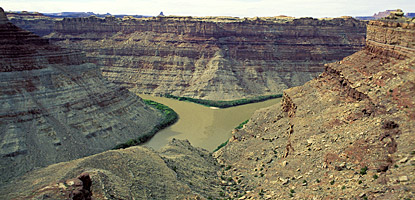
Confluence of the Colorado and Green Rivers
in Canyonlands National Park
Courtesy USGS
Photo by Marli Miller, Photographer

The objections were legitimate: In the 1890s the Federal Board on Geographic Names established the policy of naming rivers after their longest tributary. The former Grand River of Colorado and Utah was shorter than the Green River tributary by quite a bit. So the Green river should have prevailed and the Colorado should have been one of its tributaries.

However, if you judge tributary primacy by volume, the Colorado wins hands down. 100 years ago, the upper Colorado (or former Grand River) had a significantly higher total flow than the Green.

Confluence of the Colorado and Green Rivers
in Canyonlands National Park
Courtesy National Park Service

But what’s in a name? Prior to widespread European settlement, the Grand River was known as Rio Rafael and before that, different parts of the river had numerous Native American and Spanish names. A thousand years from now the rapidly evolving Colorado could have an entirely different identity. The main thing is that Utahns can enjoy and appreciate the habitat, scenery and many resources that this important waterway provides.

Thanks to the USU College of Natural Resources and the Rocky Mountain Power Foundation for supporting research and development of this Wild About Utah topic.

For Wild About Utah and Stokes Nature Center, I’m Holly Strand.

Map of the Colorado River Watershed by Karl Musser based on USGS data This file is licensed under the CCA ShareAlike 2.5 License.
Map of the Colorado River Watershed
by Karl Musser based on USGS data
This file is licensed under the
CCA ShareAlike 2.5 License.

Credits:

Images:

JamesMRobbColorado_riverDanielSmith.jpg: Taken in the Island Acres Part of James M. Robb Colorado River State park by Daniel Smith and released into the Public domain.

DeadHorsePtSP_UtahPhilArmitage.jpg: The Colorado River from Dead Horse Point State Park, near Moab, Utah, USA. Photo by Phil Armitage (May be used for any purpose)

ConfluenceUSGSMarliMiller.jpg: Confluence of the Colorado and Green Rivers in Canyonlands National Park. USGS Photo by Marli Miller.

ConfluenceNPS.jpg: Confluence of the Colorado and Green Rivers in Canyonlands National Park. National Park Service.

Colorado River Watershed Map, by Karl Musser based on USGS data, licensed under the
Creative Commons Attribution ShareAlike 2.5 License: In short: you are free to share and make derivative works of the file under the conditions that you appropriately attribute it, and that you distribute it only under a license identical to this one. Official license


Text: Mary-Ann Muffoletto, Holly Strand, Content reviewed by Jack Schmidt of Utah State University’s Department of Watershed Sciences and a longtime scholar of the Colorado River.

Additional Reading

Many years ago, the Colorado River was just Grand, Summit Daily News, Frisco, CO, Dec 23, 2003, https://www.summitdaily.com/article/20031223/OPINION/312230302

Largest Rivers in the United States, J.C. Kammerer, USGS, Rev May 1990, https://pubs.usgs.gov/of/1987/ofr87-242/

Benke, A. C., and C. E. Cushing (editors). 2005. Rivers of North America. Academic/Elsevier. Amsterdam/Boston, 1168 pages.

Casey, Robert L. Journey to the High Southwest. Guilford, CT: Globe Pequot, 2007, p. 20.

Colorado Historical Society, Frontier Historical Society, www.bioguide.congress.gov

https://www.postindependent.com/article/20080325/VALLEYNEWS/68312863

”First Biennial Report of the Utah Conservation Commission, 1913,” Salt Lake City, Utah: The Arrow Press Tribune-Reporter Printing Co., 1913. p. 131.

McKinnon, Shaun. “River’s headwaters determined by politicians, not geography.” The Arizona Republic, 25 July 2004.

James, Ian, Scientists have long warned of a Colorado River crisis, The Los Angeles Times, July 15, 2022, https://www.latimes.com/california/story/2022-07-15/scientists-have-long-warned-of-a-colorado-river-crisis

USA National Phenology Network

Courtesy USA National Phenology Network

The study of recurring plant and animal life cycle events is phenology. It is the calendar of nature. This includes when plants flower, when birds migrate and when crops mature. Phenology is relevant to interactions between organisms, seasonal timing and large-scale cycles of water and carbon. Phenology is important to us for many reasons. Farmers need to know when to plant and harvest crops and when to expect pests to emerge. Resource managers use it to monitor and predict drought and assess fire risk. Vacationers want to know when the best fall colors will be or when the wildflower blooms will peak. Timing varies but we can discern patterns.

The USA National Phenology Network monitors the influence of climate on the phenology of plants, animals and landscapes. They encourage people to observe phenological events such as flowering, migrations and egg laying. The Phenology Network provides a place to enter, store and share these observations, which are then compiled and analyzed nationwide. Participants range from individual observers in their own backyards to professional scientists monitoring long-term plots. My husband and I monitor leafing and flowering of lilacs, a key species in the program.

These observations support a wide range of decisions made routinely by citizens, managers, scientists and others. This includes decisions related to allergies, wildfires, pest control, and water management.

I urge you to participate. The National Phenology Network has many public, private and citizen partners. It is a great way to become involved in a nation-wide effort to better understand our environment. All this information and much more is available at the National Phenology website, to which there is a link from our Wild About Utah website.

This is Linda Kervin for Bridgerland Audubon Society.

Credits:

Text: Linda Kervin, Bridgerland Audubon Society
Additional Reading:

Linda Kervin’s pieces on Wild About Utah

Phenology Tools for Community Science
USA National Phenology Network, https://www.usanpn.org/
Nature’s Notebook Education Program, US National Phenology Network, https://www.usanpn.org/nn/education

North American Bird Phenology Program, USGS Patuxent Wildlife Research Center, https://www.pwrc.usgs.gov/bpp/BecomeAParticipant.cfm

eBird, https://www.ebird.org/

iNaturalist, https://www.inaturalist.org/