The Mysterious Salamander

The Mysterious Salamander: Tiger salamander egg mass, Copyright 2009 Jason Jones, Utah Division of Wildlife Resources
Tiger salamander egg mass
Copyright 2009 Jason Jones
Utah Division of Wildlife Resources
Salamanders have long been a source of mystery for humans and their name reflects some of this mystique. The word salamander has its roots in an Arab-Persian word meaning ‘lives in fire’, reflecting an early belief that salamanders could walk through fire unscathed. Mentioned by Aristotle, Aesop, and Shakespeare, this myth likely arose from salamanders that fled the fireplace once their cozy home in the woodpile was disturbedThe Mysterious Salamander

Utah is home to only one of the world’s more than 500 salamander species. Our tiger salamanders can live in a multitude of different habitats, so long as there is access to fresh water. Because of their need to stay moist, salamanders live a life often hidden from view – spending much of their time underneath rocks, leaves, and other debris. But in early spring, these unique creatures become more active and leave their homes in search of a mate.

Long-toed salamander larvae
in an egg
Copyright 2007 Jason JonesUtah Division of Wildlife Resources

The salamander lifecycle is similar to that of a frog. Eggs are laid in a pond or other source of still water, and hatch into larvae called efts, which look quite like their frog counterpart, the tadpole. After spending a few weeks in the larval stage, individuals metamorphose into an adult.

While modern science has debunked a lot of salamander myths one big mystery still remains. Not all salamanders undergo metamorphosis to become what we recognize as an adult salamander. Some remain in the larval form their entire life, and are even able to reproduce as larvae. This phenomenon, called paedomorphism, has been documented in a number of salamander species, and scientists don’t really understand why or how it happens. Some speculate that the ability to morph or not helps salamanders overcome environmental challenges, such as competition for resources, lack of water, or increased predation.

Tiger salamander eft
Copyright 2007 Jason Jones
Utah Division of Wildlife Resources

Unfortunately, this amazing adaptation has not helped salamanders overcome recent decreases in population that baffled scientists for many years. At one time mysterious, scientists now understand that salamanders are some of the first species to show the effects of pollution in their environment. Now that this particular salamander mystery has been solved, these animals are playing an increasingly important role in determining ecosystem health which may help save many other species.

For more information and photographs of tiger salamanders, please visit our website at www.wildaboututah.org. Thank you to the Rocky Mountain Power Foundation for supporting the research and development of this Wild About Utah topic.

Adult tiger salamander
Copyright 2002 Richard Fridell
Utah Division of Wildlife Resources

For the Stokes Nature Center and Wild About Utah, this is Andrea Liberatore.

Credits:

Photos:

Courtesy & Copyright Jason Jones, Utah Division of Wildlife Resources
Courtesy & Copyright Richard Fridell, Utah Division of Wildlife Resources
Courtesy & Copyright Krissy Wilson, Utah Division of Wildlife Resources
Text: Andrea Liberatore, Stokes Nature Center

Adult tiger salamander,
Copyright 2002 Krissy Wilson
Utah Division of Wildlife Resources

Additional Reading:

Donel, M., Joly, P., Whiteman, H.H. 2005. Evolutionary Ecology of Facultative Paedomorphosis in Newts and Salamanders. Biological Review 80 663-671,

https://onlinelibrary.wiley.com/doi/10.1017
/S1464793105006858/abstract

Grzimek’s Animal Life Encyclopedia, Second Edition. 2003. Volume 6: Amphibians. Farmington Hills, MI: Thompson Gale, https://www.amazon.com/Grzimeks-Animal-Life-Encyclopedia-Amphibians/dp/0787657824

Stebbins, Robert C. 2003. Peterson Field Guides: Western Reptiles and Amphibians, Third Edition. New York: Houghton Mifflin Company., https://www.amazon.com/Field-Western-Reptiles-Amphibians-Peterson/dp/0395982723

Whiteman, Howard H. 1994. Evolution of Facultative Paedomorphosis in Salamanders. The Quarterly Review of Biology 69(2) 205-220, https://www.jstor.org/pss/3037717

Pollinating Fruit Trees with Blue Orchard Bees

Audio:  mp3 Listen to WildAboutUtah

Blue Orchard Bee
Copyright Jim Cane

Apricots, plums, apples, cherries, and pears all need bees to pollinate their flowers. Traditionally, we’ve used the European honey bee, but now we know how to pollinate our fruit trees using a steely blue native bee, the blue orchard bee (Osmia lignaria). These wild bees fly nationwide.

In Utah, they live in foothill and lower montane habitats. Blue orchard bees are not social; every female is fertile and tends to her own tiny nest. Adults are the size of a chunky honeybee and are active for only 3-4 weeks in the spring. These bees naturally nest in the tunnels chewed by large wood-boring beetles in tree trunks. Each female partitions her tunnel into a series of tiny bee-sized rooms. Each room is stocked with a pea-sized provision of pollen moistened with nectar, followed by a single egg. Nest cells are partitioned, and ultimately capped, with mud, hence their other common name: “mason bees”.

Blue Orchard Bee eggs
on pollen provision mass
in nest
Copyright Jim Cane

You can have your own backyard population of blue orchard bees. An easy way to begin uses a short fat log that is seasoned and dry. Take a 5/16 bit and drill 20 or more holes radially 5 to 6 inches deep. Stand the log on end, facing the holes towards the southeast.

On cold mornings, nesting females bask in the sun before taking flight. If bees colonize your log, you will see the steely blue females busily coming and going all day long during fruit tree bloom. They tote their loads of dry yellow pollen in a brush of hair beneath the abdomen. Unloading that pollen at the nest requires some charming acrobatics that are well worth watching. While collecting pollen, female blue orchard bees pollinate your trees with hundreds of fruits resulting from each bee’s lifetime of work. Successive generations will nest for you every spring, but you’ll want to switch to replaceable nesting materials to prevent the accumulation of pathogens and parasites.

Details and links can be found at our Wild About Utah website.

This is Linda Kervin for Bridgerland Audubon Society.
Credits:

Photos: Courtesy & Copyright Jim Cane

Text: Jim Cane, Bridgerland Audubon Society
Additional Reading:

Drill Log with 5/16 holes
5 to 6 inches deep
Copyright Jim Cane

Resources:

https://www.sare.org/publications/bob.htm

https://www.ars.usda.gov/Research/docs.htm?docid=18333

https://www.pollinatorparadise.com/Binderboards/Hornfaced_Bees.htm

A Colonized log
Copyright Jim Cane

Steershead & Turkeypeas

Steershead, Dicentra uniflora
Image Courtesy & Copyright Jim Cane

There is surprise and joy when discovering a flower peeking up at you from near the lingering snow. Long after winter weary eyes have devoured the early floral offerings of gardens here in the valley, our local natives are stirring higher up. As you wander thru mountain sagebrush and meadows, you may encounter scattered groups of two native wildflowers, Steershead and Turkeypeas. Both are a delight to the eyes, but difficult to find initially, as their diminutive nature keeps them hidden amid the surrounding plant litter.

Steershead, or Dicentra uniflora, lives up to its common name. A close cousin to the bleeding heart, it has four white to pinkish petals tinged light brown to purple, two of which are spurred. The longer pair bend back, while the shorter pair are fused at the tip, providing the “cow skull” appearance of the flower. Diminutive plants, they send forth leaves and a single flower from thickened, spindle-shaped tubers. Just a few inches tall, this small plant packs a lot of charm and a bit of poison for protection against plant eaters. Steershead occurrs singly or in small clusters, so it is easily overlooked.

Turkeypea, Orogenia linearifolia
Courtesy & Copyright Intermountain Herbarium
Mary Barkworth, Photographer

Turkeypeas, Indian potato or Orogenia linearifolia, on the other hand, grows in extensive colonies, making this 4 inch tall plant a bit easier to find. A member of the carrot family, Turkeypeas produces very small whiteish flowers in umbels atop a short stem. Arising from a fleshy tuber, the leaves are divided into long linear segments (hence the name ‘linearifolia’). The starchy root is edible, though small, and historically was collected in large numbers by indigenous peoples in the spring. The tubers are avidly sought by squirrels.

So as the snow melts off the hillsides, look for these little darlings. Found only here in Western North America, I’m sure they will charm you as well.

Pictures and links are available on our wild about utah website. Thanks to Michael Piep of the Intermountain Herbarium and Utah Native Plant Society.

This is Linda Kervin for Bridgerland Audubon Society.

Credits:
Photos: Courtesy & Copyright Jim Cane
Courtesy & Copyright Intermountain Herbarium, Mary E. Barkworth, Photographer
Text: Michael Piep, Utah Native Plant Society/ Intermountain Herbarium

Additional Reading:

Resources:
Intermountain Herbarium: https://herbarium.usu.edu/
Encyclopedia of Life: https://www.eol.org/pages/596191
USU Extension: https://extension.usu.edu/files/publications/publication/HG_506.pdf

References:
Anderson, B.A & A.H. Holmgren 1996, revised. Mountain Plants of Northeastern Utah. USU Extension Services. Logan, Utah.
https://extension.usu.edu/files/publications/publication/HG_506.pdf

Shaw, R.J. 1989. Vascular Plants of Northern Utah. Utah State University Press, Logan, Utah.
https://www.usu.edu/usupress/books/index.cfm?isbn=1412

Shaw, R.J. 1995. Utah Wildflowers. Utah State University Press, Logan, Utah.
https://www.usu.edu/usupress/books/index.cfm?isbn=1702

Welsh, S.L., N D. Atwood, S Goodrich & L.C. Higgins. 2008. A Utah Flora, 4th Ed. Brigham Young University, Provo, Utah. https://www.amazon.com/Utah-Flora-Stanley-L-Welsh/dp/0842525564

Oolites

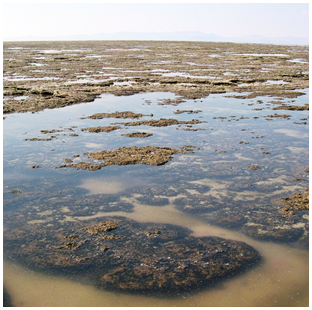
Utah’s Oolitic Sand, Photo Courtesy and Copyright Mark Larese-Casanova

Hi, this is Mark Larese-Casanova from the Utah Master Naturalist Program at Utah State University Extension.

Imagine if prehistoric brine shrimp were responsible for one of the finest examples of architecture in Salt Lake City today.

Okay, so it may be a bit of a stretch, but let me explain. In a previous episode of Wild About Utah, I discussed the life cycle of brine shrimp and the important role that they play in the Great Salt Lake Ecosystem. Well, as the billions of brine shrimp feed on bacteria in Great Salt Lake, they excrete waste in the form of tiny fecal pellets. These pellets, along with sand grains and other bits of debris, eventually settle to the bottom of Great Salt Lake.

In shallow areas of the lake, where wind and waves routinely mix the water, these small particles gradually accumulate layers of calcium carbonate, forming an oolite (spelled o-o-l-i-t-e). This is very similar to how a pearl, also layers of calcium carbonate around a small particle, is formed within the shell of an oyster or mussel. The main difference, aside from a pearl being much larger, is that oolites are typically oblong, rather than round. The beaches on the west side of Antelope Island are a great place to find oolitic sand, which will look and feel as though you have a handful of tiny pearls.

Utah’s Oolitic Sandstone
Photo Courtesy & Copyright
Mark Larese-Casanova

Around 50 million years ago, large fresh- and salt-water lakes covered parts of Utah, and in these areas, vast amounts of sediments, including oolites, were deposited. Over time, these oolites were compressed and cemented together into limestone.

A quarry near Ephraim in Sanpete County supplied oolitic limestone for the construction of the Governor’s Mansion in 1902 and the original Salt Lake City Public Library in 1905. The Library building, located at 15 South State Street, eventually housed the Hansen Planetarium and is now home to the O.C. Tanner flagship store. The building underwent an extensive restoration just a couple of years ago, and now serves as a shining example of neoclassical architecture in our capitol city.

The truth is, there are tens of millions of years separating oolitic limestone from our modern-day brine shrimp. So, we can’t exactly say that prehistoric brine shrimp were responsible for the existence of the O.C. Tanner building. But, it’s fun to imagine precious gems from around the world housed in a beautiful building constructed from the ‘pearls’ of Great Salt Lake.

Historic OC Tanner Building
(formerly the Salt Lake Library
and later the Hansen Planetarium)
Photo Courtesy & Copyright
Mark Larese-Casanova

For Wild About Utah, I’m Mark Larese-Casanova.
Credits:

Images: Courtesy and copyright Mark Larese-Casanova

Text:     Mark Larese-Casanova, Utah Master Naturalist Program at Utah State University Extension.
Additional Reading:

Utah Geological Survey https://geology.utah.gov/utahgeo/rockmineral/collecting/oolitic.htm

Utah Division of Wildlife Resources, Great Salt Lake Ecosystem Program
https://wildlife.utah.gov/gsl/facts/oolitic_sand.php

Salt Lake Brine Shrimp, https://saltlakebrineshrimp.com/harvest/