The Geology of Canyonlands National Park

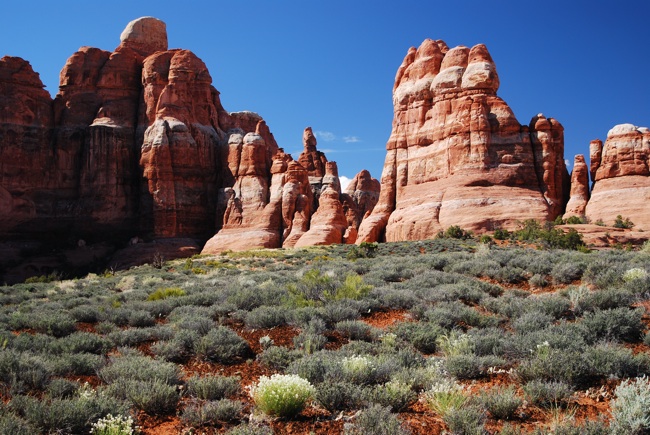
Chesler Park
Canyonlands National Park
Photo Courtesy and Copyright Kurt Repanshek, Photographer

Chesler Park
Canyonlands National Park
Photo Courtesy and Copyright Kurt Repanshek, Photographer

Baked by time like some multi-layer geologic tort, Canyonlands National Park in southeastern Utah features a landscape cut by canyons, rumpled by upthrusts, dimpled by grabens, and even pockmarked, some believe, by ancient asteroids.

Just outside of Moab rises a kaleidoscope of tilted and carved geology laid down over the eons. There’s the red and white Cedar Mesa sandstone, the grayish-green Morrison Formation, pinkish Entrada sandstone, and tawny Navajo sandstone, just to name some of the geologic layers. Stacked like pancakes, they help make Canyonlands the most rugged national park in the Southwest and, quite possibly, if you find yourself deep in the park’s Maze District, in the entire Lower 48 states.

In each of the park’s districts — Island in the Sky, Needles, Maze and Horseshoe Canyon — the remarkable effects of geologic time and its endless erosion on this sedimentary landscape rise about you.

If you could turn back the geologic clock, you would see the landscape flooded by oceans, crisscrossed by rivers, covered by mudflats and buried by sand. At various times through the millennia, the climate has resembled a tropical coast, an interior desert, and everything in between.

For hundreds of millions of years, material was deposited. Layer upon layer of sedimentary rock formed as buried materials were cemented by precipitates in the ground water. Each layer contains clues to its origin, such as patterns or fossils, which reveals the environment when it was deposited. For example, the colorful Cedar Mesa Sandstone occurred when periodic floods of iron-rich debris from nearby mountains inundated coastal dunes of white sand.

Along with sedimentation, movements in the earth’s crust altered surface features. The North American continent migrated north from the equator and the local climate and environment here changed dramatically.

Peer into the ragged maw of Canyonlands from the Island in the Sky District on the northern end of the park, and it’s no mystery how the park came by its name.

Spend the night at the Squaw Flat Campground in the Needles District and a morning hike into Chesler Park surrounds you with Creamsicle-hued minarets towering high above, like a king’s crown.

Though Canyonlands covers less than 350,000 acres, which is less than one-seventh the size of Yellowstone National Park, it feels much larger. No doubt it’s the park’s vastness and openness — you won’t find any forests here. Indeed, one old timer said that, “On a clear day, you can see the back of your own head.”

Spend a few minutes contemplating the natural forces, and the hundreds of millions of years that laid down these sediments and compressed these layers of rock. It’s really only recently that these layers have eroded to form the remarkable landscape seen today in Canyonlands National Park.

For Wild About Utah and National Parks Traveler, I’m Kurt Repanshek.

Credits:
Image: Courtesy and Copyright Kurt Repanshek, www.nationalparkstraveler.com
Text:     Kurt Repanshek, NationalParksTraveler.com.


Additional Reading:

Canyonlands National Park, National Parks Service,

Exploring The Parks: Musings From Island In The Sky At Canyonlands National Park, NationalParksTraveler.com Article – Lee Dalton – 06/24/2014

Exploring The Parks: Musings From The Needles District In Canyonlands National Park, NationalParksTraveler.com Article – Lee Dalton – 06/19/2014

Reflections Of Time In Canyonlands, NationalParksTraveler.com Article – Lee Dalton – 06/19/2014

https://www.nationalparkstraveler.com/search/apachesolr_search/canyonlands, NationalParksTraveler.com Canyonlands Articles

Hylland, Rebecca, What are Igneous, Sedimentary & Metamorphic Rocks?, Glad You Asked, Utah Geological Survey, https://geology.utah.gov/map-pub/survey-notes/glad-you-asked/igneous-sedimentary-metamorphic-rocks/

The Cutthroat Trout-A Utah Native

The Cutthroat Trout-a Local Favorite: Yellowstone Cutthroat Trout, Oncorhynchus clarki bouvieri
Yellowstone Cutthroat Trout
Oncorhynchus clarki bouvieri
Courtesy USDA Forest Service
 
Cutthroat Trout A “no-trouts-land” on the Logan River, Copyright (c) Chadd VanZanten, Photographer vanzanten-cutthroat_trout Cutthroat Trout on the Logan River, Copyright (c) Chadd VanZanten, Photographer
 
Colorado River Cutthroat Trout, Oncorhynchus clarki pleuriticusColorado River Cutthroat Trout
Oncorhynchus clarki pleuriticus
Courtesy US BLM Rawlins, WY Office
 
Utah streams offer excellent year-round fishing opportunities for every level of angler. According to the Department of Natural Resources, Utah’s waters are home to approximately 80 different species of fish, but it is the trout fishing that is the biggest attraction for fishermen. Of the trout species swimming in our rivers and lakes, the cutthroat trout is a local favorite and the only trout native to the state.

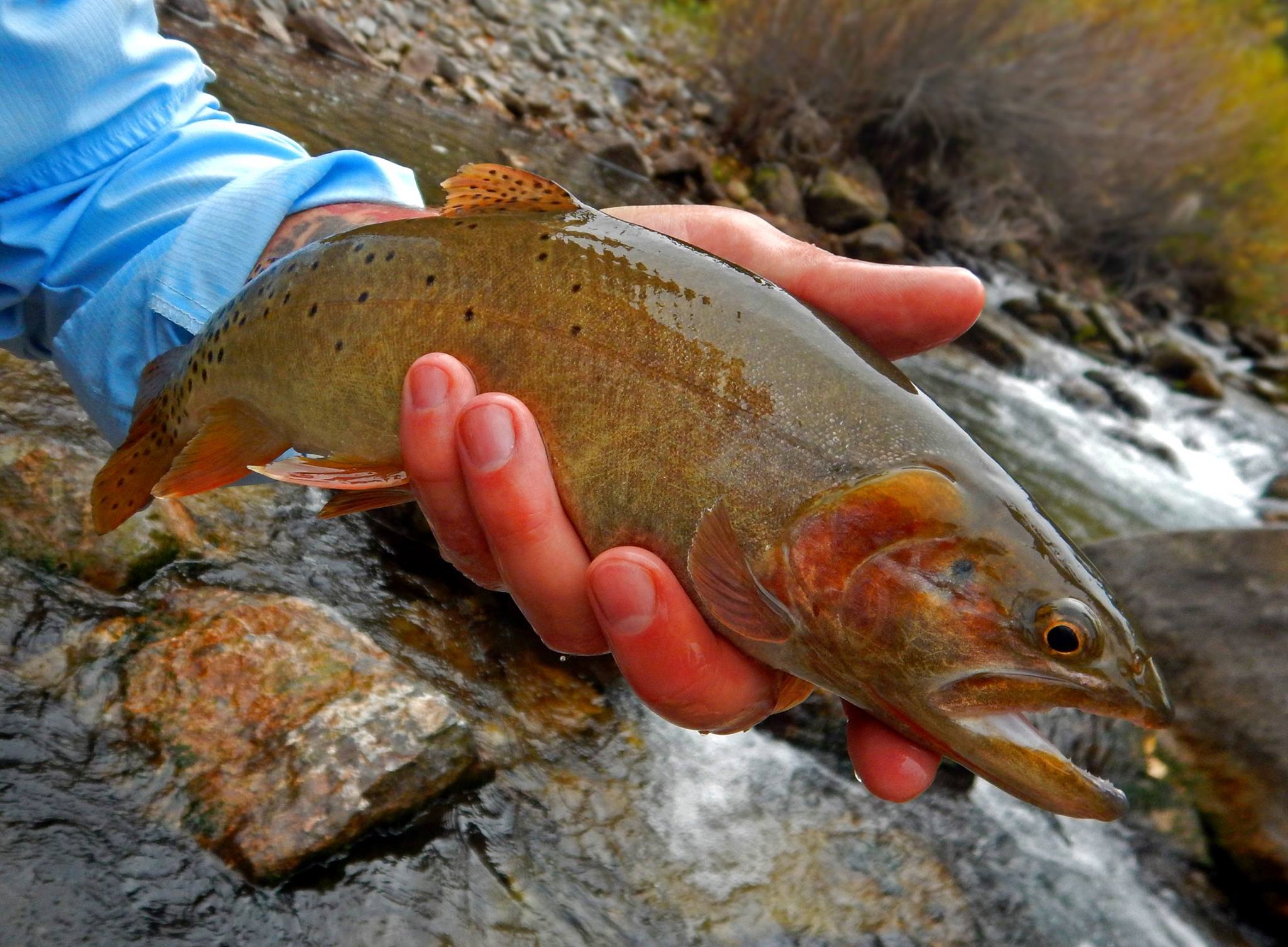
The cutthroat trout represents the most diverse trout species in North America. They are a freshwater fish of the Salmonidae family that live in cold, clear streams and lakes across the west. Cutthroat trout are distinguished from other trout species by two red slashes prominently striping the lower jaw after which they are named. All cutthroat trout share a single common ancestor, but historic population isolation gave rise to 14 subspecies, each endemic to their own geographic region and river drainage.

There are four subspecies that exist in Utah. Only three of these are considered native to the state: the Colorado River cutthroat, the Yellowstone cutthroat, and Utah’s state fish, the Bonneville cutthroat. In Utah, the Colorado River cutthroat trout can be found in some of the smaller streams and tributaries of the Green River, the San Juan River, and the Colorado River drainages. Their bright coloration and posterior black spotting distinguish these cutthroats from others.

Pure, native Yellowstone cutthroat trout are present in small numbers in the streams of the North Slope of the Raft River Mountains in northwestern Utah. However, this subspecies is more widely distributed across the state due to extensive stocking. Yellowstone cutthroat trout can be differentiated by larger-sized black spots concentrated near the tail and their gold, gray, and copper tones.

The Bonneville cutthroat trout evolved in the Bonneville Basin of Utah, Wyoming, Idaho, and Nevada. Its primary ancestors were a population of lake dwelling cutthroat trout living in the late-Pleistocene aged Lake Bonneville. The Bonneville cutthroat trout is less vividly colored and has spots that are more sparsely and evenly distributed across the body than other cutthroats. Thought to be extinct in the 1970s, populations of the Bonneville cutthroat trout are now estimated to exist in around 35% of their historic range, including the nearby Weber and Provo Rivers.

Like so many species, the native cutthroat trout of Utah are under significant pressure due to drought, habitat loss, disease, and competition with non-native species. Though only the Colorado River cutthroat is included on the Utah State Sensitive species list, conservation of all of Utah’s native cutthroat populations is a focal point for state wildlife resource managers.

For Wild About Utah, I’m Anna Bengtson of Park City.

The Cutthroat Trout-a Local Favorite-Credits:
Images: Courtesy USDA Forest Service, US Bureau of Land Management & Chadd VanZanten.
Text: Anna Bengston

Additional Reading:

Anna Bengston’s Postings on Wild About Utah, https://wildaboututah.org/author/anna-bengston/

Utah Fishing Regulations, Utah Division of Wildlife Resources, Department of Natural Resources, State of Utah, https://wildlife.utah.gov/fishing/fishing-regulations.html.

Fishes, Utah Division of Wildlife Resources, n.d. Web. 7 July 2014: https://fieldguide.wildlife.utah.gov/?class=actinopterygii.

Bonneville Cutthroat Trout, Utah Species, Utah Division of Wildlife Resources, Department of Natural Resources, State of Utah, https://fieldguide.wildlife.utah.gov/?species=oncorhynchus%20clarkii%20utah

Colorado River Cutthroat Trout,, Utah Species, Utah Division of Wildlife Resources, Department of Natural Resources, State of Utah, https://fieldguide.wildlife.utah.gov/?species=oncorhynchus%20clarkii%20pleuriticus.

Yellowstone Cutthroat Trout, Utah Species, Utah Division of Wildlife Resources, Department of Natural Resources, State of Utah, https://fieldguide.wildlife.utah.gov/?species=oncorhynchus%20clarkii%20bouvieri

Greenback Cutthroat Trout, Western Native Trout, https://www.westerntrout.org/gc-trout.html.

Cutthroat Trout, Colorado Parks and Wildlife, https://cpw.state.co.us/learn/Pages/ResearchCutthroatTrout.aspx.

Cutthroat Trout (Oncorhynchus clarkii) – FactSheet. Cutthroat Trout (Oncorhynchus clarkii) – FactSheet. U.S Geological Survey, 14 June 2013. Web. 7 July 2014: https://nas.er.usgs.gov/queries/FactSheet.aspx?speciesID=890.

Bonneville cutthroat trout (Oncorhynchus clarki utah), U.S. Fish & Wildlife Service, US Department of the Interior, https://www.fws.gov/species/bonneville-cutthroat-trout-oncorhynchus-clarkii-utah

Brown, Dylan. Shocking habitat projects help increase native Cutthroat populations. Standard Examiner, 14 May 2014. Web. 7 July 2014: https://www.standard.net/lifestyle/recreation/2014/may/13/shocking-habitat-projects-help-increase-native-cutthroat-populations/.

Chorney, Chad. For the Love of Cutthroat Trout Unlimited Blog, 29 Jan. 2013. Web. 7 July 2014: https://westslope.tu.org/comment/1556.

Golden Spike Locomotive Refurb.

Driving the golden spike ceremony at Promontory Summit, Utah on May 10, 1869, Courtesy of the US National Park Service
Driving the golden spike ceremony at Promontory Summit, Utah on May 10, 1869
Courtesy of the US National Park Service
 
Reinactment of the golden spike ceremony at Promontory Summit, Utah on May 10, 2014, Utah. Photo Courtesy US NPSReinactment of the golden spike ceremony at Promontory Summit, Utah on May 10, 2014
Courtesy of the US National Park Service
 
Box Elder County, Utah. Photo Courtesy US NPSSteve Sawyer
National Park Service Locomotive Engineer
Photo Courtesy and Copyright Pat Cone
 
Fireman Michael Ostereich. Photo Courtesy and Copyright Pat ConeFireman Michael Ostereich
Photo Courtesy and Copyright Pat Cone


This sage-covered valley is not on the way to anywhere, unless you’re a railroad and history fan. For it was here, on that May 10th, 146 years ago, that a grand undertaking came to its celebratory conclusion: the meeting of the rails and two grand locomotives.

With the driving of the Golden Spike the Central Pacific, that had clawed its way across the High Sierra and vastness of the Nevada Desert, and the Union Pacific, which rolled across the plains and Rocky Mountains completed a steel artery of commerce and transportation.

Union Pacific Number 119 and the Central Pacific Number 60 (better known at Jupiter) faced each other amidst a crowd of dignitaries, engineers, and railroad workers as the final rails were laid, and spikes were driven. President Abraham Lincoln’s dream of a transcontinental railroad was complete.

Today, the Golden Spike National Historic Site at Promontory, Utah commemorates this event, staging daily reenactments of this meeting with two, grand replica engines. And this May 10th, they’ll look and run better than ever after having undergone a thorough refurbishing.
The original engines were scrapped for their metal in the early 1900s. These two massive replicas were built in 1979 at a cost of nearly $750,000 a piece, in Costa Mesa, California, by Chad O’Connor. He had a passion for steam.

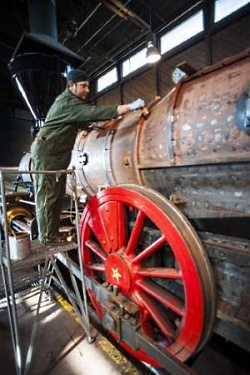
Every 15 years these locomotives are disassembled, boilers cleaned and tested, and over 166 fire tubes replaced. The boiler is pressure tested, the gauges and brass bells and whistles are brightly shined, and the funneled smokestack is repainted, ready for their big day. There’s over 500 feet of tubing in each engine, they weigh 62 tons apiece, and make steam from treated water the old fashioned way: 119 burns coal, and the Jupiter is wood-fired.

Steve Sawyer has been a National Park Service locomotive engineer for 8 years and loves driving these down the track, wearing period costume. He’s one of two engineers, and a fireman who fires them up and takes them out. “These engines run 8 hours a day for 5 months from May 1st through October 15th,” he says, so they need a thorough rebuilding.

Fireman Michael Ostereich takes his time as he puts a rust-proof sealant around the new welds on the boiler, in preparation for a layer of insulation, and the final jacket. But the three railroadmen aren’t alone. There are over 60 volunteers that help in this grand task, reminding us of what it meant to be able to travel from coast to coast in style and comfort.

Jupiter is red and blue, while Number 119 is mostly red with black. Jupiter has a bright blue cowcatcher and a large funnel, while Number 119’s cowcatcher is red with a straight smokestack. The drive wheels are as tall as most men and the pistons are shined to a mirror finish, and there are hand-painted scenes adorning them from Disney animator Ward Kimball.

They are huge, noisy, and magnificent works of art. And, they’ll both be ready for their debut during the anniversary of the meeting of the rails on May 10th. There will be kids of all ages there, so catch them in action if you can.

For Wild About Utah, this is Patrick Cone with National Parks Traveler

Credits:
Image: Courtesy US National Parks Service, www.nps.gov
Image: Courtesy and Copyright Patrick Cone, www.nationalparkstraveler.com
Text:     Patrick Cone, NationalParksTraveler.com.
Additional Reading:

Golden Spike National Historic Site, Brigham City, Utah, Golden Spike National Monument, US NPS, https://www.nps.gov/nr/Travel/cultural_diversity/Golden_Spike_National_Historic_Site.html

Golden Spike National Monument, US NPS, https://www.nps.gov/gosp/index.htm

Golden Spike Locomotives Being Refurbished, Patrick Cone, National Parks Traveler, https://www.nationalparkstraveler.com/2015/03/golden-spike-locomotives-being-refurbished26421

Blowing Off Steam…, National Parks Traveler, https://www.nationalparkstraveler.com/potw/blowing-steam22551

I Love the Four Seasons

Red Admiral Butterfly, Thomas G. Barnes, US FWS Digital Library
Red Admiral Butterfly
Thomas G. Barnes
US FWS Digital Library

Glacier Lilies
Erythronium grandiflorum
Copyright © 2010 Andrea Liberatore


I love the four seasons. Having spent my 72 years residing in the mid latitudes, I’ve learned to celebrate each of our seasons, but especially spring!

This is the rebirth flush with abundant water, new greenery, and air filled with bird song and sweet aromas as new flowers perfume the air hoping to lure in a pollinator.

With mid-April upon us and our 42 degree latitude, spring is in full swing here in northern Utah! Winter departs grudgingly slapping us with snow squalls intermingled with glorious, early summer days, a wild roller coaster ride which I truly enjoy!
I’m an avid phenology follower. Phenology is the study of how life adapts to seasonal changes. I revel in the first floral bloom, the first neotropical birds returning from Latin America with a heart full of song, and newly emerged, gaudy butterflies.

With a relatively stable climate, until recently, the timing of these events has evolved to near perfection
Let’s take a closer look at some of these phenomena. I’ll begin with our neotropical birds such as lazuli buntings, yellow warblers, and Western tanagers to mention a few. These species spend over half of their year in Mexico, Central and South America flying thousands of miles to for the breeding and nesting season in the Intermountain West. This may seem a bit extreme for these tiny flurries of life.

On closer inspection, you will find they have good reason for this daunting and dangerous task. The tropics have a relatively stable climate without the dramatic seasonal change that we experience. This results in relatively stable populations of flowers and insects, the primary food sources for most species. Further, the ratio of daylight to darkness is nearly constant with 12 hours of each. Our days lengthen as we journey toward summer solstice with nearly 16 hours of daylight! This allows a burst of energy to flow through ecosystems resulting in eruptive populations of insects and floral bloom. It also offers long hours of daylight for parents to gather food for their young which grow rapidly toward fledglings, thus reducing the possibility of predation and also preparing them for the arduous flight south as fall approaches.

Let’s examine flowers and insects. With our very warm winter and spring, I was expecting a much earlier arrival of both and was not disappointed. I counted 17 species of flowers by the second week of April! And butterflies were on a similar schedule with 9 different species during the last week of March- remarkably early! Although delighted, it occurred to me that returning birds may not be so pleased. If the flowers begin to fade, and insects begin their downward slide at the peak of birds rearing their young, trouble is afoot! A five year Audubon study revealed that 1/3 of our birds are predicted to be severely impacted by these rapid climate shifts.

On a more positive note, spring will continue as will bird song, vernal waterfalls, eruptions of wildflowers and butterflies. And spring repeats itself as we move to higher elevations. As cornices on our mountain ridges recede, up pops flowers for yet another spring bloom, and with them butterflies, bees, and birds!

Credits:

Pictures: Courtesy Dr. Thomas G. Barnes, US FWS
Pictures Lilies: Copyright © 2010 Andrea Liberatore
Audio: Courtesy and Copyright Kevin Colver
Text: Jack Greene, Bridgerland Audubon Society

Additional Reading:

Kervin, Linda, USA National Phenology Network, Wild About Utah, July 2, 2009, https://wildaboututah.org/usa-national-phenology-network/

Phenology Tools for Community Science
USA National Phenology Network, https://www.usanpn.org/
Nature’s Notebook Education Program, US National Phenology Network, https://www.usanpn.org/nn/education

North American Bird Phenology Program, USGS Patuxent Wildlife Research Center, https://www.pwrc.usgs.gov/bpp/BecomeAParticipant.cfm

eBird, https://www.ebird.org/

iNaturalist, https://www.inaturalist.org/