Climate Change and the Christmas Bird Count

Climate Change and the Christmast Bird Count: Bald Eagle on light post
Bald Eagle
Haliaeetus leucocephalus
Courtesy US FWS
On December 17th, I will join several others for an exciting day of counting bird species and numbers in our lovely, snowy valley. The numbers will be entered on a database that will be shared globally.

The Christmas Bird Count began on Christmas Day in the year 1900 when ornithologist Frank M. Chapman, an officer in the nascent Audubon Society, proposed a new holiday tradition—a “Christmas Bird Census” that would count birds during the holidays rather than slaughtering them, which had been the past ritual.

The data collected by observers over the past 116 years has allowed researchers to study the long-term health and status of bird populations across North America. When combined with other surveys such as the Breeding Bird Survey, it provides a picture of how the continent’s bird populations have changed in time and space. This long-term perspective is vital for conservationists. It informs strategists to better protect birds and their habitat and helps identify environmental issues, with implications for people as well.
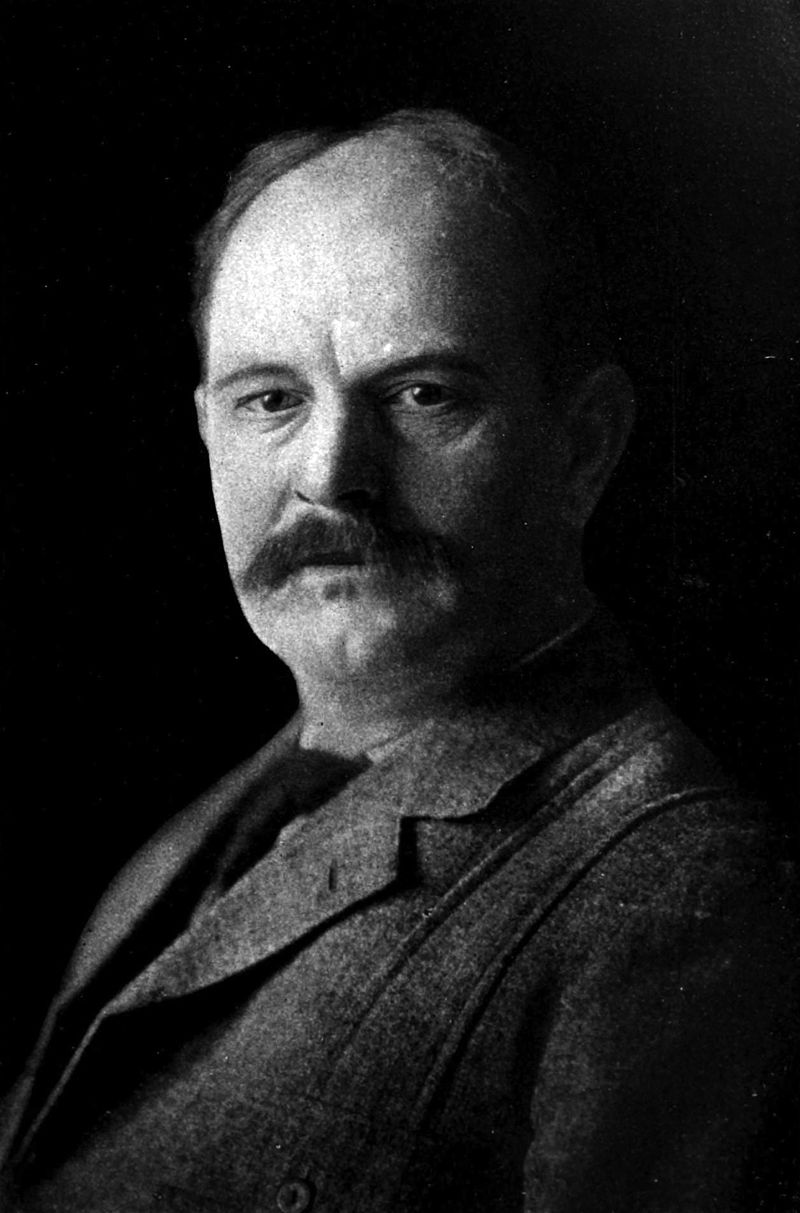
Climate Change and the Christmast Bird Count: Frank M. Chapman, organizer of the first christmas bird count, Courtesy Wikimedia, Image in the public domain
Frank M. Chapman
Courtesy Wikimedia
Image in the public domain
 

Along with the fun it brings, the count has special significance for our changing climate’s impact on birds which is disrupting populations and their spatial distribution that are changing at an accelerating rate.

Audubon’s 2014 Climate Change Report is a comprehensive, first-of-its-kind study that predicts how climate change could affect the ranges of 588 North American birds. Of the bird species studied, more than half are likely to be in trouble. The models indicate that 314 species will lose more than half of their current range by 2080.

Audubon’s Climate Initiative, the organizational response to this threat, taps into its members’ love and commitment for birds to build population resilience and demand solutions to slow the pace of warming. Audubon is encouraging its members to take steps to address the climate change threat in their backyards and communities. Visit their website at audubon.org for how to take action.

The Environmental Protection Agency has included Audubon’s climate change work from CBC data as one of 26 indicators of climate change in their 2012 report.

In 2007, CBC data were instrumental in the development of Audubon’s Common Birds in Decline Report, which revealed that some of America’s most beloved and familiar birds have taken a nosedive over the past forty years.
142 species of concern are found in Utah including our state bird, the California gull and our national bald eagle. Averaging the most recent 10 years, our valley has seen 16 species increase and 11 species decline. Of course we would need a much broader sweep to know the true story of these species, but our data may play a significant part in the overall analysis.

And please, keep those bird feeders full as we enter the coldest month of the year!

This is Jack Greene for Wild About Utah.

Credits:
Image: Courtesy Wikimedia and in the public domain
Text:     Jack Greene, Bridgerland Audubon Society


Additional Reading:

17 Dec, Cache Valley (Logan) Christmas Bird Count, Bridgerland Audubon Society, https://bridgerlandaudubon.org/our-projects/cache-valley-christmas-bird-count/
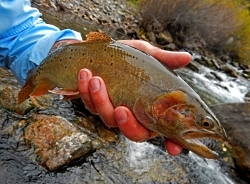
A “no-trouts-land” on the Logan River

Cutthroat Trout A no-trouts-land on the Logan River, Copyright (c) Chadd VanZanten, Photographer vanzanten-cutthroat_trout.250x184
Cutthroat Trout
Copyright © Chadd VanZanten, Photographer
Northern Utah’s Logan River is known for its solitude and grandeur. Drive just a few miles up Logan Canyon in Cache Valley and find yourself in a wild setting on the bank of a picturesque mountain stream. It would be difficult to find a place in Utah that is more accessible and yet so peaceful.

However, just a few inches beneath the riffles of the Logan River, a war rages.

This conflict has gone unresolved for more than a century. The combatants fight continuously all day, all night, and all year.

The indigenous defender is the Bonneville cutthroat trout, which migrated here hundreds of thousands of years ago from the west coast of America by way of the Snake and Columbia rivers. They’ve been here ever since, making this Logan River cutthroat army the largest wild and natural population of its kind. Presently, cutthroats hold the upper river, above Twin Bridges or thereabouts.

Invading from downstream is the brown trout, whose antecedents hail from Eurasia. The brown trout isn’t an intentional trespasser; they were stocked here in the 1880s by humans who wanted more fish to catch. However, brown trout are aggressive, and they don’t know or care that the Logan River used to belong to some other species. Brown trout dominate the lower river, especially in the neighborhood of Third Dam.

And so they fight.

The middle portion of the river is a “no-trouts-land,” where the two species meet to wage their desperate struggle. They contend for living space, compete for forage, and, when it’s convenient, they devour each other with gusto.

Which will prevail? Each species has its advantages.

The brown trout are indisputably stronger, tougher, and meaner. They tolerate low water quality and wide swings in water temperature. When brown trout encounter cutthroats of their same size, they aggressively drive out the more-docile cutthroats. Every year, the brown trout gain a little ground, pressing inch by inch upstream.

Cutthroats may not be great fighters, but they are resilient, having survived clear-cut logging, overgrazing, and the damming of the river. The cutthroats were here first, too, so they hold the high ground, and it’s much easier for fish to move downstream than up. And the cutthroats rule the upper tributaries of the Logan River, which they use to spawn and replenish their numbers. But perhaps most importantly, the cutthroats have an immensely powerful ally: humans.

That’s right. The race that brought the brown trout here in the first place now sides with the cutthroats. The humans could easily exterminate all brown trout in Logan River, from its headwaters to the confluence of the Bear River, but that’s not what’s happening. Instead, conservation measures, such as strategically placed barriers to fish passage and fishing regulations that protect cutthroats during their spawning season, give the natives a fighting chance against their fierce invaders.

Fly anglers, too, favor the cutthroat trout, which they fondly refer to as “cutties.” Fly anglers seem averse to harvesting cutties, releasing them instead unharmed after capture. Opinions vary among experts about how much catch-and-release practices actually help the Cutthroats, but this is war, and these natives, besieged by a relentless and superior foe, can use every advantage they can get.

For Wild About Utah I’m Chadd VanZanten.

Credits:
Images: Courtesy and Copyright Chadd VanZanten, Photographer
Text:     Chadd VanZanten


Additional Reading:

The Cutthroat Trout, Anna Bengston, Wild About Utah, July 10, 2014, https://wildaboututah.org/cutthroat-trout/

Cutthroat Trout, Native trout of the interior west, Utah Division of Wildlife Resources, https://wildlife.utah.gov/cutthroat-home.html

Small Stream Cutthroat Trout, Matt McKell, May 10, 2016, https://wildlife.utah.gov/blog/2016/small-stream-cutthroat-trout/

Ancient Native Plant Relationships Reviewed

Ephedra, Ephedra viridis Coville
Ephedra
Ephedra viridis Coville
Courtesy USDA, NRCS. 2016. The PLANTS Database (https://plants.usda.gov, 6 February 2016). National Plant Data Team, Greensboro, NC 27401-4901 USA., BLM Photographer

Hi I’m T.J. Knudson and I’m Gilbert Young.

Stretching from the snowy peaks of the Wellsville Mountains, south to the sandstone shadows of Beaver Dam Wash, an ancient, native relationship provided unity to the diverse landscape. It is admired in the haunting tune of a wind pipe, it comports like a wool blanket; and its tapestry goes beyond the cliff art at Potash, and preceded John Wesley Powell and Brigham Young.

The Ute, Shoshone, Piute, Goshute, and Navajo cultures each echo today an enduring sustaining relationship bonded to the reliable plant life in a diverse land. this relationship sustained our state’s ancient culture, but little is understood about these gifted craftsmen in utilizing the materials and fibers.

In southeast Utah, the shepherd Navajo nation found a companion in the Prickly-Pear Cactus. Despite his short stature and sharp countenance, this ally was able to provide a fleshy, refreshing fruit. After rolling repeatedly through the direct to lose his spines, and soaking in water; there sparks a reaction of the most spectacular die; which was often orchestrated into many shades of red. Despite his stature on the lonely desert floor, the prickly pear creates a color that epitomizes the Navajo beauty and lives on to future generations.

As our ancient travelers would ascend upward into the hills, they would spend time in the Pinyon/Juniper woodland to collect pine nuts. Natives would also search for three other valuable resources: pine pitch, firewood and shelter materials. Underneath the pines and junipers plentiful sumac, can be found; the sumac branches provide the means to develop a midnight-black die and was also an essential basketry material. The third element needed to create this black color was ocher (okerr), a yellow mineral abundant in Navajo territory. The Pinyon-Juniper woodland met the needs of native people, much like modern superstores. Like these plants working together as a team, we all have an opportunity to join others in creating a unified community.

Prickly Pear Cactus, Opuntia ficus-indica
Prickly Pear Cactus
Opuntia ficus-indica
Courtesy US FWS

Across the canyons, a lone plant is found that nursed and comforted tribes long before the hospitals and prescriptions. Ephedra was a medicinal hero, when sharp cold winds swept the valleys. It could be boiled into a delicious tea that combated the common cold, allowing airways freedom of congestion. Also known as Brigham Tea, Natives shared this knowledge to the early Utah Pioneers in their time of need. The evergreen stems of Ephedra offer healing and a comfort that aided the native people and settlers. We also have the ability to heal our souls by intimately connecting ourselves to nature’s bounteous gifts. We can also provide healing to those who are in need of comfort and guidance.

If the past could speak to us today, it would remind us of connections and relationships that have been forgotten. Our hope today is that you may connect with these ancient relationships for yourselves. For more information, check out the Wild About Utah website.

For Wild About Utah this is T.J. Knutson and Gilbert Young.

Credits:
Images: Courtesy , Photographer
Text:     T.J. Knutson and Gilbert Young.


Additional Reading:

Irruptive Migrations Move Birds South

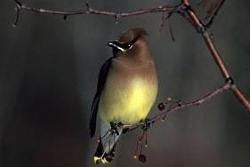
Irruptive Migrations Move Birds South: Cedar Waxwing
Cedar Waxwing US FWS FWS Digital Library, David Menke, Photographer
Every winter, many of Utah’s breeding birds migrate south to avoid the cold. After the warblers, tanagers, and orioles leave each fall, we share the snowy winter with hardier residents, such as chickadees, nuthatches, and juncos. But even hardier birds breed in the far north and venture south to Utah only during the most severe winters.

CEDW call, Western Soundscape Archive; University of Utah, Audio file copyright 2007, Kevin Colver. All rights reserved

Many people are familiar with the high, thin calls of Cedar Wawings. Less frequently heard in Utah are the slightly lower calls of their close cousins, Bohemian Waxwings.

Bohemian Waxwings(BOWA) call, Western Soundscape Archive; University of Utah, Audio file copyright 2007, Kevin Colver. All rights reserved

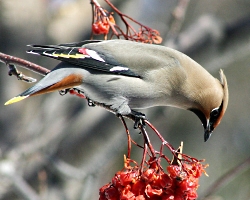
Bohemian Waxwing
Bohemian Waxwing, licensed under the Creative Commons Attribution-Share Alike 2.0 Generic license. Source Wikimedia.org, Randen Pederson, Photographer.
Bohemian Waxwings are slightly larger than Cedar Waxwings, and a little fancier—their wing feathers include red, yellow, black, and white, and the underside of their tails is a rich cinnamon. Both species gather by the hundreds to eat berries, so you won’t miss a flock if there’s one nearby. Although waxwings are songbirds, the calls you hear don’t serve the same functions as true songs, advertising mate quality and defending territories. Instead, waxwings cooperate to find and feed on scattered fruit, their main winter diet. Unlike most birds, waxwings are able to smell, which may help them find their food. If waxwings eat berries that have begun to ferment over the winter months, they may become intoxicated even though their ability to metabolize ethanol is very high. The last time Bohemian Waxwings were abundant in Utah was during the winter of 2012-2013.

White-winged Crossbill(WWCR) call, Western Soundscape Archive; University of Utah, Audio file copyright 2007, Kevin Colver. All rights reserved

If you look in a pine tree, you may see a flock of White-winged Crossbills. Last abundant in Utah during the winter of 2008-2009, this species of finch forages on the seeds inside of conifer cones.

White-winged Crossbill, Courtesy and Copyright Paul Higgins, www.pbase.com/phiggins/
White-winged Crossbill
Copyright © 2009 Paul Higgins
More photos at pbase.com/phiggins/
and utahbirds.org Photo Gallery
As the name crossbill suggests, the lower part of its bill is bent to the right and the upper part to the left, allowing crossbills to wedge open pinecone scales and lift the seeds free with their tongues. In the winter, crossbills forage in flocks of ten to fifty. They quickly assess the quality of a tree’s cones, using visual and vocal cues from their flockmates, which are quiet when they are eating but chatter when they are not. When the volume of the chatter increases to a crescendo, all the crossbills in the flock know that it’s time to switch to a new tree. Unlike most songbirds, crossbills can breed at any time of year, as long as conifer seeds are abundant.

When the weather gets cold, keep an eye and an ear out for these winter nomads.

For Wild About Utah, I’m Andrew Durso.

Credits:

Waxwing Images: Courtesy US FWS, David Menke, Photographer
White-winged Crossbill Image: Courtesy and Copyright © 2009 Paul Higgins, Photographer
Text: Andrew Durso, https://www.biology.usu.edu/htm/our-people/graduate-students?memberID=6753

Additional Reading:

Fitting the Bill, Andrea Liberatore, August 11, 2011, https://wildaboututah.org/fitting-the-bill/

White-winged Crossbill, All About Birds, Cornell Lab of Ornithology, https://www.allaboutbirds.org/guide/White-winged_Crossbill/id

Cedar Waxwing, All About Birds, Cornell Lab of Ornithology, https://www.allaboutbirds.org/guide/Cedar_Waxwing/id

Bohemian Waxwing, All About Birds, Cornell Lab of Ornithology, https://www.allaboutbirds.org/guide/Bohemian_Waxwing/id