A Utah Public Radio production featuring contributors who share a love of nature, preservation and education
Podcast: Wild About Utah
Wild About Utah is a Utah Public Radio production featuring contributors who share a love of nature, preservation and education. Contributors include Bridgerland Audubon Society, Utah Public Radio, Stokes Nature Center, the Edith Bowen Laboratory School (EBLS) at USU and many other nature-related individuals and institutions. See WildAboutUtah.org for a list of authors, voices and contributors.
A Flowing Stream, Conserving Water Starts at Home, Courtesy and Copyright Ron Hellstern, PhotographerLiquid water is essential to life as we know it on planet Earth. With rising temperatures ahead, our water resources are critical to us all. Whether nations contain hot-desert areas or not, the appropriate management of water is essential. In fact, life-sustaining water is literally far more important and valuable than oil. While most Americans generally take clean water for granted, the current generation may see unprecedented changes in water policy, development of desalinization plants, and the distant transport of water through major pipelines. While the “amount” of Earth’s water remains stable, its accessibility and distribution may change dramatically. A current example is truckloads of water being hauled from California to the Crater Lake National Park system in Oregon.
As good Earth Stewards, what can/should we do to use water responsibly? Here are 25 ideas:
Run kitchen-tap water into pitchers until it is hot before you start your dishwasher. Use that water later for your houseplants or garden.
If washing dishes by hand, use a container of rinse water rather than letting it run over dishes.
Try a Navy Shower: Get wet, turn water off, lather up, rinse. Two minutes of water use is all you’ll need.
Install a water-saver showerhead.
Keep a pitcher of cold drinking water in the fridge instead of letting the water run down the drain while waiting for it to cool.
Wash your car on the lawn.
Use a pistol-nozzle on your garden hose rather than letting it run open ended.
Use a bucket in your bathtub to catch water until it warms, then use it on plants later.
Water plants with runoff caught from rinsing fruit and vegetables under your faucet.
See if your community allows plumbing your gray water directly to your outdoor plants.
Use a broom, not water, to clean sidewalks and driveways.
Turn running water off while shaving, washing hands, or brushing teeth.
Water lawns only in the early morning or late evening, and preferably on windless days.
Compost fruit & vegetable waste rather than using the garbage disposal.
Consider replacing your lawn with water-wise plants. If you live in a desert, grow desert plants.
Run dishwashers and clothes-washers only with full loads.
Upgrade old toilets with the newer water-saving models
Make sure that lawn sprinklers never hit driveways, sidewalks, buildings, fences, etc.
Put your lawn mower on the “highest setting” to conserve water and strengthen grasses.
Check the policy in your area about using barrels to catch rainwater from your roof to use later on flower beds and gardens.
Never use running water to thaw frozen foods. Plan ahead, and defrost it in the fridge.
Fix plumbing leaks immediately.
Don’t use toilets as garbage cans.
Save money and resources by avoiding plastic water-bottles. Use your own refillable container for meetings, hiking, etc.
If you have a pool, cover it when it’s not in use to reduce evaporation loss.
For dozens of other water-saving ideas go to www.wateruseitwisely.com
A Flowing Stream, Home for Wildlife, Courtesy and Copyright Ron Hellstern, PhotographerThis is Ron Helstern with Wild About Utah.
Credits:
Images:
Courtesy & Copyright Ron Hellstern, Photographer
Text: Ron Hellstern, Cache Valley Wildlife Association
Spring Runnoff in Cottonwood Creek near Sandbagged Home From “Spring Run-off Dangers Ahead,” by Unified Fire Department Chief Mike Watson Courtesy Cottonwood Heights CityIt’s springtime in the Rockies, and Utah’s northern rivers are engorged with liquid life- and have been for what seems like months now. After a winter of record snowfall, the spring heat and a miniature monsoon season have raised our local waters to levels not seen in decades. During this exceptional seasonal runoff, it’s easy to forget that we still live in the second-most arid state in the Union. Nonetheless, this seasonal plethora of the wet stuff is an ardent reminder that, even here, it is water we Utahns have to thank for our most prestigious landscapes and the diversity of flora and fauna that call these places home. Water-Liquid Life
It has, in most cases, taken quite a lot of time, though. Consider the Great Salt Lake: Utah’s most iconic landmark. It’s a remnant of prehistoric Lake Bonneville-itself the pluvial product of slow glaciation and rainwater collection. Thousands upon thousands of years of evaporative sun exposure, though, shrank Lake Bonneville and changed the local climate and ecosystem into what we have today, a salty inland sea implanted within an arid, Mediterranean climate. Though deprived of its acreage- and being immensely saltier than its predecessor- The Great Salt Lake supports an incredibly diverse and highly complex ecosystem. Concocted by the mixture of ancient salts and fresh water provided by the Jordan, Weber, and Bear Rivers, the wetland ecosystems on the fringes of the Great Salt Lake play host to millions of migratory birds each year that are travelling along the Pacific Flyway. Without these oases, the diversity of Utah’s waterfowl-and wildlife at large- would dwindle drastically.
One cannot speak of water’s effect upon Utah’s landscapes without singing the praises of the wondrous redrock canyons that dissect our state’s southern reaches. The force of water upon the high desert of Utah’s allocation of Colorado Plateau is intermillenial, hydrological poetry. Ancient Jurassic and Cretaceous seas deposited layer upon colorful layer of various sediments before heat, pressure, and the recession of shorelines turned them to stone. Water then went back to work within a new climate upon an old geography with rare but violent torrents of flashing floods that sliced ever deeper and more intricate cleavages into the sandstone. I remember visiting one particularly beautiful slot canyon with my wife. The fossilized wave action we spotted above the rim was preserved below as well with streaks of sediment mismatched and displaced into a beautiful kaleidoscope of reds, oranges, and purples. Water’s work was not finished here, though. Dispersed along the distant trail into the best parts of this remote canyon, there were desert riparian jungles of small cottonwoods, mosses, and ferns that harbored ephemeral pools dotted with water striders and even the occasional canyon tree frog.
Street Flooding Box Elder County 2017 Courtesy https://dem.utah.gov/2017/03/31/news-release-gov-herbert-declares-state-of-emergency-for-february-flooding/Water is a fickle beast, though- crucial to maintaining life but behaving without regard for its endeavors. The same forces of hydrology that created the Great Salt Lake, our richly diverse wetland ecosystems, and the stunning desert landscapes we love to explore can likewise wreak havoc upon our daily lives. Consider the recent deluge in Cache Valley. Several weeks ago, our northern valley was inundated with precipitation, leaving some families stranded in their low-lying homes with no access to the nearest road. A friend of mine who runs a canoe rental business told tale of making deliveries to homes so that people could commute from the end of their driveway to their front door. Perhaps no other force of nature can be so frustrating yet so gratifying; so plentiful yet so fleeting. It’s a wild thing, water. It is a miraculous ubiquity that, even in the driest places, leaves an indelible mark upon the landscape and the lives that inhabit it.
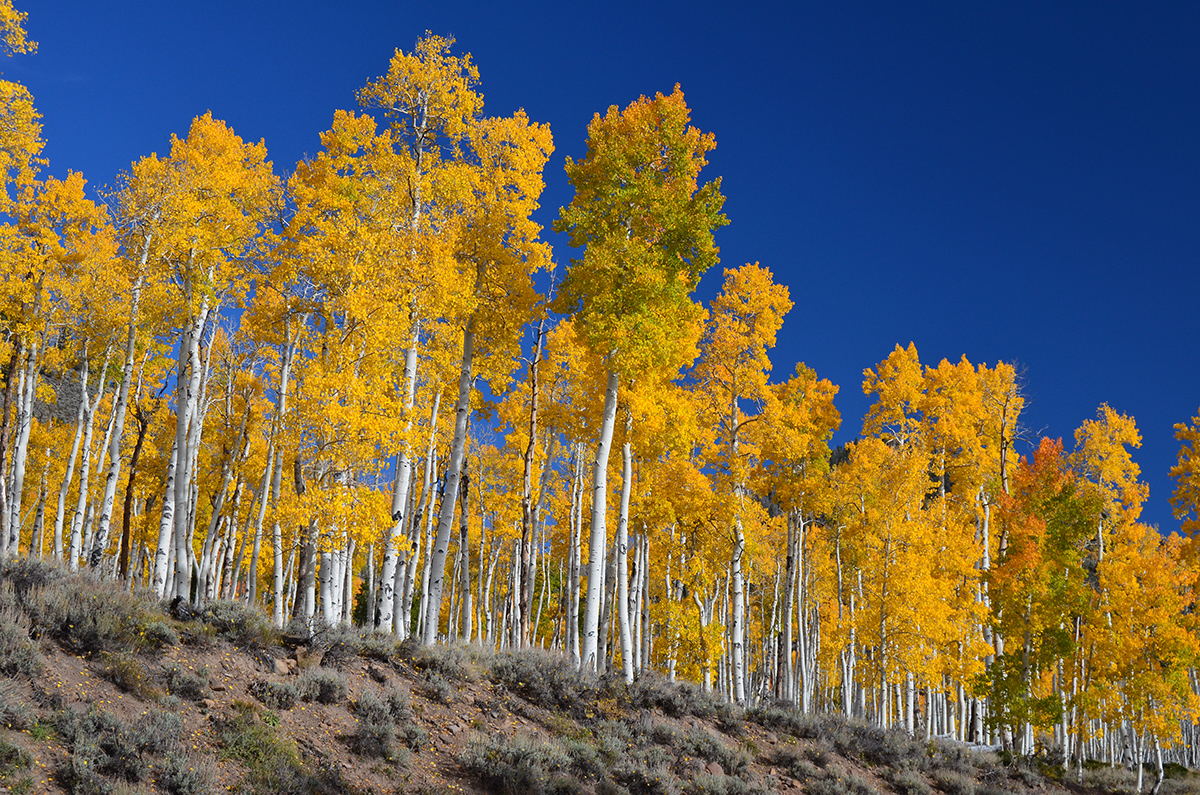
Pando, the worlds largest discovered organism at Fishlake in central Utah Image courtesy USDA Forest Service J. Zapell, Photographer
Pando, a sprawling aspen colony and the world’s largest discovered organism, is dying. On the lip of Fish Lake in Central Utah, Pando germinated from a seed the size of a grain of sand thousands of years ago. Now he sprawls over a hundred acres with approximately 47,000 trunks. The combination of the trunks and the extensive root system has Pando weighing in at around 13 million pounds. This giant male, which might be one of the oldest living organisms on the planet, is also prone to disease, wanted by humans to burn in stoves, and targeted by ungulates as a food source. And although Pando consists of literally tons of mature, geriatric trees, there aren’t many young volunteers replacing old trees that die.
Dr. Paul Rogers, a Utah State University scientist who’s trying to save Pando, explained the problem to me while we searched for new growth and deer scat on Pando. He said it would be like depending on a room filled with 90-year-olds to repopulate and save the human race—it’s possible, but not likely.
The age of the current mature trees that make up Pando is about 110-120 years. These ages are gleaned from a tree coring device called a borer. This information combined with others findings show that Pando took a turn for the worse about when Anglo-Americans showed up in central Utah. As they hunted apex predators like bears, wolves and mountain lions, populations of ungulates such as deer and elk increased. White settlers also added other ungulates—sheep, cows, and horses—to the ecosystem. Both domestic and wild ungulates feast on young, nutrient-filled Aspen trees. Which makes it so Pando can’t recolonize himself.
I asked Rogers if the reason he wanted to save Pando was because it was the superlative organism—the oldest and biggest on the globe, and he was quick to correct me. He questions the accuracy of age estimates for Pando based on current available science. And he believes there may even be larger aspen colonies, but we just haven’t found them yet. We know about Pando partially because a paved road goes right over his spine and partially because he almost touches Fish Lake. Rogers says he’s interested in saving Pando because the existence of this huge organism supports many dependent species and it likely holds lessons for sustainable cohabitation of this planet. As an afterthought he added, “If the colony dies on our watch, we’re doing something majorly wrong.”
There is hope for Pando. Aspen do two things really well: die and repopulate. In recent years, efforts have been implemented to preserve Pando. Paradoxically, some sections have been clear cut or burned to stimulate growth. Both techniques have produced positive results, but not enough. It seems the simplest solution to this problem might be the best—protect it from foraging ungulates. Eight-foot deer fences now encircle parts of Pando. Outside the fences, there are no new trees. Inside, however, green shoots can be seen pushing up from the dry ground.
WESTERN ASPEN ALLIANCE is a joint venture between Utah State University’s College of Natural Resources and the USDA Forest Service Rocky Mountain Research Station, whose purpose is to facilitate and coordinate research issues related to quaking aspen (Populus tremuloides) communities of the west. https://www.western-aspen-alliance.org/
DeWoody J, Rowe C, Hipkins VD, Mock KE (2008) Pando lives: molecular genetic evidence of a giant aspen clone in central Utah. Western North American Naturalist 68(4), pp. 493–497. https://digitalcommons.usu.edu/aspen_bib/3164
Habeck, R. J. 1992. Sequoiadendron giganteum. In: Fire Effects Information System, [Online]. U.S. Department of Agriculture, Forest Service, Rocky Mountain Research Station, Fire Sciences Laboratory (Producer). Available: https://www.fs.fed.us/database/feis/ [Accessed September 2, 2010].
Mock, K.E., C . A. Rowe, M. B. Hooten, J. DeWoody and V. D. Hipkins. Clonal dynamics in western North American aspen (Populus tremuloides) Molecular Ecology (2008) 17, 4827–4844 https://digitalcommons.usu.edu/wild_facpub/163/
Join us for Utah Water Week
We all live in a watershed. Help protect our water!
Utah Water Week runs from May 7th through the 13th, and is a perfect time of year for each of us to consider the importance of water in our lives.
In a dry state like Utah, where irrigation is important for maintaining our crops, gardens and lawns, we tend to focus on how much water we have. It’s easy to forget that the quality of this water will actually determine how (or if) we can use it.
We all value clean water to drink and use around the home, but those aren’t the only reasons we need clean water. Swimming in our lakes and reservoirs is only safe if the water is free of pathogens. Irrigation water with high salt concentrations is unusable. Fish and other aquatic life are the most dependent on clean water, needing water that is the right temperature, has sufficient dissolved oxygen and is free of toxins and other pollutants.
We’ve made great progress in this country in reducing water pollution – particularly in treating municipal and industrial waste. We’re still improving those treatment methods but the biggest problems these days are water pollutants that don’t come from a single source.
Fertilizers, pesticides, personal care products, and motor oil are just a few examples of substances that can cause serious harm when they reach our waters. Excess fertilizers that are washed into our lakes contribute to floating rafts of harmful algae, green cloudy water, and low oxygen levels. A single quart of motor oil can pollute 250,000 gallons of water. Improper disposal of medicines and personal care products are literally medicating our waters.
It’s always cheaper and easier to prevent water pollution than to clean up dirty water. Luckily, there’s a lot of pretty simple and straightforward actions we can all take to help keep our waters clean. In fact, a lot of Utahns are already helping out.
Homeowners are using more environmentally-friendly products and are composting their kitchen waste rather than sending it down the garbage disposal to a WWTP or a septic system. Gardeners and farmers are taking care to use no more fertilizer than their plants need and are implementing new irrigation methods that reduce runoff into streams and lakes. Pet owners are picking up after their pets and disposing of the waste properly. Pharmacies are partnering with our municipal offices so we can return medicines for proper disposal rather than dumping them down the drain. Municipalities are keeping their roads clean and finding innovative ways to capture and treat storm water. Farmers are reducing polluted runoff from animal operations, and across the state landowners and land managers are restoring streamside vegetation that helps intercept pollutants.
This water week, take a look around you and think of ways you can help keep our water pollutant-free. Together, our small actions will have big impacts on keeping our water clean.
For more ideas, visit our website: extension.usu.edu/waterquality.
Remember…..water is life and quality matters.
This is Eli Robinson from USU’s Water Quality Extension program…
Credits:
Images: Courtesy Utah Water Week, https://extension.usu.edu/utahwaterwatch/Calendarandevents/waterweek
Text: Eli Robinson