Mayfly Life Cycle

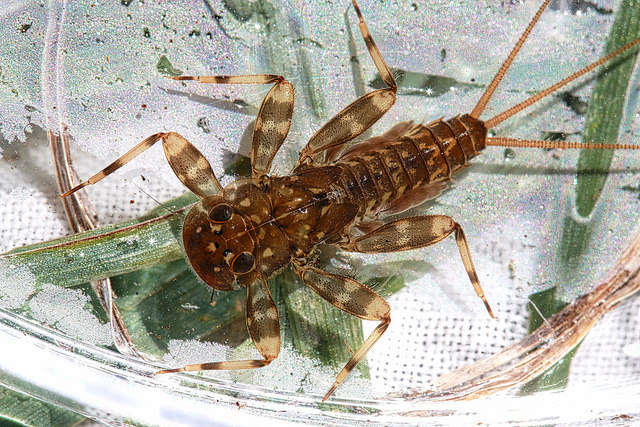
Mayfly Nymph Courtesy Robert Henricks, Photographer Found on VisualHunt.com Licensed through CC BY-SA https://creativecommons.org/licenses/by-sa/2.0/legalcode
Mayfly Nymph
Courtesy Robert Henricks, Photographer
Found on VisualHunt.com
Licensed through CC BY-SA https://creativecommons.org/licenses/by-sa/2.0/legalcode
It’s commonly believed that mayflies live for only one day. If you visit a cold, clear river in the spring or early summer, you might see what is known as a “mayfly hatch,” when millions of delicate, glassy insects suddenly appear on the surface of the water, take to the air, and then fall into the river later that day and apparently drown.

The truth is mayflies live for much longer than one day, but like many other aquatic insects, their life cycle consists of a long period during which almost nothing happens, followed by a sudden and dramatic burst of activity.

The mayfly begins life as an egg so tiny it’s nearly invisible to the naked eye. The egg sinks to the bottom of the river, and a couple weeks later a mayfly nymph hatches. Speckled and primitive-looking, the nymph simultaneously resembles a crab, shrimp, and troglodyte. For one entire year (and in the case of some species, two years), they grub around the streambed eating algae and hiding from trout. Lift a rock from a mountain stream and turn it over–if the stream is unimpaired by pollution or water quality problems, you’ll likely see a mayfly nymph doing what it does best: waiting in the mud for its birthday.
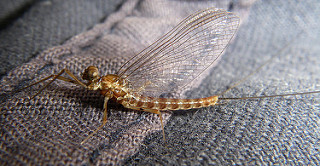
Mayfly Imago Courtesy J Schoen, Photographer Found on VisualHunt.com Licensed through CC BY-SA https://creativecommons.org/licenses/by-sa/2.0/legalcode
Mayfly Imago
Courtesy J Schoen, Photographer
Found on VisualHunt.com
Licensed through CC BY-SA https://creativecommons.org/licenses/by-sa/2.0/legalcode
In the spring, when its big day arrives, the nymph leaves the blackness of the streambed and heads for air and sunlight. But the nymph is so small and weak, the water’s surface is like a rubbery membrane that it must pierce and wriggle through. Then the nymph sheds its skin and emerges as a dull-colored and clumsy flying insect called a “sub-imago,” or what fly anglers call a “dun.” Practically weightless, they stand on the water, drifting downstream likes fleets of tiny sailboats as they wait for the UV light of the sun to harden their wings so they can fly away.

Mayfly Imago Courtesy Audrey Zharkikh,, Photographer Found on VisualHunt.com Licensed through CC BY-SA https://creativecommons.org/licenses/by-sa/2.0/legalcode
Mayfly Imago
Courtesy Audrey Zharkikh,, Photographer
Found on VisualHunt.com
Licensed through CC BY-SA https://creativecommons.org/licenses/by-sa/2.0/legalcode
It’s difficult to overstate how fragile and helpless a mayfly dun is. As the mayflies float up through the current, fight their way out of the water, and then surf along the waves, fish gorge themselves on them. When the mayflies get airborne, there are swallows and other birds to worry about. Even strong breezes and rough water can be catastrophic to duns. Luck is the only thing they can rely on.

But if the mayfly can escape the river and hole up in the bankside vegetation for just a couple hours, its skin will split open again, and a bolder, stronger creature will emerge. Now called the “imago” (fly anglers call them “spinners”), this stage can fly faster and more skillfully than before, and they use this agility to accomplish their final acts–find a partner, mate in mid-air over the stream, and deposit the seeds of a new generation in the water. Then, exhausted, the spinners die and fall back into the river, where the fish feed on them once again.

And so it’s easy to understand why some people mistakenly believe that mayflies live for only one day–by the time we see them emerging, they have only one day left to live. It’s almost as if, after a lifetime of staying home, the mayfly suddenly decides it’s time to get out and see the world, find love, and have a family, but they have to do it all that same day. Is there a lesson for us in the life cycle of a mayfly? Something about not waiting too long to do the things you want, or living every day as if it’s your last? The answer to this question, and possibly others, can be found by visiting cool, clear mountain streams in the springtime or early summer.

For Wild About Utah this is Chadd VanZanten.

Credits:
Photo credit #1: henricksrobert via Visualhunt.com / CC BY-SA
Photo credit #2: jschoen2000 via Visualhunt.com / CC BY-SA
hoto credit #3: andrey_zharkikh via Visualhunt.com / CC BY-SA
Text: Chadd VanZanten

Additional Reading:

Craig Macadam, The mayfly’s lifecycle: a fascinating, fleeting story, The Freshwater Blog, May 16, 2011, https://freshwaterblog.net/2011/05/16/the-mayflys-lifecycle-a-fascinating-fleeting-story/

Biology 5445, Entomology (Feener), https://courses.biology.utah.edu/feener/5445/Lecture/Bio5445%20Lecture%2005.pdf

Distribution of mayfly species in North America, List compiled from Randolph, Robert Patrick. 2002. Atlas and biogeographic review of the North American mayflies (Ephemeroptera). PhD Dissertation, Department of Entomology, Purdue University. 514 pages and information presented at Xerces Mayfly Festival, Moscow, Idaho June, 9-12 2005, https://www.usu.edu/buglab/Content/Mayflylist.pdf
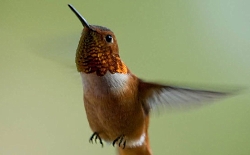
Rufous Hummingbirds

Rufus Hummingbird Courtesy US FWS, Roy W, Lowe, Photographer
Rufus Hummingbird
Courtesy US FWS,
Roy W. Lowe, Photographer

Who doesn’t love hummingbirds! I’m always amazed how a tiny life form with a brain smaller than a pea is capable of such amazing intelligence and behaviors. In fact, a hummingbird’s brain is proportionally larger in size to their body than that of any other bird. And like the corvid family (jays, magpies, and crows), research has found that hummers have an amazing memory.

Now is the seasonal peak for hummingbird activity with young birds fresh off the nest. One of my favorites, the migrating rufous hummingbird, may join the milieu on their long distance marathon as they make their way from as far north as Alaska to winter in Mexico.

The feistiest hummingbird in North America, the brilliant orange male and the green-and-orange female are relentless attackers at flowers and feeders. These fearless competitors will challenge even the largest hummingbirds of the Southwest, which can be double their weight, and often win the contest! Rufous Hummingbirds are wide-ranging, and breed farther north than any other hummingbird. Look for them in spring in California, summer in the Pacific Northwest and Alaska, and now in the Rocky Mountains as they make their annual circuit of the West.

Rufous Hummers have the hummingbird gift for fast, darting flight and pinpoint maneuverability. Like other hummers, they eat insects as well as nectar, taking them from spider webs or catching them in midair.

Rufous Hummingbirds breed in open areas, yards, parks, and forests up to timberline. On migration they pass through mountain meadows as high as 12,600 feet where nectar-rich, tubular flowers are blooming. Winter habitat in Mexico includes shrubby openings and oak-pine forests at middle to high elevation.

They may take up residence (at least temporarily) in your garden if you grow hummingbird flowers or put out feeders. But beware! They may make life difficult for any other species that visit your yard. If you live on their migration route, the visiting Rufous is likely to move on after just a week or two.

Regarding feeders, make sugar water mixtures with about one cup of sugar per quart of water. Food coloring is unnecessary; table sugar is the best choice. Change the water before it grows cloudy or discolored and remember that during hot weather, sugar water ferments rapidly to produce toxic alcohol. If you are among those who have these dazzling sprites of amazing life stop by, consider yourself fortunate indeed!

This is Jack Greene reading for “Wild About Utah”

Credits:

Pictures: Courtesy US FWS, Roy W Lowe, Photographer
Text: Jack Greene, Bridgerland Audubon Society

Additional Reading:

Strand, Holly, Hummingbirds in Utah, Wild About Utah, UPR/Bridgerland Audubon Society, Sept 3, 2009, https://wildaboututah.org/hummingbirds-in-utah/

Kervin, Linda, Gardening for Hummingbirds, Wild About Utah, UPR/Bridgerland Audubon Society, June 5, 2014, https://wildaboututah.org/hummingbirds-in-utah/

Liberatore, Andrea, Hummingbird Nests, Wild About Utah, UPR/Bridgerland Audubon Society, June 14, 2012, https://wildaboututah.org/hummingbird-nests/

Hummingbird Society, https://www.hummingbirdsociety.org/index.php

Coro Arizmendi Arriaga, Maria del, Hummingbirds of
Mexico and North America, In Spanish and English, CONABIO, 2014, https://www.biodiversidad.gob.mx/Difusion/pdf/colibries_mexico_y_norteamerica.pdf

June Fireflies

Click for a larger view of a firefly, Courtesy Wikimedia, Bruce Marlin, Photographer, licensed under Creative Commons Attribution-Share Alike 2.5 Generic license
Firefly
Courtesy Wikimedia,
Bruce Marlin, Photographer
Licensed under
Creative Commons Attribution-
Share Alike 2.5 Generic license


Most people are fascinated by unusual displays of light. Meteor showers, solar eclipses, and the stunning Aurora Borealis, or Northern Lights, are grandiose in scale and mesmerize onlookers. But people are also enchanted with the small life-forms that create their own light.

Bioluminescence, the production of light by living creatures, is an incredible phenomenon produced by certain mushrooms, scorpions, millipedes, bacteria, snails, worms, beetles, and nearly half of marine life including single-celled plankton, jellyfish, octopi, and fish. Some are also fluorescent by absorbing light rays and then emitting them as a different color.

But today we will focus on fireflies, also known as lightning bugs, which are actually beetles.

How, and why, do these creatures produce their own light? Scientists are still learning how the process works, but basically it is a chemical reaction involving luciferin, a light-emitting compound, being catalyzed by an enzyme and reacting with oxygen to release cool, light photons.

The “why” part is primarily for locating mates. But other species could also use it to lure prey, as a method of escape, and to warn predators.

The nighttime hours of late Spring and early Summer months are prime time for firefly activity. They live around wetland areas where the soil is moist and will start flashing when the sky is dark. Females remain fairly stationary atop tall grass and watch for males who fly around flashing various light signals. When a female approves of a suitor’s signal, she will respond with her own glow pattern which allows the male to find her. After mating, the female will lay eggs in the moist soil or leaf litter where they won’t dry out. The eggs usually hatch in 3-4 weeks.

The larvae live in the soil hunting worms, snails or slugs. At this stage they may actually begin glowing. They live in the soil for one or two winters before pupating and undergoing metamorphosis into the adult stage. And the purpose of the adult stage is primarily breeding.

While we enjoy seeing these insect “shooting stars” it is critical to avoid trying to capture them since the Utah populations are small and fragile. (Photos are available online on many websites if one needs to see them closeup.) Walking on the soil can kill the eggs or larvae, and light from automobiles, street lights and flashlights can disrupt their ability to see the flashing of their prospective mates. While the “Firefly Citizen-Science Project” from the Natural History Museum of Utah indicates sightings at more than 50 locations, careless actions, as well as loss of critical habitat, are actually causing a decrease in populations across the country.

Let’s do our best to be good stewards of the earth and only “observe” the amazing firefly.

This is Ron Helstern with Wild About Utah.

Credits:

Image: Courtesy Wikimedia, Bruce Marlin, Photographer, Licensed under Creative Commons Attribution-Share Alike 2.5 Generic license
Theme music: Composed by Don Anderson and performed by Leaping Lulu, https://leapinglulu.com/
Text: Ron Hellstern, Cache Valley Wildlife Association

Reported Sightings:

24 June 2017
Today while waiting for local city fire works we saw a lighting bug or two. We are in West Haven.


Report your sighting


Additional Reading

Holly Strand, Firefly Light, Wild About Utah, 20 June 2013, https://wildaboututah.org/firefly-light/

Clayton Gefre, Sparks Fly: Researchers track firefly populations across Utah, The Herald Journal, https://news.hjnews.com/allaccess/sparks-fly-researchers-track-firefly-populations-across-utah/article_270ac8b9-3d3f-5a01-9b5b-ac22e89a54bb.html

Natalie Crofts, New Website Tracks Utah Firefly Sightings, KSL, https://www.ksl.com/article/34439516

Utah Museum of Natural History, Firefly Citizen Science Project, https://nhmu.utah.edu/fireflies

Greater Sage-Grouse in Utah

Female Sage-Grouse Flying in Winter, Courtesy & Copyright Todd Black, Photographer
Utah’s dry, sagebrush covered landscapes are home to one of North American’s largest grouse species, commonly known as the greater sage-grouse.

The females are attractive chicken-size birds with gently curved bodies. Their feathers show streaks of black, brown and gray. This pattern acts as a natural camouflage in their sagebrush habitat to help protect them from predators.

Male Sage-Grouse on Lek, Courtesy & Copyright Todd Black, Photographer
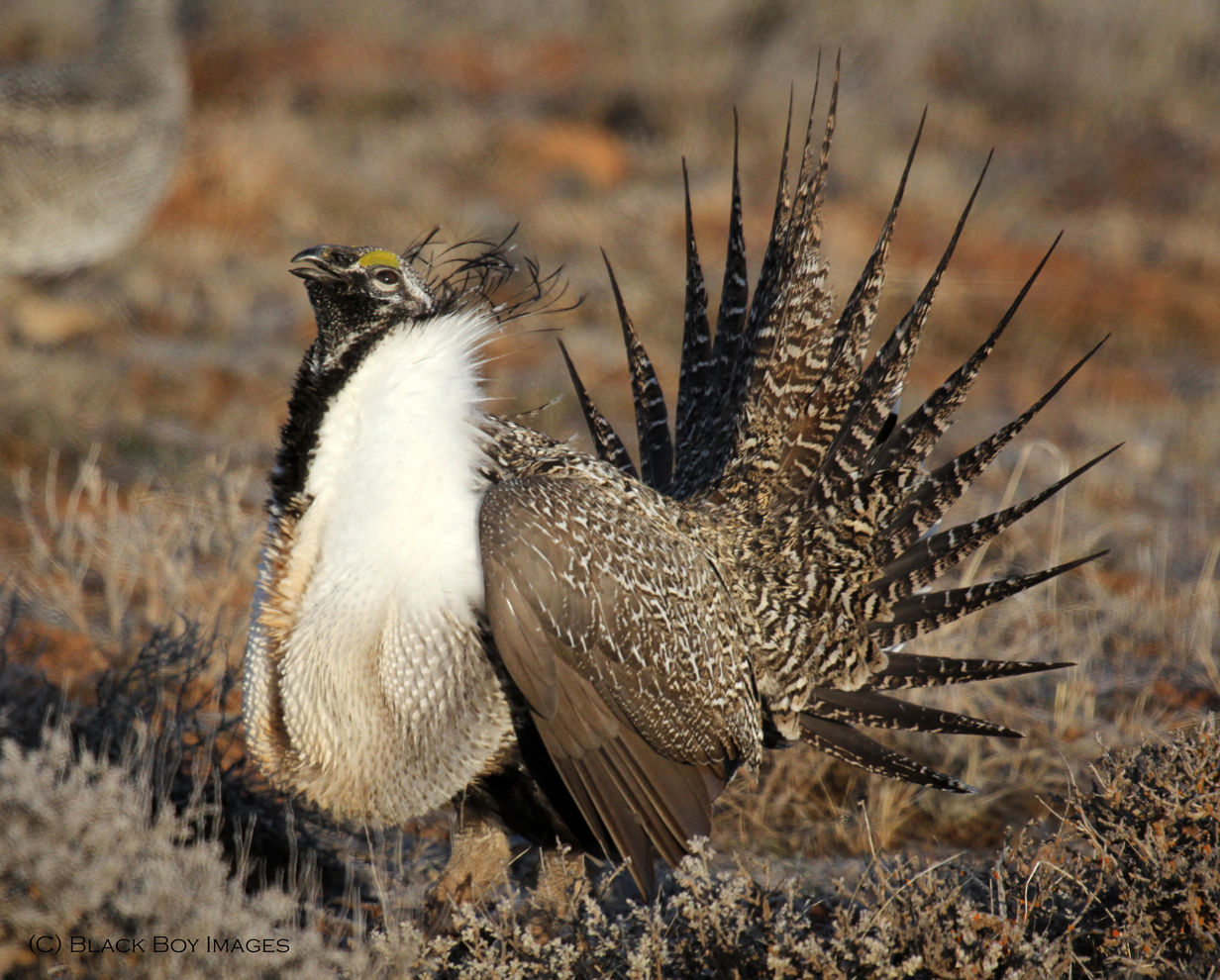
Males are distinguished from females by their majestic form and decorative feather patterns. They are often twice the size of females and can weigh over seven pounds. A thick layer of white plumage covers the males’ breast and wraps up around both sides of their thick necks. Their tails are a long spray of pointy feathers, which rise into a beautiful fan during courting season and provide the basis for their scientific name Centrocercus urophasianus derived from the Greek word “kentron” meaning spiny, “kerkos” meaning tail, and urophasianus meaning tail of a pheasant.

To help protect against predators their wing and back feathers have streaks of black, grey, and brown – similar to the females.

Buried under the male’s white breast feathers are two air sacs that remain concealed until mating season begins.
The greater sage-grouse are probably best known, by most, for their extravagant courtship rituals.

Around the beginning of March, the male grouse return to their communal mating grounds called a lek where they compete with other males to attract and breed with the females. The ritual is called lekking. The lek is in an open area where visibility is good – such as a dry lakebed.

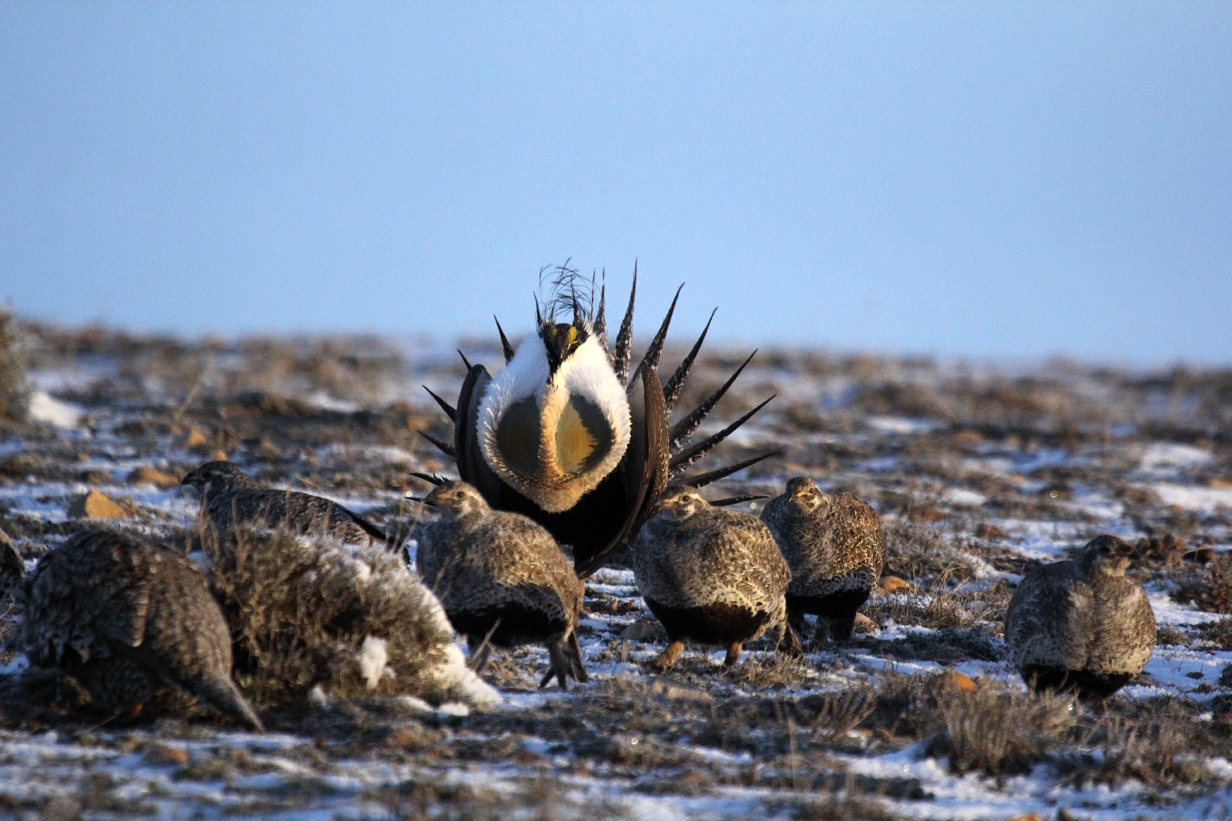
Dominate Male Sage-Grouse with Females, Courtesy & Copyright Todd Black, Photographer
To show their dominance, the males raise their tail feathers in a magnificent fan, fill their breast sacs with air then thrust the air out of the sacs making a popping/bubbling sound as they strut around the lek in a regal fashion.

The females are attracted to the leks by the calls of the males, which can carry for over 1.5 miles. When they arrive, they roost among the males to watch their strutting performances. The hens may visit the lek several times during the breeding season before nesting.

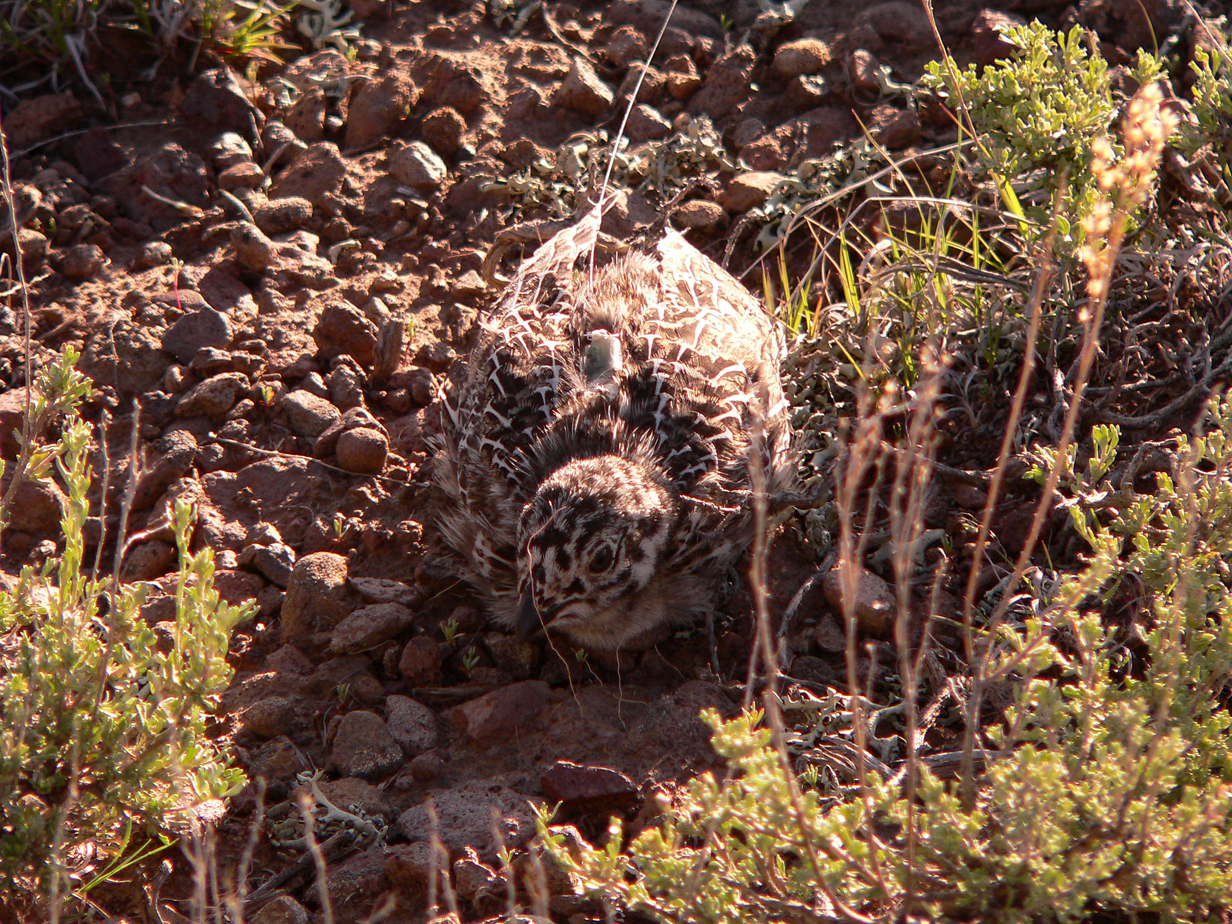
During the courtship rituals, the females will begin searching for a nesting site. Most will choose to build their nests under the protective cover of a sagebrush bush. The female lines the bowl-shaped nest with dead grass and a few feathers. When she sits on her nest of 6-8 eggs, her camouflage colors go to work and make her nearly invisible from her surroundings. A potential predator may often pass by her as she sits motionless and in silence on her nest for a 30-day incubation period.

Week-old Sage-Grouse Chick with Transmitter, Courtesy & Copyright Todd Black, Photographer
Dr. Terry Messmer, Utah State University Extension wildlife specialist and director of the Berryman Institute explains, “Greater sage-grouse do not have a muscular crop and are not able to digest hard seeds like other upland game species such as the ring-necked pheasant… they depend on sagebrush for their survival. In fact, during the winter sage-grouse survive by only eating sagebrush. They are the only species that can gain weight during the winter by [consuming] sagebrush.”

Biologists estimate that since the European settlement of North America there has been a 50% decline of the sage-grouse sagebrush habitat and population.

In the late 1990’s, in an effort to reverse this trend, Messmer through Utah State University entered into a collaboration with the State of Utah and numerous other stakeholders to develop a community-based conservation plan. Its purpose was to bring local communities, agencies, and researchers together to determine the best methods to preserve sage-grouse, their sagebrush habitats, and benefit the local community – without having to list it for protection under the federal Endangered Species Act.

After two decades of hard work, the partners have witnessed a resurgence of the greater sage-grouse as their habitats have been protected, enhanced and expanded.

If you’d like to see greater sage-grouse, the largest populations are found in western Box Elder County, on Blue and Diamond Mountains in Uintah County in northeastern Utah, in Rich County, and on Parker Mountain in south central Utah. Just remember to bring your binoculars.

This is Shauna Leavitt for Wild About Utah.

Credits:
Photos: All photos courtesy of and used with permission of Todd A. Black.
Text: Shauna Leavitt, Utah Cooperative Fish and Wildlife Research Unit, Quinney College of Natural Resources, Utah State University

Additional Reading

To learn more about Utah sage-grouse conservation, please go to www.utahcbcp.org.