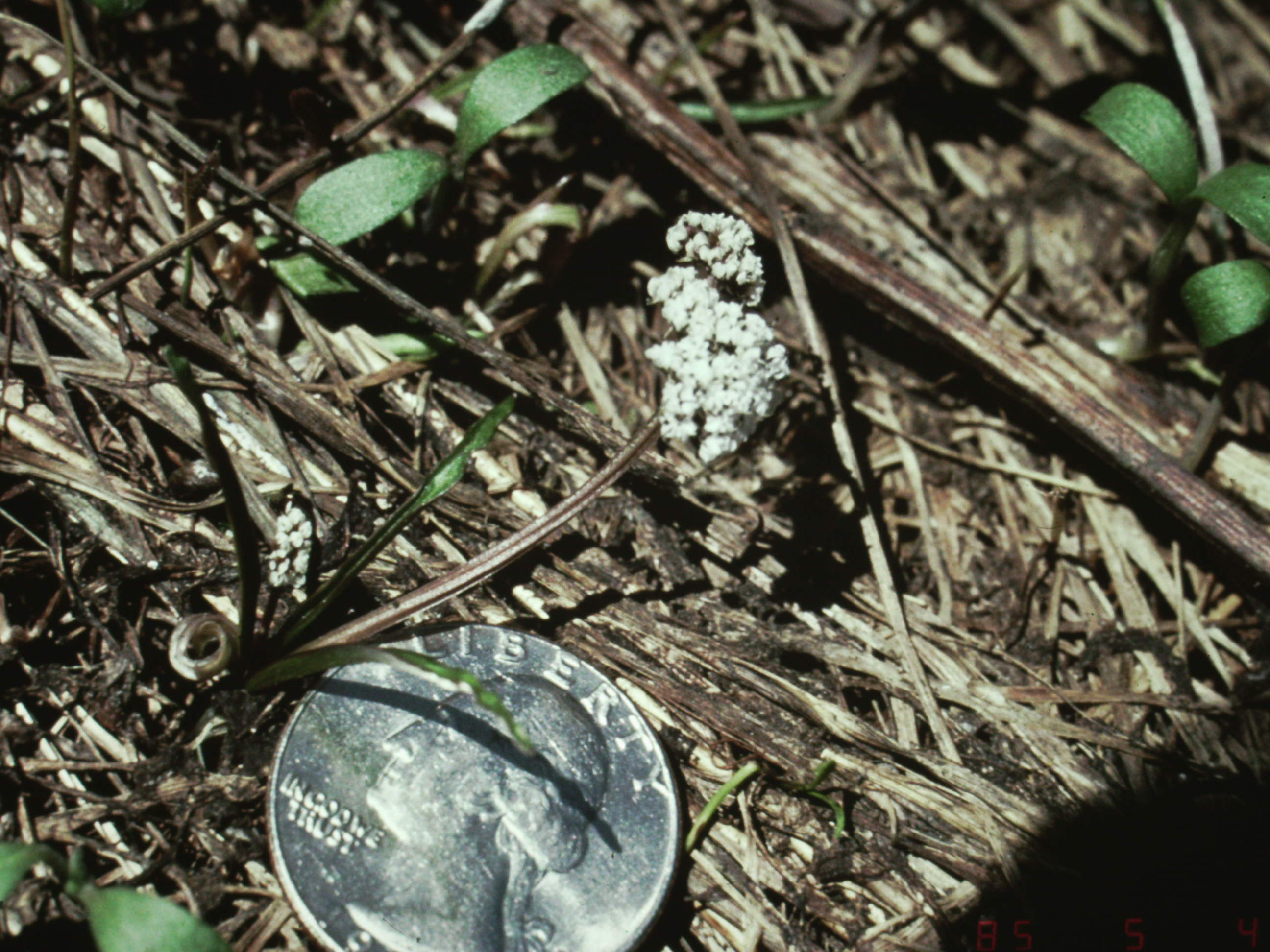
Graupel Snow

Graupel Snow
Image Courtesy & Copyright Jim Cane
Snow graces the winter sky in many different forms. We have large lazy flakes drifting down, sharp needles driven by harsh winds and thick curtains that swiftly blanket the landscape. Late winter storms offer good chances to observe one of our more unusual and distinctive kinds of snowfall; “graupel”. Graupel – that sounds like some kind of respiratory malady, doesn’t it? Also known as soft hail or tapioca snow, graupel consists of tender round snow pellets no bigger than a pea. The name comes from the German word for hulled grain, “graupe”.

Graupel accompanies warmer winter storms, the kind we often have in March, as well as during summer showers high in the mountains. The pellets form when snow crystals fall through a low cloud of super-cooled liquid droplets. The foggy droplets readily coalesce and freeze around the falling ice crystals, accumulating to form soft graupel pellets. The process is somewhat akin to making rock candy from a concentrated hot sugar syrup, or the method used to generate artificial snow. In contrast, sleet forms when raindrops fall through a cold air layer and freeze.

Our big snowfalls are spawned by storms that generate sprawling unbroken cloud decks. Graupel snow, on the other hand, tumbles down from the bellies of fluffy cumulus clouds. As a consequence, squalls of graupel are brief, the pellets accumulating in a thin white bumpy layer, hence the other common name, “tapioca snow”. A buried layer of tapioca snow is prone to avalanche for the first day or two, after which the pellets anneal and stabilize. Any connoisseur of Utah snow should have graupel in their lexicon of wintry terminology, at the ready to impress any Sun Belt visitor met on the slopes.

This is Linda Kervin for Bridgerland Audubon Society.
Credits:

Photos: Courtesy & Copyright Jim Cane

Text: Jim Cane & Linda Kervin, Bridgerland Audubon Society
Additional Reading:

Wild About Utah pieces by Jim Cane and Linda Kervin

Riehl, Herbert: Introduction to the Atmosphere, McGraw-Hill Book Company, 1972 https://www.amazon.com/Introduction-Atmosphere-Herbert-Riehl/dp/0070526567

Rime and Graupel [link removed Oct 6, 2024. Page formerly found at:] https://emu.arsusda.gov:80/snowsite/rimegraupel/rg.html

Severe Weather 101, How does hail compare to other types of frozen precipitation?, NOAA National Severe Storms Laboratory, https://www.nssl.noaa.gov/education/svrwx101/hail/types/ [added Oct 6, 2024]

American Meteorological Society, Glossary of Meteorology [updated Oct 6, 2024] https://glossary.ametsoc.org/wiki/Graupel

Graupel – What is Graupel? https://weather.about.com/od/g/g/graupel.htm

The Dynamic History of Arches

The Dynamic History of Arches: Utah's Delicate Arch, Photo Courtesy and Copyright Mark Larese-Casanova
Utah’s Delicate Arch
Photo Courtesy & Copyright
Mark Larese-Casanova

Hi, this is Mark Larese-Casanova from the Utah Master Naturalist Program at Utah State University Extension.

The Dynamic History of Arches

A “bow-legged pair of petrified cowboy chaps” is how Edward Abbey once described Delicate Arch, that timeless example of Utah’s peculiar geology. In fact, it’s become such an icon that we see it on automobile license plates throughout the state. What we might not realize, though, is that there is nothing ‘timeless’ about Utah’s arches at all.

To help us understand this, let’s go back in time about 300 million years ago. At that time, inland seas routinely flowed into eastern Utah and evaporated, leaving behind a layer of salt that, in some places, is thousands of feet thick. During the next 200 million years, winds, oceans, and rivers deposited a rainbow of sediment layers in southern Utah. These sediments were eventually cemented into sandstones, limestones, and other sedimentary rocks.

Dynamic History of Arches: How nature builds an arch, Graphic Courtesy US National Parks Service
Click Graphic to
Learn How Nature Builds an Arch
Graphic Courtesy
US National Parks Service

Under the weight of all of these rock layers, along with the gradual uplift of the Colorado Plateau around 10 million years ago, the unstable salt layer below flowed like toothpaste. This caused the rock layers above to shift and buckle. Think of it as trying to build a brick house on top of a bed of mud- you would eventually have a house full of cracks.

In some areas, many parallel cracks formed at the surface, and as water flowed into these cracks, the sandstone eroded into tall vertical fins. Some of the fins collapsed over time, and some eroded in just the right way to form an arch. Arches continue to erode and will eventually collapse. But, at the same time, new arches will always form.

There are over 2,000 catalogued arches just within Arches National Park. That’s a lot of arches within such a small area! Within the park, most of the arches have formed in the red, iron-rich Entrada sandstone, however the tan Navajo sandstone also has several. Other rock formations to be seen include spires, mesas, windows, natural bridges, and balanced rocks.

To learn more about Utah’s amazing geologic history, visit Arches National Park’s website at nps.gov/arch or the Utah Geological Survey’s website at geology.utah.gov. And, make sure to visit and explore Utah’s arches as often as you can. After all, they won’t be around forever…

For Wild About Utah, I’m Mark Larese-Casanova.
Credits:

Images: Courtesy US National Parks Service

Delicate Arch, Courtesy & Copyright Mark Larese-Casanova

Text:     Mark Larese-Casanova, Utah Master Naturalist Program at Utah State University Extension.
Additional Reading:

Desert Solitaire, Edward Abbey, https://www.amazon.com/Desert-Solitaire-Edward-Abbey/dp/0671695886

Arches National Park, US National Park Service, US Department of the Interior, www.nps.gov/arch/

Utah Geological Survey, State of Utah, www.geology.utah.gov


The Sistine Chapel in Utah

The Sistine Chapel in Utah
Holy Ghost group, part of the
Great Gallery in Horseshoe Canyon
Photo Courtesy
David Sucec, BCSProject
(photographer, copyright holder)

Utah is famous for the beautiful and mysterious rock art found on its colorful canyon walls.

There are two main types of rock art. A petroglyph is an image that is pecked, incised, or scratched into rock. Petroglyphs are often found on rock surfaces coated with desert varnish. The dark stained varnish provides high contrast as the image is carved into the lighter underlying stone.

Pictographs, however, are painted onto rather than carved into a rock surface. Mineral pigments such as hematite, limonite, azurite, and gypsum were used to produce long lasting liquid and solid paints. Paint was applied with brushes, fingertips or hands, with fiber wads and even by spraying or blowing paint. It’s possible that vegetable dyes were also used by ancient artists but these would have been washed away without leaving a trace.

Archaeologists classify ancient rock art into different styles according to image content, drawing techniques, location, and the relationships between various picture elements. The so-called Barrier Canyon Style is well-known in eastern Utah where its greatest level of expression is found.

The Barrier Canyon Style features human-like figures with a supernatural appearance. Torso lengths are exaggerated and shaped like mummys or bottles. Heads may have horns, rabbitlike ears or antennalike projections. Eyes of the figures are often round and staring. Hands, if present, may be holding plant-like images or snakes. Aside from the human-like figures, birds, canines, bighorn sheep, and rabbits are also common in Barrier Canyon Style compositions.

Cultural affiliations of the Barrier Canyon Style artists are still not fully understood. But most archeaologists agree that the artists were part of small bands of nomadic people who roamed the Colorado Plateau between 7500 BC and 300 AD.

Perhaps the best place to view the Barrier Canyon style is in the Great Gallery in Horseshoe Canyon near Canyonlands National Park. The Great Gallery features a 300 feet long mural with over 60 figures. David Sucec (pronounced Soosek)–who is coordinating an effort to photograph and record all Barrier Canyon Style rock art–calls the Great Gallery ‘Utah’s Sistine Chapel.’

So far over 230 different sites featuring Barrier Canyon Style rock art have been discovered. In Utah, look for them in the Book Cliffs area, the San Rafael Swell, around Moab and in Canyonlands National Park.

Thanks to the Red Cliffs Lodge in Moab, Utah for supporting research and development of this Wild About Utah topic.

For Wild About Utah, I’m Holly Strand.

Credits:

Images: Courtesy & Copyright David Sucec
Text:     Holly Strand, Stokes Nature Center

Sources & Additional Reading:

BCSProject. https://www.bcsproject.org/about.html

Cole, Sally. 1990. Legacy on Stone: Rock Art of the Colorado Plateau and Four Corners Region. Boulder, CO: Johnson Printing

Repanshek, Kurt. Traces of a Lost People. 2005. Smithsonian magazine. March 2005. https://www.smithsonianmag.com/people-places/lost.html

Schaafsma, Polly. The Rock Art of Utah. 1971, Third Printing 1987, Papers of the Peabody Museum of Archaeology and Ethnology Vol. 65, paper, 169 pp. https://www.amazon.com/Rock-Art-Utah-Polly-Schaafsma/dp/0874804353

Take the Pledge to Protect the Past, Utah State Historical Preservation Office, Department of Cultural & Community Engagement, State of Utah, https://ushpo.utah.gov/shpo/upan/

Snowshoes

Maliseet Snowshoe
Photo Courtesy & Copyright Hudson Museum, University of Maine

Imagine yourself living in Utah hundreds of years ago – before cars, before horses, before European influences. Summers provide you with abundant game and a multitude of plants for food and other materials, but the winters are harsh and full of snow. How did Native Americans manage to survive winter without modern amenities like snow plows and grocery stores? These hearty individuals owe their ability to hunt and travel in our snowy climate to one important tool – the snowshoe.

Snowshoes have been a part of life for humans in cold-weather climates for at least 6,000 years. From what historians can tell, people living in central Asia learned to strap thin planks of wood to their feet in order to help them travel through deep snow. Snowshoes work by increasing the surface area of the wearer’s foot, which distributes his or her weight across more snow – allowing them to basically float on top of the snow.

Western Subartic Antique
Indian Snowshoes. circa 1890 – 1920.
Photo Courtesy & Copyright VintageWinter.com

From this common ancestor in central Asia, both snowshoes and skis arose. Over the years, people began to spread out and move to new locations. Those who went west, into Europe, eventually developed the ski and those who went east across Siberia and into the Americas developed the snowshoe. The early snowshoes used by Native Americans were constructed of a wooden frame which was laced with babiche, un-tanned animal hide.

While we will likely never know why that first person decided to strap a plank of wood to their foot, perhaps they took their cue from Mother Nature. You see, humans are not the only ones who have figured out how to keep ourselves afloat on snow – some members of the animal world have too, and Utah holds two standout examples: the aptly named snowshoe hare and the Canada lynx. Both of these animals have extraordinarily large feet, which act much the same as our snowshoes, distributing the animal’s weight across a larger surface area.

Perhaps it’s no coincidence that both snowshoe hares and Canada lynx share this amazing adaptation. These two species are closely connected to each other in a special relationship: that of predator and prey. Leaving us to ponder the question: whose snowshoes came first, the lynx or the hare?

Eastern Subartic Indian Snowshoes. circa 1855 – 1900
Photo Courtesy & Copyright VintageWinter.com

For more information and photos of traditional snowshoes, please visit our website at www.wildaboututah.org. Thank you to the Rocky Mountain Power Foundation for supporting the research and development of this Wild About Utah topic.

For the Stokes Nature Center and Wild About Utah, this is Andrea Liberatore.

Credits:

Photos: Courtesy Hudson Museum,
University of Maine
www.umaine.edu/hudsonmuseum/
Nick Thomas, SkiEO, VintageWinter www.vintagewinter.com
Text: Andrea Liberatore, Stokes Nature Center

Vintage Snowshoe Slideshow
Visit the Vintage Winter Sports Museum
Courtesy & Copyright VintageWinter.com

Additional Reading:

Prater, Gene. 1998. Snowshoeing, 3rd Edition. Seattle: The Mountaineers

Zeveloff, Samuel I. 1988. Mammals of the Intermountain West. Salt Lake City: University of Utah Press