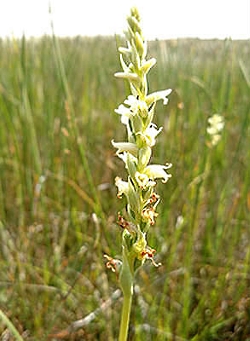
Ute Ladies’ Tresses-Orchids in Utah

Orchids in Utah: Ute Ladies' Slippers (Spiranthes diluvialis) Courtesy of the U.S. Fish and Wildlife Service, Lindstrom, Photographer
Ute Ladies’ Slippers (Spiranthes diluvialis)
Courtesy U.S. Fish and Wildlife Service
Lindstrom, Photographer
What is it about orchids in our desert state that excites me so? Perhaps its finding them so far removed from their usual tropical biome, or their uncommon beauty. I was surprised to discover that Utah has at least 16 native species of orchids. Most occur in moist, higher elevations, but a few are found in our valley bottoms.

I rejoice at spotting the first white bog orchid or striped coral root as I hike mountain trails. In the Uintah’s you may find the gorgeous Calypso orchid- also called lady slipper, perhaps my favorite. Now, the late season rattlesnake plantain is in full bloom.

Further, I was amazed to find orchids species diversity second only to the composites with orchids hosting 28 thousand species!

Last evening, I joined 8 others with the Bear River Land Conservancy near Mendon to survey a wet meadow for the late blooming Ute Ladies Tresses, a fragile beauty placed on the EPA Threatened Species list in 1992. Shrinking habitat, limited reproduction, over collection, competition from exotic weeds, and herbicides are the main threats. Other threats include impacts from recreation; mowing for hay production, grazing by cattle or horses; hydrology alteration, herbivory by native wildlife (especially meadow voles); reduction in the number and diversity of insect pollinators; drought; and conflicting management with other rare species.

Regarding reproduction, their minute seeds contain little stored food to sustain embryos and are probably short-lived in the soil. Recent attempts to germinate them took up to 1.5 years. It is hypothesized that germinated seedlings must quickly establish a symbiotic relationship with mycorrhizal soil fungi in order to survive. The absence or rarity of appropriate fungal symbionts in the soil may be a major factor limiting the establishment of new Ute ladies’- tresses populations. On a more positive note, under favorable conditions, they have extreme longevity living beyond 50 years.

Bees are their primary pollinators, particularly solitary bees in the genus Anthophora, bumblebees, and occasionally non-native honeybees. Long-term monitoring studies indicate that the relative abundance and composition of the available bee fauna varies from year to year, which may impact overall fruit production rates for the Ladies Tresses.

Orchids have vast cultural connections in art a literature. They are revered as the national flower for several countries and cities. Reading “The Orchid Thief” by Susan Orlean gave me insights into the very lucrative business world surrounding this coveted flower.

For more, visit The Utah Orchid Society and Utah Native Plant Society websites for further information and plan to join them for their frequent outings.

This is Jack Greene reading and writing for Wild About Utah.

Credits:
Images: Courtesy and Copyright
Text: Jack Greene, Bridgerland Audubon Society
Additional Reading:

MOUNTAIN PLANTS OF NORTHEASTERN UTAH, Original booklet and drawings by Berniece A. Andersen and Arthur H. Holmgren, https://forestry.usu.edu/files/uploads/hg506.pdf

https://rockymountainorchids.org/

US Wildflower’s Database of Wildflowers for Utah, https://uswildflowers.com/wfquery.php?State=UT

Spiranthes diluvialis Sheviak (Ute lady’s tresses), USDA Plants Database,
https://plants.sc.egov.usda.gov/plant-profile/EPGI

Spiranthes diluvialis (Ute ladies’-tresses), Lady Bird Johnson Wildflower Center,
https://www.wildflower.org/plants/result.php?id_plant=EPGI

Spiranthes diluvialis, Missouri Botanical Garden, (Temporarily unavailable) https://www.facebook.com/missouribotanicalgarden/posts/pfbid02LUT74wA4PBr45myWNMkbSyaXmb1hUe2bnydmrCMhsKA31sobcZGUAQHrWfPJXq7tl
https://www.efloras.org/florataxon.aspx?flora_id=1&taxon_id=10638

Spiranthes diluvialis, Intermountain Regional Herbarium Network, SEINet,
https://intermountainbiota.org/portal/taxa/index.php?taxon=102217

Ute ladies’-tresses (Spiranthes diluvialis), ECOS Environmental Conservation Online System, USFWS, https://ecos.fws.gov/ecp0/profile/speciesProfile?spcode=Q2WA

Conserving Rare Plants and Private Wetlands in Cache Valley, Thursday, Jun. 02, 2016, https://www.usu.edu/today/?id=55893

Spiranthes diluvialis Sheviak, Streambank Lady’s Tresses, Ute Lady’s Tresses, North American Orchid Conservation Center, https://goorchids.northamericanorchidcenter.org/species/spiranthes/diluvialis/

Desert Tortoise Research in the Red Cliff Desert Reserve

Desert Tortoise Research in the Red Cliff Desert Reserve: Ann walks a transect looking for desert tortoises in the Red Cliffs Desert Reserve in southwestern Utah. Courtesy & Copyright Jessie Bunkley, Photographer
Ann walks a transect looking for desert tortoises in the Red Cliffs Desert Reserve in southwestern Utah. Courtesy & Copyright Jessie Bunkley, Photographer

Desert Tortoise Research in the Red Cliff Desert Reserve: Ann McLuckie, a wildlife biologist with the Utah Division of Wildlife Resources, uses a mirror to direct sunlight into the depths of a desert tortoise burrow. Courtesy & Copyright Jessie Bunkley, Photographer Ann McLuckie, a wildlife biologist with the Utah Division of Wildlife Resources, uses a mirror to direct sunlight into the depths of a desert tortoise burrow. Courtesy & Copyright Jessie Bunkley, Photographer

Click for a larger view of an adult Desert Tortoise. Courtesy & Copyright 2009 Kevin Durso, Photographer Adult Desert Tortoise
Gopherus agassizii
Courtesy & Copyright 2009
Kevin Durso, Photographer

Hi, I’m Ann McLuckie and I work with the Division of Wildlife Resources working primarily on desert tortoises within the Red Cliff Desert Reserve. (Sound of walking in the background) We’re going out in the field today and we’re going to do a transect. We’ve done transects since 1997 and our ultimate goal is to estimate population densities and those densities will allow us to look at how tortoises are doing and then if we get densities over time we can see are the populations increasing, decreasing, or are they stable. What we’ve learned is that we have had some pretty dramatic events, such as wildfires in 2005 and a severe drought in 2002, that have impacted tortoise populations. So we’ve seen tortoises fairly stable until those two events and since we’ve actually had fairly stable populations, but at lower densities.

Oh – here’s a fresh tortoise scat! So where there’s a fresh tortoise scat there’s got to be a tortoise close by. (Sound of walking) Oh, I think I see a tortoise. I think it’s in a burrow. I’m going to get the mirror (sound of Ann setting down her backpack and unzipping it). Oh yep, there it is and I think we can get it because it’s right by the edge. Let’s see I’m going to crawl into the burrow here. Let me get my gloves (sound of gloves being removed from a plastic bag and rocks scraping). Ok there, I think I’ve got it.

So when we get a tortoise we take three measurements, two width measurements and one length measurement called the carapace length. The carapace is the upper shell of the tortoise and it gives us an idea of how old the tortoise is. So I’ll measure the tortoise. Ok. (Sound of calipers on the tortoise shell). Oh, this looks like an adult tortoise. Let see, let me sex it. The tortoise shell is made of the carapace, which is the upper shell, and then the plastron, which is the lower shell or the belly of the shell basically, and the gular is the bony plates that are under the chin. So males have a concave plastron and that allows it to mate with females so it can fit over the female shell and males also have a large gular.

We give each tortoise that we encounter a unique file number. On the edge of the carapace are what we call marginal scutes and those are just smaller sections of the shell and each of those marginal scutes is assigned a number. Whatever marginal scutes we file we add up those scutes and that gives that tortoise a unique number. So the number that this tortoise that we’re filing right now is going to have, let’s see, (sounds of flipping through datasheets) it’s going to have 3096, so that will be its number. (Sounds of filing the scutes). Ok, I think that’s about it. And we have encountered tortoises that have been previously filed and we have a whole database of those tortoises so we can just go back to our database and figure out when that tortoise was first encountered, where it was first encountered, and get to know a little bit about that tortoise.

I’m Ann McLuckie in the Red Cliff Desert Reserve signing off on Wild About Utah.

Credits:
Images: Courtesy & Copyright Jessie Bunkley
Text: Jessie Bunkley. Wildlife technician, Utah DWR/Graduate Teaching Assistant, BNR, Utah State University with assistance from Ann McLuckie, Utah Division of Wildlife Resources

Sources & Additional Reading

Red Cliffs Desert Reserve, https://www.redcliffsdesertreserve.com

Desert tortoise monitoring plan, Red Cliff Desert Reserve, Washington County, Utah (Publication / Utah Division of Wildlife Resources), Richard Fridell, 1998, https://www.amazon.com/tortoise-monitoring-Washington-Publication-Resources/dp/B0006R3LYO

World Turtle Database, EMYSystem Species Page: Gopherus agassizii, https://emys.geo.orst.edu/ (Search for “Desert Tortoise”)

Grover, Mark C., DeFalco, Lesley A, Desert Tortoise(Gopherus agassizii): Status-of-Knowledge, Outline With References, USDA, 1995, https://www.fs.fed.us/rm/pubs_int/int_gtr316.pdf

Desert Tortoise, Gopherus agassizii, Mojave National Preserve, https://www.mojavenp.org/Gopherus_agassizii.htm

Gopherus agassizii (COOPER, 1861), The Reptile Database, Peter Uetz and Jakob Hallermann, Zoological Museum Hamburg,
https://reptile-database.reptarium.cz/species?genus=Gopherus&species=agassizii

Desert Tortoise, Animal Species, Utah Division of Natural Resources, https://fieldguide.wildlife.utah.gov/?species=gopherus%20agassizii

Desert Tortoise Information and Collaboration, Mojave Desert Ecosystem Program, https://www.mojavedata.gov/deserttortoise_gov/index.html

Shrubby-Reed Mustard: The Best Little Plant You’ve Never Heard of (Aug 2016)

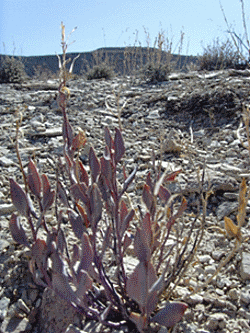
Shrubby-Reed Mustard Bush, Hesperidanthus suffrutescens
Shrubby-Reed Mustard Bush
Hesperidanthus suffrutescens
Courtesy & Copyright Matt Lewis

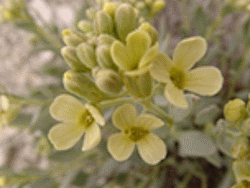
Shrubby-Reed Mustard Blossoms, Hesperidanthus suffrutescens Shrubby-Reed Mustard Blossoms
Hesperidanthus suffrutescens
Courtesy & Copyright Matt Lewis

Shrubby-Reed Mustard Blossoms Closeup, Hesperidanthus suffrutescens Shrubby-Reed Mustard Blossoms
Hesperidanthus suffrutescens
Courtesy & Copyright Matt Lewis

Tucked into isolated pockets of the Uintah Basin’s arid wildlands is the best little plant you’ve never heard of. Known to exist only in Duchesne and Uintah Counties, Shrubby-reed Mustard seems to occupy only the semi-barren “islands” of white shale in areas of the Green River Formation’s Evacuation Creek region. The endangered plant features thick, almost succulent, blue-green leaves and small yellow flowers.

“The habitat of Shrubby-reed Mustard is visually striking,” says USU alum Matt Lewis, a botanist with the Bureau of Land Management in Vernal, Utah. “It grows in very shallow, fine-textured soils and shale fragments that form narrow bands in the desert shrub community.”

Among the first plants to flower in spring, the perennial herb is visited by large number of insects, including many native bee species that forage for pollen. Scientists believe these bees may be critical in the plant’s reproduction and survival.

Lewis says the plant, also known as Toad-Flax Cress and Uintah Basin Waxfruit, offers an understated beauty to the stark landscape. With a shrub-like form and multiple stems, Shrubby-reed Mustard grows to about 20 centimeters in height. Its leaves, which feel almost like leather, change to a bright purple in the fall.

The plant is also enticingly fragrant, Lewis says. “Its scent reminds me of roses mixed with apples and pears.”

Despite its fragile status, Shrubby-reed Mustard is a long-lived plant. USU ecologist Geno Schupp says some individual plants may be one hundred years old.

The elusive species has outlived scientists’ attempts to classify it and has undergone several taxonomic changes. It currently boasts the scientific name Hesperidanthus suffrutescens, placing it solidly in the mustard family.

Lewis knows of no history of Shrubby-reed Mustard as a culinary or medicinal herb, though documented reports of such uses for mustard plants date back to ancient times. The plant appears to provide welcome forage for some four-legged creatures, he says, as he recently witnessed plants that had been grazed completely and ripped from the ground.

“Whether that was due to livestock or native ungulates, I’m not sure.”

Credits:
Images: Courtesy & Copyright Matt Lewis
Text:     Mary-Ann Muffoletto, Utah State University College of Natural Resources
Credits:
Matt Lewis, botanist, Bureau of Land Management, Vernal, Utah.
Eugene “Geno” Schupp, professor, USU Department of Wildland Resources.

Additional Reading:

https://www.fws.gov/mountain-prairie/factsheets/ShrubbyReed-mustardFactSheet.pdf

https://www.fws.gov/mountain-prairie/species/plants/shrubbyreedmustard/5YearReview2010.pdf

Bird Banding in Red Butte Canyon

Bird Banding Red Butte Canyon: Volunteers and members of the Şekercioğlu lab who run the bird banding station in Red Butte Canyon. From left to right: Kyle Mika, Jennifer Bridgeman, Kylynn Clare, Anna Vickrey, JJ Horns, Ahmed Bwika, and Patricia Gao.
Volunteers and members of the Şekercioğlu lab who run the bird banding station in Red Butte Canyon. From left to right:
Kyle Mika, Jennifer Bridgeman, Kylynn Clare, Anna Vickrey, JJ Horns, Ahmed Bwika, and Patricia Gao.
Courtesy & Copyright Jessie Bunkley, Photographer

[Sound of walking on gravel]

J.J. Horns – Our lab name is the Biodiversity and Conservation Ecology lab and our work focuses on how human land use affects different types of wildlife.

J.J. – I’m J.J. Horns.
Patricia Gao – I’m Patricia.
Ahmed Bwika – I’m Ahmed.
Anna Vickrey – I’m Anna Vickrey.
Kyle Mika – I’m Kyle Mika.
Jennifer Bridgeman – I’m Jennifer Bridgeman.
Kylynn Clare – I’m Kylynn Clare.

Bird Banding in Red Butte Canyon: J.J. Horns, a graduate student in the University of Utah Biodiversity and Conservation Ecology lab, observes a yellow warbler (Setophaga petechia) that was recently measured and banded.
J.J. Horns, a graduate student in the University of Utah Biodiversity and Conservation Ecology lab, observes a yellow warbler (Setophaga petechia) that was recently measured and banded.
Courtesy & Copyright Jessie Bunkley, Photographer

J.J. – Here in Red Butte Canyon we monitor migratory songbirds as they move through and try and get a picture of one, what is the bird community like in Utah. That’s why Red Butte Canyon is such a nice place to work because it’s a protected canyon so it gives an idea of what the natural state of birds along the Wasatch should be like. And we monitor their populations, look for any population level changes, and we look for changes in their migration, in the health of the birds, and try and understand how human effects like land development and climate change are affecting these bird communities.

Metal leg bands with unique numbers are attached to each bird, like this spotted towhee (Pipilo maculatus), allowing individuals to be identified in the future if they are recaptured.
Courtesy & Copyright Jessie Bunkley, Photographer

Ok, so we’re ready to go around and check our nets.

Anna – The mist net is this really superfine, hard to see material with shelves in it. So when the bird flies into the net it kind of falls into one of these net shelves and that material is so fine, especially if you put it in front of a tree, that the birds don’t see it and so they’ll just fly right into it, fall in, and we come around frequently enough that they’re not in there for a long time.

J.J. – So this is a bird called a spotted towhee and based on how brown that head is

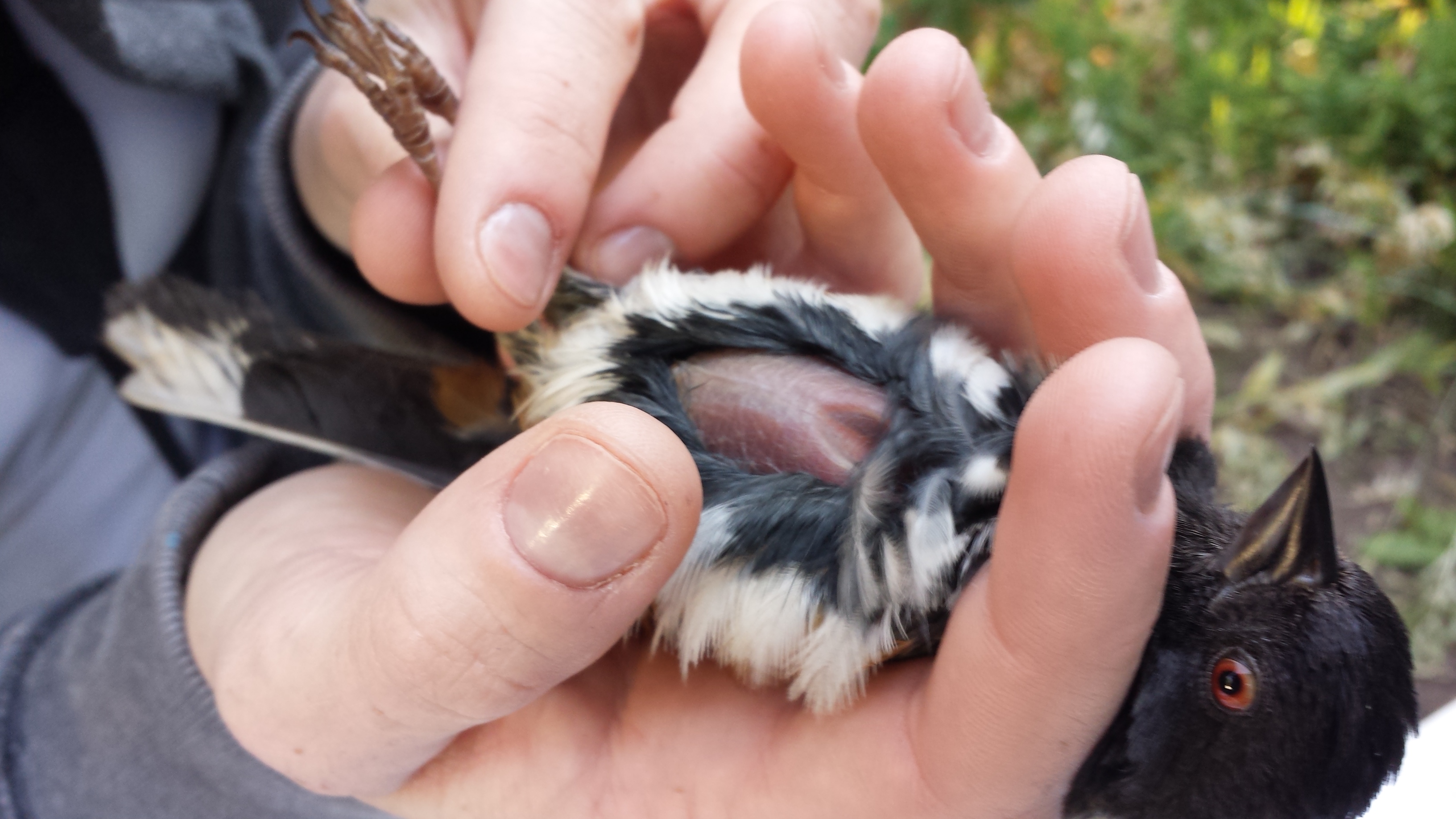
Blowing the feathers away from the body allows researchers to examine a bird's fat levels and overall health. An inspection of this spotted towhee also reveals a brood patch, indicating it is incubating eggs.
Blowing the feathers away from the body allows researchers to examine a bird’s fat levels and overall health. An inspection of this spotted towhee also reveals a brood patch, indicating it is incubating eggs.
Courtesy & Copyright Jessie Bunkley, Photographer

Anna – And the eye color, right?

J.J. – and the eye color, we can tell that it’s a little baby, just born this year. Towhee squawking in the background. When the bird lands in the net like this they get all tangled up, they get the net around their wings and around their legs, and so what we do is we carefully take it off of any part of their body where it’s tangled up and then we put them in these little bird bags. And the bird bags are just little cloth sacks that keep the bird warm and because they’re kind of dark the bird stays really calm.

Blowing feathers away from the head reveals the skull beneath, enabling the bird's age to be determined. The pattern of skull ossification on this black-headed grosbeak (Pheucticus melanocephalus) indicates it is an adult.
Blowing feathers away from the head reveals the skull beneath, enabling the bird’s age to be determined. The pattern of skull ossification on this black-headed grosbeak (Pheucticus melanocephalus) indicates it is an adult.
Courtesy & Copyright Jessie Bunkley, Photographer

Jennifer – It’s a baby yellow warbler!

Kylynn – Spotted towhee.

J.J. – Black-headed grosbeak.

Mourning dove.

Kyle – Song sparrow.

J.J. – So this is a yellow warbler. So as part of the banding we take the age and the sex and then a bunch of morphological measurements. We can tell this one’s a male by those brown streaks on the breast and we can also tell it is an older bird. It’s been around for at least one year because of that nice yellow edging on those tiny feathers there.

[Sound of JJ blowing the bird’s feathers away from its body.]

A mourning dove is examined closely by a scientist at the Red Butte Canyon bird banding station. Courtesy & Copyright Jessie Bunkley, Photographer
A mourning dove is examined closely by a scientist at the Red Butte Canyon bird banding station.
Courtesy & Copyright Jessie Bunkley, Photographer

Let’s say a CP of one. A CP is a cloacal protrusion, it’s what males get when they’re breeding. Sound of blowing. No brood patch. Brood patches are where birds will loose feathers on their stomachs so they can incubate eggs. Sound of blowing. No fat. Birds deposit fat in a really predictable way. They have a little cavity where their collar bone is. Sound of blowing. No body molts. Not growing any feathers on his body. Wing is sixty-two and his weight is 8.4.

If anyone is interested in helping out bird conservation just in their day to day life, if you have cats either keep them inside or buy them a cat bib or a couple of bell collars. That’s probably the number one thing you can do to help bird conservation.

Everyone – For Wild About Utah this is the Şekercioğlu lab in Red Butte Canyon!