Zion National Park Human-Ringtail Interactions

Human-Ringtail Interactions

Human-Ringtail Interactions: Ringtail (Bassariscus astutus), Photo Courtesy US FWS, San Andres NWR
Ringtail (Bassariscus astutus), Photo Courtesy US FWS, San Andres NWR
Within Zion national park, there is a small, little known creature named the ringtail.It is related to the raccoon and is completely nocturnal. With big eyes, bigger ears, and a black and white striped tail, they seem like a fairy tale critter. However, they are very real, albeit elusive and extremely smart. They are about the size of a house cat and spend their time hunting for mice, lizards, bird eggs, and insects while also foraging for berries and seeds. They are quite adaptable mammals, changing their diet to suit their surroundings. They can be found throughout the southwest and western coastal states from Oregon to Texas, in all sorts of habitats. However, they are rarely seen, so their presence in the desert of southern Utah usually goes unnoticed. Many residents of southern Utah don’t even know that ringtails exist, let alone live in their back yard.

A relatively large population of ringtails exist in Zion National Park, one of the most heavily traveled national parks in the US. Last year, alone, over 3.6 million people visited the park. Those tourists and visitors often eat packaged and pre-cooked foods while in the park, disposing of their trash in proper receptacles or, rather irresponsibly, along trails and campgrounds. This creates ample opportunities for ringtails to gain access to human food, such as trashcans, and may encourage them to forage for food around campsites and visitor lodging. This behavior is a problem for the guests and employees of Zion National Park, but it is also extremely problematic for the ringtails in this area.

Ringtail (Bassariscus astutus), Photo Courtesy US BLM
Ringtail (Bassariscus astutus)
Photo Courtesy US BLM
© Lee Dittmann, Photographer
The consumption of human foods and trash items are creating a significant shift in the composition of the diets of ringtails in this park. Researchers at Utah State University collected scats from ringtails in the park to analyze what they were eating. While the scats collected far from human buildings and activity showed the diet that is expected for wild ringtails in this area (e.g. insects, plant material, and some small rodent remains), the scats collected around and inside human buildings told a much more disconcerting story. There was trash and non-digestible food items present in over a third of the scats collected. These items perhaps could be due to the wrappings of human food, such as napkins, or they could be a byproduct of trying to gain access to the food, such as eating foil candy bar wrappers. A lot of human food is accessed through improperly sealed trash containers, poor food storage in campsites and cabins, and potentially hand feeding, all of which put the ringtails at risk for dietary problems, behavioral problems, and possibly death.

The ringtails are also coming towards buildings in the communities around Zion National Park, such as Springdale and Rockville, to seek easy shelter in the colder months, something that is not necessary for their survival. Properly sealing homes, particularly attics, in the areas where ringtails occur will prevent the ringtails from entering the living spaces of humans, and gaining access to food items dangerous to them. It will also prevent the homeowner from dealing with the aftermath of having a ringtail take up residence in an attic or crawlspace. Any hole larger than 2″ in diameter is enough to allow an adult male ringtail to enter. Surveying a house’s foundations and siding each fall to identify any such holes, and fill them in, can go a long way toward preventing ringtails from entering a home; helping ringtails practice healthy, wild behavior.

Ringtails are a certainly a wildlife sighting to remember, but make sure you only see them on their terms. Always properly store, prepare, and dispose of food items when in areas with wildlife. It protects you and it protects them, making sure your experience in natural areas remains a positive one.

Human-Ringtail Interactions-Credits:
Human-Ringtail Interactions
Images:   Courtesy US FWS
               Courtesy US BLM & Copyright © Lee Dittmann, Photographer
Text:        Adrian Roadman, Nicki Frey and Mary-Ann Muffoletto
Read by:  Mary-Ann Muffoletto, Utah State University College of Natural Resources
Credits:    Adrian Roadman and Nicki Frey

Human-Ringtail Interactions-Additional Reading:

Frey, S. Nicole & Godding, Heather, Ringtails (Bassariscus astutus), Resolving Human-Wildlife Conflicts – Southwestern Wildlife Series, Extension Utah State University, July 2013, https://digitalcommons.usu.edu/cgi/viewcontent.cgi?article=2218&context=extension_curall

Roadman, Adrian & Frey, S. Nicole, Detection and Relative Distribution of Ringtails (Bassariscus astutus) in Zion National Park, Utah
Extension Utah State University, July 2019, https://digitalcommons.usu.edu/cgi/viewcontent.cgi?article=3024&context=extension_curalll

The Great Salt Lake–A Giant Among Us

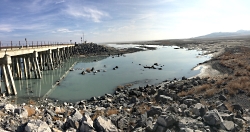
A Giant Among Us, The Great Salt Lake: The Great Salt Lake Breach
The Great Salt Lake Breach
Courtesy U.S. Geological Survey
Department of the Interior/USGS
Mike Freeman, Photographer
10 Nov 2015
Water flowing through the Great Salt Lake breach in 2011, when lake levels were high due to above average snowfall in the Wasatch and Uinta Mountains. The Great Salt Lake breach is an area that allows water to travel between the southern and northern parts of the lake.
There is a giant among us with a profound influence on our past, present, and future. My first encounter with this giant was both buoyant and delightful as I floated in the brine on a lovely summer day. But I was oblivious to the Great Salt Lake’s immense value as an environmental, cultural, and economic resource.

A Giant Among Us–The Great Salt Lake

Much of what follows is taken from a very recently released collaborative study titled “Impacts of Water Development on Great Salt Lake and the Wasatch Front” which was a collaborative effort from four institutions(Utah State University, Utah Division of Water Resources, Salt Lake Community College, and the Utah Division of Wildlife Resources.)

A 2012 analysis by Bioeconomics estimated the economic value of the lake at $1.32 billion per year for mineral extraction, brine shrimp cyst production, and recreation. The abundant food and wetlands of the lake attract 3 million shorebirds, as many as 1.7 million eared grebes, and hundreds of thousands of waterfowl during spring and fall migrations. Because of this, it has been designated as a Western Hemisphere Shorebird Reserve Network Site. Due to its enormous surface area, it produces the “lake affect” which enhances our snow pack by an estimated 8%, a significant amount for both skiers and our available water. But our giant is shrinking.

Since the arrival of 19th Century pioneers water diversions for irrigation have decreased its elevation by 11 feet exposing much of the lake bed. Natural fluctuations in rainfall and river flow cause the lake level to rise and fall, but there has been no significant long‐term change in precipitation and water supply from the main tributaries since their coming in 1847.

The Great Salt Lake Breach 2015
The Great Salt Lake Breach
Credit: U.S. Geological Survey
Department of the Interior/USGS
Mike Freeman, Photographer
10 Nov 2015

For the first time since it was opened in 1984, water has stopped flowing through the Great Salt Lake causeway breach, an area that allows water to travel between the southern and northern parts of the lake.
To significantly reduce water use, a balanced conservation ethic needs to consider all uses, including agriculture, which consumes 63 percent of the water in the Great Salt Lake Basin. There are no water rights to protect our Great Lake, so water development currently focuses solely on whether there is water upstream to divert. If future water projects reduce the supply of water to the lake, (such as the Bear River Development Project, its level will (most likely) continue to drop.

We must look beyond the next few decades and decide how we value the lake for future generations. Lower lake levels will increase dust pollution and related human health impacts, and reduce industrial and environmental function of Great Salt Lake. We must be willing to make decisions now that preserve Great Salt Lake’s benefits and mitigate its negative impacts into the coming centuries.

John Muir, one of my favorite early American naturalists would most certainly agree with me. From his baptismal plunge into the Great Salt Lake. “I found myself undressed as someone else had taken me in hand and got myself into right lusty relationship with the brave old lake. I was conscious only of a joyous exhilaration….”
And where else could John and I have such a wonderfully buoyant experience?

This is Jack Greene reading for Wild About Utah.

2015 Great Salt Lake Breach at Lakeside, Utah
Gauge near the Great Salt Lake Breach
Credit: U.S. Geological Survey
Department of the Interior/USGS
Mike Freeman, Photographer
10 Nov 2015
A gauge to measure lake water levels stands dry in the lake bed of the Great Salt Lake. For the first time since it was opened in 1984, water has stopped flowing through the Great Salt Lake causeway breach, an area that allows water to travel between the southern and northern parts of the lake.
Credits:
Image: Courtesy U.S. Department of the Interior, U.S. Geological Survey(USGS), gallery.usgs.gov
Text:     Jack Greene, Bridgerland Audubon Society & USU Office of Sustainability
Additional Reading:

Great Salt Lake, Utah, Stephens, Doyle W. and Gardner, Joe, USGS Science for a Changing World, https://pubs.usgs.gov/wri/wri994189/PDF/WRI99-4189.pdf

Salt Lake Brine Shrimp, https://saltlakebrineshrimp.com/harvest/

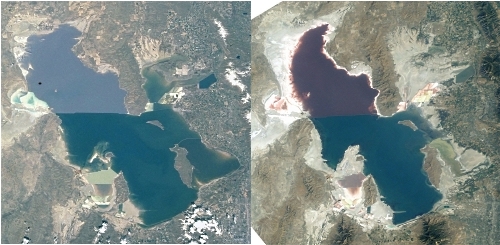
Great Salt Lake Footprint 2001 vs 2003 Comparison
Great Salt Lake Footprint Comparison
2001 vs 2003
Images Courtesy NASA
NASA’s Earth Observatory

Edible Weeds: Lambs Quarters and Purslane

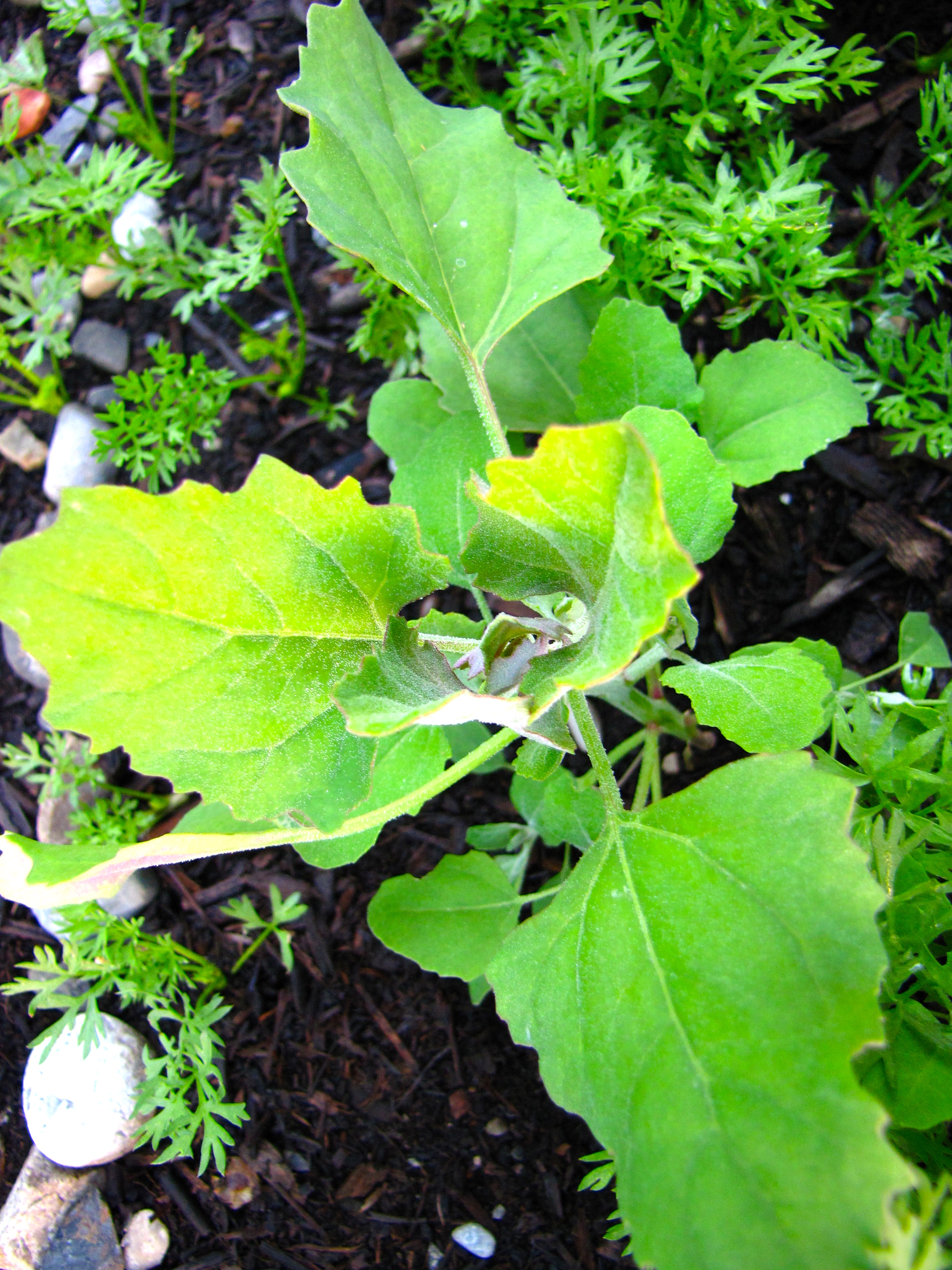
Lambs Quarter Courtesy and Copyright Roslynn Brain, Photographer
Lambs Quarter
Courtesy and Copyright Roslynn Brain, Photographer
Michael Pollan, author of “In Defense of Food” and “The Omnivores Dilemma”, called lambs quarters and purslane “two of the most nutritious plants in the world.” Weeding them would be a waste, both taste and health-wise!

Also called pigweed, goosefoot and wild spinach, lambs quarters is a common garden weed and is found with easy access in most urban settings. Sporting broad, green leaves and a powdery-white middle, lambs quarters can substitute as spinach in any dish, and is packed with nutrients too!

While most edible weeds are best harvested in spring, lambs quarters thrive throughout the entirety of summer. While young, the plant can be collected whole, but as it ages and becomes tougher, only the tender tops are recommended. Try it raw in salads or green smoothies. Seeds can be collected as an excellent source of protein.

Nutritionally, lambs quarters is a close competitor with spinach. 1 cup of boiled and lightly salted lambs quarters has a whopping 6g of protein, more than double your daily value of Vitamin A, 66 mg Vitamin C and 120 mg Iron.

Purslane Courtesy and Copyright Roslynn Brain, Photographer
Purslane
Courtesy and Copyright Roslynn Brain, Photographer
Another common weed found growing between sidewalk cracks or in our gardens is purslane. Purslane is a succulent originally from India, but is now found as a wild weed in all 50 U.S. states. This plant grows low to the ground, contains slightly reddish stems and sports tangy succulent green leaves with a similar quality as okra.

The leaves, stems, and flowers of purslane can all be eaten either fresh or cooked. The health benefits rival many other green vegetables you work hard to plant and maintain in your garden, yet it grows effortlessly!

The fresh succulent leaves of this wonder weed contain more omega-3 fatty acids than any other leafy vegetable plant, and has five times the concentration than can be found in spinach! It also contains more omega-3’s than many fish oils in the grocery store. In a 100 gram serving of raw Purslane, you can get more than 1320 international units of Vitamin A, 21 mg Vitamin C, and a dense array of B-complex vitamins!

As Ralph Waldo Emerson rhetorically asked, “what is a weed? A plant whose virtues have never been discovered.”

For Utah State University Extension Sustainability, this is Roslynn Brain.

Credits:
Images: Courtesy and copyright Roslynn Brain, Photographer
Text:     Roslynn Brain, Utah State University Extension Sustainability


Additional Reading:

The Logan River June Bug

“Darling, I’m having a struggle with the trout. They are too much for me in the swift, rushing river. I lose ‘em. Went out yesterday… and lost two—one a large fish. The ‘June Bugs’ – a red bodied insect, as big as the biggest grasshopper you ever saw, fall from the leaves on to the river and are such large juicy mouthfuls that the trout have abundant food, and don’t care much for a fly.”1

Frederick Jackson Turner c 1890 Public Domain Courtesy Wikipedia
Frederick Jackson Turner
c 1890
Public Domain
Courtesy Wikipedia
That is an excerpt from a letter from U.S. historian and novice fly angler Frederick Jackson Turner. He was writing to his wife Caroline Mae on June 20, 1924, while visiting Utah Agricultural College in Logan. Turner didn’t know it at the time, but the large red-bodied “June Bugs” were actually salmonflies, a prehistoric-looking stonefly from the genus Pteronarcys. Turner was also unaware that his letter would become the earliest written record showing that salmonflies were once abundant in the Logan River.

Salmonflies are a type of large stonefly that live in many western rivers and are often called “rock rollers” or “shredders” because they hide under boulders and gorge themselves on leaf litter until early summer when they crawl out from under the rocks, shed their exoskeleton, and clumsily fly around hoping to bump into a mate. These bugs love cold, clean, oxygenated water, all of which are hallmarks of the Logan River. Existing records show that salmonflies were well established on the Logan River until at least 1951, after which time something wiped them out. The last time anyone saw a Pteronarcys on the Logan River was September 7, 1966, near Mendon Bridge.2

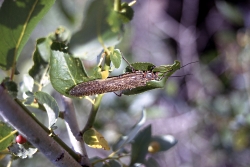
Salmon fly; Photographer unknown; 1967 Yellowstone Photo Collection Courtesy NPS and Yellowstone Association
Salmon fly;
Photographer unknown;
1967
Yellowstone Photo Collection
Courtesy NPS and Yellowstone Association
In 2001, the “Disappearance of the Salmonflies,” as it’s now known among bug enthusiasts, sparked the curiosity of Mark Vinson, former director of the Utah State University National Aquatic Monitoring Center, aka the “USU Bug Lab.” Vinson decided to compare the Logan River to nearby Blacksmith Fork River, which continues to support a healthy population of salmonflies. Vinson observed that the absence of salmonflies in the Logan River was one of the few differences between the invertebrate faunas in the two streams. He studied discharge and water temperature regimes between the two and found they were also similar and had not changed since the 1960s. He wrote, “Overall, the Logan River within Logan Canyon remains a beautiful stream and habitat, and water quality conditions have not changed much since 1960, at least not enough to prevent salmonflies from living in the river.”3 To test his observations Vinson decided to try and recolonize the Logan River with salmonflies from the Blacksmith Fork River. Between 2004 and 2007 volunteers relocated thousands of salmonflies in the hope they would once again call the Logan River home. Out of the thousands of immigrant stoneflies, Vinson only found two that survived longer than one year. The massive relocation effort was a bust, and proved that there was still something about the Logan River that these critters didn’t like.

Each semester, watershed science students at Utah State University don leaky waders and wander up Logan Canyon to conduct aquatic invertebrate sampling. I was once one of those bright-eyed students, standing in the Logan River with a kick-net and dreams of finding the long-lost Pteronarcys. I never found one. Over the years, researchers have ruled out obvious factors like water quality, stream temperature, or habitat, that might limit salmonfly reproduction on the Logan River. Chemical spills and sagebrush abatement in Logan Canyon during the 1950s may have originally contributed to the bugs’ demise, but doesn’t explain why they can’t survive for long in the river today. Of course, anglers have their own ideas about what going on, including tales of a giant Sasquatch urinating in the river somewhere near Rick’s Spring.

Even today the plot thickens. Continued aquatic invertebrate sampling by the Bug Lab has shown that salmonflies are also absent from Left Hand Fork of Blacksmith Fork River as well as upper Rock Creek.4 Incredibly, both of these streams are tributaries to the main stem Blacksmith Fork River, which is full of salmonflies. This anomaly has everyone scratching their heads. All anyone can say for certain is that some variable, biotic or abiotic, or possibly even “Sasquatch-iotic” is keeping salmonflies from populating these two tributaries. Could it be the same variable that’s keeping Frederick Jackson Turner’s “June Bugs” from reclaiming the Logan River? The answer to this question, along with whether Turner ever did land a trout, has yet to be answered.

For Wild About Utah, I’m Brad Hansen.

Footnotes:
1. Ray A. Billington, “Frederick Jackson Turner and ‘Logan’s National Summer School,’ 1924,” Utah Historical Quarterly 37, no. 3 (1969): 327.
2. Nancy A. Erman, “Occurrence and Distribution of Invertebrates in Lower Logan River” (master’s thesis, Utah State University, 1968), 17. Available online at https://digitalcommons.usu.edu/cgi/viewcontent.cgi?article=1333&context=etd
3. Mark Vinson, “A short history of Pteronarcys californica and Pteronarcella badia in the Logan River, Cache County, Utah.” January 14, 2008. Available online at https://www.usu.edu/buglab/Content/Files/salmonfly%20history.pdf
4. Phone conversation with Joe Kotynek, USU Bug Lab Taxonomist, January 24, 2017.

Credits:
Photo: Courtesy Wikipedia (Public Domain) and
Photo: Courtesy NPS and Yellowstone Association
Text: Brad Hansen

Additional Reading

Logan River Salmonfly Disappearance, USU Buglab Archived Projects, https://www.usu.edu/buglab/Projects/ArchivedProjects/