A Nuthatch In Three Varieties

White-breasted nuthatch	 Sitta carolinensis Courtesy US FWS David Brenzinski, Photographer
White-breasted nuthatch
Sitta carolinensis
Courtesy US FWS
David Brenzinski, Photographer
Inverted woodpecker, a phrase I use to describe the feeding habits of the amazing nut hatch family. I first became aware of this lovely little songbird growing up in Michigan, where the white-breasted nut hatch was common fare in the north woods. Their little laughing notes were most welcome as I sat on my deer stand where I would watch them search bark crevices for yummy morsels of grubs, insect eggs or seeds they had wedged in for tomorrow’s snack.

Red Breasted Nuthatch Courtesy US FWS Dave Menke, Photographer
Red Breasted Nuthatch
Courtesy US FWS
Dave Menke, Photographer
Now having lived many years in Utah, it is the red-breasted nut hatch that has replaced this eastern cousin for the most part. Their “yank, yank, yank” vocalizations light up my life whenever and wherever they occur. They prefer conifers but will gladly substitute a deciduous tree, especially those with more furrowed bark. Where there is food or water, infrequently a white-breasted will appear, especially in our higher elevations, although I’ve had them join the red-breasted at our feeder during winter months – a rare treat.

Pygmy nuthatch, Sitta pygmaea, Courtesy US FWS Lee Karney, Photographer
Pygmy nuthatch
Sitta pygmaea
Courtesy US FWS
Lee Karney, Photographer
If one spends much time in our Ponderosa pine forests in central and southern Utah, another family member can be found. Unlike the other two more solitary species, these tiny pygmies occur in small flocks and are very chatty. Highly social, the pygmy nut hatch appear to enjoy a food frolic as they fly from tree to tree for feeding and social interaction. Thus, Utah’s blessed with all three North American species of nut hatch.

If you observe them as they search the main stem of a tree, my inverted woodpecker title will be justified. Rather than moving from top to bottom of the tree facing up as do the woodpeckers, the nut hatch prefers head down from top to bottom. They also like hanging upside down on a horizontal limb. Why? Evolution keeps us mysteries well-guarded. I conjecture partitioning might be part of the answer: a phenomenon where bird species will utilize different parts of the tree to avoid competing for resources with other species.

As with all of life, I pay attention to how our shifting climate has been observed or predicted to affect their populations and distribution. As long as there are conifers breeding season, nut hatches are content. They can be found in dry Ponderosa pine foothills, in moist boreal bogs, around tree line in the mountains, and even in planted Christmas tree plantations. Audubon’s seven-year generated climate model shows an overall northward drift of the species’ range with more disruption and range loss in summer than in winter. The nut hatch is a habitat generalist in winter, so summertime climate is the chief concern going forward. However, whether the species adapts in the decades ahead will be determined in large part by the conifer forest health in a changing climate. The projection for species range change from 2000 to 2080 is 19% of summer 2000 range remaining stable and 58% of winter range projected to be stable. It’s my plan to follow them wherever they may go.

Wild about Utah is brought to you in part by our listeners and the Moab area travel council, whose support of tourism events and recreation in Grand county promotes and protects the natural beauty for visitors from across the state of Utah. Information available online at discovermoab.com

This is Jack Green, reading and getting wilder about Utah as days pass.

Credits:

Pictures: Courtesy US FWS, David Brenzinski, Photographer
Contains Sound: Courtesy Kevin Colver
Text: Jack Greene, Bridgerland Audubon Society //Utah State University Sustainability

Additional Reading:

White-breasted Nuthatch, All About Birds, Cornell Lab of Ornithology, https://www.allaboutbirds.org/guide/White-breasted_Nuthatch/id

Red-breasted Nuthatch, All About Birds, Cornell Lab of Ornithology, https://www.allaboutbirds.org/guide/Red-breasted_Nuthatch/id

Pygmy Nuthatch, All About Birds, Cornell Lab of Ornithology, https://www.allaboutbirds.org/guide/Pygmy_Nuthatch/id

Red-breasted Nuthatch, Sitta canadensis, eBird, Cornell Lab of Ornithology, https://ebird.org/species/rebnut

Thoughts on Bird Brains

CT image of a Bird Brain Golden Woodpecker, Melanerpes aurifrons https://www.nsf.gov/news/mmg/mmg_disp.jsp?med_id=79726
CT image of a Bird Brain
Golden Woodpecker
Melanerpes aurifrons
https://www.nsf.gov/news/mmg/mmg_disp.jsp?med_id=79726
When I was a young lad being called “bird brain” was an indication that one was lacking in mental capacity.
Over the years I’ve come to question this connotation, and might even consider it a compliment. I suggest that quantity of this gray matter might be outweighed by quality.

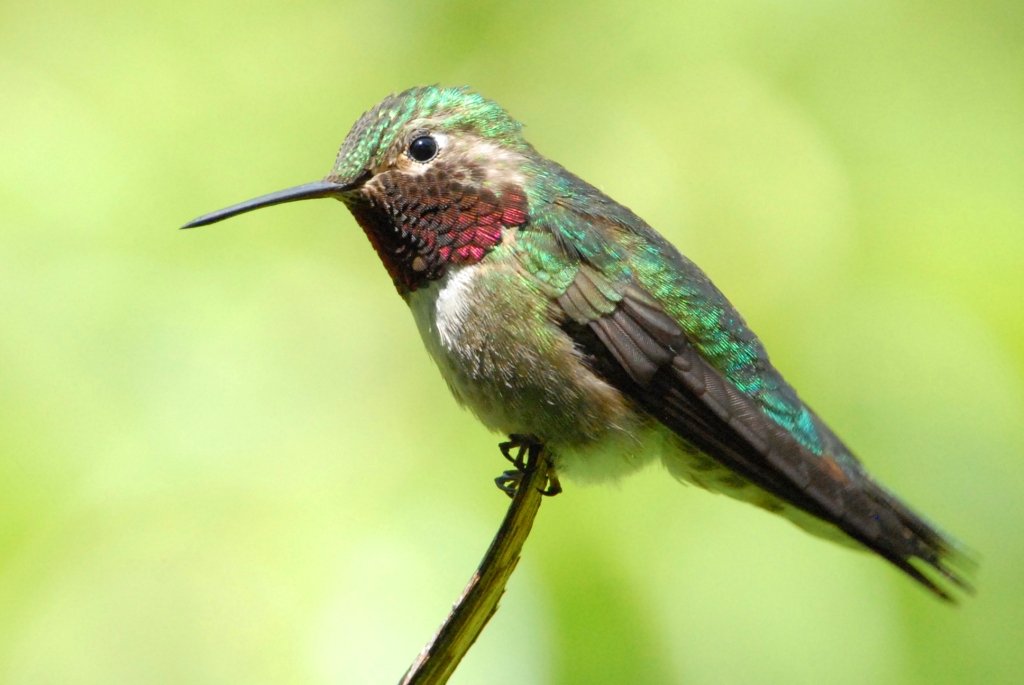
Consider the hummingbird brain. Slightly larger than a bibi, it is very capable of feats beyond our imagining. Think unerring migration over hundreds of miles, efficient pollination while suspended in air, extraordinary flight capability, adjusting to extreme environmental challenges of cold, heat, predation, nourishment; exquisite nest design and construction, and so on.

Clark's Nutcracker Courtesy US Fish & Wildlife Service Dave Menke, Photographer
Clark’s Nutcracker
Courtesy US Fish & Wildlife Service
Dave Menke, Photographer

Regarding memory, nothing has been found to match the recall ability of the Clark’s nutcracker, which can bury thousands of pine nuts in rugged mountain terrain, finding them with uncanny ability following months of absence. Of course they hoard far more than needed, allowing many to germinate into seedlings- an amazing keystone species responsible for planting millions of trees from Mexico to Canada – this “squirrel bird” of the Rockies.

I’ve watched crows dropping nuts on roadways so they can be crushed open by passing vehicles, then flying down to eat the contents between oncoming traffic. And gulls dropping rocks on our pets to shoo them away from food dishes so they can have their turn at the table.

An ice fisherman was puzzled by a thief who was stealing his fish by pulling the line out of the ice hole and removing the fish. The culprit was finally observed- a raven- who used its beak and feet to gradually pull up the line with fish attached- an easy catch!

How about those mimics- parrots, corvids, starlings, gray catbirds, and the masterful mocking bird who can expand their repertoire of mimics to nearly 100 imitations without a pause.

And let us consider the remarkable Peregrine falcon. How is it possible that this lovely bird can strike a fast moving, highly maneuverable target as it drops from the heavens at a speed approaching 200 mph? Eyes, muscles, and nerves woven in such a manner that allow it to perform this feat is beyond comprehension.

I’ll conclude with perhaps my favorite bird attribute- their vocalizations. The more scientists learn, the richer their communications appear, possessing qualities once ascribed solely to the human language. Recent research has revealed that birds use syntax, which is altering the sequence of notes for variable meanings. Call order matters to them, much like word order does to us. The sound of birds calling isn’t just pretty. It’s full of meaning. I dare you to call me bird brain!

This is Jack Greene and I’m Wild About Utah

Credits:

Pictures: Courtesy US National Science Foundation & Courtesy US Fish & Wildlife Service, Dave Menke, Photographer
Audio: Courtesy and Copyright Kevin Colver
Text: Jack Greene, Bridgerland Audubon Society

Additional Reading:

Bird IQ Tests: 8 Ways Researchers Test Bird Intelligence, National Audubon, Alexandra Ossola, 9 Dec 2015, https://www.audubon.org/news/bird-iq-tests-8-ways-researchers-test-bird-intelligence

Bird Intelligence: Using Tools, Speech, Memory, Interactive Toys, and Emotional Displays
Veterinary & Aquatic Services Department, Drs. Foster & Smith, PetEducation.com, Petco Wellness LLC, https://www.peteducation.com/article.cfm?c=15+1795&aid=3342

Here’s Why ‘Birdbrain’ Should Be a Compliment, Simon Worrall, National Geographic, 15 May 2016, https://news.nationalgeographic.com/2016/05/160515-genius-birds-animal-intelligence-ackerman-ngbooktalk/


Our Invasive Phragmites

Our Invasive Phragmites: Great Salt Lake Phragmites Courtesy & Copyright Karin Kettenring
Great Salt Lake Phragmites
Courtesy & Copyright Karin Kettenring
Those unfamiliar with the history of the Utah’s wetlands may see Phragmites and say, “What a beautiful, elegant plant! It looks so graceful blowing along the shore.” Our Invasive Phragmites
However, the plant’s attractiveness and ability to absorb pollutants may not compensate for its negative impacts.

Phragmites is an invasive perennial grass that now thrives in much of the wetlands around the Great Salt Lake and other marshes in northern Utah. It grows in dense clusters and normally reaches 5 to 10 feet in height. If the conditions are right it can reach 15 feet.

The patches of grass are so dense that wetland managers are called out each year to rescue duck hunters – who are lost in the Phragmites.

Karin Kettenring, associate professor of wetland ecology in the Department of Watershed Sciences at USU and her research team have been studying Utah Phragmites for the past decade.

Kettenring explains why Phragmites is a concern, “We fear it is fundamentally changing the habitat of Great Salt Lake wetlands which are renowned for being a home for migratory birds including waterfowl and shore birds.”

The exotic grass most likely started in the Great Salt Lake wetlands after the flooding of 1983. The flood washed out the marshes. When the water levels receded, the salty water had destroyed all the native vegetation in the wetlands. Phragmites then moved in. By 2011, the exotic grass had spread over 24,000 acres.

Mowing Phragmites Courtesy & Copyright Karin Kettenring
Mowing Phragmites
Courtesy & Copyright Karin Kettenring
Scientists believe humans inadvertently brought Phragmites to Utah, since birds don’t migrate East and West, and the birds usually don’t eat the seeds. Someone’s boat may have transported the seeds into Utah. They sat dormant in the soil until the conditions were perfect, then the spread of Phragmites began.

Today an average small patch of Phragmites, about 20 feet square, can spread a couple yards a year just from the stems it sends out above and below the ground. However, research has shown it’s not the stems that cause the most reproduction – but the seeds.

Karin_Kettenring-in-the-Great-Salt-Lake-Wetlands Courtesy & Copyright Karin Kettenring
Karin_Kettenring-in-the-Great-Salt-Lake-Wetlands
Courtesy & Copyright Karin Kettenring
Karen Mock, associate professor in the Department of Wildland Resources and a long-term collaborator on this project helped Kettenring with the genetic work.

They tested the genetics of a lot of Phragmites pulled from the same patches and found many different genotypes – proving the plants came from different seeds, not the stems of neighboring plants.

With these results, Kettenring’s lab discovered the best way to control the invasive grass is to first control the seed production by mowing the grass mid-summer to keep it from spreading. Then in the fall spraying the area with herbicide three years in a row. An herbicide approved for use in wetlands can be used – such as Rodeo.

If the Phragmites has been there only a few years then the seeds of the native vegetation will still be in the soil, and they’ll come back on their own.

However, if the Phragmites has been there for a long time then re-seeding of native plants will be necessary.

To determine the best way to re-seed wetlands, Kettenring partnered with Utah Division of Wildlife Resources, Utah Division of Forestry, Fire & State Lands and David England – one of Kettenring’s past graduate students. England has spent extensive time in the lab determining how to help seeds germinate.

Emily Martin, Kettenring’s current graduate student will also help with the UDWR reseeding as she searches for techniques to make seeding more effective.

Ultimately their goal is to restore native plant communities to keep Phragmites from coming back and restore habitat for important migratory birds.

This is Shauna Leavitt and I’m Wild About Utah.

Our Invasive Phragmites-Credits:
Photos: Courtesy & Copyright Karin Kettenring
Audio: Courtesy and Copyright Kevin Colver
Text: Shauna Leavitt, Utah Cooperative Fish and Wildlife Research Unit, Quinney College of Natural Resources, Utah State University

Our Invasive Phragmites-Additional Reading

How to control Phragmites
Kettenring, Karin, Rupp, Larry, Whitesides, Ralph, Hazelton, Eric, Phragmites Control at the Urban/Rural Interface, 2014, https://works.bepress.com/karin_kettenring/92/

Extensive readings about Phragmites:
https://works.bepress.com/karin_kettenring/

Video: USU researchers mowing Phragmites in the Great Salt Lake wetlands. The passenger is Chad Cranney a past graduate student of Karin Kettenring’s:
https://bft.usu.edu/rqcq9

*****

Larese-Casanova, Mark, Phragmites-Utah’s Grassy Invader, Wild About Utah, August 23, 2012, https://wildaboututah.org/phragmites-utahs-grassy-invader/

Common Reed, Phragmites australis. National Invasive Species Information Center, USDA National Agricultural Library, https://www.invasivespeciesinfo.gov/aquatics/commonreed.shtml

Phragmites Factsheet, US Fish & Wildlife Service, https://www.fws.gov/GOMCP/pdfs/phragmitesQA_factsheet.pdf

Phragmites Phragmites australis, Aquatic Invasive Species, Utah Division of Wildlife Resources, Sept 17, 2013, https://wildlife.utah.gov/habitat/ans/phragmites.php

Phragmites Phragmites australis, Plants Database, USDA Natural Resources Conservation Service(NRCS), https://plants.sc.egov.usda.gov/plant-profile/phau7

Habitat Heroes Explore Utah Biomes

Utah is a wildly diverse place. Ecological and biological diversity are usually tied to an abundance of water; but here in Utah, despite our relative lack of the wet stuff, we boast of at least nine unique biomes spanning from the low-elevation Mojave Desert around St. George to the high Alpine Tundra of our many snowcapped mountain ranges. You can think of a biome as a large community of similar organisms and climates or a collection of similar habitats. Just recently, my third grade students wrapped up a semester-long investigation into seven of those biomes found in Utah including the high Alpine Tundra, Riparian/Montane Zone, Sagebrush Steppe, Wetlands, and the Great Basin, Colorado Plateau, and Mojave Deserts. We explored those biomes by way of researching a specific animal endemic in Utah to each of those biomes. We called our project “Habitat Heroes.” I’ll let a few of my students explain their findings.

(Student readings)
Asher's Gila Monster Courtesy & Copyright EBLS (Full Student Name Redacted)
Asher’s Gila Monster
Courtesy & Copyright EBLS
(Full Student Name Redacted)
Asher’s Gila Monster:
My name is Asher, and my animal is the Gila Monster. The Gila Monster lives in the Mojave desert biome in southwest Utah. Gila Monsters look like a lizard, just black and orange or pink and yellow with a black face and a short thick tail. Gila Monsters eat the eggs from ground birds, lizards, and snakes. Gila Monsters live in the Mojave desert in sandy areas and on rocky shelves and in burrows.
Jane's Pygmy Rabbit Courtesy & Copyright EBLS (Full Student Name Redacted)
Jane’s Pygmy Rabbit
Courtesy & Copyright EBLS (Full Student Name Redacted)
Jane’s Pygmy Rabbit:
I am Jane, and I am going to tell you about the pygmy rabbit. The pygmy rabbit lives in the sagebrush steppe biome in Utah. Did you know that a pygmy rabbit can protect itself by hiding in the sagebrush? They eat sagebrush and they drink lake water and river water. They have to chew on food to keep their teeth short.
Haven's Red Fox Courtesy & Copyright EBLS (Full Student Name Redacted)
Haven’s Red Fox
Courtesy & Copyright EBLS (Full Student Name Redacted)
Haven’s Red Fox:
My name is Haven, and my animal is the red fox. The red fox lives in the alpine tundra biome in Utah. Red foxes eat small mammals, berries, insects, and other food, too. They have huge ears so they can hear when other animals are coming. The red fox is a really tricky and aggressive animal because it can do a lot of really tricky and aggressive things!

In addition to researching the different biomes and learning about the adaptations animals must possess in order to survive there, these third graders have been visiting the several biomes local to Cache Valley and investigating their research animals’ habitats. These experiences have been powerful in helping students realize what it’s really like to exist in the wilds of Utah.

I’m Josh Boling, and I’m Wild About Utah!

Investigating Beaver Habitats Along Temple Fork Courtesy & Copyright Eric Newell, EBLS
Investigating Beaver Habitats Along Temple Fork
Courtesy & Copyright Eric Newell, EBLS
Exploring an alpine-type biome along beaver creek Courtesy & Copyright Eric Newell, EBLS
Exploring an alpine-type biome along beaver creek
Courtesy & Copyright Eric Newell, EBLS
Flying like the birds; Bear River Migratory Bird Refuge Courtesy & Copyright Eric Newell, EBLS
Flying like the birds; Bear River Migratory Bird Refuge
Courtesy & Copyright Eric Newell, EBLS
Looking at tree migration in Green Canyon Courtesy & Copyright Eric Newell, EBLS
Looking at tree migration in Green Canyon
Courtesy & Copyright Eric Newell, EBLS
Investigating Beaver Curtis Creek wanderings; Hardware Ranch; Blacksmith Fork Canyon Courtesy & Copyright Eric Newell, EBLS
Investigating Beaver Curtis Creek wanderings; Hardware Ranch; Blacksmith Fork Canyon
Courtesy & Copyright Eric Newell, EBLS

Credits:
Images:
    Artwork Courtesy & Copyright Josh Boling’s 3rd Grade students
    Special thanks to Lisa Saunderson, Edith Bowen Lab School Art Teacher, for her help in instructing the students toward the creation of their artwork
    Photos Courtesy & Copyright Eric Newell, Edith Bowen Laboratory School Field Experience Director
Sound:
Text: Josh Boling, 2017, Bridgerland Audubon Society

Sources & Additional Reading

Boling, Josh and students, Habitat Heroes Explore More Utah Biomes, Wild About Utah, Apr 8, 2019, https://wildaboututah.org/explore-utah-biomes/

Edith Bowen Laboratory School, https://edithbowen.usu.edu/

Biomes, Kimball’s Biology Pages, https://www.biology-pages.info/B/Biomes.html

Mission Biomes, NASA Earth Observatory, https://earthobservatory.nasa.gov/experiments/biome

The World’s Biomes, University of California Museum of Paleontology, UC Berkeley, https://ucmp.berkeley.edu/glossary/gloss5/biome/