“Greetings puny earthlings”

Download Pre-broadcast audio
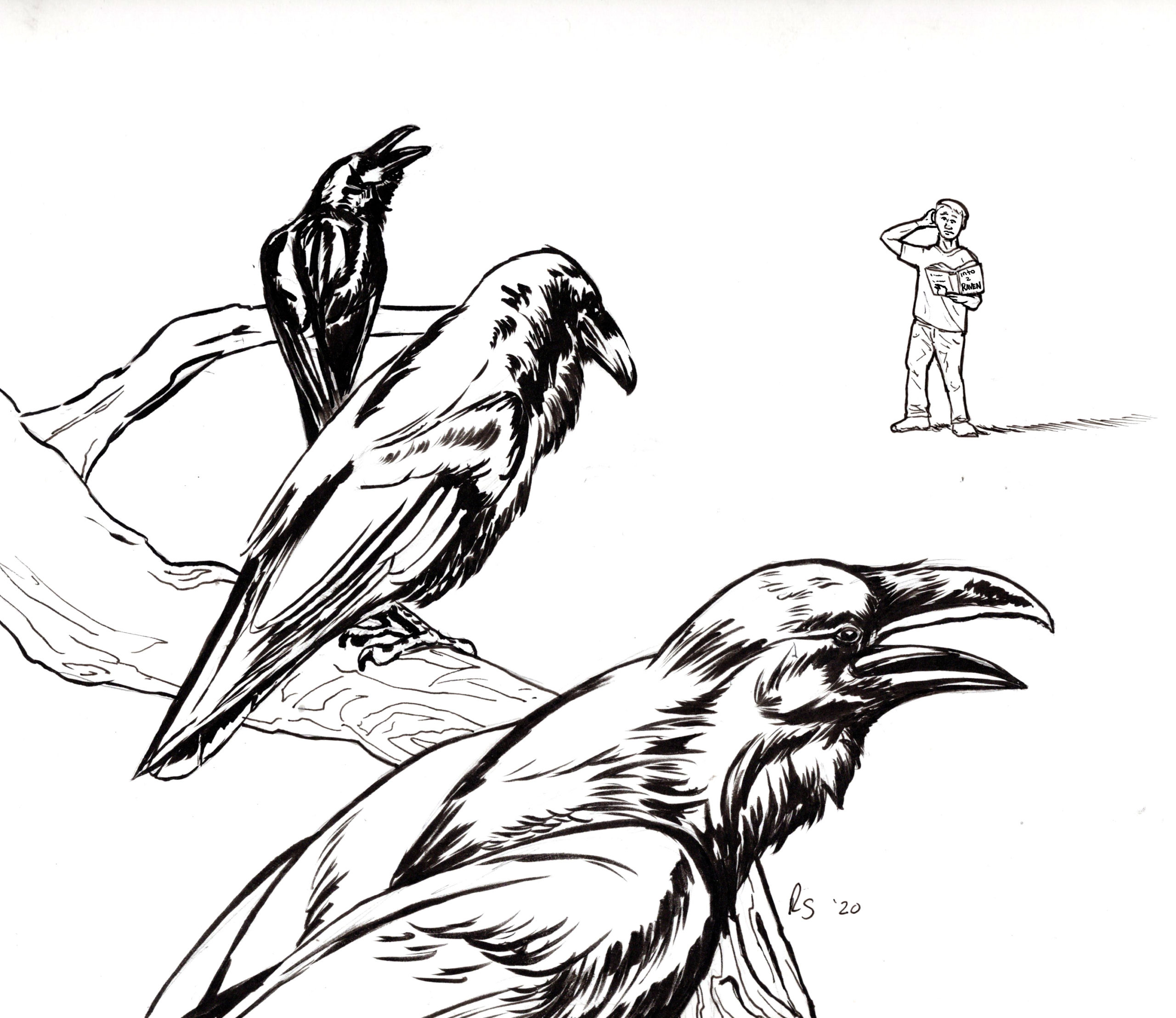
Greetings puny earthlings: Raven, Courtesy & © Rob Soto Used with permission
Raven
Courtesy & © Rob Soto Used with permission
What does it mean to speak and not simply talk? Does it mean you croak back with ravens? Or does it mean that ravens croak back with you?

I have spent many hours on many days for many years speaking with ravens. It’s not easy though to learn a new language, and their patience with my workshopping is not high on their honey-do list. Nevertheless, I work on it every chance I get, and they humor me with free lessons and bountiful harvests of humility.

Before you can speak though, you must first listen. Hear what dialect they speak because they do differ. Do their calls sound like mercury dropping into a still pail of clear cool water, or a porcupine purring as a trusted one scratches an old itch with gentle trepidation? Perhaps this raven growls in fours, fives, and sevens. Perhaps it mimics the locking door beeps it learned from the untrusting cars at a dusty desert gas station. Any way they call though, don’t forget that they do so without lips. When you call back, remember to curl yours back to show your own black beak. It also helps if you look friendly, so maybe give them a smile, too.

What I’ve learned from years speaking with ravens, is that they enjoy engaging with us wilderness tourists just like how I imagine the French mock Americans who ask simple questions through their noses while in berets at the Eiffel Tower. The ravens, still like how I imagine the French, will chirp or croak or clop back at you, but always faster than you thought you had tacitly agreed to. Can’t you hear that I’m not a native speaker, and can’t you respect that I’m at least trying? Oh, they can and they don’t. That’s the humor.

Sometimes they’ll throw new words your way, too, and always with a gleam in their eye. Just as you’re learning how to hock “hello,” they’ll pop quiz you and bleet back, “howdy,” “hey there,” and “greetings puny earthings,” just to smile to themselves at your dense bones and plucked, useless wings. To you, they may all sound like new noises. To them, they’re new jokes. Even when they start to cackle at my attempts, in time I’ve learned to cackle at myself, too. The lessons go on.

So next time you’re high in the mountains or deep in the desert and find yourself startled by a raven asking what life is like from way down there on the target range, listen first. Hear for the intonation, the subtleties in rhythm and iridescent syncopation, and their sandstone timbre. Then simply repeat after them. Curl your lips back, clench your larynx, and croak. Taste a new language. Harness the moment as a shared moment. Allow yourself to be the wild echo of a wild raven. Soon, you’ll find that when you speak the right language, ravens will give your own wild echo back. So now the question arises: will allow yourself to continue learning to speak with ravens, or will you simply settle to talk amongst your fellow puny earthlings?

I’m Patrick Kelly, and I’m Wild About Utah
 
Credits:

Images: Images Courtesy & Copyright Rob Soto, Artist, all rights reserved
Audio: Contains audio courtesy Davyd Betchkal, NPS Audio
Text:    Patrick Kelly, Director of Education, Stokes Nature Center, https://logannature.org
Included Links: Lyle Bingham, Webmaster, WildAboutUtah.org

Additional Reading

Boling, Josh, Josh’s Raven Encounter, Wild About Utah, June 11, 2018, https://wildaboututah.org/joshs-raven-encounter/

Boling, Josh, The Language of Ravens, Wild About Utah, February 19, 2018, https://wildaboututah.org/language-of-ravens/

Strand, Holly, Crow vs. Raven, September 15, 2011, Wild About Utah, https://wildaboututah.org/crow-vs-raven/

Strand, Holly, Cache and Retrieve, Wild About Utah, January 19, 2012, https://wildaboututah.org/cache-and-retrieve/

Kelly, Patrick, As a Child I Loved Nature, Wild About Utah, April 29, 2019, https://wildaboututah.org/as-a-child-i-loved-nature/

Raven Sounds:

Max Ushakov, A huge raven making weird sounds in front of a crowd at the Tower of London., YouTube.com, July 14 2016, https://www.youtube.com/watch?v=l7jgjovK5lY

ESL and Popular Culture, Raven ~ bird call, YouTube.com, Dec 12, 2012, https://www.youtube.com/watch?v=DDv_PlrBg14

Common Raven, Animals, National Geographic, https://www.nationalgeographic.com/animals/birds/c/common-raven/

Bird Note, How to Tell a Raven From a Crow, Oct 22, 2012, Audubon, https://www.audubon.org/news/how-tell-raven-crow

https://video.nationalgeographic.com/video/raven_intelligence

Ravens, Arches National Park, National Park Service – NPS.gov, Last updated: February 8, 2017, https://www.nps.gov/arch/learn/nature/ravens.htm

Common Raven, Zion National Park, National Park Service – NPS.gov, Last updated: January 31, 2016 https://www.nps.gov/zion/learn/nature/raven.htm
Equinox, or Equilux?

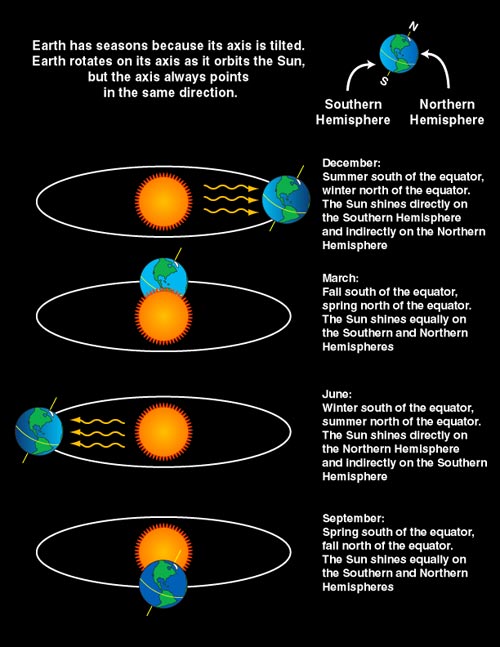
Equinox, or Equilux: Seasons Courtesy NASA https://www.weather.gov/dvn/Climate_Astronomical_Seasons
Seasons
Courtesy NASA
https://www.weather.gov/dvn/Climate_Astronomical_Seasons
We raced west toward home from the high plains, trying to beat the heavy snow that had been forecasted for Labor Day evening. Finally in the canyon—the revelation that seasons had passed while we were away. Temperatures plummeted, and the forests reacted. Favorite stands of aspens were already aglow above that familiar bend in the river. Meteorological fall had promptly arrived.

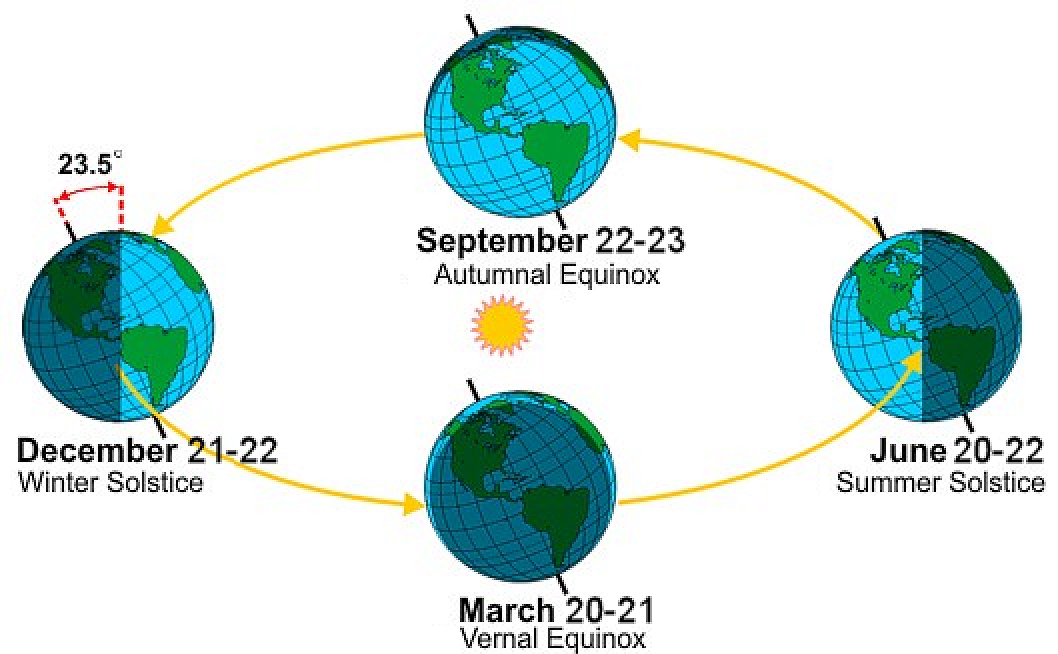
Its astronomical counterpart—the autumnal equinox—is a bit of a misnomer. The word equinox is our late Middle English iteration of the Latin term for “equal night,” but, astronomically speaking, this isn’t exactly true. The equinox is the single moment when the Earth’s axis is pointing neither toward nor away from the sun, providing entire hemispheres equal portions of light. This year’s autumnal equinox occurs at precisely 7:30 AM on Tuesday, September 22nd, and though daylight and night will share almost equal portions of the clock that day, they don’t split it evenly until two or three days later on what is called the ‘equilux’, meaning “equal light.”

Earth Orbit - With Date Spans, Courtesy National Weather Service (NWS)
Earth Orbit – With Date Spans
Courtesy National Weather Service (NWS)
https://www.weather.gov/abq/clifeatures_springequinox
It works like this. We count daytime from the moment the sun peeks above the horizon to the moment it sinks below. But, of course, the sun isn’t a light switch. We have several minutes of twilight before the sun rises and after it sets thanks to the lens-like refraction provided by our atmosphere. So, on the day of the equinox, those several minutes of twilight before sunrise and after sunset offset the equal exposure of the sun’s rays to our hemisphere by a small margin, giving us a tad more daylight than night. The equilux has to wait for Earth’s tilt to allow darkness to catch up.

But wait. It gets a little more complicated. Because the Earth’s axis begins tilting away from the sun immediately following the autumnal equinox (or toward it following the vernal equinox), different latitudes will experience the equilux at different intervals. As a rule, the closer one is to the equator, the longer they will wait for the equilux to occur in the fall and the sooner it will arrive in the spring. That is, unless you live within 5 latitudinal degrees of the equator. Then, sadly, you don’t get an equilux at all, ever, because you always have more than twelve hours of daylight.

Depending on where you live here in Utah, you will experience the equilux sometime on September 25th or 26th. So, this week, take out your stopwatch, and turn your eyes skyward.

I’m Josh Boling, and I’m Wild About Utah!

Credits:
Photos: Courtesy Weather.gov, US National Weather Service(NWS), https://www.weather.gov/dvn/Climate_Astronomical_Seasons
Photos: Courtesy
Sound: Courtesy & Copyright Friend Weller, Utah Public Radio
Text: Josh Boling, 2020

Sources & Additional Reading

The Equinox Isn’t What You Think It Is, PBS Digital Studios, https://www.youtube.com/watch?v=MVDCsXUygEw

Kher, Aparna, Equinox: Equal Day and Night, Almost, https://www.timeanddate.com/astronomy/equinox-not-equal.html

City of North Logan, Utah, USA — Sunrise, Sunset, and Daylength, September 2020, Time and Date AS, https://www.timeanddate.com/sun/@7173983

Seasons, SciJinks, Jet Propulsion Laboratory, https://scijinks.gov/review/solstice/seasons/

Which Pole is Colder?, Climate Kids, The Earth Science Communications Team, NASA’s Jet Propulsion Laboratory, California Institute of Technology, https://climatekids.nasa.gov/polar-temperatures/

Earth’s Seasons – Equinoxes and Solstices – 2018-2025, The U.S. Naval Observatory, Astronomical Applications Department, https://www.weather.gov/media/ind/seasons.pdf

Changing seasons, Climate Resource Collections, National Oceanic and Atmospheric Administration, https://www.noaa.gov/education/resource-collections/climate/changing-seasons

Boling, Josh, A Solstice Vignette, Wild About Utah, December 16, 2019, https://wildaboututah.org/a-solstice-vignette/

Equinoxes, National Geographic, https://youtu.be/kaG6PTVrFP4

What is an Equinox? National Geographic, https://youtu.be/enlih8M5DN0

The Autumnal Equinox is Near, Watch the Skies Blog, NASA, https://blogs.nasa.gov/Watch_the_Skies/tag/equinox/


Insect Musicians

Insect Musicians: Katydid Courtesy US FWS, Dr Thomas Barnes, Photographer
Katydid
Courtesy US FWS
Dr Thomas Barnes, Photographer
It gives me great pleasure to take a moonlight walk on these warm summer nights, serenaded by a gazillion insect musicians. Pulsing in unison with a background of cricket chirps, it reminds me that summer is waning and I must enjoy what remains!

As birds grow silent with nesting season past, I become aware of the gradually intensifying chorus of the inset tribe- a cacophonous mixture of chirps, trills, ticks, scrapes, shuffles, and buzzes. What a joy to behold these choruses of males, serenading females of their own species until cold weather dampens the chorus and heavy frost finally brings it to a close. Crickets, katydids, grasshoppers, and cicadas are prominent songsters. They can be found in trees, shrubs, lawns, fields, woodlands—nearly all habitats, and sometimes inside our homes.

My USU entomologist friend recommends the Snowy Tree Cricket as a champion night chorister here among the insects. It’s “snowy” name is derived from its pale coloration causing it to appear white. Snowy Tree Crickets sing from brushy understory plants at forested margins or within open woodlands. During cold spells, they can be found close to the ground on the trunks of small trees where they find a warmer micro-climate. It is also referred to as the “thermometer cricket” due to its accuracy of giving the temperature in degrees F. Just count the chirps for 15 seconds and add 40.

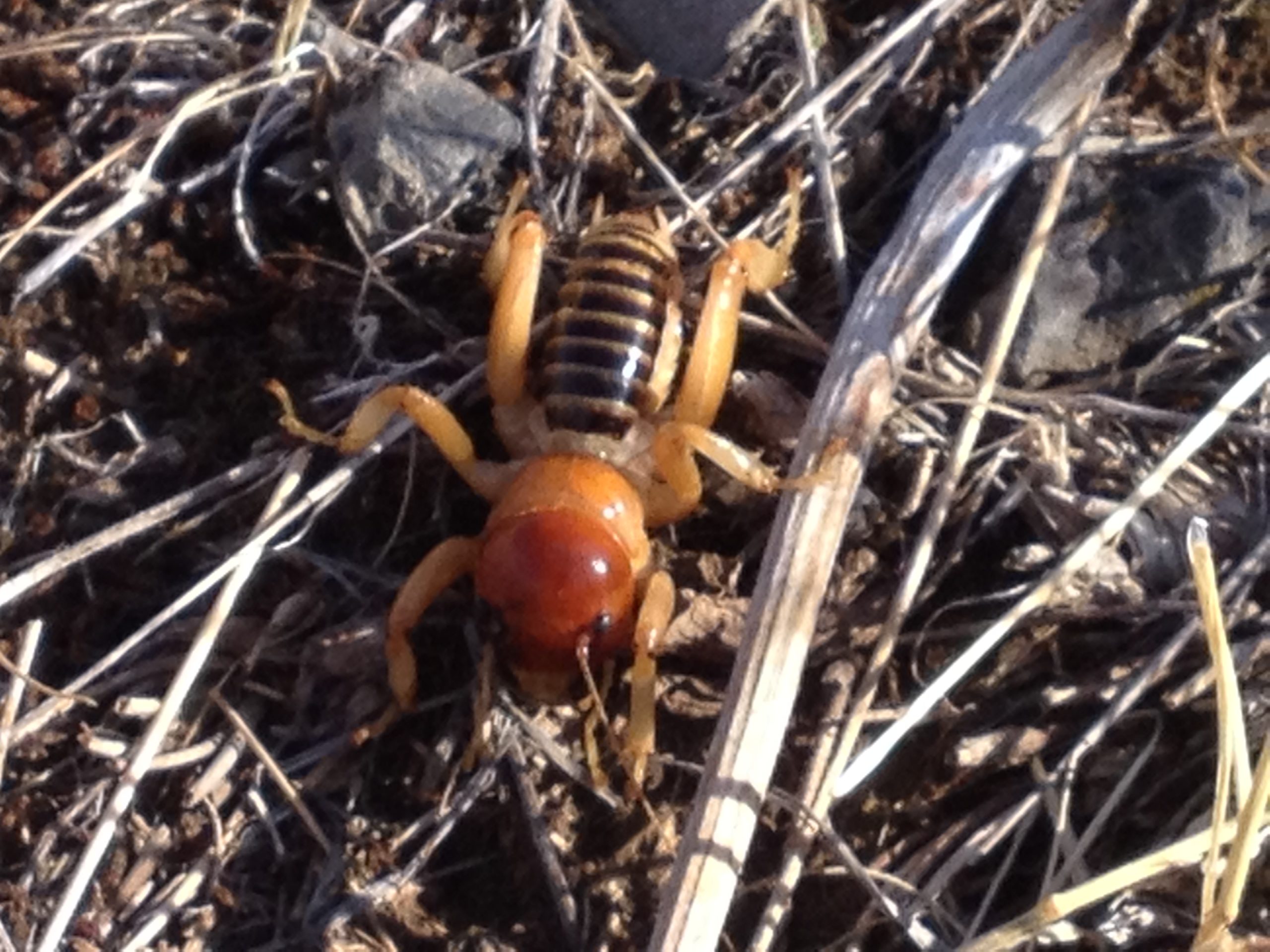
Jerusalem Cricket Orthoptera: Stenopelmatidae Copyright 2013 Holly Strand
Jerusalem Cricket
Orthoptera: Stenopelmatidae
Copyright 2013 Holly Strand
The Spring and Fall Field Crickets are next in line as musicians. They look very similar to each other, but are two different species. The season they appear helps identify them. Another difference is their life histories. Fall Field Crickets overwinter as eggs while the Spring version as nymphs.

Spring Field Crickets develop quickly when warm weather arrives and adults typically appear and begin singing and mating in late spring, continuing until late June or early July when they finish laying eggs and die off. In contrast, Fall Field Crickets hatch in the spring, and adults don’t appear and begin singing until mid to late July, after which they continue singing and mating into the autumn, when they are finally killed by frosts. In most areas of overlap, there is a period of silence in midsummer when neither species is heard.

Finding and identifying a singing insect can be a fun challenge. With the help of a flashlight and considerable patience, you will be able to track down individual singers, and perhaps even view a singing performance firsthand! Many are small and well camouflaged in their green and brown coats, and they sit motionless when singing, blending into their surroundings. Many sing only in the dark of night. Use LED lights as their spectrum seems to enhance finding them.

Check out these glorious beings at songsofinsects.com.

Jack Greene for Bridgerland Audubon Society, I’m wild about Utah!

Credits:

Images: Katydid, Courtesy US FWS, Dr. Thomas Barnes, Photographer
Images: Jerusalem Cricket, Courtesy & Copyright 2013 Holly Strand
Audio: Courtesy & Copyright Friend Weller, Utah Public Radio
Text:     Jack Greene, USU Sustainability Program Volunteer, Bridgerland Audubon Society

Additional Reading:

Hershberger, Wil & Elliott, Lang, Songs of Insects, https://songsofinsects.com/

Montagne, Renee, Insect Sounds: Telling Crickets, Cicadas And Katydids Apart, NPR, September 8, 2015, https://www.npr.org/2015/09/08/438473580/insect-sounds-telling-crickets-cicadas-and-katydids-apart

Rankin, Richard, Bug Bytes, Reference Library of Digitized Insect Sounds – USDA ARS, https://www.ars.usda.gov/ARSUserFiles/3559/soundlibrary.html

Utah Fireflies

Utah Fireflies: Firefly Courtesy & Copyright BJ Nicholls
Firefly
Courtesy & Copyright BJ Nicholls
Hi, My name is Christy Bills, I am the entomologist at the Natural History Museum of Utah.

I am excited to talk about the Utah Firefly citizens science project. A lot of people are surprised to know that we have fireflies in Utah, but we actually have them in 20 of the 29 counties, that we’ve discovered so far. People are often surprised that they’re here, and they think that they’ve just arrived but they haven’t. They like to live in marshy areas, and they are only adults from late May to early July, so that’s why people often don’t see them, because people aren’t usually recreating in marshy areas.

Utah Fireflies: Flashing Firefly Courtesy & Copyright BJ Nicholls
Flashing Firefly
Courtesy & Copyright BJ Nicholls
The firefly citizens science project asks people to report when they see them to the museums website, and that allows us as researchers to know where they are so we can track their activity. We’ve been collecting data on them for 4 or 5 years and learning more about them over that time period.

I’ve actually gone through old newspapers that have been digitized online, and looked for any reference to fireflies or lightning bugs, and I have found zero reference dating back 100 years. However, when you actually talk to people in rural communities who have pastures and farms, it turns out anecdotally a lot of people know about them. This is a really wonderful way of people bridging the academic rural divide, and finding out that people in these communities have a wealth of knowledge that we can draw from, and they’ll say, “Oh yeah my grandpa always had them in the orchard,” or “We always knew that they were there,” so it turns out people always knew about them. Not a lot of people, but enough people.
People have anecdotes about knowing about them in urban areas, where there are clearly not anymore because of development and light pollution. That helps us also know what factors make them go away.

More information about the project is available, at NHMU.UTAH.EDU/fireflies.

I’m Christy Bills and I’m wild about Utah.

Credits:

Image: Courtesy & Copyright BJ Nicholls, Photographer
Featured Audio: Friend Weller, Utah Public Radio
Text: Christy Bills, Entomologist, Natural History Museum of Utah, https://nhmu.utah.edu/newsdesk/experts/christy-bills

Report:


Report your sighting


Sources & Additional Reading

Western Firefly Project: A Community Science Initiative, Natural History Museum of Utah. https://nhmu.utah.edu/fireflies/

Hellstern, Ron, June Fireflies, Wild About Utah, June 19, 2017, https://wildaboututah.org/june-fireflies/

Strand, Holly, Firefly Light, Wild About Utah, Jun 20, 2013, https://wildaboututah.org/firefly-light/

Buschman, L L. Biology of the firefly Pyractomena lucifera (Coleoptera: Lampyridae). Florida Entomologist 67.4 (1984): 529-542. https://journals.flvc.org/flaent/article/view/57962 (click on PDF for full text)

Lloyd, James E., 1964. Notes on Flash Communication in the Firefly Pyractomena dispersa (Coleoptera: Lampyridae) Annals of the Entomological Society of America, Volume 57, Number 2, March 1964 , pp. 260-261. (James Lloyd is a leading authority on fireflies. He retired from academic duty at the University of FL, but here is a web page with some of his wisdom and musings. https://entnemdept.ufl.edu/lloyd/firefly/

(Boston) Museum of Science Firefly Watch
Volunteers help citizen scientists track firefly occurrences.
https://www.mos.org/fireflies

National Geographic. Firefly (Lightning Bug) Lampyridae, https://animals.nationalgeographic.com/animals/bugs/firefly/

Phys.org news service. Jun 26, 2012. Romancing the firefly: New insights into what goes on when the lights go off. https://phys.org/news/2012-06-romancing-firefly-insights.html#inlRlv

Stanger-Hall, Kathrin F., James E. Lloyd, David M. Hillis. 2007. Phylogeny of North American fireflies (Coleoptera: Lampyridae): Implications for the evolution of light signals. In Molecular Phylogenetics and Evolution 45 (2007) 33-49.

Utah State University Insect Collection has over 117 cabinets housing approximately two million pinned insects and 35,000 microscope slides. Location: Room 240, Biology and Natural Resources Bldg.; Telephone: 435-797-0358
https://biology.usu.edu/research/research_centers/insect-collection

Clayton Gefre, Sparks Fly: Researchers track firefly populations across Utah, The Herald Journal, https://news.hjnews.com/allaccess/sparks-fly-researchers-track-firefly-populations-across-utah/article_270ac8b9-3d3f-5a01-9b5b-ac22e89a54bb.html

Natalie Crofts, New Website Tracks Utah Firefly Sightings, KSL, https://www.ksl.com/?sid=34439516