Rocky Mountain Elk

Rocky Mountain Elk: Canada Elk Cervus canadensis Courtesy William(13222272) and Pixabay
Canada Elk
Cervus canadensis
Courtesy William(13222272) and Pixabay

Bull Elk in Profile Courtesy US FWS, Ryan Hagerty, Photographer Bull Elk in Profile
Courtesy US FWS, Ryan Hagerty, Photographer

Jackson Elk Herd Courtesy US FWS, Lori Iverson, Photographer Jackson Elk Herd
Courtesy US FWS, Lori Iverson, Photographer

Bull Elk and Herd at National Elk Refuge Courtesy US FWS, Kari Cieszkiewicz, Photographer Bull Elk and Herd at National Elk Refuge
Courtesy US FWS, Kari Cieszkiewicz, Photographer

The Rocky Mountain elk is Utah’s state mammal for good reason. No one can deny its majesty and uncanny intelligence while being hunted, and the spine tingling bugle released in fall mountain splendor.

My introductory encounter with Rocky Mountain elk came during my first deer hunt in Utah on the east side of Mt. Nebo. I was nearly trampled by a large bull and herd of cows that leaped over me as I cowered behind large boulders. What magnificent beings they were, dwarfing the whitetail deer I had grown up with in Michigan.

Since that time, I’ve led countless groups of students and others to view elk during the rut in Grand Teton National Park. On one occasion, we were sleeping under the stars on a warm fall evening, awakened by a minor earth quake as a herd ran through us, a wakeup call I’ll never forget!

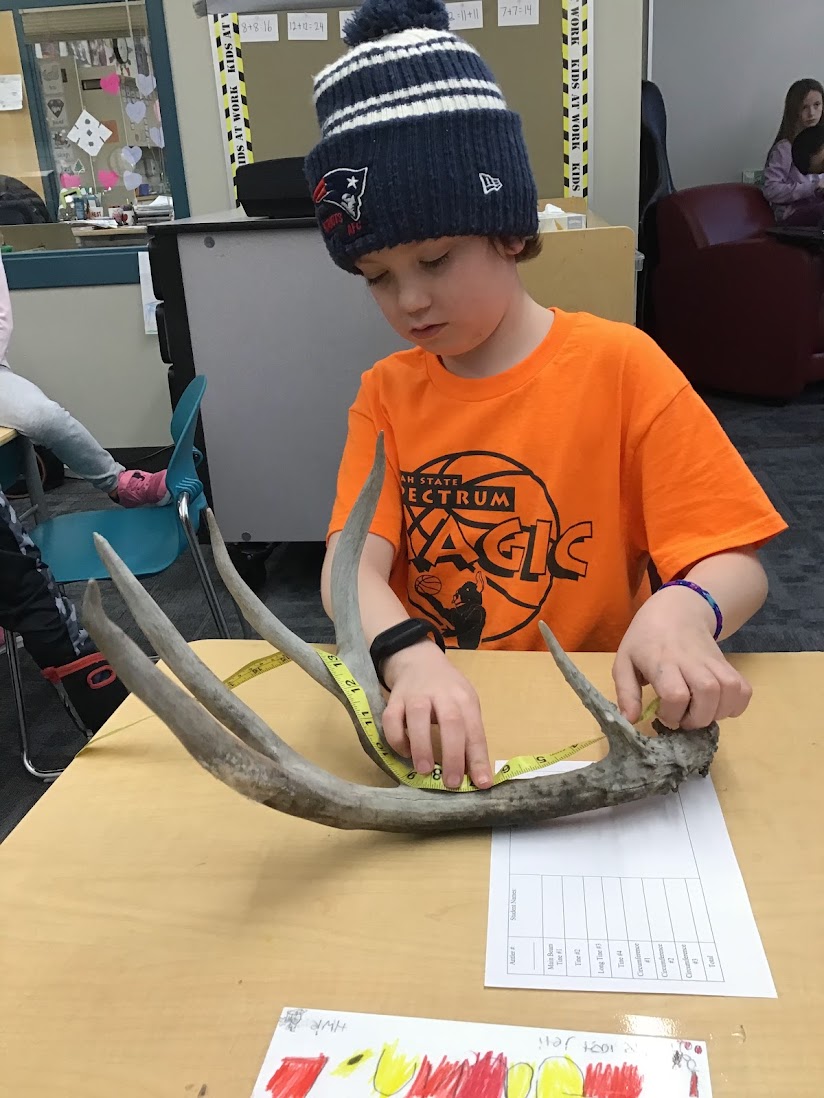
A matriarchal society, the cow elk rules the herd other than during the fall rut. Bulls will often separate to avoid this embarrassing situation. If you’ve had the pleasure of holding a large set of elk antlers, you will appreciate the physiology that allows this amount of annual growth to produce such weapons and status symbols. Cows generally outlive the bulls by several years. Prime bulls exhaust themselves, during the rut, and face the harsh winter months in a depleted condition. Some won’t make it providing a feast for waiting predators and scavengers come spring.

Elk are a sacred animal for many Native Americans. “Elk Medicine is a powerful totem animal of stamina, strength, sensual passion, nobility, pride, respect, and survival. Elk are also known as Spirit Messengers. Their antlers connect to the medicine of lightening, and channel that energy to earth. With this medicine comes instant knowing and messages from Spirit with great clarity.” Animal Spirit Medicine Elk by Beverly Two Feathers

My spiritual encounter came on a full moon vernal evening on a ridge in Birch Canyon near Smithfield. It was unusually warm so decided to take a moonlit stroll. Once on the ridge, large, gray forms emerged. I soon found myself surrounded by an elk herd. I moved slowly for safety, and not to startle the animals. A euphoric moment. Another came last fall when I had a large group of USU international students with me. It was after dark at the base of Teewinot. I hushed their chatter. Soon after came the hauntingly beautiful sound sliding down the slope above, bugling of bull elk. They were transfixed as was I.

A favorite book is Wapiti Wilderness, coauthored by Olaus and wife Margaret Murie, capturing their lives in the Yellowstone and Teton wilderness tracking elk herds over many years, often with their young children. A revealing and enduring read I highly recommend.

This weekend I will be taking 24 international students to Hardware Ranch for a sleigh ride among the wintering pasturing elk. Here they are fed hay to replace their lower winter range, which has been replaced by human activity. Yet another spiritual experience!

This is Jack Greene for Bridgerland Audubon and I’m Wild About Utah and its elk.

Credits:
The Wonders of Bird Migration
Picture: Courtesy Pixabay William(), Photographer, https://pixabay.com/photos/elk-canada-deer-wildlife-nature-4825105/
Image: Bull Elk in Profile, Courtesy US FWS, Ryan Hagerty, Photographer, https://digitalmedia.fws.gov/digital/collection/natdiglib/id/20291/rec/19
Image: Bull elk and herd at National Elk Refuge, Courtesy US FWS, Kari Cieszkiewicz, Photographer, https://digitalmedia.fws.gov/digital/collection/natdiglib/id/33128/rec/5
Image: Jackson Elk Herd, Courtesy US FWS, Lori Iverson, Photographer, https://digitalmedia.fws.gov/digital/collection/natdiglib/id/18432/rec/2
Audio: Courtesy & © Kevin Colver https://wildstore.wildsanctuary.com/
Text: Jack Greene, Bridgerland Audubon, https://bridgerlandaudubon.org/
Additional Reading: Lyle W Bingham, Webmaster, and Jack Greene, Author, Bridgerland Audubon, https://bridgerlandaudubon.org/

Additional Reading:

Jack Greene’s Postings on Wild About Utah, https://wildaboututah.org/author/jack/

Murie, Margaret, Murie, Olaus, Wapiti Wilderness, University Press of Colorado, December 15, 1987, https://www.amazon.com/Wapiti-Wilderness-Margaret-Murie/dp/087081155X

National Elk Refuge, US Fish & Wildlife Service, US Department of the Interior, https://www.fws.gov/refuge/national-elk

Visiting Hardware WMA-Education Center, Utah Division of Wildlife Resources, Department of Natural Resources, State of Utah, https://wildlife.utah.gov/hardware-visit.html

Owens, Beverly, a.k.a. Beverly Two Feathers, Native American Totems, https://native-american-totems.com/author/bevspaper/page/13/

Teewinot, NPS History, US National Park Service, Autumn 2004, https://npshistory.com/publications/grte/newspaper/fall-2004.pdf

Why, It Was Definitely the Snow!

Why, It Was Definitely the Snow! "Utah’s Winter King: A Key Individual in the History of Utah’s Ski Industry"
Photo from 1989 Utah History Fair
Courtesy & Copyright Shannon Rhodes
“Utah’s Winter King: A Key Individual in the History of Utah’s Ski Industry”
Photo from 1989 Utah History Fair
Courtesy & Copyright Shannon Rhodes

Snow-frosted Hoodoos of Bryce Canyon
Courtesy & Copyright Shannon Rhodes, Photographer Snow-frosted Hoodoos of Bryce Canyon
Courtesy & Copyright Shannon Rhodes, Photographer

Snow. Tiny specks of dust and other particles in the air that attract water vapor to become ice crystals. That is what fascinated a man named Wilson ‘Snowflake’ Bentley enough to capture thousands of one-of-a-kind snowflake photographs and what drew my friend Alf to Utah. In the winter and early spring of 1989, I sat as a Bonneville Junior High ninth grader with Alf Engen in his office at Alta. As a presenter at the Utah History Fair that year, I was gathering stories and artifacts for my project titled Utah’s Winter King: A Key Individual in the History of Utah’s Ski Industry.

Engen shared stories about building ski jumps over the fences between his home and school and his journey from Norway to America, not to ski but to buy back the Engen estate divided up at his father’s death of the Spanish Flu in 1919. He said, “I was going to make enough money to go back, but I didn’t know how I was going to do that. I didn’t even know there was much snow here, I never read about that.” After sharing stories about arriving in Ellis Island, playing soccer in Milwaukee, scaffold hill jumping on Ecker Hill, and cross-country skiing as a forest service employee over Catherine Pass to imagine Alta as a ski hub, he ended with how he felt about jumping Utah’s snow: “They would say “Send Gummer–that is ‘old man’ in Norwegian–over first,” and I would have to do anything new. I knew I could do it, even if I had never tried it before. Once you are up there, you can fly.”

I had forgotten about that experience chatting about snow with a Utah snow giant until a few weeks ago, gazing out at the snow-frosted hoodoos of Bryce Canyon. I gripe about snow plowing piles and delayed-start school days, and I’d rather cut snowflakes from paper than be out in it most frigid days. Yet, this Christmas a friend gave me a blue and white book titled “The Little Book of Snow.”

For someone who grew up in “the greatest snow on earth,” I thought I knew snow well enough, but in addition to discovering linguistic similarities for the word snow and that some have estimated the number of snowflakes that fall to earth each year to be a number with at least 24 zeroes, I confirmed my suspicions about snow that is not white. I’ve often encountered pink snow patches at the high altitudes of Utah, and with a nudge from the watermelon snow paragraph, I found an intriguing citizen science opportunity online called The Living Snow Project led by Dr. Robin Kodner at Western Washington University. By contributing data about spring snow algal blooms through sample vials or at least observation photographs, scientists can study microscopic snow communities and their impact on snow melt.

Snow. When I asked him what about Utah made him stay, Alf Engen said, “Why, it was definitely the snow.” Snow is the stuff of which stories, science, and wonderful dreams are made.

I’m Shannon Rhodes, and I’m wild about Utah.

Credits:

Images: Courtesy & Copyright Shannon Rhodes, Photographer
Audio: Courtesy & © Friend Weller, https://upr.org/
Text:     Shannon Rhodes, Edith Bowen Laboratory School, Utah State University https://edithbowen.usu.edu/
Additional Reading Links: Shannon Rhodes

Additional Reading:

Blanchard, Duncan. 1970. The Snowflake Man. https://snowflakebentley.com/snowflake-man-bio

Coulthard, Sally. 2018. The Little Book of Snow. https://www.chroniclebooks.com/products/the-little-book-of-snow

Engen, Alan K. 2001. Alf Engen: A Son’s Reminiscences. https://issuu.com/utah10/docs/uhq_volume69_2001_number4/s/10191712​​

Greene, Jack. 2020. I Love Snow. Wild About Utah, https://wildaboututah.org/i-love-snow/

Larese-Casanova, Mark. 2014. Utah’s Rich Skiing History. Wild About Utah, https://wildaboututah.org/utahs-rich-skiing-history/

Libbrecht, Kenneth G. 1999. Guide to Snowflakes. https://www.its.caltech.edu/~atomic/snowcrystals/class/class-old.htm

Liberatore, Andrea. 2011. Snowflakes. Wild About Utah, https://wildaboututah.org/snowflakes/

Living Snow Project. https://wp.wwu.edu/livingsnowproject/

Local Lexi. 2021. The History of “The Greatest Snow on Earth” https://www.skiutah.com/blog/authors/lexi/the-history-of-the-greatest-snow-on.

Martin, Jacqueline Briggs. 1998. Snowflake Bentley. Boston: Houghton Mifflin. https://www.amazon.com/Snowflake-Bentley-Jacqueline-Briggs-Martin/dp/0547248296

Strand, Holly. 2009. A Utah Skier’s Snow Lexicon. Wild About Utah, https://wildaboututah.org/a-utah-skiers-snow-lexicon/

Rascoe, Ayesha. 2022. Why Snow Is Turning Pink at High Altitudes. https://www.npr.org/2022/12/18/1143929924/why-snow-is-turning-pink-at-high-altitudes

Weller, Kristine. 2023. In a State Obsessed with Snowpack, Finding Pink Snow in Utah Is a Problem. https://www.kuer.org/health-science-environment/2023-01-03/in-a-state-obsessed-with-snowpack-finding-pink-snow-in-utah-is-a-problem

Winter is Vinegar Honeydew

Vinegar Honeydew: Cucumber Pickles Courtesy Pixabay, CongerDesign, Photographer
Cucumber Pickles
Courtesy Pixabay, CongerDesign, Photographer
Winter is the season of withholdings come free and taboos undone. Those things we tell ourselves which are not for the warm months come to roost, and our allowances to ourselves grow as the season’s light shrinks.

Winter is when we get to have a sit by the fire and exhale from our work like young exhausted parents, listening to the world’s sleep because of our good labor done. It’s when we can crack open our stores and taste the results of our year on this earth from the gardens and fields; the flavors of hope without fear of waste. Vinegar truly is the honeydew of the long nights.

It’s also when we can have freedom in the snow. The snow is that sweeping medium which allows us to climb mountains and then descend at speeds which in any other season would be a cause for concern, even if moderate.

Each mode of winter travel has its partakers and dissuaders, though none is surely the best for all. Cross country, sitski, telemark, downhill, snowbike, snowskate, snowboard, sled, tube, and contractor bag all each have their place for us to slide at speeds too great to pass up. Some have edges for control, some have fewer for fun, yet all allow for wind to blow through your hair and to dance with gravity, more apparent than ever in the cold.

Winter also gives us stories not available elsewhen. Many skilled naturalists have given many good lessons to me on how to read the snows over the years, yet not one lecture can compare to what happens when you go out by yourself and see what the world itself has to say. I’ve spent good hours finding a good track and following it, whether it’s a hare to its burrow, deer to the nearest alfalfa field, or my eyes wandering skywards to see whose wings caught the vole which once did scurry all a tither. The words though melt in the sun, and so the snow is the rarest of books. Perhaps it is also the most precious. Stories carved in stone seem mortibund to those on paper, and so those tattooed upon tree pulp seem to the cuneiform in the nivian ether.

So this winter, do not forget to enjoy the allowances you’ve worked all year: warming your bones by the fire; reading the precious snows; sliding down hills; and vinegar honeydew from your stores.

I’m Patrick Kelly, and I’m Wild About Utah.
 
Credits:
Images: Courtesy Pixabay, CongerDesign, Photographer https://pixabay.com/photos/cucumbers-pickle-jar-preserves-886036/
Audio: Courtesy & © J. Chase and K.W. Baldwin. https://upr.org
Text:    Patrick Kelly, Director of Education, Stokes Nature Center, https://www.logannature.org
Included Links: Patrick Kelly & Lyle Bingham, Webmaster, WildAboutUtah.org

Additional Reading

Wild About Utah, Posts by Patrick Kelly

Stokes Nature Center in Logan Canyon, https://www.logannature.org/

Strand, Holly, Snowshoe Hare, Wild About Utah, February 18, 2010, https://wildaboututah.org/snowshoe-hare/

Larese-Casanova, Mark, The Shape of Wildlife in Winter Wild About Utah, January 26, 2012, https://wildaboututah.org/the-shape-of-wildlife-in-winter/

Larese-Casanova, Mark, Utah’s Rich Skiing History Wild About Utah, January 23, 2014, https://wildaboututah.org/utahs-rich-skiing-history/

Strand, Holly, A Utah Skier’s Snow Lexicon Wild About Utah, January 29, 2009, https://wildaboututah.org/a-utah-skiers-snow-lexicon/

Nummer, Brian, Getting Crisp Home Pickled Vegetables, Extension, Utah State University, https://extension.usu.edu/preserve-the-harvest/research/getting-crisp-home-pickled-vegetables

Food Safety & Preservation, Extension, Utah State University, https://extension.usu.edu/saltlake/home-family-food/food-safety-preservation

Reindeer

Yuki the Reindeer from the Mountain West Animal Hospital. Courtesy & Copyright Mary Heers, Photographer
Yuki the Reindeer from the Mountain West Animal Hospital
Courtesy & Copyright Mary Heers, Photographer

Mary with Bluebell the Reindeer from the Rockin Reindeer Ranch at the Ogden City Christmas Square. Copyright Mary Heers Mary with Bluebell the Reindeer
from the
Rockin Reindeer Ranch
Ogden City Christmas Square
Copyright Mary Heers

I first time I came face to face with a living, breathing reindeer was a few weeks ago at the Reindeer Express hosted by Utah State University vet students. Two vets from the Mt. West Animal Hospital near Provo had brought two of their reindeer with them to Cache Valley and were standing by to answer our questions.

The first thing I learned was that both male and female reindeer grow a new set of antlers every year. The antlers are solid bone and can weigh up to 15 pounds. The males usually drop their antlers in Nov after the mating season, while the females keep theirs a few months longer – until after they drop their calves in the Spring. A vet student chimed in. He said reindeer losing their antlers looks a lot like us losing a baby tooth. The antlers get a little wobbly and simply fall off. The reindeer just keeps grazing.

Now I was hot on the trail of reindeer in Utah. I went to the Ogden City Christmas Square to meet Bluebell from the Rockin Reindeer farm near Ogden. As admirers were taking pictures, Bluebell’s owner told me that watching the antlers regrow could be pretty exciting. Every morning you could get up and easily see how the antlers had grown another inch overnight.

I also learned if you listened closely, you could hear a clicking when the reindeer walked. The first time they heard it, they thought something was terribly wrong. But all reindeer click when the tendon in their leg slides over a bone. Clicking seems to be a way for the herd to find each other in white-out winter weather.

Another adaptation to intense cold is the hair that covers every reindeer’s nose This helps keep it warm in the reindeers natural habitat in the far north.

I can trace my own fascination with reindeer to my childhood days when my father arranged for a friend of his to dress up as Santa and personally deliver a big white sack full of presents to our house. The fact that Santa rang our doorbell didn’t strike me as odd since we didn’t have a chimney. One Christmas Eve I was talking all day about how I would soon get to meet Santa’s reindeer. When the doorbell rang, I rushed to open the door. There was Santa with his big white sack. No reindeer.

“Where are the reindeer?” I asked.

“I left them down the street,” Santa said. “Let’s go see them after we open the presents. “

That did the trick. I forgot all about the reindeer.

But now that I’m older and wiser, I know that most male reindeer drop their antlers in Nov, while the females keep theirs a few more months. So the odds are very, very good that the Santa that rang my doorbell was driving an all-female dream team.

This is Mary Heers and I’m Wild About Utah

Credits:
Photos: Courtesy Mary Heers,
Featured Audio: Courtesy & Copyright © Friend Weller, Utah Public Radio upr.org
Text: Mary Heers, https://cca.usu.edu/files/awards/art-and-mary-heers-citation.pdf
Additional Reading: Lyle Bingham, https://bridgerlandaudubon.org/

Additional Reading

Wild About Utah, Mary Heers’ Wild About Utah Postings

Heaps, Spenser, (The Daily Herald), Springville veterinarian and his reindeer find success, Salt Lake Tribune, June 6, 2015 https://archive.sltrib.com/article.php?id=2596124&itype=CMSID

Bott, Isaac, DocBott – Musings of a mixed animal veterinarian, https://docbott.org/

Rockin Reindeer Ranch, https://www.rockinreindeerranch.com/