Pollinating Fruit Trees with Blue Orchard Bees

Audio:  mp3 Listen to WildAboutUtah

Blue Orchard Bee
Copyright Jim Cane

Apricots, plums, apples, cherries, and pears all need bees to pollinate their flowers. Traditionally, we’ve used the European honey bee, but now we know how to pollinate our fruit trees using a steely blue native bee, the blue orchard bee (Osmia lignaria). These wild bees fly nationwide.

In Utah, they live in foothill and lower montane habitats. Blue orchard bees are not social; every female is fertile and tends to her own tiny nest. Adults are the size of a chunky honeybee and are active for only 3-4 weeks in the spring. These bees naturally nest in the tunnels chewed by large wood-boring beetles in tree trunks. Each female partitions her tunnel into a series of tiny bee-sized rooms. Each room is stocked with a pea-sized provision of pollen moistened with nectar, followed by a single egg. Nest cells are partitioned, and ultimately capped, with mud, hence their other common name: “mason bees”.

Blue Orchard Bee eggs
on pollen provision mass
in nest
Copyright Jim Cane

You can have your own backyard population of blue orchard bees. An easy way to begin uses a short fat log that is seasoned and dry. Take a 5/16 bit and drill 20 or more holes radially 5 to 6 inches deep. Stand the log on end, facing the holes towards the southeast.

On cold mornings, nesting females bask in the sun before taking flight. If bees colonize your log, you will see the steely blue females busily coming and going all day long during fruit tree bloom. They tote their loads of dry yellow pollen in a brush of hair beneath the abdomen. Unloading that pollen at the nest requires some charming acrobatics that are well worth watching. While collecting pollen, female blue orchard bees pollinate your trees with hundreds of fruits resulting from each bee’s lifetime of work. Successive generations will nest for you every spring, but you’ll want to switch to replaceable nesting materials to prevent the accumulation of pathogens and parasites.

Details and links can be found at our Wild About Utah website.

This is Linda Kervin for Bridgerland Audubon Society.
Credits:

Photos: Courtesy & Copyright Jim Cane

Text: Jim Cane, Bridgerland Audubon Society
Additional Reading:

Drill Log with 5/16 holes
5 to 6 inches deep
Copyright Jim Cane

Resources:

https://www.sare.org/publications/bob.htm

https://www.ars.usda.gov/Research/docs.htm?docid=18333

https://www.pollinatorparadise.com/Binderboards/Hornfaced_Bees.htm

A Colonized log
Copyright Jim Cane

Steershead & Turkeypeas

Steershead, Dicentra uniflora
Image Courtesy & Copyright Jim Cane

There is surprise and joy when discovering a flower peeking up at you from near the lingering snow. Long after winter weary eyes have devoured the early floral offerings of gardens here in the valley, our local natives are stirring higher up. As you wander thru mountain sagebrush and meadows, you may encounter scattered groups of two native wildflowers, Steershead and Turkeypeas. Both are a delight to the eyes, but difficult to find initially, as their diminutive nature keeps them hidden amid the surrounding plant litter.

Steershead, or Dicentra uniflora, lives up to its common name. A close cousin to the bleeding heart, it has four white to pinkish petals tinged light brown to purple, two of which are spurred. The longer pair bend back, while the shorter pair are fused at the tip, providing the “cow skull” appearance of the flower. Diminutive plants, they send forth leaves and a single flower from thickened, spindle-shaped tubers. Just a few inches tall, this small plant packs a lot of charm and a bit of poison for protection against plant eaters. Steershead occurrs singly or in small clusters, so it is easily overlooked.

Turkeypea, Orogenia linearifolia
Courtesy & Copyright Intermountain Herbarium
Mary Barkworth, Photographer

Turkeypeas, Indian potato or Orogenia linearifolia, on the other hand, grows in extensive colonies, making this 4 inch tall plant a bit easier to find. A member of the carrot family, Turkeypeas produces very small whiteish flowers in umbels atop a short stem. Arising from a fleshy tuber, the leaves are divided into long linear segments (hence the name ‘linearifolia’). The starchy root is edible, though small, and historically was collected in large numbers by indigenous peoples in the spring. The tubers are avidly sought by squirrels.

So as the snow melts off the hillsides, look for these little darlings. Found only here in Western North America, I’m sure they will charm you as well.

Pictures and links are available on our wild about utah website. Thanks to Michael Piep of the Intermountain Herbarium and Utah Native Plant Society.

This is Linda Kervin for Bridgerland Audubon Society.

Credits:
Photos: Courtesy & Copyright Jim Cane
Courtesy & Copyright Intermountain Herbarium, Mary E. Barkworth, Photographer
Text: Michael Piep, Utah Native Plant Society/ Intermountain Herbarium

Additional Reading:

Resources:
Intermountain Herbarium: https://herbarium.usu.edu/
Encyclopedia of Life: https://www.eol.org/pages/596191
USU Extension: https://extension.usu.edu/files/publications/publication/HG_506.pdf

References:
Anderson, B.A & A.H. Holmgren 1996, revised. Mountain Plants of Northeastern Utah. USU Extension Services. Logan, Utah.
https://extension.usu.edu/files/publications/publication/HG_506.pdf

Shaw, R.J. 1989. Vascular Plants of Northern Utah. Utah State University Press, Logan, Utah.
https://www.usu.edu/usupress/books/index.cfm?isbn=1412

Shaw, R.J. 1995. Utah Wildflowers. Utah State University Press, Logan, Utah.
https://www.usu.edu/usupress/books/index.cfm?isbn=1702

Welsh, S.L., N D. Atwood, S Goodrich & L.C. Higgins. 2008. A Utah Flora, 4th Ed. Brigham Young University, Provo, Utah. https://www.amazon.com/Utah-Flora-Stanley-L-Welsh/dp/0842525564

Oolites

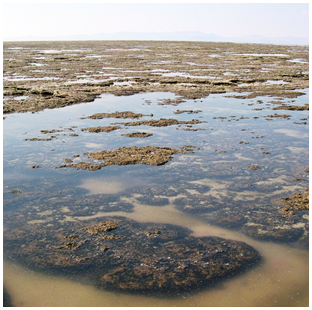
Utah’s Oolitic Sand, Photo Courtesy and Copyright Mark Larese-Casanova

Hi, this is Mark Larese-Casanova from the Utah Master Naturalist Program at Utah State University Extension.

Imagine if prehistoric brine shrimp were responsible for one of the finest examples of architecture in Salt Lake City today.

Okay, so it may be a bit of a stretch, but let me explain. In a previous episode of Wild About Utah, I discussed the life cycle of brine shrimp and the important role that they play in the Great Salt Lake Ecosystem. Well, as the billions of brine shrimp feed on bacteria in Great Salt Lake, they excrete waste in the form of tiny fecal pellets. These pellets, along with sand grains and other bits of debris, eventually settle to the bottom of Great Salt Lake.

In shallow areas of the lake, where wind and waves routinely mix the water, these small particles gradually accumulate layers of calcium carbonate, forming an oolite (spelled o-o-l-i-t-e). This is very similar to how a pearl, also layers of calcium carbonate around a small particle, is formed within the shell of an oyster or mussel. The main difference, aside from a pearl being much larger, is that oolites are typically oblong, rather than round. The beaches on the west side of Antelope Island are a great place to find oolitic sand, which will look and feel as though you have a handful of tiny pearls.

Utah’s Oolitic Sandstone
Photo Courtesy & Copyright
Mark Larese-Casanova

Around 50 million years ago, large fresh- and salt-water lakes covered parts of Utah, and in these areas, vast amounts of sediments, including oolites, were deposited. Over time, these oolites were compressed and cemented together into limestone.

A quarry near Ephraim in Sanpete County supplied oolitic limestone for the construction of the Governor’s Mansion in 1902 and the original Salt Lake City Public Library in 1905. The Library building, located at 15 South State Street, eventually housed the Hansen Planetarium and is now home to the O.C. Tanner flagship store. The building underwent an extensive restoration just a couple of years ago, and now serves as a shining example of neoclassical architecture in our capitol city.

The truth is, there are tens of millions of years separating oolitic limestone from our modern-day brine shrimp. So, we can’t exactly say that prehistoric brine shrimp were responsible for the existence of the O.C. Tanner building. But, it’s fun to imagine precious gems from around the world housed in a beautiful building constructed from the ‘pearls’ of Great Salt Lake.

Historic OC Tanner Building
(formerly the Salt Lake Library
and later the Hansen Planetarium)
Photo Courtesy & Copyright
Mark Larese-Casanova

For Wild About Utah, I’m Mark Larese-Casanova.
Credits:

Images: Courtesy and copyright Mark Larese-Casanova

Text:     Mark Larese-Casanova, Utah Master Naturalist Program at Utah State University Extension.
Additional Reading:

Utah Geological Survey https://geology.utah.gov/utahgeo/rockmineral/collecting/oolitic.htm

Utah Division of Wildlife Resources, Great Salt Lake Ecosystem Program
https://wildlife.utah.gov/gsl/facts/oolitic_sand.php

Salt Lake Brine Shrimp, https://saltlakebrineshrimp.com/harvest/
 

Owl Vision

Barn Owl Sleeping in a Tree
Copyright © 2010 Mike Fish

Hi I’m Holly Strand.

Great-horned and other nocturnal owls have phenomenal nighttime vision. In some respects—they see much better by night than we can by the light of the sun. The visual acuity of owls springs from a number of interesting adaptations.

Of course you’ve noticed that owls have big eyes. If our eyes were in the same proportion to the size of our head, they would be the size of grapefruits! Large owl corneas and lenses help maximize the amount of light received by the retina.

There are two types of photo receptors in the retina. Cones operate in bright light and give fine detail and color vision. Rods work with much less light but compromise somewhat on detail and color. Owl eyes contain considerably more rods than cones while the eyes of daytime animals–like us –contain many more cones than rods.

Great Horned Owl
Copyright © 2010 Mike Fish

Owls –and other nocturnal creatures—have a mirror-like structure behind the retina called a tapetum. Light passes through the rods and cones, strikes the tapetum and is reflected back through the eye to the light source. The tapetum ensures that any light unabsorbed by receptor cells is reflected back through the eye. This gives the receptor cells a second chance at stimulating the rods.

Owls, like most predators, have eyes positioned forward on the face and looking in the same direction. The resulting binocular vision gives the owl a three dimensional perspective. By accurately sensing depth, the owl can zero in on a tasty little mouse scurrying across a field and make adjustments on the wing as it closes in for a kill. To help triangulate even more precisely, owls will often bob or weave their heads to get several viewpoints of an object.

Finally, because of their unique eye structure, owls cannot move their eyes within the sockets. No worries! The owl just moves its whole head instead. On an exceptionally mobile neck, an owl head can rotate at least 270 degrees from side to side and 90 degrees up and down.

For some great pictures of owls and their enigmatic eyes, go to www.wildaboututah.org

For Wild About Utah, I’m Holly Strand.

Credits:

Photos: Courtesy and Copyright 2010 Mike Fish

Text: Holly Strand

Sources & Additional Reading:

Cornell Lab of Ornithology. https://www.birds.cornell.edu/

Utah Division of Wildlife Resources. Utah Conservation Data Center. https://dwrcdc.nr.utah.gov/ucdc/

Scholz, Floyd. 2001. Owls. Mechanicsburg PA: Stackpole Books

Sparks, John and Tony Soper. 1989. Owls: Their Natural and Unnatural History. NY: Facts on File.