Peregrine Falcons: Fierce predators rescued from the abyss

Peregrine Falcons: Fierce predators rescued from the abyss: Falco peregrinus, Tooele County, Utah, 21 Jun 2009. Photo Courtesy & Copyright Kent R. Keller and found on utahbirds.org
Peregrine Falcon, Falco peregrinus
Tooele County, Utah, 21 Jun 2009
Courtesy & Copyright © Kent R. Keller
Courtesy utahbirds.org/birdsofutah/

PeregrinePeregrine Falcon
Courtesy US FWS
Frank Doyle, Photographer
 
Click to view larger image of a Peregrine Falcon in Flight. Courtesy US FWS, Katherine Whittemore, PhotographerPeregrine Falcon in Flight
Courtesy US FWS
Katherine Whittemore, Photographer

What predatory bird can guide a screaming 200 MPH freefall dive to intercept a flying duck, killing it with a blow from a fist of talons? Tornado winds howl at 200MPH. Even flying horizontally, this bird can accelerate to 70MPH. No animal is faster. It must therefore be a falcon, in today’s case, the Peregrine Falcon. This species inhabits all continents but Antarctica. The Peregrine likes cliff ledges for nesting, such as the high basalt walls at the Birds of Prey Refuge along the Snake River near Boise. In such places, listen for its call, which is very similar to this Prairie Falcon:

Kevin Colver recording: Songbirds of the Southwest Canyon Country

Fifty years ago, the Peregrine Falcon was in a different dive, a plunge to extinction. The culprit was DDT. It wasn’t poisoning the birds, but it insidiously interfered with birds’ calcium metabolism, leaving thin-shelled eggs that broke under brooding parents. DDT is persistent. Worse, DDT bioaccumulates in fats of species high on the food chain, birds like falcons, eagles, and pelicans. Robins provided the first persuasive evidence of DDT bioaccumulation.

On December 28, 1973, President Nixon signed the Endangered Species Act into law. The peregrine falcon was immediately listed. DDT use in the United States was banned. Worried wildlife researchers undertook a bold program to rescue intact eggs from cliff-face nests. The captive nestlings were raised up and taught to hunt. Over the years, 1600 peregrines were released into the wild. The peregrine’s population plunge was halted, then reversed. In 1999, it was formally delisted. By 2003, 3000 pairs bred in Canada, the U.S. and Mexico. Peregrines have never been common, but today, you are four times more likely to see a Peregrine Falcon in Utah than 30 years earlier. You can see similar rebounds in Red-tailed Hawks, Brown Pelicans and other predatory birds by going to the website of the National Audubon Christmas bird counts. This is an environmental success story worth celebrating.

This is Linda Kervin for Bridgerland Audubon Society.

Credits:

Photo: Courtesy & Copyright Kent R. Keller and
Courtesy images.fws.gov
Text: Jim Cane, Bridgerland Audubon Society
Voice: Linda Kervin, Bridgerland Audubon Society
Bird Recordings Courtesy and Copyright Dr. Kevin Colver,https://wildstore.wildsanctuary.com/collections/special-collections & WildSanctuary, Soundscapes, https://www.wildsanctuary.com

Additional Reading:

Peregrine Falcon (Falco peregrinus), U.S. Fish & Wildlife Service, May 2006, https://www.fws.gov/species/american-peregrine-falcon-falco-peregrinus-anatum

Christmas Bird Count, National Audubon Society, https://birds.audubon.org/christmas-bird-count

The Birder’s Handbook: a field guide to the natural history of North American birds : including all species that regularly breed north of Mexico [Book] by Paul R. Ehrlich, David S. Dobkin, Darryl Wheye
https://www.amazon.com/Birders-Handbook-Natural-History-American/dp/0671659898

Feathers: The Evolution of a Natural Miracle, Thor Hanson, Illustrated. 336 pages. Basic Books.
https://www.amazon.com/Feathers-Evolution-Natural-Thor-Hanson/dp/0465028780/

Salt Lake City Peregrine Falcon Cameras, Wildlife.utah.gov, See YouTube, https://youtu.be/L9DQW1uBMzY
Utah’s Changing Climate and Weather

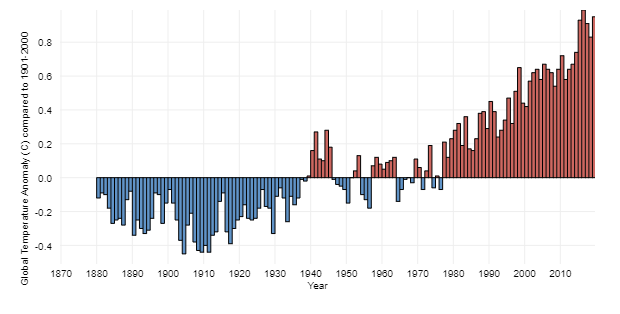
Utah's Changing Climate and Weather: History of global surface temperature since 1880 Click to visit https://www.climate.gov/news-features/understanding-climate/climate-change-global-temperature and explore interactive graph. Courtesy NOAA Climate.gov
History of global surface temperature since 1880
Click to visit https://www.climate.gov/news-features/understanding-climate/climate-change-global-temperature and explore interactive graph.
Courtesy NOAA Climate.gov
Hi, this is Mark Larese-Casanova from the Utah Master Naturalist Program at Utah State University Extension.Utah’s Changing Climate and Weather

When I’m standing in line at the post office on a cold, snowy day, I inevitably hear someone make a sarcastic comment about global warming. The reality is, weather and climate are two distinctly different measures. Weather is the combination of current atmospheric conditions, such as temperature, humidity, precipitation, and wind. It changes from day to day, sometimes from minute to minute. It affects our choices of clothing each day, or whether we carry an umbrella.

Climate, however, is a prediction of future weather conditions based on data that have been collected during at least the past few decades. Climate can change as well, but this occurs more slowly over greater time scales. Climate determines which plants we can grow and how much we insulate our homes.

During the last 500 million years, the earth has experienced several different climates from very warm periods to ice ages. Between about one hundred thousand to ten thousand years ago, the planet was impacted by an Ice Age where 30% of the earth was covered by ice extending from the poles. During part of this time, much of Utah was covered by Lake Bonneville, and was home to several now-extinct mammals, such as mammoths, saber-toothed cats, and ground-sloths.

The modern era has also seen climatic changes. Ocean sediments and polar ice core data show that from 900-1300 A.D., the earth’s climate was warmer than normal. However, between about 1300-1900 A.D., the earth experienced a little ice age. Scientists believe this was caused by a combination of three major, natural events- less solar radiation reaching Earth, five major volcanic eruptions, and the disruption of ocean circulation due to melting polar ice caps.

Even though Utah has the second driest climate in the country, annual precipitation has actually increased 14% since the late 1800’s. Sounds great, right? Well, during this same time period, the average temperature has increased three degrees Fahrenheit. This means that more of Utah’s precipitation is falling as rain rather than snow. Because water is released from snowpack at a slower rate, we are provided with water throughout the year. If more of this water comes from rain, it could result in increased stream flow in winter and spring, but decreased stream flow in summer and fall. Furthermore, it is predicted that Utah will be faced with a reduction in snowpack upwards of 50% by the year 2085.

While those of us who enjoy winter sports might experience a gradually shortening ski season, less snowpack is likely to affect us all throughout the year. With Utah’s population expected to double around the year 2050, we’ll need to find creative solutions to an increased demand on water resources.

For Wild About Utah, I’m Mark Larese-Casanova.

Credits:
Utah’s Changing Climate and Weather
Images:
Text:     Mark Larese-Casanova, Utah Master Naturalist Program at Utah State University Extension.
Utah’s Changing Climate and Weather
Additional Reading:

Climate Change and Utah. 1998. US Environmental Protection Agency. EPA 236-F-98-007z. Available at: https://nepis.epa.gov/Exe/ZyPDF.cgi?Dockey=40000PTI.PDF

Hotter Utah- Not All Bad? 2007. Deseret News. March 18, 2007. Available at: https://www.deseretnews.com/article/660204298/Hotter-Utah–not-all-bad.html

Global Warming: What about Water? 2006. Salt Lake Tribune. October 30, 2006. Available at: https://archive.sltrib.com/article.php?id=4149629&itype=NGPSID

Lindsey, Rebecca and Dahlman, LuAnn, Climate Change: Global Temperature, Climate.gov, NOAA,

Steenburgh, Jim, Wasatch Weather Weenies https://wasatchweatherweenies.blogspot.com/

Weatern Regional Headquarters, National Weather Service, National Oceanographic and Atmospheric Administration(NOAA) https://www.weather.gov/wrh/

Woody Plants of Utah

Rubber Rabbitbrush
Ericameria nauseosa

Copyright © 2010 Lyle Bingham 

Big Sagebrush
Artemisia tridentata

Southwest Regional Gap Analysis Project Field Crew/life.nbii.gov 

Shadscale Saltbush
Atriplex confertifolia

Southwest Regional Gap Analysis Project Field Crew/life.nbii.gov 

Hi I’m Holly Strand.

If you ‘re a plant lover, I’ve got just the thing for your Christmas list! A new field guide is just now hitting the shelves. It’s called Woody Plants of Utah by Renee Van Buren, Janet Cooper, Leila Shultz and Kimball Harper.

You may already own the very excellent Guide to the Trees of Utah and Intermountain West by Michael Kuhns. This book will help you identify over 219 native and introduced trees. It’s very useful because trees are what people tend to notice and appreciate. But trees are the dominant plant form on only 15% of Utah’s land area. Elsewhere, frequent droughts and extreme temperatures make life too hard for them.

Shrublands however, cover over 50% of the state. And that—in my opinion—is why you would also want the book Woody Plants of Utah on your shelf or in your backpack, for its pictures and descriptions of shrubs are outstanding.

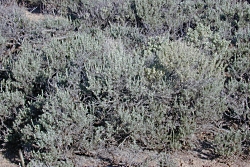
I was amazed to find that there are over 82 species of shrub in the sunflower family alone! Sagebrush is in this family so that helps push the number up. Every Utahn should be able to recognize the aromatic big sagebrush that occurs in virtually every Utah county. As its common name implies it is larger than other kind of sagebrush. It can grow over 3 meters high! Other common species are Bigelow, sand, silver, and Wyoming sagebrush. In all there are over 19 different sagebrush species in the state.

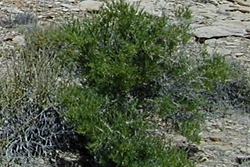
Rabbitbrush is the common name for a number of shrub species distributed within 3 genera of the sunflower family. One of the most common forms, ericameria nauseosa, sounds like it might make you ill. Yet as the name suggests this yellow-flowered shrub is consumed by rabbits as well as by deer, elk, and pronghorn.

Where evaporation exceeds precipitation there’s a build-up of salts in the soil. This is common around the Great Salt Lake where water leaches into surrounding lands and then evaporates, concentrating salts near the surface. A number of shrubs are specifically adapted to saline conditions. Shadcale is one of the more common salt-tolerant amaranths. You many not recognize the name but undoubtedly you’ve driven or walked by this shrub innumerable times.

There are so many other shrubs to get to know: manzanitas, ephedras, mesquite, mountain mahogany, wild rose and wild raspberry just to name a few. Woody Plants of Utah will help you explore this fascinating but often underappreciated life form that blankets so much of our state.

Order the book through Utah State University Press or find it at your local bookstore.

For pictures and links go to www.Wildaboututah.org

For Wild About Utah, I’m Holly Strand.

Credits:

Images: Courtesy and Copyright Lyle Bingham
and Courtesy the NBII LIFE, https://life.nbii.gov
Text: Holly Strand

Sources & Additional Reading:
Van Buren, Renee, Janet Cooper, Leila Shultz and Kimball Harper. 2011.
Woody Plants of Utah: A Field Guide with Identification Keys to Native and Naturalized Trees, Shrubs, Cacti, and Vines. Utah State University Press.
https://www.usu.edu/usupress/books/index.cfm?isbn=8244

Kuhns, Michael. 1998. Guide to the Trees of Utah and Intermountain West Utah State University Press.
https://www.usu.edu/usupress/books/index.cfm?isbn=8244

Jardine Juniper

Jardine Juniper
a Rocky Mountain Juniper
Juniperus scopulorum
Courtesy & © 2010 Andrea Liberatore
Stokes Nature Center


Jardine Juniper
a Rocky Mountain Juniper
Juniperus scopulorum
Courtesy & © 2010 Andrea Liberatore
Stokes Nature Center

Hi, I’m Chelsea McMahon and I’m Rose Wiarda from Utah State University’s Department of Environment and Society.

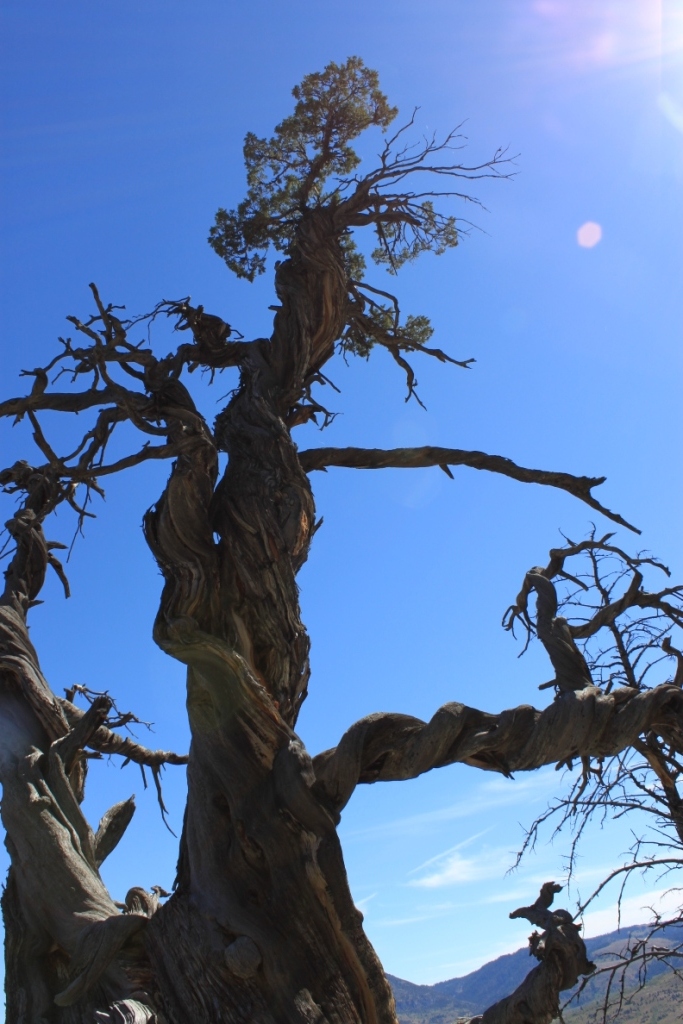
Can you recall watching a tree grow from a seed to a shade-giving giant over your lifetime? Now imagine this happening on a timescale of over 50 generations! Logan Canyon’s Jardine Juniper is a tree that has survived through many centuries of human history. Core samples taken from this gnarled giant reveal its age as an estimated 1500 years old. The Jardine Juniper was discovered in 1923 by Maurice Lindford, a student at Utah State Agricultural College, now Utah State University. Lindford named the tree in honor of fellow alumnus and U.S. Department of Agriculture Secretary William Mason Jardine.

The Jardine Juniper is a Rocky Mountain juniper, one of Utah’s two tree-sized native juniper species. The Rocky Mountain juniper is characterized by bluish-green foliage and bright blue berry-like cones. Native American tribes throughout the Intermountain West and the western Great Plains have traditionally used juniper berries, foliage, and roots for medicinal purposes.

The Jardine Juniper holds a position on Utah’s Big Tree champion list as the largest Rocky Mountain juniper in the state. It also occupies a position on the prestigious National Register of Big Trees. This register, which is maintained by non-profit group American Forests, records the dimensions of the largest trees in the nation. The Jardine Juniper overshadows other trees of its species with a 284-inch diameter and 40-foot height, making it not only the largest in the U.S., but the largest in the world.

Although its current foliage is sparse, the tree is still alive. This hardy sentinel has kept watch over centuries of change in the canyon, witnessing the comings and goings of native Shoshone peoples, the arrival of fur trappers and Mormon settlers, and the development of the canyon as part of the Uintah-Wasatch-Cache National Forest.

If you wish to see this majestic remnant of another age, take a hike! The hike to the Jardine Juniper is about 9 miles round trip and is accessible by the Uintah-Wasatch-Cache National Forest trail 014, the Jardine juniper trail. Wear weather appropriate clothing and bring plenty of water—this hike is steep in places! Above all, enjoy your time in the presence of this impressive vestige of the past and remember that its preservation depends on kind treatment from visitors like you.

I’m Rose Wiarda and I’m Chelsea McMahon for Wild About Utah.
Credits:

Photos: Courtesy & © 2010 Andrea Liberatore, Stokes Nature Center https://logannature.org/
Text:    Rose Wiarda & Chelsea McMahon, USU Environment & Society

Additional Reading:

American Forests National Register of Big Trees: https://www.americanforests.org/our-programs/bigtree/

General info about Jardine Juniper: https://ewb.usu.edu/wp-content/uploads/2010/08/INFO-Jardine-Juniper.pdf

General info about the Rocky Mountain Juniper: https://plants.usda.gov/plantguide/pdf/cs_jusc2.pdf

The Jardine Juniper Trail: https://www.fs.usda.gov/recarea/uwcnf/recreation/recarea/?recid=9376&actid=24

Jardine Juniper Trail, LoganCanyonHiking.com, https://www.logancanyonhiking.com/jardine.htm