Snow Pack Dynamics

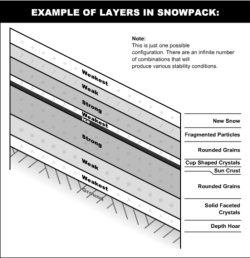
Click for more information on Snow Layers. Graphic Courtesy Forest Service Avalanche Center www.fsavalanche.org
Snow Layers
Courtesy:
Forest Service Avalanche Center
Jim Conway, Graphic Artist
Formerly fsavalanche.org
See: https://avalanche.org/avalanche-encyclopedia/#snow-layer
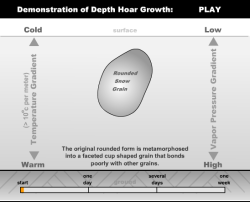
Click for more information on Depth Hoar. Graphic Courtesy Forest Service Avalanche Center www.fsavalanche.orgDepth Hoar
Click to watch archived animation
Courtesy:
Forest Service Avalanche Center
Jim Conway, Graphic Artist
Formerly fsavalanche.org
See: https://avalanche.org/avalanche-encyclopedia/#depth-hoar-basal-facets

See Archived Avalanche Encyclopedia https://web.archive.org/web/20100312232112/http://www.avalanche.org/~uac/encyclopedia/

Water is our planet’s magical molecule, changing states faster than a presidential candidate. Snowpacks vaporize, ice melts and re-freezes, lakes evaporate, and cooled water vapor condenses back as clouds, snowflakes and hoarfrost. The muffled silence of the winter snowpack belies its dramatic pace of transformation.

In his book entitled “Life in the Cold”, author Peter Marchand explains the dynamic nature of the snowpack. Within a few hours after a snow storm, destructive metamorphism sets to work on the newly fallen snow. The delicate crystalline structure of each snowflake is quickly degraded. The intricate flakes transform to amorphous icy grains. Wind, warmth and compression accelerate destructive metamorphism, leaving a firmer, denser snowpack. At the surface, not only does snow strongly reflect the weak warmth of winter sunlight, but on a clear night, it radiates energy, greatly cooling the surface.

Meanwhile, the soil beneath the snowpack is typically warmer than the overlying snow, which is why springs can run all winter long. Three feet underground, soil temperature is within a few degrees of that location’s average annual air temperature. Sandwiched between the warm soil and the cold air, the blanket of snow is a great thermal insulator; fresh snow is the equal of fiberglass insulation. As a result, soil warmth transforms snow deep under the snowpack into water vapor. This moisture spreads through air spaces in the snowpack, following the thermal gradient to the chilly snow surface. As the moisture vacates the lower layers, a brittle porous layer develops in the snowpack. Termed “depth hoar”, it is weak, icy and prone to collapse. When the heavy overlying snowpack shifts, the crumbly depth hoar can release an avalanche, a powerful reminder of snowpack transformations for any backcountry traveler.

Come spring, every particle of Utah’s snowpack undertakes its final transformation. Some sublimates to waft away on warm springtime winds. Most of it melts away to feed the groundwater, springs and streams that give us cool relief on a hot summer day and provide the precious water that every Utahn depends on.

This is Linda Kervin for Bridgerland Audubon Society.

Credits:

Graphics: Courtesy Forest Service Avalanche Center, https://www.fsavalanche.org/
Text: Jim Cane, Bridgerland Audubon Society

Additional Reading:

Life in the Cold by Peter Marchand:https://www.upne.com/9619460.html

Forest Service National Avalanche Center, Avalanche Awareness Website: https://www.fsavalanche.org/

Depth Hoar: https://www.fsavalanche.org/encyclopedia/depth_hoar.htm

Utah Avalanche Center: https://utahavalanchecenter.org/
The Shape of Wildlife in Winter

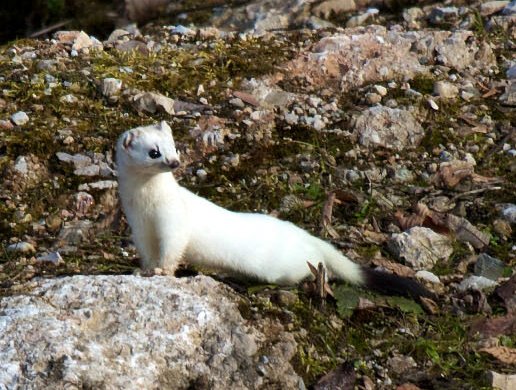
The Shape of Wildlife in Winter: Short-tailed weasels, also known in winter as ermine, have a long, slender body shape that allows them to invade subnivean tunnels to prey upon smaller mammals.
Short-tailed weasels, also known in winter as ermine, have a long, slender body shape that allows them to invade subnivean tunnels to prey upon smaller mammals.
Photographer: Steven Hint
Courtesy Wikimedia
Licensed under Cc-by-sa-3.0

Hi, this is Mark Larese-Casanova from the Utah Master Naturalist Program at Utah State University Extension.

Now that snow is finally accumulating in Utah’s mountains, weekend hiking trips have come to an end. But, that means it’s time to dust off the snowshoes and skis and get back outside. We humans are lucky in that we have countless types of gear to help us adapt to almost all winter conditions.

While a fur coat might help keep mammals warm or camouflaged in winter, there are many other adaptations that also aid in winter survival. Decreased mobility in deep snow can often prevent animals from finding food, possibly causing starvation in winter.

Some animals have feet that are particularly large for their body size, which helps them travel on top of deep snow. One of the best examples of this adaptation can be found in snowshoe hares. Snowshoe hare prints are easy to spot among the spruce and fir trees- the large teardrop-shaped hind feet leave prints that look like the hare was wearing miniature snowshoes, which is how it got its name.

While some animals are adapted to walk on top of deep snow, others do their best to simply walk though it. The long, slender legs of moose help keep the majority of their bodies above the snow, minimizing the energy required to travel in winter.

Instead of walking on top of or through the snow, small mammals such as mice and voles travel under the snow. As snow accumulates, mice and voles create vast networks of tunnels on top of the ground, but under the snow. This subnivean environment is typically warmer than air temperature above the snow, and still provides access to food, such as grasses, seeds, and bark.

Short-tailed weasels, also known in winter as ermine, have a long, slender body shape that allows them to invade subnivean tunnels to prey upon smaller mammals. As long as its head can fit into a tunnel, its narrower body can follow. This adaptation comes with a price, though. Slender bodies lose heat quickly, so weasels must consume around one-third of their body weight in food each day in order to produce enough heat to survive.

So while deep powder might seem like a winter wonderland to those of us who can adapt with the right gear, other mammals continually struggle to stay warm and find food. Some, however, choose to give up the fight and sleep the winter away.

For Wild About Utah, I’m Mark Larese-Casanova.

Credits:

Images: Pending rights approval
Text:     Mark Larese-Casanova, Utah Master Naturalist Program at Utah State University Extension.
Additional Reading:

Ellsworth, E. Surviving the winter: The importance of snowshoe hare foraging behavior. BEHAVE: Stories of Applied Animal Behavior. University of Idaho. Available at: https://www.cnr.uidaho.edu/range556/appl_behave/projects/hare_forage.html

Gellhorn, J. (2002). Song of the alpine: The Rocky Mountain tundra through the seasons. Johnson Books.

Lieberg, A. (2009). Charismatic minifauna. Northwest Connections. Available at: https://www.northwestconnections.org/documents/news/EOE_09feb26_Lieberg.pdf

Cache and Retrieve

Click for a larger view of the Clark's Nutcracker, Nucifraga columbiana, Image licensed through the noted CCL.  Stephen Pavlov, Photographer
Clark’s Nutcracker
Nucifraga columbiana
Courtesy Steven Pavlov
This file is licensed under the Creative Commons Attribution-Share Alike 3.0 Unported license 

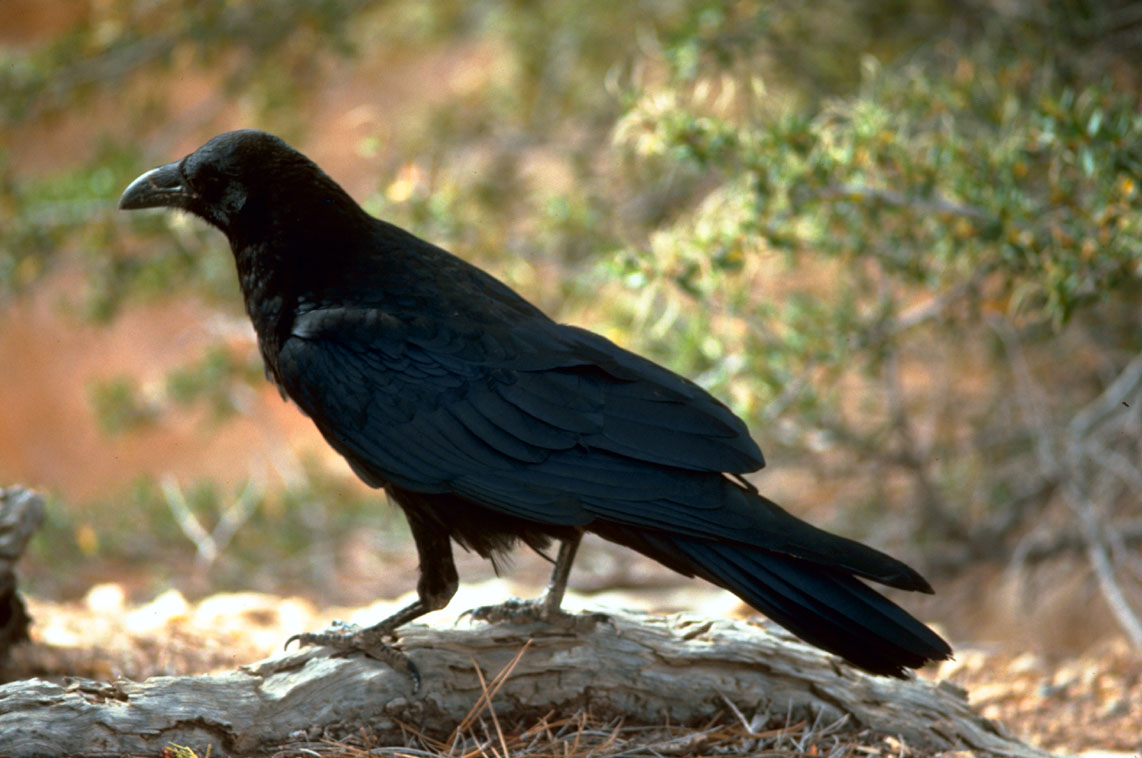
Common Raven
Corvus corax
Courtesy US FWS
Gary M. Stolz, Photographer 

Hi I’m Holly Strand.

Every year, just before Christmas, I comb through the house looking for presents hidden earlier in the year. I check inside old shoes, unfold towels in the closet, and peer way back into the dark recesses of seldomly-used cabinets. With a child in the house, you have to be tricky! The problem with this complex gift stashing behavior is that sometimes I forget where I hid the present when it’s time to wrap it! And once in awhile I forget that I bought something at all! Out of sight—out of mind!

You wouldn’t make a very good magpie, I have been told. For magpies– along with jays, crows and ravens, are masters at hiding–or caching as it’s called– and then retrieving. Of course, what they cache is not Christmas presents but food.

One Utah bird that is much admired for its caching and retrieving skills is Clark’s nutcracker . This large jay lives in mountainous areas throughout the west. Experts say that Clark’s nutcracker can cache 10s of thousands of pinyon, whitebark or limber pine seeds in a single season. Starting in August, the bird will hide 1-15 seeds at a time, often distributing them several kilometers and at much different elevations from the original tree. Caches lie 1-3 centimeters deep in forest litter, bare soil, under bark, in holes, in logs or stumps.

As winter wears on, the nutcracker will retrieve its caches with the help of visual landmarks such as rocks, trees or logs. Using these visual cues, the nutcracker will retrieve the seeds through summer of the following year. Forgotten or abandoned seed caches often germinate, growing into trees that produce more food.

Just as I worry about prying eyes when I hide Christmas presents, birds who cache must be careful to notice who is watching. The common raven is notorious for its spying and thieving behavior. One raven will covertly observe while another caches scraps of meat, eggs, bones or seeds. The observer will then shamelessly raid the cache usually within a couple of days. But having probably raided someone else at some point, the caching raven is on the lookout too. If the caching raven senses the presence of a would-be looter, it might wait for the other bird to become preoccupied. Or it may move the food to a different site altogether. Caching ravens will also hide behind some structure to avoid being seen.

Interestingly, these sly birds will even engage in fake caching. Ravens will cache inedible or low value food items in plain view of other ravens but then stash the good stuff in secret. Fake caching seems designed to throw looters off track, . But perhaps it’s also a character test for fellow ravens? Or maybe—for the intelligent raven—it’s all just an amusing shell game?

For sources and pictures for this and past stories, go to www.wildaboututah.org

For Wild About Utah, I’m Holly Strand.

Credits:

Theme: Courtesy & Copyright Don Anderson as performed by Leaping Lulu
Images: Courtesy Wikimedia/ Steven Pavlov, Photographer
and Courtesy US FWS, Gary M. Stolz, Photographer
Text & Voice: Holly Strand

Sources & Additional Reading:

Balda, R.P. & Kamil, A.C. 1989. A comparative study of cache recovery by three corvid species. Animal Behaviour 37: 486-495. https://doi.org/10.1016/S0003-3472(89)80041-7

Boarman, W. I. and B. Heinrich (2020). Common Raven (Corvus corax), version 1.0. In Birds of the World (S. M. Billerman, Editor). Cornell Lab of Ornithology, Ithaca, NY, USA. https://doi.org/10.2173/bow.comrav.01 or https://birdsoftheworld.org/bow/species/comrav/cur/introduction

Bugnyarf, Thomas and Kurt Kotrschal. 2001. Observational learning and the raiding of food caches in ravens,Corvus corax: is it ‘tactical’ deception? Animal Behavior, Volume 64, Issue 2, August 2002, Pages 185–195. https://doi.org/10.1006/anbe.2002.3056

Heinrich, Bernd and John W. Pepper. 1998. Influence of competitors on caching behaviour in the common raven, Corvus corax . Animal Behaviour. Vol. 56, 1083–1090, https://doi.org/10.1006/anbe.1998.0906

Marzluff, John and Tony Angell. 2005. In the Company of Crows and Ravens. Yale University Press. https://yalepress.yale.edu/yupbooks/book.asp?isbn=0300100760

Schaming, T. D., D. F. Tomback, and T. J. Lorenz (2024). Clark’s Nutcracker (Nucifraga columbiana), version 2.0. In Birds of the World (N. D. Sly, Editor). Cornell Lab of Ornithology, Ithaca, NY, USA. https://doi.org/10.2173/bow.clanut.02 or https://birdsoftheworld.org/bow/species/clanut/cur/introduction

[Page Updated February 12, 2026]

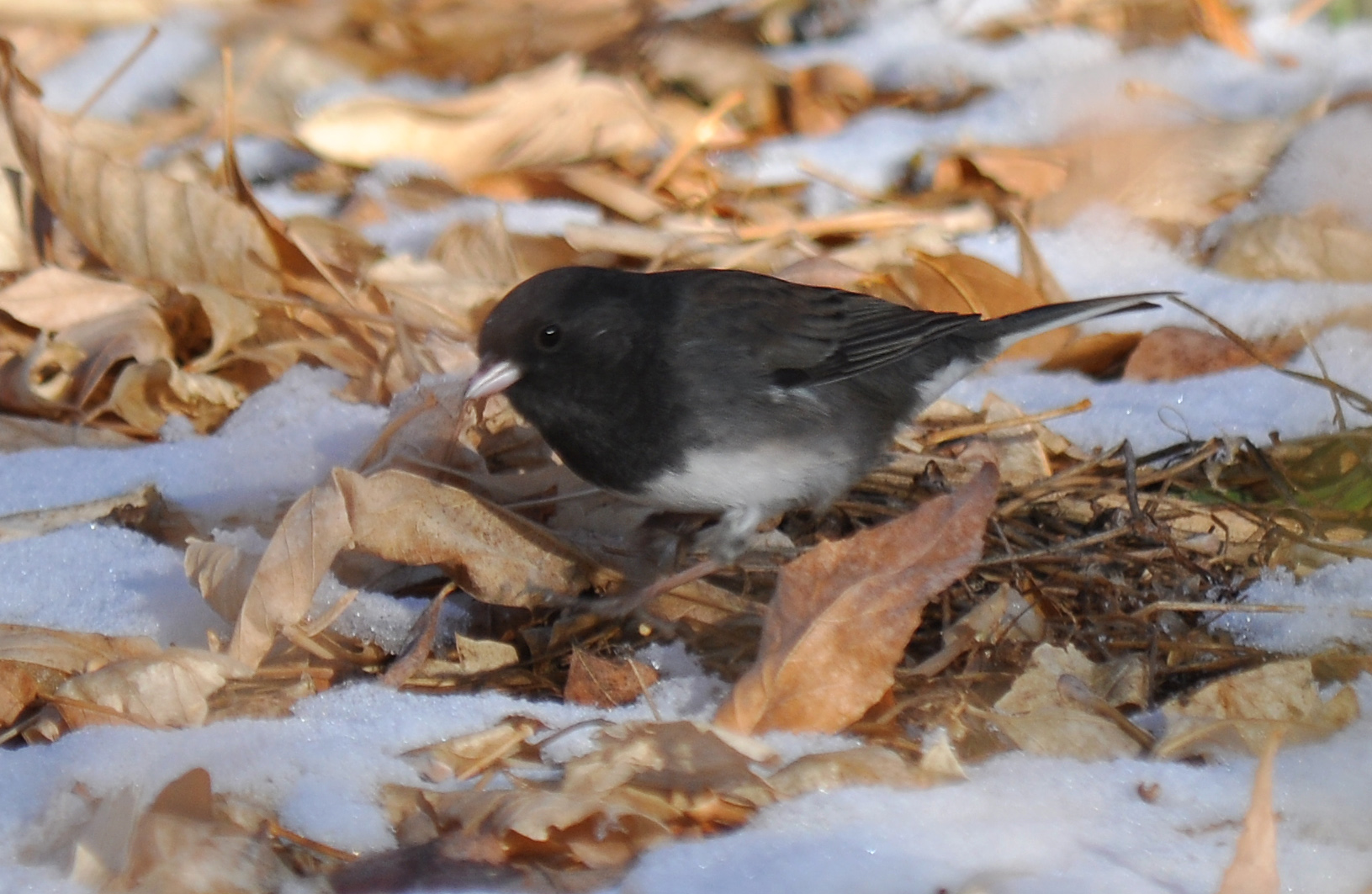
Dark-eyed Juncos

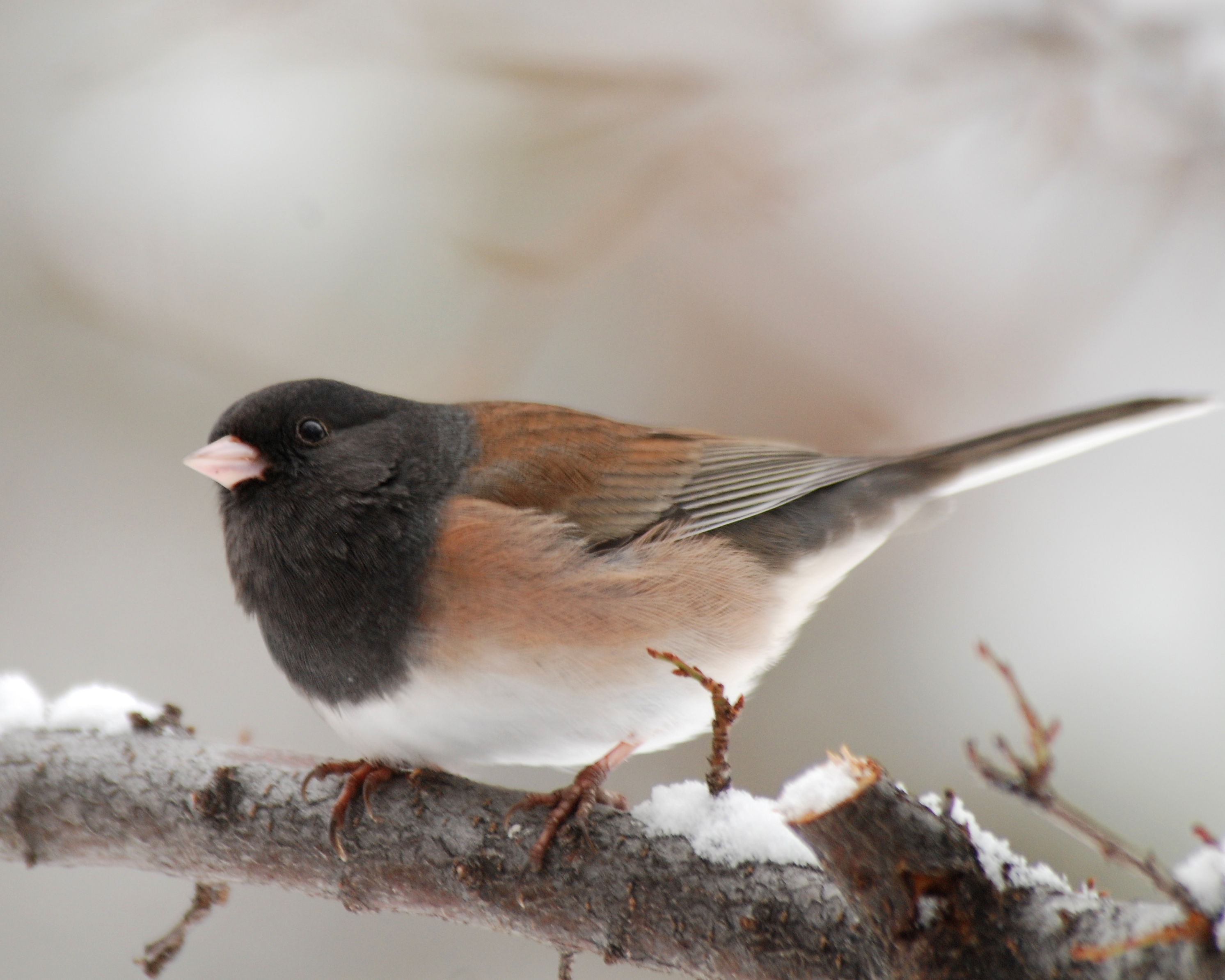
Dark-eyed Junco “Oregon” Male
Junco hyemalis montanus
Courtesy & © 2008 Ryan P. O’Donnell 

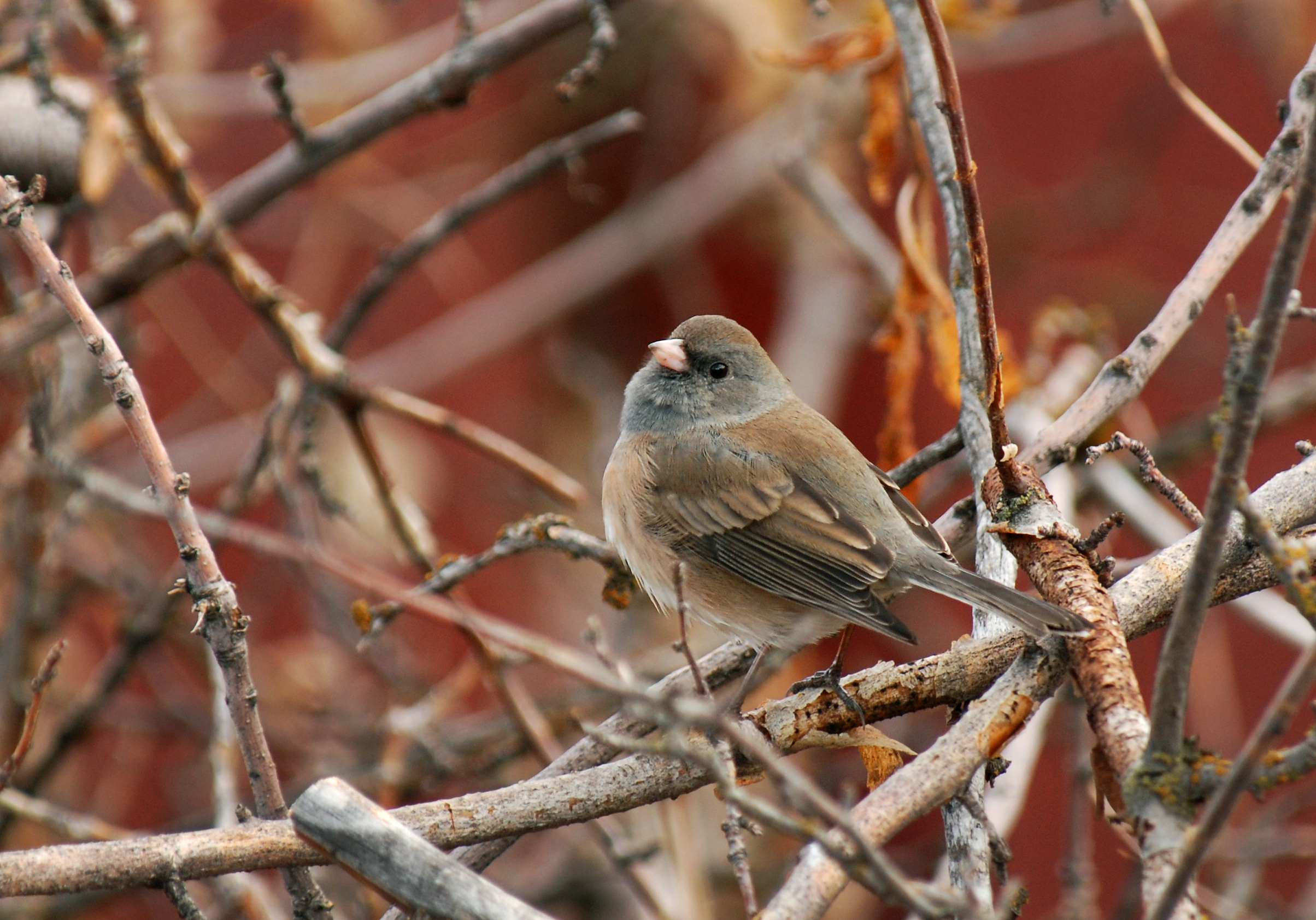
Dark-eyed Junco “Oregon” Female
Junco hyemalis montanus
Courtesy & © 2011 Ryan P. O’Donnell 

Dark-eyed Junco “Pink Sided”
Junco hyemalis mearnsi
Courtesy & © 2011 Ryan P. O’Donnell 

Dark-eyed Junco “Cassiar”
Junco hyemalis cismontanus
Courtesy & © 2011 Ryan P. O’Donnell 

Dark-eyed Junco “Gray-headed”
Junco hyemalis caniceps
Courtesy & © 2011 Ryan P. O’Donnell 

My backyard bird feeders are a busy place this time of year. I enjoy keeping track of who visits – especially as a relative newcomer to the Utah bird scene. Last winter, however, I was baffled by the identity of what turned out to be a fairly ordinary bird.

Dark-eyed juncos are a common sight throughout the United States, but as it turns out, they exhibit an incredible geographic variation in plumage colors. There is a ‘slate-colored race’ which I was used to seeing in the Midwest – uniformly gray above with a white underbody. During Utah winters, the ‘Oregon race’ is common, with its black hood, brown back and peachy sides. Another ‘gray-headed race’ sports varying shades of gray with a distinct reddish brown patch on its back.

Depending on who you ask, there are up to fifteen different races, also called sub-species, of dark-eyed junco – all quite visually distinct, but all considered to be the same species. It wasn’t always this way, however. In the late 1950’s what we now call dark-eyed juncos were recognized as four different species, and in the 1890’s there were six.

These changes beg the question, at what point does speciation occur? And the answer lies in the ability of these birds to interbreed. One scientific definition of a species is those organisms or populations of organisms that are “potentially capable of interbreeding.”

Unique plumage patterns have evolved in a number of geographic locations across the junco’s range, however all of the dark-eyed junco variants could potentially interbreed if they happened to meet. Indeed in places where these geographic territories overlap inter-breeding does take place resulting in blends of the usually-distinct color patterns.

Juncos aren’t the only bird species with recognized color variants. Any raptor enthusiast will be familiar with variations in plumage colors that many birds of prey exhibit, such as merlins and red-tailed hawks. What makes dark-eyed juncos unique is that they are being studied as a possible case of speciation in progress. It turns out that there is more than just a difference in color among dark-eyed juncos. Some sub-species also exhibit variation in song patterns, social behavior, body size, and migration patterns, any of which may eventually cause these groups to stop interbreeding and allow a new species to emerge.

To see pictures of dark-eyed junco subspecies, visit our website at www.wildaboututah.org. Thank you to Rocky Mountain Power Foundation for supporting the research and development of this Wild About Utah topic.

For the Stokes Nature Center and Wild About Utah, this is Andrea Liberatore.

Credits:

Photos: Courtesy & © Ryan P. O’Donnell
Text:    Andrea Liberatore, Stokes Nature Center, logannature.org

Additional Reading:

Atwell, J.W., O’Neal, D.M, and Ketterson, E.D. (2011) Animal Migration as a Moving Target for Conservation: Intra-species Variation and Responses to Environmental Change, as Illustrated in a Sometimes Migratory Songbird. Environmental Law. Vol. 41:289 p. 289-319, https://www.amazon.com/Animal-migration-moving-target-conservation/dp/B005C29H7I

Alderfer, Jonathan (editor) (2005) National Geographic Complete Book of Birds. National Geographic Press. Dark-eyed junco information available online at: https://animals.nationalgeographic.com/animals/birding/dark-eyed-junco/

Cornell Lab of Ornithology, All About Birds: Dark-eyed Junco. https://www.allaboutbirds.org/guide/Dark-eyed_Junco/id/ac

History of Name Changes for Juncos. Cornell Lab of Ornithology. https://www.birds.cornell.edu/pfw/News/junco_taxonomy.pdf