Yesterday’s Camels

Yesterday’s camel
Courtesy Wikimedia,
Arthur Weasley, Artist
Licensed under
GNU Free Documentation License
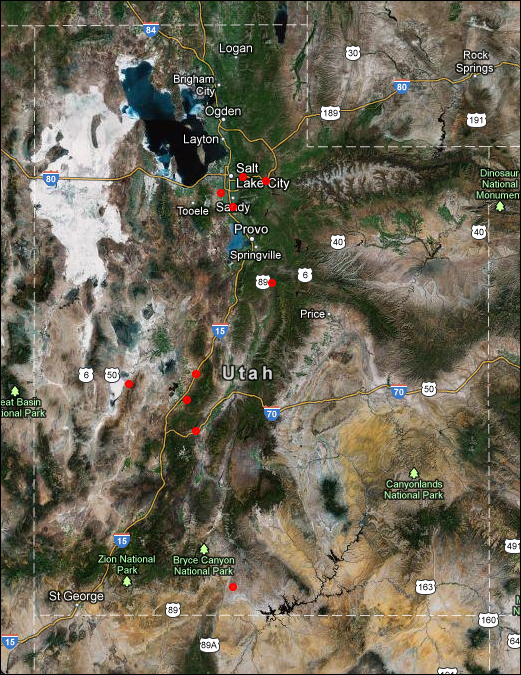
Utah locations where
ancient camel bones
were discovered.
Courtesy BerkeleyMapper,
created by
Berkeley Natural History Museums,
UC Berkeley at https://berkeleymapper.berkeley.edu/_

Map data ©2013Google,
INEGI Imagery, © 2013 Terra Metrics

Hyrum Museum
Courtesy Holly Strand, Photographer

Hi, I’m Holly Strand.

There’s a small, but very engaging museum underneath the public library in Hyrum UT. This museum showcases a number of artifacts reflecting the history, customs and environment of Cache Valley. When I first visited in 2009, a couple of odd items caught my eye. One was an enormous hairball that had formed in the stomach of a Cache Valley cow. Such hairballs are called bezoars, a Persian word meaning “antidote.” Centuries ago, bezoars were believed to be a universal antidote that could neutralize any poison.

The other odd item at the museum was a camel tooth. Now a cow hairball can seem geographically appropriate as Cache Valley has plenty of cows. But why would a camel tooth be in a museum about the history of Northern Utah?

Well it turns out that this particular tooth belonged to a native Utah camel species. It most likely came from we now call Yesterday’s camel (or Western camel) which lived over 10,000 years ago. This camel was twenty percent larger than a dromedary and had a longer, narrower head and thick muscled lips. Its footpad was soft and toes were splayed, approaching the foot structure of modern camels. We don’t really know whether or not Yesterday’s camel had a hump. Remains of this Pleistocene ancestor have been found throughout the American West and in a number of UT locations.

Further, I was surprised to learn that camels are a purely North American invention, first appearing some 40- 50 million years ago. At the peak of their North American career–during the Miocene–there were 13 genera of camels. Overall, at least 95 species in 36 genera have been described for this continent alone.

The earliest camel was no more than 2 feet high. After that we find camel legs and necks grew longer to allow browsing on trees and shrub tops. One particular species (Aepycamelus giraffinus ) stood 19 feet high. Essentially this camel had become America’s giraffe on what was then a Serengeti-like plain.

Other camels resembled gazelles, and still others looked more like the camelids of today.

4 million years ago, camelids first crossed the land bridge to Eurasia . Living in Eurasian deserts, they evolved into arid land specialists with a remarkable physiological capacity for water conservation.

Other North American camelids drifted south to colonize South America. They evolved into today’s llamas, guanacos, alpacas, and vicunas—all high altitude grazing specialists.

After a few waves of migration, camels suddenly vanished from their birthplace. In fact much of the North America’s megafauna suddenly vanished in the late Pleistocene. Perhaps due to human hunting, perhaps climate change. We may never know for sure.

But one thing is clear to me now–a camel tooth definitely has a place in a Utah history museum.

For more information and sources, and a link to the Hyrum Museum, go to www.wildaboututah.org

For Wild About Utah, I’m Holly Strand.

Credits:

Image: Courtesy Wikimedia, Arthur Weasley, Photographer
          Courtesy & Copyright © Holly Strand, Photographer
          Courtesy BerkeleyMapper, created by Berkeley Natural History Museums,
          UC Berkeley at https://berkeleymapper.berkeley.edu/_
          Map data ©2013Google,
          INEGI Imagery, © 2013 Terra Metrics
Text: Holly Strand

Sources & Additional Reading

Flannery, Tim. 2001. The Eternal Frontier: An Ecological History of North America and its Peoples, NY: Grove Press.
https://www.amazon.com/Eternal-Frontier-Ecological-History-byFlannery/dp/B004XOXF06

Honey, J. J. Harrison, D. Prothero, M. Stevens, 1998. Camelidae. In:
C. Janis, K. Scott, L Jacobs, (eds.), Evolution of Tertiary Mammals of North America, Vol. 1. Terrestrial carnivores, ungulates and ungulate-like mammals, Cambridge University Press, Cambridge, UKIrwin, Robert. 2010. Camel. London : Reaktion Books
https://www.amazon.com/Evolution-Tertiary-Mammals-North-America/dp/0521619688

San Diego Zoo Global. 2009. Extinct Western Camel, Camelops hesternus
https://library.sandiegozoo.org/factsheets/_extinct/camel_extinct_western/extinctcamel.htm [Accessed at time of publication – Note from Library.SanDiegoZoo.org 11/24/2024: The SDZWA Staff Publications Repository and Zoonooz/Journal Index are both unavailable as we work with a new vendor to provide users a better searching experience. Please contact the Library team, or check back here soon, for more information.]

Hyrum Museum
50 West Main Street
Hyrum, UT 84319
435-245-0208
https://hyrumcitymuseum.org/

Amazing Adaptations of Utah’s Desert Plants

Amazing Adaptations of Utah’s Desert Plants: Click to view larger image of Tap roots that grow deep into the soil to reach groundwater, Photo Courtesy and Copyright Mark Larese-Casanova, Photographer
Tap roots grow deep
to seek groundwater
Photo Courtesy & Copyright
Mark Larese-Casanova, Photographer

Amazing Adaptations of Utah’s Desert Plants: Click to view larger image of Winterfat trichomes, the light-colored dense ‘hairs’ on leaves and stems that shade the plant and collect morning dew, Photo Courtesy and Copyright Mark Larese-Casanova, PhotographerWinterfat trichomes
Hair-like trichomes provide shade
and absorb dew
Photo Courtesy & Copyright
Mark Larese-Casanova, Photographer

Amazing Adaptations of Utah’s Desert Plants: Click to view larger image of the waxy coating of the Waxy Creosote Leaves, Photo Courtesy and Copyright Mark Larese-Casanova, PhotographerPrickly Pear Cactus
Fibrous roots quickly absorb water
and store it in wide succulent leaves
Photo Courtesy US FWS
Gary M. Stolz, Photographer

Amazing Adaptations of Utah’s Desert Plants: Click to view larger image of the waxy coating of the Waxy Creosote Leaves, Photo Courtesy and Copyright Mark Larese-Casanova, PhotographerWaxy Creosote Bush
Leaf coating inhibits desication
Photo Courtesy & Copyright
Mark Larese-Casanova, Photographer

Hi, this is Mark Larese-Casanova from the Utah Master Naturalist Program at Utah State University Extension.

Anyone who lives in Utah knows that it’s a dry state. In fact, around three-quarters of our state is considered desert. A desert is often characterized as an area that receives less than ten inches of precipitation each year. But, high levels of evaporation, which are influenced by temperature, wind speed, and solar radiation, also contribute to creating a dry desert ecosystem.

So, how exactly are plants able to survive in Utah’s deserts, which are so dry? It turns out that the plants that grow and flourish in Utah’s deserts have an amazing array of adaptations for survival.

Many shrubs and trees, such as desert willow, and certain species of sagebrush and mesquite, have thick taproots that grow deep into the soil to reach groundwater. This helps the plants survive the hot, dry summer. Some mesquite taproots have been found to grow as deep as 200 feet to reach a constant water supply.

Cacti, such as the various types of prickly pear, have almost an opposite adaptation. They produce dense tufts of fibrous roots just below the surface of the soil. This allows cacti to quickly absorb water from brief rainstorms, and then store the water in their thick, succulent leaves.

As temperature increases, desert plants face the danger of excessive water loss from their leaves. A thick, waxy coating on the outside of leaves often helps to retain water. The shiny wax also reflects sunlight to keep the leaves relatively cooler. To further reduce leaf temperature and water loss, some plants, such as brittlebush, grow light-colored dense ‘hairs’ on their leaves and stems. These trichomes not only shade the plant, but also aid in absorbing water from morning dew.

If temperatures get too hot, and drought stress too great, some plants, such as creosote bush and ocotillo, may drop their leaves several times each year to ensure survival. Some of these plants have green chlorophyll in their stems so they can still produce food through photosynthesis when there are no leaves on the plant.

While this is just a sample of an amazing collection of adaptations, it’s clear that desert plants are champions of survival in a harsh ecosystem where water is so scarce.

For Wild About Utah, I’m Mark Larese-Casanova.

Credits:

Images: Courtesy & Copyright Mark Larese-Casanova
US FWS images.fws.gov
Text:     Mark Larese-Casanova, Utah Master Naturalist Program at Utah State University Extension.
Additional Reading:

Utah’s Desert Dwellers: Living in a Land of Climate Extremes. Wildlife Review. Utah Division of Wildlife Resources
wildlife.utah.gov/wr/0706desert/0706desert.pdf

Deserts. James MacMahon. The Audubon Society Nature guides. 1985. https://www.amazon.com/Deserts-National-Audubon-Society-Nature/dp/0394731395

Natural History of the Colorado Plateau and Great Basin, Harper, St. Clair, Thorne, and Hess (Eds.), 1994. https://www.amazon.com/Natural-History-Colorado-Plateau-Great/dp/0870815113

The Biology of Deserts, David Ward, Oxford University Press, 2009. https://www.amazon.com/Biology-Deserts-Habitats/dp/0199211477


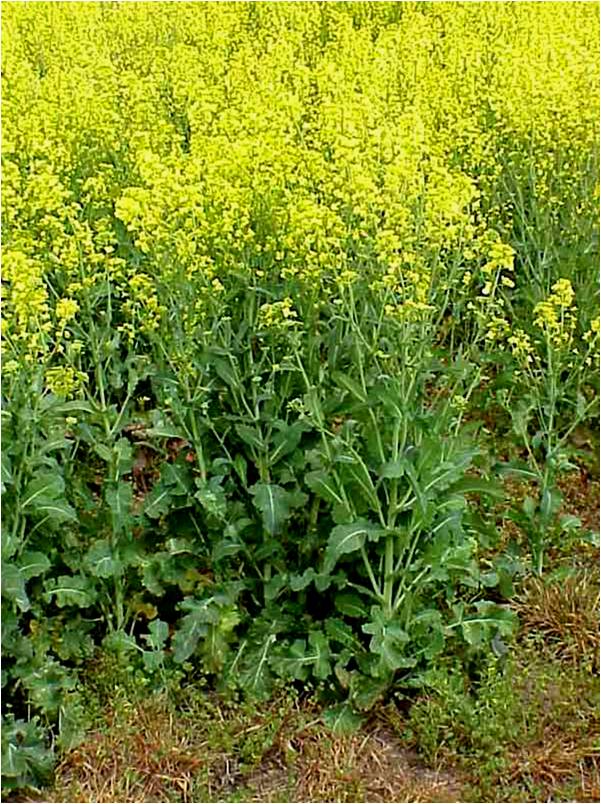
Dyer’s Woad

Click to view a larger picture; Dyer's Woad in blossom courtesy and copyright 2009 Brad Kropp - as found on bugwood.org
Dyer’s Woad in blossom
Courtesy of and
Copyright © 2009 Brad Kropp
As found on bugwood.org

In early May, pale yellow carpets some hillsides of Northern Utah. The plants are a non-native known as Dyer’s Woad. This Asian member of the cabbage family has been cultivated as a dye and medicinal plant in Europe and Asia for 2000 years. Dyer’s Woad produces a glorious blue dye, but the process is tricky. No synthetic dye equals the color and characteristics of woad dyes.

Woad had arrived in Utah by 1932 as a seed contaminant. Now it is a noxious weed. Woad has a number of unique abilities that contribute to its vigor. Being a biennial plant, it spends the first year of life as a rosette of leaves, building reserves. In its second year, those reserves allow a woad plant to send forth a tall, lanky stem covered with pale yellow flowers that ultimately yield up to 10,000 seeds per plant.

Although Dyer’s Woad is not toxic, few animals relish it either. The seeds have chemicals that inhibit germination and root elongation in other plants, giving woad a competitive edge. Woad causes millions of dollars in losses each year, so control is a major issue. Herbicides and mechanical removal are best used against the rosettes, but nature has provided a native fungus that views woad as dinner. This rust fungus is very effective at eliminating or severely reducing seed production. Plants infected with the rust fungus are misshapen, wrinkly, and covered in dark spots. Those spots brim with rust spores. Therefore, when removing woad, leave the sickly plants to infect yet more woads.

Click to view a larger picture; Dyer's Woad with rust courtesy and copyright 2009 Brad Kropp - as found on bugwood.org
Dyer’s Woad with rust
Courtesy of and
Copyright © 2009 Brad Kropp
As found on bugwood.org

This is Linda Kervin for Bridgerland Audubon Society.
Credits:
Photos: Brad Krupp, Utah State University, Bugwood.org
Text: Michael Piep, Utah Native Plant Society

Additional Reading:

Resources:
Intermountain Herbarium: https://herbarium.usu.edu/

Washington Weed Board: https://www.nwcb.wa.gov/weed_info/Written_findings

/Isatis_tinctoria.html

References:
Edmonds, J. 2006. The History of Woad and the Medieval Woad Vat. https://www.lulu.com/product/paperback/the-history-of-woad-and-the-medieval-woad-vat/4928037

Shaw, R.J. 1989. Vascular Plants of Northern Utah. Utah State University Press, Logan, Utah. https://www.usu.edu/usupress/books/index.cfm?isbn=1417

Welsh, S.L., N D. Atwood, S Goodrich & L.C. Higgins. 2008. A Utah Flora, 4th Ed. Brigham Young University, Provo, Utah. https://www.amazon.com/Utah-Flora-Stanley-L-Welsh/dp/0842525564

Earthworms

Click for a larger view of an earthworm, Courtesy and copyright 2013 Andrea Liberatore, Photographer
Earthworm (Nightcrawler)
Lumbricus terrestris
Copyright 2013
Andrea Liberatore, Photographer
 

Click for a larger view of a worm, Courtesy and copyright 2013 Andrea Liberatore, Photographer3Red Garbage Eating Earthworm
Eisenia foetida
Copyright 2013
Andrea Liberatore, Photographer


Click for a larger view of a fossil, Courtesy FWS, Cara Schildtknecht PhotographerA child shows others the worm
she found while helping plant the
pollinator garden at the FWS National
Conservation Training Center Garden
Courtesy FWS
Cara Schildtknecht, Photographer


As we enter into May, the familiar old rhyme of ‘April showers bring May flowers’ is proving to be true. But April showers always seem to bring something else out worth noticing – earthworms! A walk in the neighborhood the morning after a spring rainstorm reveals pink, wiggling – or sometimes not wiggling – worms on the sidewalks, streets, and lawns. This behavior obviously makes the robins happy, but I can’t imagine it’s all that good for the worms themselves. So what’s going on?

While worms need to be moist at all times, it turns out that they can’t handle too much water. Worms have no lungs, and instead breathe directly through their skin. A little bit of moisture facilitates the exchange of air into and out of their bodies, but too much moisture inhibits this process, essentially suffocating them. Another hypothesis suggests that worms might take advantage of the moist environment to travel. When the air is dry, worms are restricted to underground movement, which takes considerable time and effort. After a spring rain, however, they can travel across the surface, moving faster than they otherwise would.

Not all earthworms are alike – there are upwards of 7,000 known species and counting. They can range in size from less than an inch to over six feet long, and are distinguished by size, body shape, color, and many other minute differences. For simplicity’s sake, worms can be divided into three broad categories based on where they are found in the ground. The first group – called the Epigenic species – are found very close to the surface of the soil, typically in the leaflitter layer. These are the worms used for vermicomposting because they rapidly break down large volumes of organic matter. The second group – the Endogenic species – are found in the upper soil levels and do not have permanent burrows. They are constantly moving, eating all the while and filling up their burrows with their waste – called worm castings – as they go. Lastly, there are the deep burrowing Anecic species, which contains the familiar nightcrawler. Anecic species create more permanent burrow systems that can be quite extensive and stretch several feet deep. They frequently visit the soil surface to locate and pull organic matter down below, leaving little piles of castings at the burrow entrance.

Contrary to popular belief, earthworms don’t in fact eat dirt, or even dead and decaying matter. Instead, they feed on the bacteria and fungi that live on the dead and decaying matter, breaking that stuff into smaller pieces in the process. This, of course, greatly aids decomposition, making new nutrients available to plants. In fact, worms are of great assistance to the average gardener. As they move through the soil in search of food, they increase the porosity of the ground which allows rainwater to seep in and stay there longer. Worms are constantly on the move – carrying nutrients from the surface down into the lower layers of the soil and vice versa as they go, all the while providing channels for plant roots to easily follow.

Any search for earthworm information uncovers a litany of amazing facts. Earthworms have five hearts. They are hermaphrodites – meaning they have both male and female characteristics. In one acre of productive land, there can be as many as one million earthworms. And perhaps strangest of all – the abundant earthworm is not native to any part of North America once covered by glaciers. But there is one common wives’ tale that is too good to be true. If you cut an earthworm in half, it will not create two worms. While worms can regrow parts of their bodies, a headless worm segment cannot grow a new head. If the damage is not too extensive, however, the tailless worm can grow a new tail. So be kind to the worms wiggling out onto your sidewalk after a hard rain. If you’re feeling extra generous, you might even relocate a few to a stretch of lawn or garden – perhaps saving them from the watchful eye of the ever-present robins.

For pictures of worms and a lesson plan on making mini worm habitats, visit www.wildaboututah.org.

For the Stokes Nature Center and Wild About Utah, this is Andrea Liberatore.

Credits:

Photos: Courtesy & © Andrea Liberatore
Text:    Andrea Liberatore, Stokes Nature Center, logannature.org


Additional Reading:

Appelhof, Mary (1997) Worms Eat My Garbage. Flower Press. Kalamazoo, MI https://www.amazon.com/Worms-Eat-My-Garbage-Composting/dp/0977804518

Edwards, Clive A. Soil Biology. Chapter 8: Earthworms. A publication of the United States Department of Agriculture. Available online at: https://soils.usda.gov/sqi/concepts/soil_biology/earthworms.html

Ransford, Matt (2008) Science of the Everyday: Why Earthworms Surface. Popular Science. Available online at: https://www.popsci.com/scitech/article/2008-03/science-everyday-why-earthworms-surface

Utah LessonPlans (2007) Making a Mini Worm Habitat. Utah State Office of Education. Available online at: https://www.uen.org/Lessonplan/preview.cgi?LPid=18886

Sullivan, Kaitlin, Invasive ‘Jumping’ Worms Are Now Tearing Through Midwestern Forests, Audubon Magazine, January 2, 2020, https://www.audubon.org/news/invasive-jumping-worms-are-now-tearing-through-midwestern-forests

Weston, Phoebe, ‘A poor man’s rainforest’: why we need to stop treating soil like dirt, The Guardian, April 16, 2021, https://www.theguardian.com/environment/2021/apr/16/poor-mans-rainforest-stop-treating-soil-like-dirt-aoe