
Aquatic Insects, Harbingers of Health

Aquatic Insects, Harbingers of Health
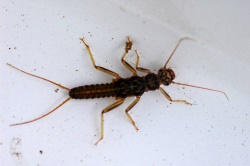
Skwala (Large Springflies)
Stonefly Nymph
Courtesy & Copyright
Robert Newell
As found on
TroutNut.com
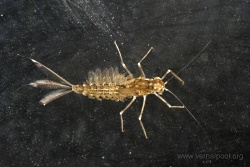
Aquatic Insects, Harbingers of HealthMayfly nymph
Courtesy & Copyright
Leo Kenney, Vernal Pool Association

Aquatic Insects, Harbingers of HealthNorthern caddisfly Larvae

Limnephilidae
Photo Credit:
Howard Ensign Evans,
Colorado State University,
Bugwood.org
Used under
Creative Commons Attribution 3.0
License.

Hi, this is Mark Larese-Casanova from the Utah Master Naturalist Program at Utah State University Extension.

As we officially enter summer, it’s easy to notice nature at its peak. Wildflowers are in bloom, birds are feeding their young, and insects fill the air. Life is especially robust near our wetlands, lakes, and streams.

Our aquatic, or wet, ecosystems provide habitat to abundant plants and animals. Only 1% of Utah is wet, but over 80% of all wildlife in Utah depend on aquatic ecosystems for at least part of their life cycle. However, the quality of Utah’s aquatic habitats is often affected by chemical pollution or excessive nutrients and sediment.

Some organisms, including many aquatic insects, only live in the healthiest of aquatic habitats. Many of the insects we see in summer live in the water when young, during the larval or nymph stage, before becoming adults. Three insects in particular- mayflies, stoneflies, and caddisflies- require especially clean, cold streams low in nutrients and high in dissolved oxygen to survive.

Mayflies are aquatic as nymphs and emerge from the water to live as adults for just a day. The external feather-like gills of the nymphs can be seen fluttering along the sides of their abdomen. They feed by scraping algae from rocks.

Stonefly nymphs are well adapted to living among the rocks of swift-moving streams. Their hooked legs grasp the slick rocks as they shred apart plant litter that falls into the stream.

Caddisfly larvae spin a sort of spider silk to glue rocks or sticks together to form a case in which they live. They will also build webs underwater to collect small particles of food that drift by.

The quality of a stream habitat can be assessed by counting the number of different species, or types, of mayflies, stoneflies, and caddisflies. A greater number of species generally means that habitat and water quality are higher. Dramatic decreases in insect diversity from season to season or year to year can signal a decline in stream health. Monitoring aquatic insects over time gives us an accurate picture of the long-term health of our stream ecosystems.

For more information about monitoring water quality and aquatic insects, visit Utah State University Water Quality Extension’s website. Once there, you’ll find a wealth of information about monitoring Utah’s aquatic ecosystems, including Utah Water Watch, a statewide volunteer citizen science program.

For Wild About Utah, I’m Mark Larese-Casanova.

Credits:
Images: Northern caddisfly larvae, Howard Ensign Evans,
            Colorado State University
            Creative Commons Attribution 3.0 License.
            Stonefly Nymph, © Robert Newell, displayed on Troutnut.com
            Mayfly nymph, © Leo Kenney Vernal Pool Association
Text:     Mark Larese-Casanova, Utah Master Naturalist Program
            at Utah State University Extension.


Additional Reading:

Larese-Casanova, M. Utah Master Naturalist Watersheds Wildlife Field Guide. Utah State University Extension. 2012. https://extension.cart.usu.edu/Details.cfm?ProdID=41&category=0

USU Water Quality Extension. Utah Stream Team Manual. https://extension.usu.edu/waterquality/htm/citizen_monitoring/ust

Voshell, J. R. A Guide to Common Freshwater Invertebrates of North America. The McDonald and Woddward Publishing Company. 2002. https://www.amazon.com/Guide-Common-Freshwater-Invertebrates-America/dp/0939923874

Firefly light

Click for a larger view of a firefly, Courtesy Wikimedia, Bruce Marlin, Photographer, licensed under Creative Commons Attribution-Share Alike 2.5 Generic license
Firefly
Courtesy Wikimedia,
Bruce Marlin, Photographer
Licensed under
Creative Commons Attribution-
Share Alike 2.5 Generic license

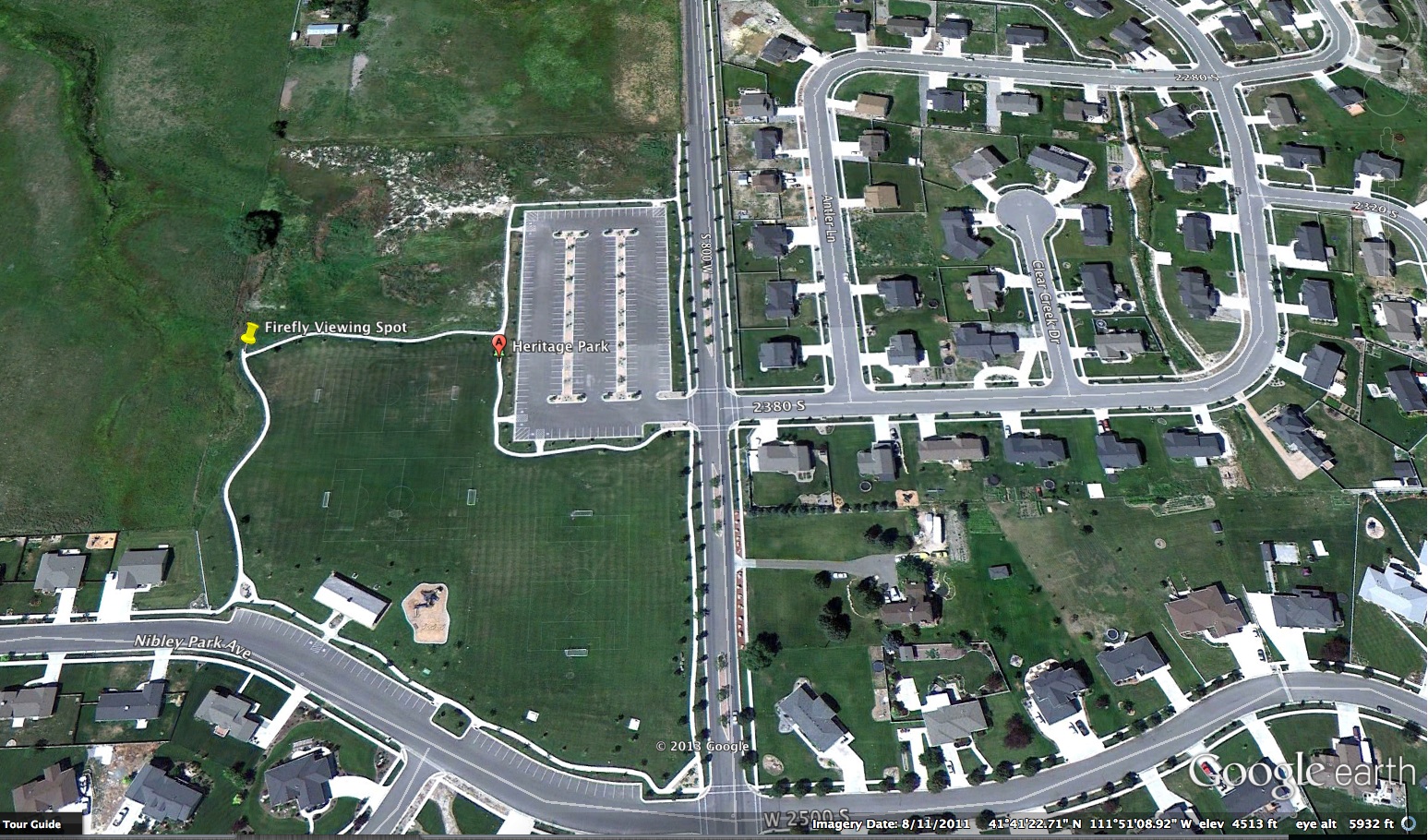
Click for a larger view of Nibley Firefly viewing spot Courtesy and copyright Google EarthFirefly viewing spot
Heritage Park, Nibley, UT
2456 S 800 W

Access 800 W from either 2600 S
(from Hwys 165 or 89)
OR 2200 S (Hwy 89 only)
41° 41′ 23″ N 111° 51′ 17″ W

Courtesy Google Earth, Imagery Date 8/11/2011

Hi, I’m Holly Strand.

One of my greatest delights during childhood was to visit my grandmother in North Carolina. For around her farmhouse I could spend endless hours chasing and catching fireflies–we called them lightening bugs back then. As an adult, I am still captivated by the dancing lights that animate the muggy darkness, often with a background chorus of crickets and cicadas.

Flashing in fireflies evolved as a way to identify a mate. The male flashes his invitation while patrolling the local air space. If a female is impressed, she responds, either from the ground or at some perch in a shrub or on tall grass. Different species emit different flash patterns to avoid interspecific mix-ups.

Fireflies are very common in the moister, eastern half of the US. Look for them near ponds, streams, wet meadows and marshes. Many popular science sources will assert that fireflies don’t occur in the arid west. Or they will say that fireflies in the west don’t flash. For while the larvae of all firefly species glow, the adult forms of some species don’t flash. And those non-flashing forms are the species which are documented online and in collections for Utah and surrounding states.

Until recently I felt sorry that Utah kids don’t get to experience these magical bioluminescent displays. But on Monday night just before 10 PM, my family and I stood at the end of the sidewalk behind the soccer fields in Nibley’s Heritage Park. As the sky darkened, tiny amber lights began to wink on and off. An entire field of twinkling lights lay before us. I had to pinch myself to make sure I wasn’t dreaming.

I asked around and discovered that –in the last 10 years or so–there have been several sightings of flashing fireflies here in Utah. In 2002, biologist Jim Cane discovered some in River Heights. Utah State University’s Insect Collection features a 2007 specimen from Heber Valley. In recent years, additional sightings have been reported in Escalante, the Uinta, Spanish Fork and now Nibley.

We don’t know why Utahns are now able to enjoy these insect light displays. Have the flashing fireflies always been here and we just didn’t notice them? Did we notice them, but didn’t document it publicly? Or is the range of this particular species expanding? And if so, why?

To see the Nibley fireflies check our website www.wildaboututah.org. We’ve posted a map. And if you have seen flashing fireflies now or in the recent past here in Utah, let us know and we’ll post it on our website for others who might be nearby.

In general, firefly populations are declining around the world, and they are obviously still rare here. So if you run across them, treat them with respect!

Thanks to Utah State University entomologists Charles Hawkins, Ted Evans and Jim Cane for sharing their firefly expertise.

For Wild About Utah, I’m Holly Strand.

Credits:

Image: Courtesy Wikimedia, Bruce Marlin, Photographer
Map/Satellite Image: Courtesy Google Earth
Theme music: Composed by Don Anderson and performed by Leaping Lulu, https://leapinglulu.com/
Text: Holly Strand

Reported Sightings:

22 June 2013
I just read the article about fireflies and want to say I’ve seen them in Mill Creek Canyon, just out of Moab (not Mill Canyon, which is north of town). I’m familiar with them from being in Missouri as a kid on vacation to see relatives.

Thanks for a great website! CM


24 June 2017
Today while waiting for local city fire works we saw a lighting bug or two. We are in West Haven.


Report your sighting


Sources & Additional Reading

Buschman, Lawrent L., Biology of the Firefly Pyractomena lucifera (Coleoptera: Lampyridae). The Florida Entomologist. 1984. Vol. 67(4):529. DOI: 10.2307/3494462 https://www.jstor.org/stable/3494462?origin=crossref&seq=5

Lloyd, James E., 1964. Notes on Flash Communication in the Firefly Pyractomena dispersa (Coleoptera: Lampyridae) Annals of the Entomological Society of America, Volume 57, Number 2, March 1964 , pp. 260-261. (James Lloyd is a leading authority on fireflies. He retired from academic duty at the University of FL, but here is a web page with some of his wisdom and musings. https://entnemdept.ufl.edu/lloyd/firefly/

(Boston) Museum of Science Firefly Watch
Volunteers help citizen scientists track firefly occurrences.
https://legacy.mos.org/fireflywatch/
https://www.massaudubon.org/programs-events/community-science/firefly-watch/view-explore-data

National Geographic. Firefly (Lightning Bug) Lampyridae
https://animals.nationalgeographic.com/animals/bugs/firefly/

Phys.org news service. Jun 26, 2012. Romancing the firefly: New insights into what goes on when the lights go off. https://phys.org/news/2012-06-romancing-firefly-insights.html#inlRlv

Stanger-Hall, Kathrin F., James E. Lloyd, David M. Hillis. 2007. Phylogeny of North American fireflies (Coleoptera: Lampyridae): Implications for the evolution of light signals. In Molecular Phylogenetics and Evolution 45 (2007) 33-49. http://www.bio-nica.info/biblioteca/stangerhall2007fireflies.pdf

Utah State University Insect Collection has over 117 cabinets housing approximately two million pinned insects and 35,000 microscope slides. Location: Room 240, Biology and Natural Resources Bldg.; Telephone: 435-797-0358
https://www.usu.edu/biology/research/insect-holdings/

Cats vs. Wildlife

Rooster, the Stokes Nature Center Housecat
Felis silvestris catus
Copyright 2013
Andrea Liberatore, Photographer

This past winter we took on a new staff member at the Stokes Nature Center. In exchange for room and board, he lives in our building and is on call 24 hours a day. He’s arguably our most popular employee, but I’m not jealous. Rooster is, after all, cuter than me. He’s also a cat.

As one of the only buildings for miles around, we attract a lot of mice. Taking on a cat seemed like a fun and ecological answer to a frustrating long-term problem. Obviously, this isn’t a new idea. Cats and humans have been coexisting for thousands of years – probably since the time our ancestors were developing agriculturally-based societies in the Middle East 12,000 years ago. With agriculture came grain storage, and with grain storage came mice. Cats quickly became an important part of our food security system.

As humans spread around the globe, our newly domesticated feline friends came along too. But while most of us keep cats for reasons other than their hunting prowess these days, they have retained the skills that attracted us to them in the first place. Cats are predators. Even when they’re fed at home, and have no need for additional calories, their hunting instincts don’t dissipate. A recent study estimated that cats in the US alone kill around 2.4 billion birds and 12.3 billion small mammals every year. These statistics make cats the number one anthropogenic threat to wildlife.

Utah’s wildlife evolved in an environment void of small feline predators, and their behaviors reflect this. Ground-nesting birds such as quail, nightjars, and killdeer are especially prone to predation. Domestic cats are a non-native species against which many of our birds and mammals have few defenses.

So what can you do to help? The most straightforward answer is to keep your cat indoors. If however, you insist he goes out, there are still a few things you can do to keep neighborhood animals a little safer. Attaching a bell to your cat’s collar can warn wildlife that she’s around. If your yard is a haven for birds and mammals, provide dense vegetation for them to take refuge in. And of course, spay and neuter cats to avoid bringing any more unwanted felines into the world. There are already more stray and feral cats in the US than there are loving homes for them. Controlling cat populations can save the lives of millions of birds and small mammals.

If the welfare of birds and mammals isn’t enough to motivate you, consider that research shows your cat is safer, and will live longer, if kept indoors. An innovative study by the University of Georgia – dubbed ‘Kitty Cams’ – can give you a sense of what your cat might be up to during the day. Small cameras attached to the collars of housecats record not only wildlife kills, but also fights with neighborhood dogs and opossums, and trips into storm sewers, across busy roads, and into the undercarriages of parked cars.

So far, Rooster is earning his keep. We have noticed a wonderful decrease in nibbled-on file folders and tiny footprints in desktop dust. But we don’t want our outdoor critters to decrease in numbers, and so despite his (sometimes very vocal) desires, he will remain an indoor feline. For the sake of all our Utah wildlife, I hope you consider doing the same.

For a photo of Rooster, a link to the Kitty Cams site, and more suggestions on keeping wildlife safe from cats, visit our website at www.wildaboututah.org .

For the Stokes Nature Center and Wild About Utah, this is Andrea Liberatore.

Credits:

Photos: Courtesy & © Andrea Liberatore
Text:    Andrea Liberatore, Stokes Nature Center, logannature.org

Additional Reading:

Loss, S. R., Will, T., Marra, P. P. (2013) The Impact of Free-ranging Domestic Cats on Wildlife of the United States. Nature Communications 4, Article number: 1396 Accessible online at: https://www.nature.com/ncomms/journal/v4/n1/abs/ncomms2380.html

Angier, Natalie (2013) That Cuddly Kitty is Deadlier Than You Think. New York Times. Published January 29, 2013. Accessible online at: https://www.nytimes.com/2013/01/30/science/that-cuddly-kitty-of-yours-is-a-killer.html

The National Geographic & University of Georgia Kitty Cams (Crittercam) Project: A window into the world of free-roaming cats. Accessible online at: https://www.kittycams.uga.edu/

National Audubon Society. (2013) Reducing Threats from Cats. Available online at: https://web4.audubon.org/bird/at_home/safecats.html

Zax, David (2007) A Brief History of House Cats. Smithsonian Institution. Accessible online at: https://www.smithsonianmag.com/history-archaeology/brief_cats.html

Blind Snakes

Click for a larger view of Western Blind Snake in a bucket, Leptotyphlops humilis. Courtesy and Copyright 2006 John S. Ascher, Photographer, https://www.discoverlife.org/mp/20p?see=I_JSA1964&res=640
Western Blind Snake
Leptotyphlops humilis
Courtesy & Copyright 2006
John S. Ascher, Photographer

If you’re unfamiliar with blindsnakes, don’t worry; most people haven’t heard of them. The 400 species of these seriously strange serpents are mostly tropical. Two species do occur in the southwestern United States, including western Washington County in Utah. They are small, many no larger than a shoelace, and have smooth scales and small eyes.

Blindsnakes typically live underground in loose, moist soil, so you are most likely to find one when gardening. If you do, don’t be alarmed – these tiny snakes are harmless and beneficial. Look closely, or you might mistake one for a worm due to its pinkish color. A black light can be used to tell the difference, as Utah blindsnakes glow fluorescent like scorpions. Blindsnakes eat ants, termites, centipedes and spiders. They can help control populations of these invertebrate pests around your home.

Their jaw architecture is unique. The jaws work like tiny scoops to shovel the larvae and pupae of ants and termites into their mouths. Unlike most snakes, who only eat once every few weeks, blindsnakes consume huge numbers of prey items very quickly. One Australian Blackish Blindsnake was seen to ingest over 1,400 ant larvae without pause!

Biologists in Texas report that screech owls sometimes carry live blindsnakes to their nests. Up to fifteen live among the chicks. Nests with blindsnakes have fewer mites, insects and spiders. Owlets in these nests survived and grew faster than owlets from nests without blindsnakes. This amazing mutualism may have evolved long ago. At over 100 million years old, blindsnakes are the oldest living group of snakes. Although considered primitive, blindsnakes are incredibly successful, if secretive, members of our modern serpent fauna.

Today’s program was written by Andrew Durso of Utah State University’s biology department.

Our theme music was composed by Don Anderson and is performed by Leaping Lulu.

Credits:

Theme: Courtesy & Copyright Don Anderson as performed by Leaping Lulu
Images: Courtesy & Copyright 2006 John S. Ascher, Photographer
Text: Andrew Durso, https://www.biology.usu.edu/htm/our-people/graduate-students?memberID=6753

Additional Reading:

Screech Owls and Blindsnakes: An Unlikely Mutualism, Life is Short, But Snakes are Long, A blog about snake natural history and herpetology research, Andrew Durso, February 28, 2013, https://snakesarelong.blogspot.com/2013_02_01_archive.html

Western Blind Snake (Leptotyphlops humilis), Red Cliffs Desert Reserve, Washington County HCP Administration, http://www.redcliffsdesertreserve.com/western-blind-snake

Feeding Mechanisms of Blindsnakes, Mandibular raking in Leptotyphlopidae, Video Clips, The Kley Lab, Department of Anatomical Sciences, Stony Brook University, The State University of New York, https://renaissance.stonybrookmedicine.edu/anatomy/people/facultypage/kley/videos

[Page Updated February 11, 2026]