Winter Encounters With Moose

Winter Encounters With Moose
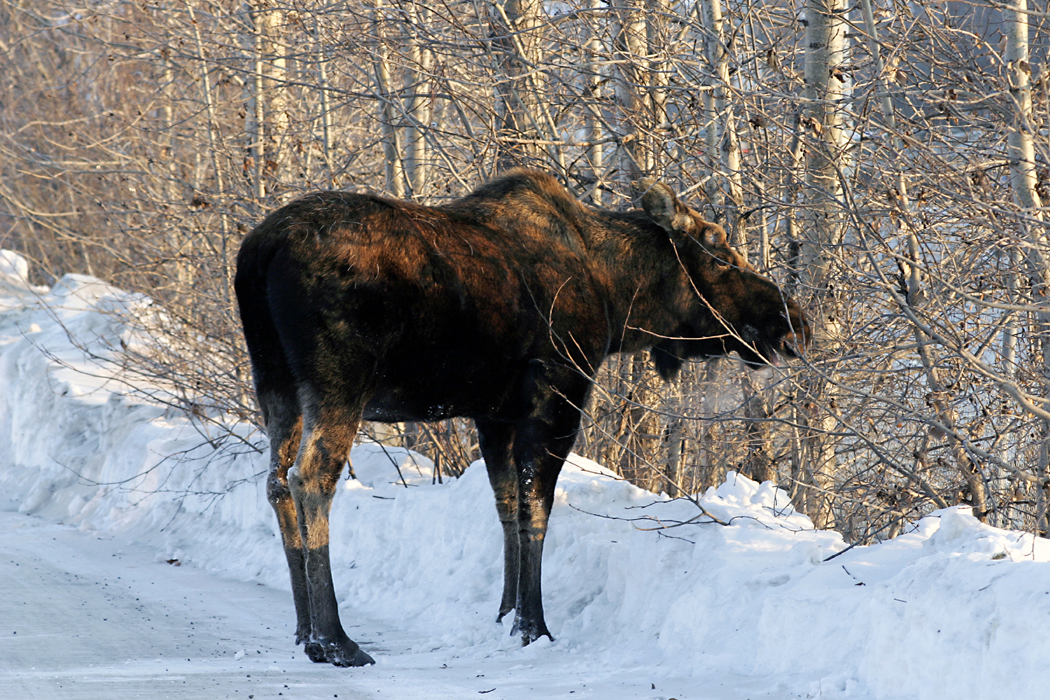
Moose in Parking Log
Photo Courtesy US FWS
Ronald Laubenstein, Photographer
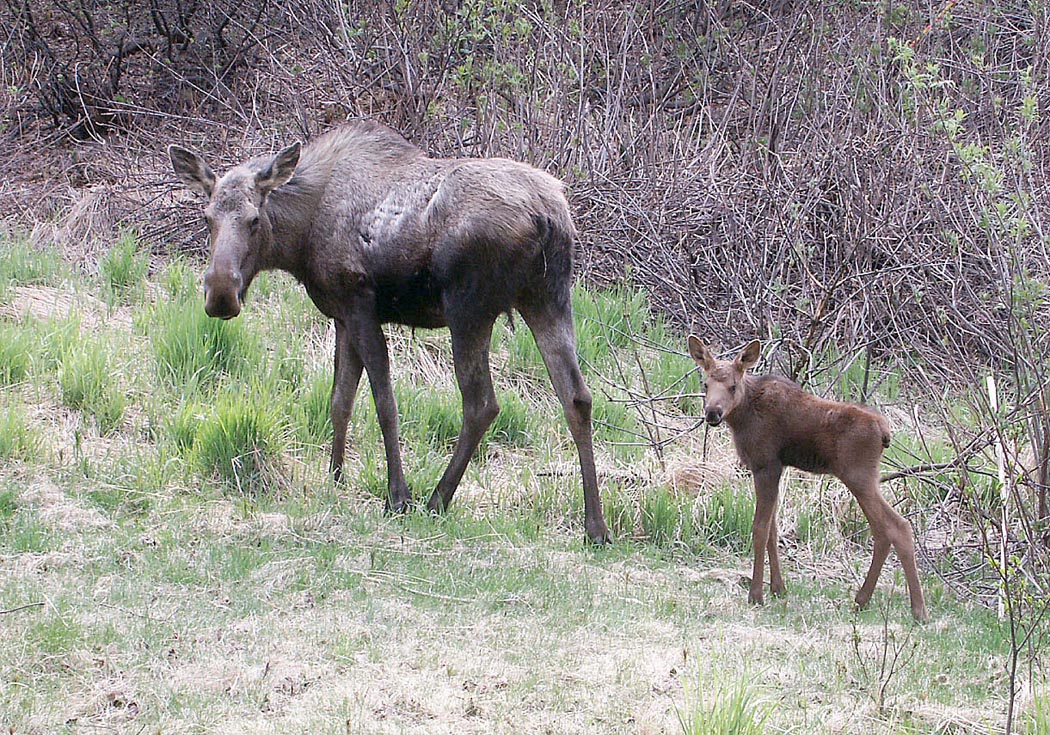
Winter Encounters With MooseCow Moose and Calf
Photo Courtesy US FWS
Tim Bowman, Photographer
Winter Encounters With MooseBull Moose
Courtesy & © 2007 Jason Pietrzak

Hi, I’m Ru Mahoney with Stokes Nature Center.

If you’ve ever had the opportunity to visit Stokes Nature Center in the Uinta-Wasatch-Cache National Forest, you know that we’re located about a third of a mile up a narrow trail cut out of a steep slope of the Bear River Mountains on one side and dropping down into the rocky waters of the Logan River on the other. Which is why it’s always a particularly sobering experience, when making a winter morning trek up the aptly named River Trail to the nature center to find my way blocked by 1200 pounds of antlered bullish brown bulk, standing 6 feet at the shoulder. In case you’ve never happened upon a moose yourself, they are what happens when Mother Nature decides that the bulk of an NFL player and the legs of a supermodel should get together in one massively large and absurdly leggy Deer-zilla. And while I’ve never met a moose who’s bored browsing and indifferent glance didn’t make it pointedly, and yes, a little painfully obvious that I was far more impressed with them than they’ve ever been with me, they can pose a threat to the incautious admirer. While I don’t encounter moose every month of the winter, I do hear well-intentioned nature center visitors talk frequently about their own encounters, which too often include accounts of trying to get closer to snap a great picture.

Moose are the largest member of the deer family in North America, and are found in the north and northeastern forests of Utah. Despite their size and top heavy appearance, they thrive in watery environments. An adult moose doesn’t hesitate to wade into deep water to browse on aquatic vegetation and can often be spotted swimming effortlessly across lakes and marshes to get to prime grazing or escape a perceived threat. Their hollow hair makes them incredibly buoyant swimmers and keeps them well insulated against the cold both in and out of the water. In winter months they may leave frozen high alpine lakes and seek out forage on evergreens and bark, making encounters on lower elevation hiking trails more likely.

Male moose rut in the fall, tirelessly seeking out willing females. Easily distinguished by their large antlers, which can spread to more than 4 feet across, a bull moose in rut can become unexpectedly aggressive. Signs of aggression include laying back their ears, raised hair along their neck and licking their snout. Female moose don’t have the impressive antlers of their male counterparts, but don’t let that fool you into thinking they’re docile. A mother moose with her spring calf is quite possibly the most dangerous moose, and will use her powerful legs and sharp hooves to trample anything she thinks might be a threat to her babe. This includes the unlucky hiker or – more often – an unleashed dog.

Wild Aware Utah, a nonprofit offering education on how to reduce conflict with wildlife, recommends responding calmly to encounters with moose, talking loudly to let them know you’re there and leashing pets. Often the moose will move along on its own, uninterested in conflict. But if you find yourself in the bullseye of a moose’s ire, the best course of action is to back away slowly. And if you’re unlucky enough to be charged, get behind a tree or solid obstacle. Moose can run up to 35 miles an hour, which means you’re unlikely to outrun one, no matter how much adrenaline is fueling your flight.

To learn more about moose and how to prevent conflict with other Utah wildlife, visit WildAwareUtah.org.

For Wild About Utah and Stokes Nature Center, I’m Ru Mahoney.

Credits:
Images: Courtesy US FWS,
              Courtesy and Copyright 2007 Jason Pietrzak
Text:     Ru Mahoney, Stokes Nature Center in Logan Canyon.


Additional Reading:

Wild Aware Utah, (Hogle Zoo, Utah DNR, Utah State University Cooperative Extension,) https://www.wildawareutah.org/

Hardware Ranch Wildlife Management Area Management Plan, Prepared by The Hardware Ranch Stewardship Team
and Logan Simpson Design, Inc., Utah Division of Wildlife Management, Mar 20, 2012, https://wildlife.utah.gov/hardwareranch/comment/HRWMA_management_plan.pdf

Utah Moose Statewide Management Plan, Utah Division of Wildlife Management, Utah Department of Natural Resources, Nov 30, 2017, https://wildlife.utah.gov/hunting/biggame/pdf/moose_plan.pdf

Hersey, Kent R., Utah Division of Wildlife Resources statewide management plan for moose (2000), Utah. Division of Wildlife Resources, https://digitallibrary.utah.gov/awweb/guest.jsp?smd=1&cl=all_lib&lb_document_id=10838

Wolfe, Michael L, Hersey, Kent R., Stoner, David C., A History of Moose Management in Utah, Department of Wildland Resources, Utah State University, Logan, Utah 84322-5230; 2Utah Division of Wildlife Resources, Salt Lake City, Utah, https://www.researchgate.net/publication/257449101_A_HISTORY_OF_MOOSE_MANAGEMENT_IN_UTAH

Prettyman, Brett, What’s making Utah’s moose numbers rise and fall?
Study will track populations of animals with radio collars in Uintas and Wasatch Front, Dec 17, 2012, https://www.sltrib.com/sltrib/news/55461427-78/aoude-decline-moose-north.html.csp

Pietrzak, Jason, Moose in Utah, Wild About Utah, Sep 30, 2008, https://wildaboututah.org/moose-in-utah/

Wildlife in Utah, Utah.com, https://www.utah.com/wildlife/northern.htm

Ruffed Grouse and the Christmas Bird Count

Ruffed Grouse and the Christmas Bird Count
Ruffed Grouse
Bonasa umbellus
Courtesy Utah Division of Wildlife Resources

I set out this week to investigate why so many gifts in ‘The 12 Days of Christmas’ are birds. You know the song: there are swans a swimming, geese a laying, calling birds, French hens, turtle doves, and that partridge in the pear tree. Well, I never did find the answer. But what I did find was some interesting information about a native bird often incorrectly referred to as a partridge –a bird that is supremely well adapted to life in winter.

Ruffed grouse resemble partridges in that they are ground-dwelling game birds of similar size and stature. Their name comes from a collar of long feathers surrounding the necks of males who fluff them out when seeking mates in spring. The birds come in two color phases, differentiated mainly by their tail feathers, which can be either gray or chestnut brown. While not well understood, a grouse’s color phase seems to be linked to climate. Grouse with gray tails are more prevalent in areas defined by cold winters, while brown grouse are more common in warmer climates.

Now that snow is blanketing the landscape across much of their territory, the ruffed grouse is in its element. Harsh winters that adversely affect populations of other ground-dwelling game birds such as quail, pheasant, and turkeys, don’t seem to faze ruffed grouse. Their ability to survive is dictated by a number of special adaptations. The first is on their feet, where each winter nubby feathers called pectinations grow on the sides of the birds’ toes. Looking like strange combs, the bristles act as snowshoes, allowing the grouse to walk on top of even the softest snow. More special feathers grow on grouse legs like personal leg-warmers, and also near the bird’s beak, covering its nostrils. Scientists believe the feathered mustache enables grouse to breathe in warmer air than they otherwise would, thus keeping their internal temperature more stable.

Changes in weather bring about some changes in behavior as well. Warmer months find the birds resting in evergreens or thick brush. But in winter, when a foot or more snow covers the ground, grouse roost in the snow. The birds create small burrows which hide them from predators, offer protection from frigid winter winds, and keep them surprisingly snug and warm. Many a backcountry skier or snowshoer has been startled by a hidden grouse bursting noisily from its snowy lair.

The birds’ diet also changes seasonally from a summer sampling of green foliage, seeds, berries and insects, to the protein-rich dormant flower buds of trees such as aspen and birch. Grouse also won’t hesitate to eat the sweet flower buds of domestic trees like apples, and were at one time considered a pest in New England orchards. And so it’s actually not out of the question that within ruffed grouse territory, you might wake up one Christmas morning to find a ‘partridge’ in your pear tree.

Speaking of birds and the holiday season, it’s nearly time for the Audubon Society’s annual Christmas Bird Count. Over the next few weeks, tens of thousands of volunteers around the country will join in this 113-year-old tradition, collecting data on the types and numbers of birds living in their area. This data allows scientists to monitor and track populations over time and space. Participants can be seasoned birders, first timers, or anything in-between. In Logan, Ogden, Salt Lake, and Zion National Park, the count takes place Saturday, December 20th. Other locations around the state will host their events between now and January 5th. To find a count near you, visit birds.audubon.org and click on Christmas Bird Count. For the Stokes Nature Center and Wild About Utah, this is Andrea Liberatore.

For the Stokes Nature Center and Wild About Utah, this is Andrea Liberatore.

Credits:

Theme: Courtesy & Copyright Don Anderson Leaping Lulu
Images: Courtesy Utah Division of Natural Resources
Text & Voice: Andrea Liberatore, Stokes Nature Center

Additional Reading:

Furtman, Michael. (1999) Ruffed Grouse: Woodland Drummer. Stackpole Books, Mechanicsburg, PA.
https://www.amazon.com/Ruffed-Grouse-Woodland-Michael-Furtman/dp/0811731227

Rawley, E. V., W. J. Bailey, D. L. Mitchell, J. Roberson, and J. Leatham. 1996. Utah upland game. Publication number 63-12. Utah Division of Wildlife Resources, Modified text available online at: https://fieldguide.wildlife.utah.gov/?species=bonasa%20umbellus

New York State Department of Environmental Conservation (2012) Ruffed Grouse. Available online at: https://www.dec.ny.gov/animals/45436.html

National Audubon Society’s Christmas Bird Count:
https://birds.audubon.org/get-involved-christmas-bird-count-find-count-near-you

Utah Christmas Bird Counts:
https://utahbirds.org/cbc/cbc.html

Logan Christmas Bird Count:
Bridgerland Audubon Society Logan Christmas Bird Count 15 Dec 2012

The Geology of Canyonlands National Park

Chesler Park
Canyonlands National Park
Photo Courtesy and Copyright Kurt Repanshek, Photographer

Chesler Park
Canyonlands National Park
Photo Courtesy and Copyright Kurt Repanshek, Photographer

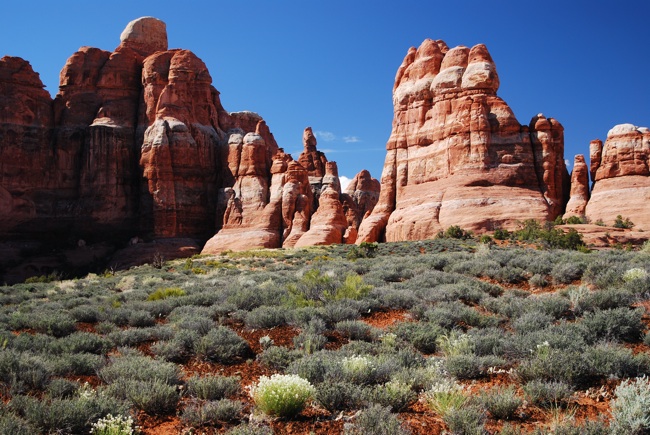
Baked by time like some multi-layer geologic tort, Canyonlands National Park in southeastern Utah features a landscape cut by canyons, rumpled by upthrusts, dimpled by grabens, and even pockmarked, some believe, by ancient asteroids.

Just outside of Moab rises a kaleidoscope of tilted and carved geology laid down over the eons. There’s the red and white Cedar Mesa sandstone, the grayish-green Morrison Formation, pinkish Entrada sandstone, and tawny Navajo sandstone, just to name some of the geologic layers. Stacked like pancakes, they help make Canyonlands the most rugged national park in the Southwest and, quite possibly, if you find yourself deep in the park’s Maze District, in the entire Lower 48 states.

In each of the park’s districts — Island in the Sky, Needles, Maze and Horseshoe Canyon — the remarkable effects of geologic time and its endless erosion on this sedimentary landscape rise about you.

If you could turn back the geologic clock, you would see the landscape flooded by oceans, crisscrossed by rivers, covered by mudflats and buried by sand. At various times through the millennia, the climate has resembled a tropical coast, an interior desert, and everything in between.

For hundreds of millions of years, material was deposited. Layer upon layer of sedimentary rock formed as buried materials were cemented by precipitates in the ground water. Each layer contains clues to its origin, such as patterns or fossils, which reveals the environment when it was deposited. For example, the colorful Cedar Mesa Sandstone occurred when periodic floods of iron-rich debris from nearby mountains inundated coastal dunes of white sand.

Along with sedimentation, movements in the earth’s crust altered surface features. The North American continent migrated north from the equator and the local climate and environment here changed dramatically.

Peer into the ragged maw of Canyonlands from the Island in the Sky District on the northern end of the park, and it’s no mystery how the park came by its name.

Spend the night at the Squaw Flat Campground in the Needles District and a morning hike into Chesler Park surrounds you with Creamsicle-hued minarets towering high above, like a king’s crown.

Though Canyonlands covers less than 350,000 acres, which is less than one-seventh the size of Yellowstone National Park, it feels much larger. No doubt it’s the park’s vastness and openness — you won’t find any forests here. Indeed, one old timer said that, “On a clear day, you can see the back of your own head.”

Spend a few minutes contemplating the natural forces, and the hundreds of millions of years that laid down these sediments and compressed these layers of rock. It’s really only recently that these layers have eroded to form the remarkable landscape seen today in Canyonlands National Park.

For Wild About Utah and National Parks Traveler, I’m Kurt Repanshek.

Credits:
Image: Courtesy and Copyright Kurt Repanshek, www.nationalparkstraveler.com
Text:     Kurt Repanshek, NationalParksTraveler.com.


Additional Reading:

Canyonlands National Park, National Parks Service,

Exploring The Parks: Musings From Island In The Sky At Canyonlands National Park, NationalParksTraveler.com Article – Lee Dalton – 06/24/2014

Exploring The Parks: Musings From The Needles District In Canyonlands National Park, NationalParksTraveler.com Article – Lee Dalton – 06/19/2014

Reflections Of Time In Canyonlands, NationalParksTraveler.com Article – Lee Dalton – 06/19/2014

https://www.nationalparkstraveler.com/search/apachesolr_search/canyonlands, NationalParksTraveler.com Canyonlands Articles

Hylland, Rebecca, What are Igneous, Sedimentary & Metamorphic Rocks?, Glad You Asked, Utah Geological Survey, https://geology.utah.gov/map-pub/survey-notes/glad-you-asked/igneous-sedimentary-metamorphic-rocks/

Best Snow

Skier at Brian Head
Photo Courtesy USDA Forest Service

As the mountains begin to take on hues of scarlet, gold and russet, many Utahns might be looking eagerly toward the coming months when those slopes will be blanketed in white. The Utah ski industry nurtures a whopping annual income of about $800 million dollars. It’s no surprise, therefore, that the state claims to have the “greatest snow on earth.” In fact, the state of Utah managed to make their slogan a federal trademark in 1995 after winning a lawsuit brought by the Ringling Brothers and Barnum & Bailey circus group, who felt the catchy marketing phrase might be confused with their slogan, the Greatest Show on Earth.

The trademark must have worked, because Utah draws so many visitors to its slopes, it racks up about 4 million skier days annually. But disregard plenty of evidence that we do indeed draw a crowd, and the statement is pretty subjective. So what’s the science behind our legendary powder?

The ideal condition skiers hope for is a deep, fluffy snow that creates the illusion of bottomless powder. And finding it is a bit like the Goldilocks story. Too wet, and you bog down. Too dry, and there’s not enough body to create a floating sensation beneath the ski. If the terrain is too steep, the powder won’t stick. And if it’s not steep enough, you can’t build sufficient momentum to glide over the top.

To get to the bottom of why Utah’s snow is just right, we actually have to look even further westward, toward the slow warm waters of the North Pacific current. As water laden clouds move inland, snow first falls over the Cascades in the north and the Sierra Nevadas further south, with an average moisture content of 12%. Even in areas like Washington’s Mt. Baker, where annual snowfall comes in greater quantities than Utah, the moister maritime snow creates a heavy base that bogs down skis. By the time these winter storms cross the Great Basin and reach the skiers’ Mecca of Alta and the Wasatch Range, the moisture content will have decreased to about 8.5%. And that seems to be the sweet spot. The moisture content of Utah’s intermountain snow is just enough that powder from our first storms settles into a soft but voluminous base. As winter progresses, fresh snow falls in a cold and mostly arid environment, forming very fine, symmetrical crystals called dendrites. The microscopic structure of dendrites allows them to accumulate in well ventilated, incompact drifts, much like the puffy down in your favorite pillow or ski jacket.

And perfect powder isn’t the only advantage Utah’s ski resorts have over their neighbors. Our mountainous topography, with its wealth of winding canyons, means we have an abundance of slopes well protected from strong winds which could compact or carry away fresh snowfall. And while so many cold and overcast days might get you down, it also protects our top powder from radiation and air mass effect, which can create a crust along the surface. And that means our freshly fallen powder sticks around for longer.

So consider that Utah offers 26,000 acres of mountain, blanketed in more than 500 annual inches of perfect intermountain snow, and it’s no wonder we enjoy 5 times the number of “powder days” as our neighbors. “The Greatest Snow on Earth” starts sounding a lot less subjective, and more like truth. In fact, you just might be tempted to make like Goldilocks and make yourself at home.

For Wild About Utah and Stokes Nature Center, I’m Ru Mahoney.

Credits:
Image: Courtesy USDA Forest Service, fs.usda.gov
Text:     Ru Mahoney, Stokes Nature Center in Logan Canyon.


Additional Reading: