
Arctic Dreams

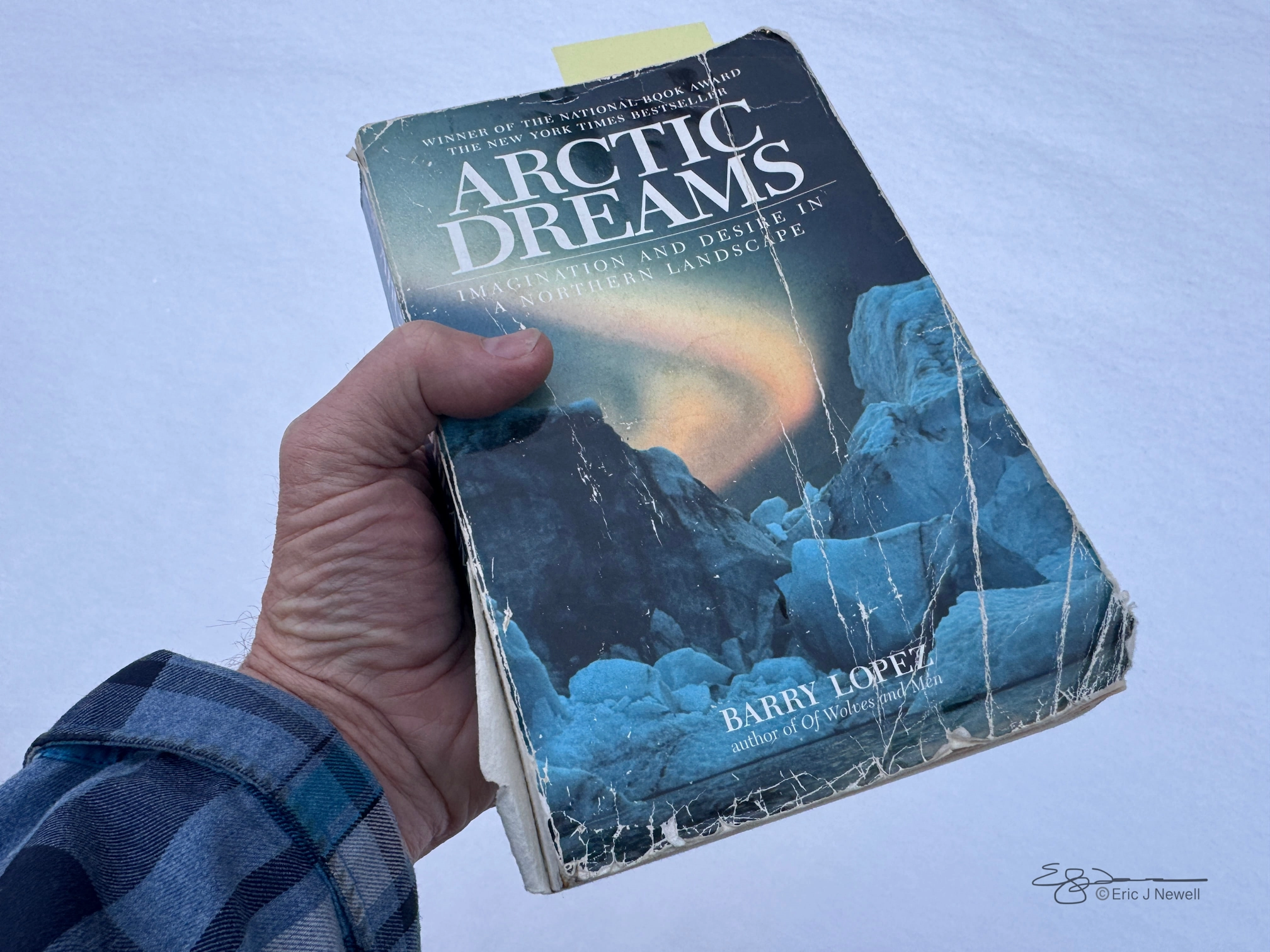
My well-worn copy of Artic Dreams by Barry Lopez, Cover Courtesy Alaska Stock Images, © Johnny Johnson, R. E. Johnson Photographers, Maps illustrated by David Lindroth, Photo Courtesy & Copyright Eric Newell
My well-worn copy of Artic Dreams by Barry Lopez
Cover Courtesy Alaska Stock Images, © Johnny Johnson, R. E. Johnson Photographers
Maps illustrated by David Lindroth
Photo Courtesy & Copyright Eric Newell
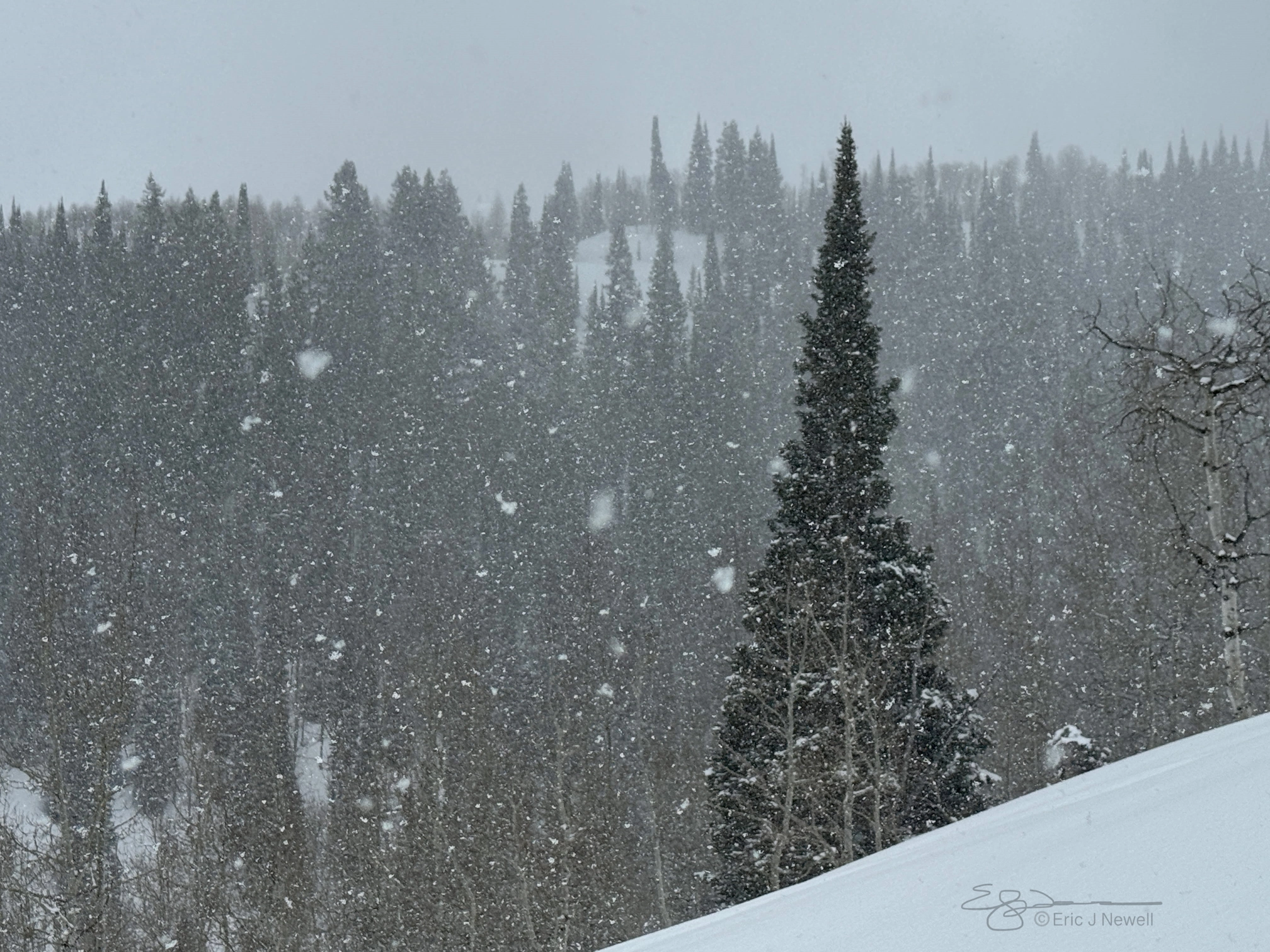
“This is an old business, walking slowly over the land with an appreciation of its immediacy to the senses and what lies hidden in it.” -Barry Lopez, Arctic Dreams

Snowflakes
Photo Courtesy & Copyright Eric Newell
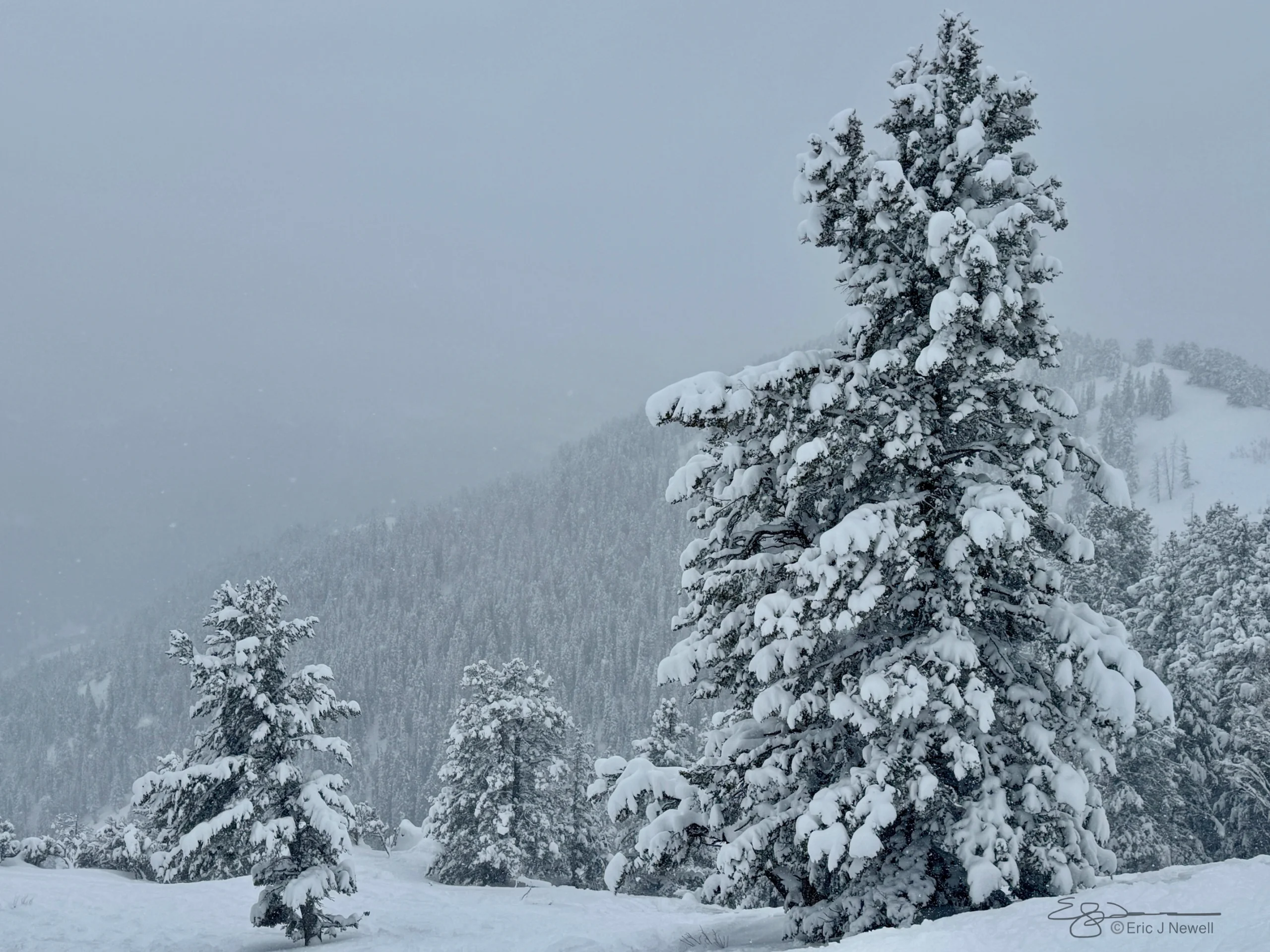
Snowflakes
Photo Courtesy & Copyright Eric Newell
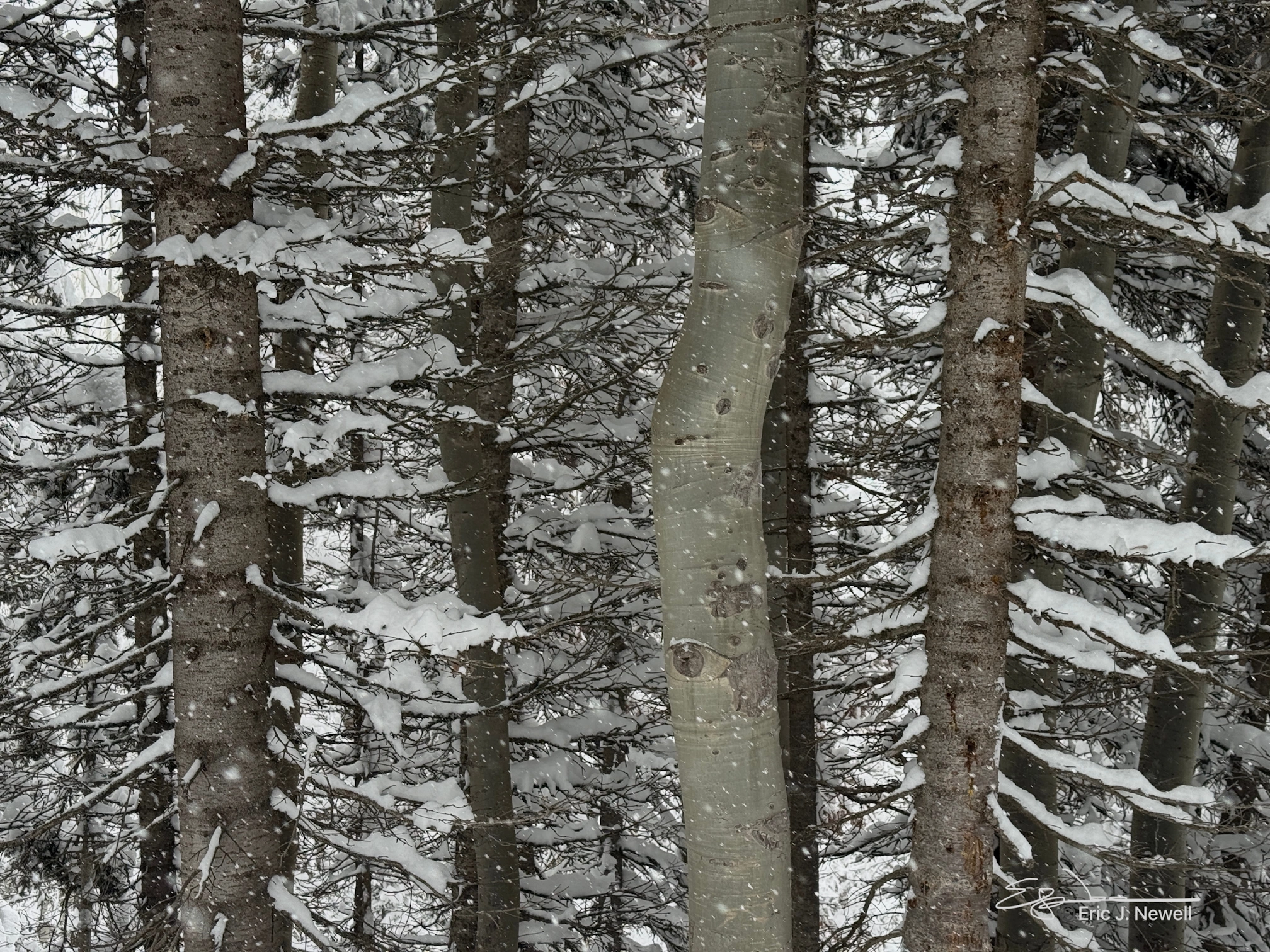
Logan Canyon Tree
Photo Courtesy & Copyright Eric Newell Logan Canyon Tree
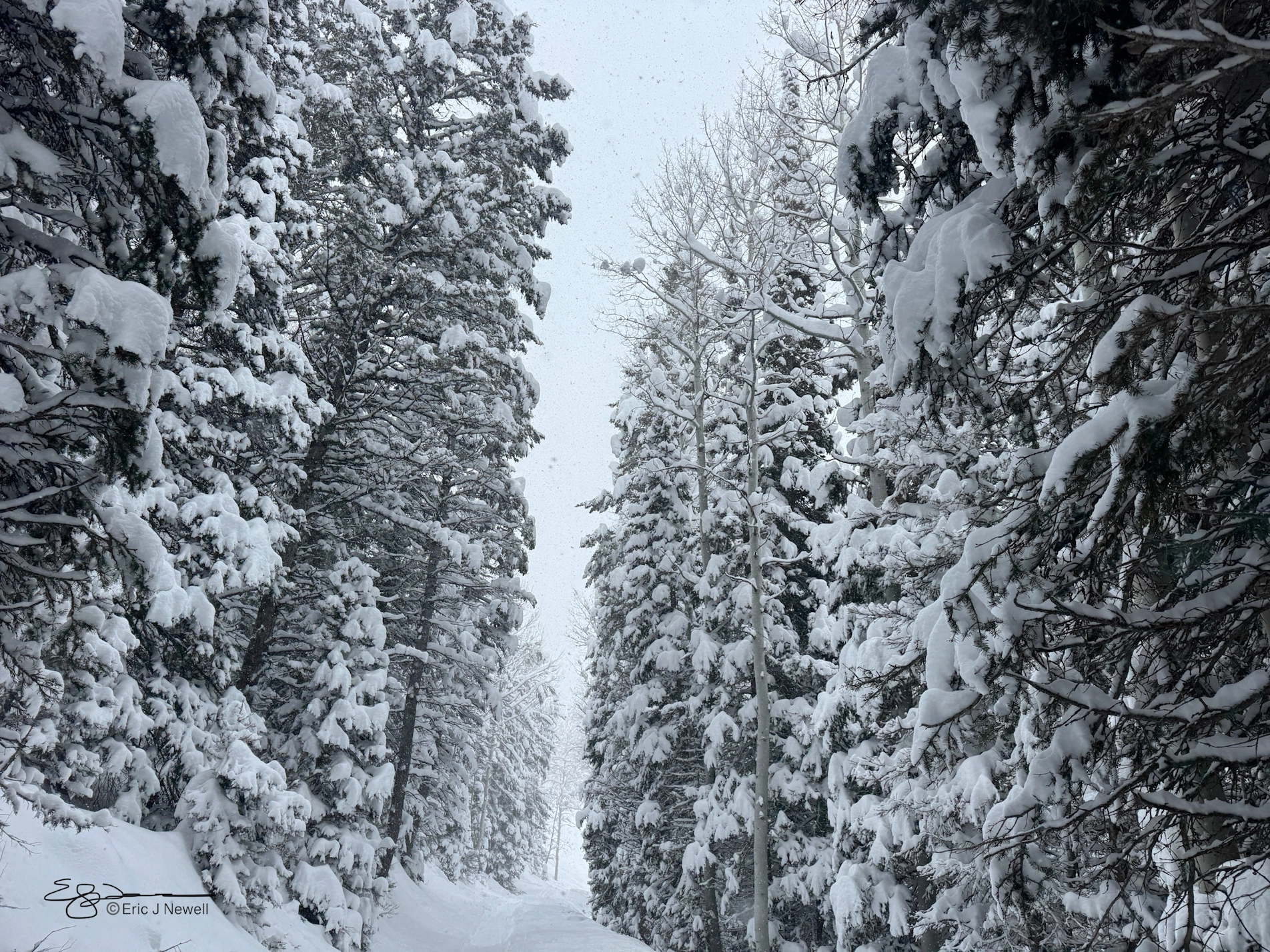
Photo Courtesy & Copyright Eric Newell

Logan Canyon Forest
Photo Courtesy & Copyright Eric Newell Logan Canyon Forest
Photo Courtesy & Copyright Eric Newell

Logan Canyon
Photo Courtesy & Copyright Eric Newell Logan Canyon
Photo Courtesy & Copyright Eric Newell

The snow came late this year. If it is a measuring stick, Beaver Mountain ski area, in Logan Canyon, did not open before Christmas for the first time since 1977. The lifts started turning the last day of 2025.

Every tree, every elk and deer, every squirrel, every insect, every living thing in the Bear River Mountains prepared for winter weeks, even months, ago. The whole range seemed to sit in eerie limbo, waiting for the snow to fly.

This past week, I found myself pondering the immense weight of the world in the midst of the first real winter storm of the season—at least for me. I looked up from my feet at millions of snowflakes descending upon me, crisscrossing one another in a flurry. I’m talking about giant conglomerate snowflakes. The kind that transform the sky into a straight-up dreamland. I felt pure delight.

The other day, I pulled Barry Lopez’s 1986 New York Times best seller, Arctic Dreams, from my bookshelf and browsed the passages I had highlighted or underlined 25 years ago. Until his death in 2020, Lopez wrote his books on an IBM Selectric III typewriter.

Lopez asked the questions, “How do people imagine the landscapes they find themselves in?” and “How does the land shape the imaginations of the people who dwell in it?”

I imagined each snowflake as gift from the Pacific. Tiny droplets of frozen water meandering to the ground. Each is part of an endless cycle of water, dating back to the origins of the earth. I wondered how long ago these snowflakes last fell free through the sky. How long did they spend in the depths of the ocean? Where will they go on their journey from here? And how did I happen to be in this place, with these snowflakes, in this moment in time?

Everything is temporary—a snowflake, a lifetime, human history, even geologic time.

In another passage Lopez wrote: “Because [humans] can circumvent evolutionary law, it is incumbent upon [us], say evolutionary biologists, to develop another law to abide by if [we] wish to survive…. [We] must learn restraint. [We] must derive some other, wiser way of behaving toward the land.”

To that I would add, we must also derive some other, wiser way of behaving towards one another because the greatest threat to humanity is, frankly, humanity. The biggest threat to life on earth isn’t the sun’s eventual demise or a rouge asteroid. It is us. Can we learn to live sustainably, and can we learn to understand and respect those who are different from ourselves?

Later, Lopez continues the thought:

“The cold view to take of our future is that we are therefore headed for extinction in a universe of impersonal chemical, physical, and biological laws. A more productive, certainly more engaging view, is we have the intelligence to grasp what is happening, the composure not to be intimidated by its complexity, and the courage to take steps that may bare no fruit in our lifetimes.”

That requires collective action.

As Oscar Schindler identified in Schindler’s List, power is when we have every justification to take, or to control, or to act on impulse, and we don’t. We refrain.

Each snowflake individually seems insignificant, but together, relentless by the millions, snow crystals pile up. They cover the ground, flock the trees, and settle into the gaps of my jacket. Their strength is in their numbers and their ability to bond with each other.

I imagine snow accumulating on a steep mountain. As the storm rages, the sheer weight of snow increases, one single snowflake at the time, until finally, one seemingly insignificant snowflake settles on the surface, and it is suddenly too much for buried weak layers to withstand. Then, “Whoomph!” The result is a spontaneous avalanche. Inertia is both a property of matter and a property of culture.

In the big scheme of geologic time and human history, each of us are insignificant. Yet the power of our collective consciousness and action is significant. We have the capacity to lesson our footprint on the earth and deepen our impact on one another through small gestures that accumulate like falling snow: To consume less, to care more, to increase our capacity to love and understand, to be both frugal and generous, to be curious rather than judgmental, to smile or laugh with a stranger or a friend.

I catch several snowflakes on my tongue, as I walk through the blizzard, trying to pick out the biggest ones—the ones that are barely able to cling together. Several snowflakes crash-land on my face. I blink them off my eyelashes. One flake that I miss, spirals as it falls faster than the others. Each snowflake feels like a blessing from above that represents some kind of hope. Hope that the rivers will swell to fill their banks in April and May; hope that high mountain springs will gush throughout summer, hope for renewal that comes with each spring, and yes, hope for humanity.

I am Eric Newell, and I am wild about Utah snow and the power of small gestures.

Credits:
Images: Courtesy & Copyright Eric Newell, Photographer
Featured Audio: Courtesy & Copyright © J. Chase and K.W. Baldwin
Text: Eric Newell, Edith Bowen Laboratory School, Utah State University
Additional Reading: Eric Newell

Additional Reading

Wild About Utah Pieces by Eric Newell

Links:
Caswell, Kurt, His Life Helped: In Memory of Barry Lopez, 1945-2020, Terrain.org, Terrain Publishing, January 11, 2021, https://www.terrain.org/2021/currents/his-life-helped/

Barry Lopez died on December 25th
The proselytiser for a different understanding of landscape and Nature was 75, The Economist Newspaper Limited, https://www.economist.com/obituary/2021/01/02/barry-lopez-died-on-december-25th

O’Connell, Nicholas, At One With The Natural World Barry Lopez’s adventure with the word & the wild, March 24, 2000, Commonweal Magazine, https://www.commonwealmagazine.org/one-natural-world-0

Beaver Mountain [Ski Resort], https://www.skithebeav.com/

Logan Avalanche Forecast Page, Utah Avalanche Center, https://utahavalanchecenter.org/forecast/logan

Climate Data Recording

USU Climate Measurement Instrument Courtesy & Copyright Mary Heers, Photographer
USU Climate Measurement Instrument
Courtesy & Copyright Mary Heers, Photographer
Last week while walking across the Utah State University campus, I rounded the Northeast corner of the University Inn and suddenly found myself face to face with a giant stick figure made of steel tubing. Painted a gleaming white, it looked like an elegant butler standing stiffly at attention. Planted firming on three sturdy legs, its rectangular body soared up 12 feet, and two of its outstretched arms seemed to be holding a bowl in one hand and a ball in the other.

Then I noticed the interactive display pedestal nearby. I discovered my “butler” was actually holding a rain gauge and an air temperature sensor. In fact, there were almost 30 sensors attached to the frame. Tapping on each picture of the sensor, I could see the exact measurement it was making at the moment. More tapping and I could look back as far as 500 days ago.

This magnificent machine was recording data so smoothly that I had to laugh when I remembered how in the early days of climate monitoring it wasn’t so easy.

In the 1980’s, after moving to Cache Valley, I was getting used to the cold temperatures and wondering how cold could it get. The engineers at Campbell Scientific, including my husband Art, had just developed a new temperature and wind sensor that could record its measurements into a box. The box would then send a radio signal to a relay station on top of Mt Logan, and then on to the base computer in Logan. They installed the sensor at Peter Sinks, near the summit overlooking Bear Lake. Then they sat down in front of the base computer to wait. They watched the temp drop, -55, -65. Then a tiny gust of air would blow by and the temperature would rise. Finally, they went to bed. But the datalogger kept working. In the morning, they looked at the data sheet – and there it was in black and white: -69.3 degrees Fahrenheit! In the early morning Feb 1, 1985, a record was set for the coldest temp ever recorded in Utah that still stands today.

But my favorite memory from the early days is the farm kid who bought one of the first Campbell Scientific dataloggers, the CR10. Art and I were on a road trip when he realized we were close by. We rang the doorbell. His mother told us to go upstairs. There was the young kid sitting on his bed. The CR10 was on the floor. He showed us how the datalogger was recording the level of oxygen in the water in his nearby catfish pond. When the Oxygen level dropped to a dangerous low, the CR10 would turn on a giant eggbeater-like machine that would throw the pond water high into the air. When the water fell down, it carried Oxygen with it into the pond. The kid was all smiles. Gone were the days when he had to get up every night at 3 am, march through heavy mud, check his Oxygen sensor, and manually turn on the eggbeater.

The kid pointed to the CR10 on the floor.

“Piece of your brain in there?” he asked Art.

“Yes,” answered Art, “And a piece of my heart.”

This is Mary Heers and I’m Wild About Utah.

Credits:
Photos: Courtesy and Copyright Mary Heers,
Featured Audio: Courtesy & © Anderson, Howe and Wakeman
Text: Mary Heers, https://cca.usu.edu/files/awards/art-and-mary-heers-citation.pdf
Additional Reading: Lyle Bingham, https://bridgerlandaudubon.org/

Additional Reading

Wild About Utah, Mary Heers’ Wild About Utah Postings

Peter Sinks Temperature Monitoring, Utah Climate Center at Utah State University, https://climate.usu.edu/PeterSinks/

Tonks, Sara, Peter Sinks, UT, Was Over 50 Degrees Below Zero Wednesday Morning. Here’s Why That’s Both Unusual And Normal, Weather News, The Weather Channel, February 13, 2025, https://weather.com/news/weather/news/2025-02-13-temperature-sinks-cold-explained-geography

Campbell Scientific, Inc., https://www.campbellsci.com/
Company History, https://www.campbellsci.com/history

Franchi, John, Man reflects on recording all-time Utah low temperature in 1985, Fox 13 News, Scripps Media, Inc., February 03, 2023, https://www.fox13now.com/news/local-news/man-reflects-on-recording-all-time-utah-low-temperature-in-1985

Davis, Jim, Where is the COOLEST Spot in Utah?, Survey Notes, v. 45 no. 3, September 2013, Utah Geological Service, Utah Department of Natural Resources, https://geology.utah.gov/map-pub/survey-notes/glad-you-asked/coolest-spot-in-utah/

Outdoor Gear

Members of the 10th Mountain Division at Camp Hale, Colorado. Left -to- right: Clare Symonds, Elton Beard, Vincent Dalzell, Francis or Roger Duchesneau, Clifford Perkins. image c.a. 1940-1944. (Unit History Collection). (Members of what was then called the 10th Light Division (Alpine), prepare for ski training at Camp Hale, Colo. )
Courtesy US Army
Members of the 10th Mountain Division at Camp Hale, Colorado. Left -to- right: Clare Symonds, Elton Beard, Vincent Dalzell, Francis or Roger Duchesneau, Clifford Perkins. image c.a. 1940-1944.
Members of what was then called the 10th Light Division (Alpine) were recruited by the National Ski Patrol, which was directed by Charles Minot “Minnie” Dole. Applicants had to prove their ability to ski.
(Unit History Collection) Courtesy US Army, The Denver Public Library ArchivesSpace and Wikipedia
Skiing up our lovely canyon yesterday, enjoying American dipper and stream music, occasional king fisher chatter, Townsend’s solitaire melodies, I began ruminating on my ski equipment while watching their effortless glide through snow.

A few weeks earlier, I had donated a pair of WWII 10th Mountain Division US military issue skies to the Stokes Nature Center for their “History of Skiing” program. Seven feet long with leather and steel bindings, each weighing near 10 pounds. The Division trained at Camp Hale, Colorado with 60-90-pound packs, leather boots strapped onto seven-foot long wooden skis with thick cable bindings. Casualties in the winter of 1945 were staggering, but when the ski troops returned home they poured their heart and soul into the newly-evolving ski industry, opening ski resorts, managing ski schools and influencing innovation.

Compare this to my skies made of plastic materials with aluminum alloy bindings weighing in at 3 pounds each, my boots various synthetic materials, light and durable, and a minuscule day pack attached to my back.

When I began Nordic skiing some 40 years ago, my Bonna laminated wood skies were coveted. I miss their natural beauty and high performance. Now, they sit in a corner, replaced by a light weight, wax free pair. Somethings lost, something’s gained.

From there it went on to my backpacking equipment from boots, backpack with contents, and my clothing attire. All synthetics with the exception of RMI type, super light weight dehydrated space/military evolved food and equipment.

Looking back to my early Scouting days, our tents were heavy canvas, backpacks with heavy metal alloy frame and canvas fabric, clunky leather boots, wool and cotton clothing, and beefy cooking pots and pans, metal canteen, and several pounds of canned food.

We were tough then. My Scouts grew blisters on shoulders and feet. A few tears were shed from the arduous hike up a mountain or across hot desert, near collapse, sure they couldn’t take another step. Now, as middle aged adults, their fondest memories were from those crazy days of long suffering. Many survival stories came later of their intrepid accomplishments.

We have evolved to a plastic, synthetic culture replacing canvas, cotten, wool, wood, and heavy metals. How soft, comparatively effortless, and efficient we have become. No longer from a farm of hard work in extremes of hot and cold. Something lost, something gained. Nostalgia. Longing.

Do I wish to return to those days? Back then, we never foresaw an easier way in the offing. We just endured the pain and moved on, as did the mountain troops with their giant skis and heaving loads. I admire us as we were.

USU has a new major in Outdoor Product Design & Development to further design new, light weight convenient gear. “Master the design process, user research, idea visualization, and CAD modeling techniques to develop products conceptually and as producible prototypes.”

One thing that hasn’t changed appreciably are the natural wonders that surround us. Birds and flowers, butterflies, bees, and rushing streams are still with us. Challenging steep trails, scorching desert paths still challenge us, as are natures fickle atmospheric moods.

Jack Greene for Bridgerland Audubon Society, and I’m Wild About the Joy & Challenge of Utah Wilds!

Credits:
Image: Courtesy US Army army.mil, With text by way of US Army and Wikipedia
For additional images and histories of Camp Hale, we recommend the Denver Public Library, Special Collections and Archives Department
Featured Audio: Courtesy & © Kevin Colver https://wildstore.wildsanctuary.com/ and Friend Weller https://upr.org/
Text: Jack Greene, Bridgerland Audubon, https://bridgerlandaudubon.org/
Additional Reading: Jack Greene & Lyle W Bingham, Webmaster, Bridgerland Audubon, https://bridgerlandaudubon.org/

Additional Reading:

Jack Greene’s Postings on Wild About Utah, https://wildaboututah.org/author/jack/

McCrimmon, Katie Kerwin, Daring WWII ‘ski troops’ honored at new Camp Hale-Continental Divide National Monument, UCHealth Oct. 27, 2022 https://www.uchealth.org/today/daring-wwii-ski-troops-honored-at-new-camp-hale-continental-divide-national-monument/

Kennedy (Drum), Mrs. Michelle, Bootprints in History: Mountaineers take the Ridge, US Army, February 19, 2015, https://www.army.mil/article/143088/bootprints_in_history_mountaineers_take_the_ridge

Charles Minot Dole, Hall of Fame Class of 1958, U.S. Ski and Snowboard Hall of Fame and Museum Inc., https://skihall.com/hall-of-famers/charles-minot-dole/

Chabalko, Justin J, Art of War Papers, Forging the 10th Mountain Division for War, 1940–45, How Innovation Created a Highly Adaptive Formation, Army University Press, 2019, https://npshistory.com/publications/usfs/camp-hale-continental-divide/forging-10th-mtn-div.pdf

Bonna Wooden Touring skis, Scottish Mountain Heritage Collection, https://smhc.co.uk/collection/bonna-wooden-touring-skis/

Utah Outdoor Recreation Companies, Utah Division of Outdoor Recreation, State of Utah, https://recreation.utah.gov/utahs-outdoor-companies/

Outdoor Product Design and Development – BS, College of Agriculture and Applied Sciences, Utah State University, https://www.usu.edu/degrees-majors/outdoor-product-design-and-development_bs

Three of Logan’s Finest

The Folly Courtesy & Copyright Eric Newell, Photographer
The Folly
Courtesy & Copyright Eric Newell, Photographer
Kick. Step. Breathe. Kick. Step. Breathe.

Skier John Louviere Courtesy & Copyright Eric Newell, Photographer
Skier John Louviere
Courtesy & Copyright Eric Newell, Photographer

Skier Eric Newell Courtesy & Copyright John Louviere, Photographer Skier Eric Newell
Courtesy & Copyright John Louviere, Photographer

Miniature pellets of snow swirl past my face, land on the slope we are struggling against, then tumble hundreds of feet down the snow-encased mountain. My friend John Louviere and I have skied the Bear River Range backcountry together since we first met as Utah State University students in 1995.

Today the light is flat, causing both sky and mountain to blend into a single dimension, making it difficult to distinguish snow from clouds. The Dry Canyon slope we are ascending is prominent from nearly everywhere in Cache Valley. Each winter its absolute openness and gentle, seductive rolls tantalize backcountry skiers. For us, it is a blank canvas. We stare at it on our way to and from work, occasionally spotting other skier’s tracks, best highlighted when late evening sunlight turns the mountain hues of pink and orange.

But embedded in the stark beauty of this mountain is a dark past. Backcountry skiers call this slope “The Folly” for good reason: it measures exactly thirty-eight degrees in steepness—precisely the slope angle that produces the most deadly avalanches. Thirty-eight degree slopes are gentle enough to allow dangerous slabs of snow to build, where they can rest precariously without commitment to the mountain. A single skier, snowboarder, snowmobile, or even just one last snowflake can set it all in motion.

Because The Folly faces southwest, prevailing winds tend to transport freshly fallen snow off the slope, over the ridge, and deposit it in Spring Hollow. Afternoon sunshine also welds new layers of snow to old layers rather quickly. Both of these factors combine to stabilize the slope, despite its steepness, but it still shouldn’t be reckoned with unless you know and understand the composition and history of the snowpack. The spring-like conditions present today are exactly what John and I have waited for—everything is frozen firmly in place.
In January of 1997, Karl Mueggler and Max Lyon, who both grew up in Cache Valley, were visiting families for the holidays. The two decided to catch up on old times with Logan resident Keith Maas by ski-camping in Dry Canyon.

They pitched their tents in a stand of aspens interspersed with Englemann spruce at the base of The Folly. Trees generally serve as a good indicator of safety from avalanches since proven slide paths obliterate timber. Had they camped there any other night in a 20-year span, they would have awakened to another memorable ski day.
But while they slept, a foot of new snow fell and the west wind shifted, blowing violently from the northeast, heaping tons of snow from the Spring Hollow side onto The Folly. A week before, unseasonably warm temperatures caused rain to fall on the slope which later froze into a hard, smooth ice crust. All of these factors combined to create the perfect conditions for a spontaneous and catastrophic avalanche.

Despite their years of backcountry experience Karl, Max, and Keith were buried in their tent under five feet of concrete-hard snow. The community was devastated. Though I didn’t know Karl or Keith, I had spent a day skiing with Max only a few weeks before. He embodied the type of person anyone would aspire to become. Excitement for living radiated from his face. He laughed easily and spoke optimistically of the future. The same has been said of Karl and Keith. They were educators, outdoor activists, and advocates for community.
Over the years, I venture up here in the spring to pay tribute to their lives.

At the top of The Folly, still surrounded by thick clouds and meandering snowflakes, we start down, one at a time. Without warning, gracious sunlight bursts through the squall. We accelerate, gliding over the glowing snow, unsure if we are flying or skiing—a truly ethereal moment. The snow beneath our skis is firm and our metal edges cut tight turns with precision as we descend from the clouds, honoring three of Logan’s finest the best way we know how.

I’m Eric Newell, and I am wild about Utah.

Credits:
Images: Courtesy & Copyright Eric Newell, Photographer, Eric Newell image Courtesy & Copyright John Louviere
Featured Audio: Courtesy & © Kevin Colver https://wildstore.wildsanctuary.com/, Courtesy & © Friend Weller, https://www.upr.org/people/friend-weller, Courtesy & Copyright © Anderson, Howe, Wakeman
Thank you Eric Newell for recording the student audio clips
Text: Eric Newell, Edith Bowen Laboratory School, Utah State University
Additional Reading: Eric Newell

Additional Reading

Wild About Utah Pieces by Eric Newell

A longer version of this story was printed in the Herald Journal Outdoors section May 5, 2006.

Opsahl, Kevin, Memories of fatal ’97 avalanche still fresh, The Herald Journal, Jan 14, 2017,
https://www.hjnews.com/accidents_disaster/memories-of-fatal-avalanche-still-fresh/article_03c457bd-ffa2-5e92-8527-38514ddb7016.html

Outdoor Leadership Scholarship
The Lyon, Maas, Mueggler Outdoor Leadership Scholarship pays 50% of the tuition for the Desert Mountain Medicine Wilderness First Responder (WFR) certification course.
Lyon, Maas, Mueggler, Outdoor Leadership Scholarship, Utah State University
https://www.usu.edu/campusrec/outdoor/

Cane, James, Snow Dynamics, Wild About Utah, February 2, 2012, https://wildaboututah.org/snow-pack-dynamics/

Utah Avalanche Center https://utahavalanchecenter.org/