Birds and West Nile Virus

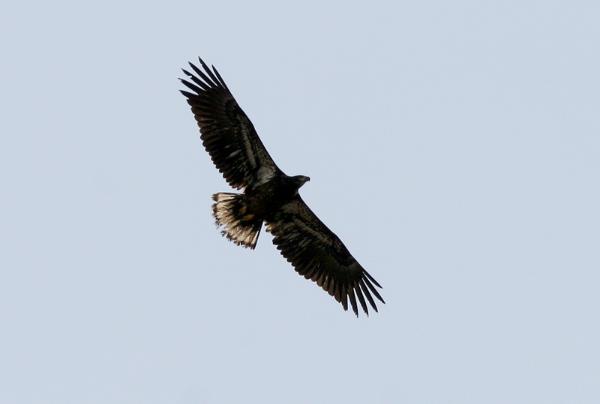
Birds and West Nile Virus: Bald Eagle, Haliaeetus leucocephalus
Bald Eagle
Haliaeetus leucocephalus
Courtesy US FWS
It’s that time of year again when we encounter a barrage of public health messages alerting us to take precautions during cold and flu season. However, a different disease outbreak has been making headlines this winter in Utah: West Nile virus.

Though West Nile virus is not a new name to most of us, our familiarity with it typically comes from summer time outbreaks amongst human populations. Yet this particular flare up has gained attention for causing the deaths of over 50 Bald Eagles and it happened during winter.

West Nile virus is maintained in nature by a transmission cycle between mosquitoes and birds. In this cycle, birds simply act as pathogen reservoirs, while the mosquitoes act as pathogen vectors passing the virus on to their eggs and infecting humans and animals through bites. Historically, in the locations of its origin – Africa, Europe, Asia, and the Middle East – this pathogen is rarely fatal to its avian hosts. In fact, antibodies to West Nile virus have been found in the blood of birds native to this region.

It wasn’t until 1997, when a stronger strain of West Nile virus emerged and caused fatalities in a wide range of avian species, that the infection started to be considered pathogenic to birds. When the disease first reached the United States in 1999 it proved to be highly virulent in North American bird populations. The American crow was particularly susceptible. Within 4 months of detection in New York, nearly 5,500 crows died from the infection. Since this first outbreak, West Nile virus spread across the United States and has been isolated in over 250 species of birds, including Bald Eagles.

While wintertime infection amongst human populations is rare, infection during this season is not so uncommon for birds. This is because birds can contract the disease by a variety of routes other than mosquito bites and direct contact. This is especially the case amongst opportunistic scavengers like raptors. If a raptor consumes the carcass of a bird killed by West Nile virus it can contract the virus orally, as the Bald Eagles did after consuming the remains of infected Eared Grebes. Luckily, while bird-to-bird transmission does occur amongst birds that exhibit roosting and group behaviors, the likelihood of a Bald Eagle, which is typically a solitary bird, directly passing the disease to another Bald Eagle is quite low. Meaning that once the last of the infected food source is gone, hopefully no further infections will occur.

For Wild About Utah, I’m Anna Bengtson.

Credits:
Image: Courtesy US FWS
Text: Anna Bengston

Sources & Additional Reading:

West Nile Virus, World Health Organization, https://www.who.int/mediacentre/factsheets/fs354/en/

DWR Learns What Killed Bald Eagles, Wildlife News, Utah Division of Wildlife Resources, https://wildlife.utah.gov/wildlife-news/1330-utah-dwr-learns-what-killed-bald-eagles.html

Koenig, W.D., Hochachka, W. M., Zuckerberg, B., and Dickinson, J.L. 2010. Ecological Determinants of American Crow Mortality Due to West Nile Virus During its North American Sweep. Oecologia, 163: 903-909. https://www.nbb.cornell.edu/wkoenig/K156TA_10.pdf

Powell, Hugh, Counting Crows: The Impact of the West Nile Virus, All About Birds, Cornell Lab of Ornithology, October 15, 2010. https://www.allaboutbirds.org/Page.aspx?pid=1956

Rappole, J.H., Derrickson, S.R., and Hubálek, Z. 2000. Perspectives: Migratory Birds and Spread of West Nile Virus in the Western Hemisphere. Emerging Infectious Diseases, Vol. 6, No. 4, July-August 2000, pp. 319-328. https://wwwnc.cdc.gov/eid/article/6/4/pdfs/00-0401.pdf

Reisen, William K. 2013. Ecology of West Nile Virus in North America. Viruses, Vol. 5, Issue 9, pp. 2079-2105. https://www.mdpi.com/1999-4915/5/9/2079

Robins in Winter

American Robin
American Robin
Turdus migratorius
Courtesy US FWS, images.fws.gov
Dr. Thomas G. Barnes, Photographer
 

Robin with Chicks in NestAmerican Robin
Turdus migratorius
Courtesy US FWS, images.fws.gov
Lee Karney, Photographer
 

Robin with Chicks in NestRobin with Chicks in Nest
Courtesy US FWS, images.fws.gov
James C. Leopold, Photographer

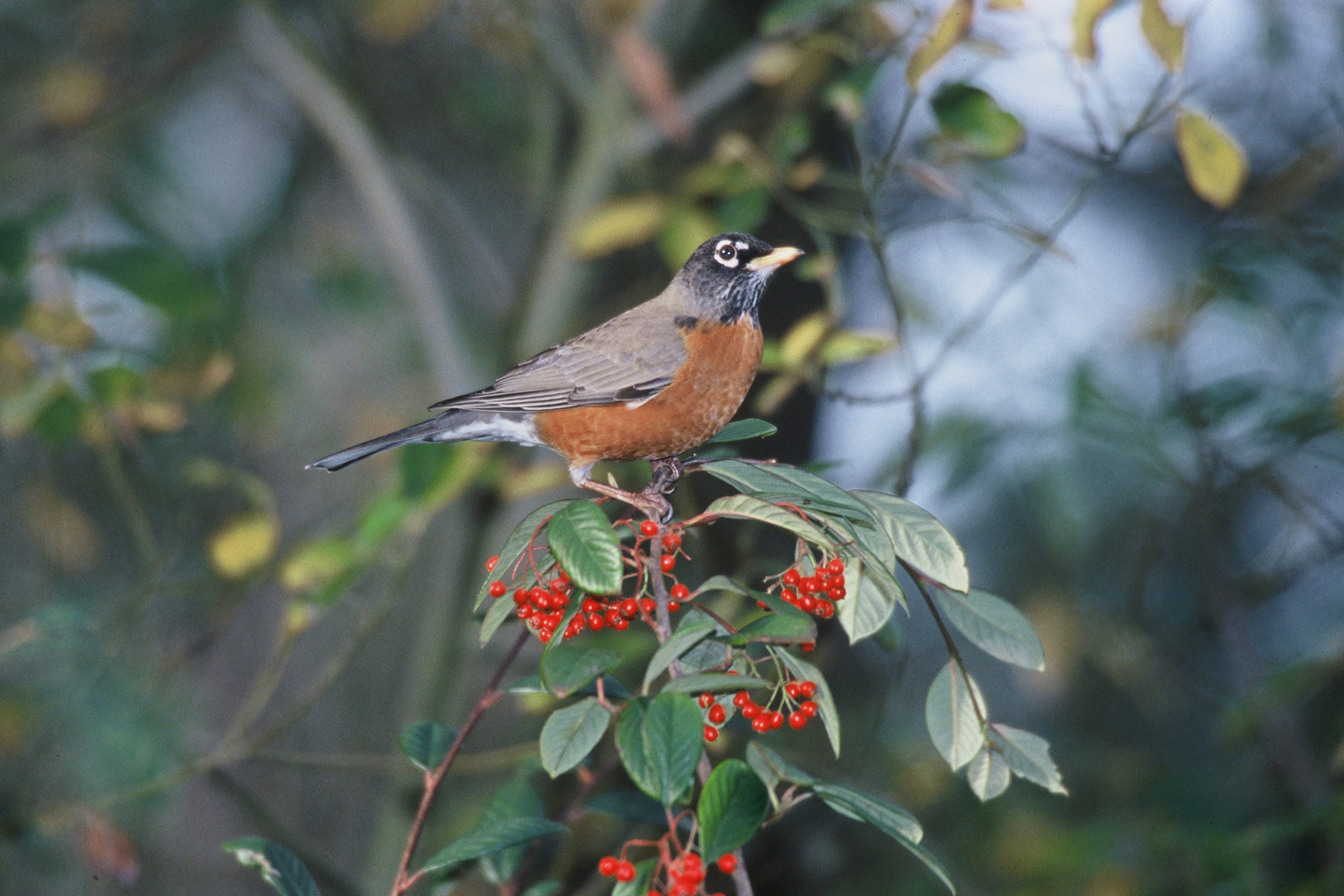
The American robin with its abundance, red breast, and loud song is one of the most recognizable backyard birds in North America. For many of us the robin – or Turdus migratorius – is also thought of as a herald of spring. So why is it that we still occasionally see them in our wintry Utah backyards?

Seasonal bird migration can be triggered by a number of things, but the two main drivers are food supply and nesting habitat. In spring and summer the birds move northward to take advantage of insect hatches, budding plants, and the plethora of nesting sites. Then, as food sources dwindle in fall, the birds move southward to areas where the necessary resources are still plentiful.

The distances birds migrate in order to access these resources can range widely. Therefore, birds are generally categorized as being short-, medium-, or long-distance migrants. Robins are considered short-distance migrants. While their range spans all of Canada and the United States extending down into Mexico, most robins do not travel far from their breeding grounds in winter and may not leave at all. Only the populations that breed and reside on the edges of this range will migrate seasonally.

The robin’s varied diet and behavioral adaptability are the primary reasons these short-migratory or non-migratory patterns are possible. Robins are preferably ground foragers, feasting on insects and earthworms in the spring and summer months. Yet, during the fall and winter, robins eat a fruit-based diet. They track this seasonal food source in flocks, abandoning their summer individualistic and territorial behavior. These flocks – or roosting aggregates – also help them survive the cold winter temperatures. As a result, robins are able to cope with the ground freezing, the disappearance of their preferred food source, and the harsh winter weather.

Returning to our original question: is the American robin truly a sign of spring here in Utah? Is it strange to see this bird in our backyards during the winter months? The simple answer is no. Robins can be found year round almost anywhere south of Canada. While they may migrate nomadically, staying or leaving areas as weather and snow cover affect their food supply, there could be some keeping us company in Utah all winter.

For Wild About Utah, I’m Anna Bengtson.

Credits:

Featured Music: Courtesy & Copyright Don Anderson as performed by Leaping Lulu
Image: Courtesy US FWS, Lee Karney, James C. Leopold, Photographers
Text & Voice: Anna Bengston
Additional Reading: Anna Bengston and Lyle Bingham

Sources & Additional Reading:

American Robin Profile, Utah Birds, Utah County Birders, http://utahbirds.org/birdsofutah/BirdIndex.htm

American Robin, All About Birds, The Cornell Lab of Ornithology, https://www.allaboutbirds.org/guide/American_Robin

American Robin, The Birds of the World Online https://birdsoftheworld.org/bow/species/amerob/cur/introduction

The Basics of Bird Migration: How, Why, and Where, Cornell Lab of Ornithology, August 1, 2021, https://www.allaboutbirds.org/news/the-basics-how-why-and-where-of-bird-migration/ [Updated January 31, 2026]

Where Have all the Robins Gone?, Migration, Cornell Lab of Ornithology https://www.birds.cornell.edu/AllAboutBirds/faq/master_folder/migration/document_view

Snow Depth Survey, The Great Backyard Bird Count [Formerly at https://www.birdsource.org/gbbc/science-stories/past-stories/snow-depth-survey – A mention of the Snow Depth Survey is found in an article in The Lahontan News, National bird count starts today, February 15, 2002]

Winter Robins, The Great Backyard Bird Count [Formerly at https://www.birdsource.org/gbbc/science-stories/past-stories/is-that-winter-flock-of-robins-in-your-yard-unusual Updated January 31, 2026]

Kelly, Patrick, A Moral Dilemma, Wild About Utah, June 29, 2020, https://wildaboututah.org/a-moral-dilemma/

Bengston, Anna, Robins in Winter, Wild About Utah, February 2, 2015, https://wildaboututah.org/robins-in-winter/

Bengston, Anna, American Robin, Wild About Utah, January 18, 2016, https://wildaboututah.org/american-robin-160118/

Bingham, Lyle, Richard Hurren(voice), The Occupants on Robin Street, Wild About Utah, July 8, 2008, https://wildaboututah.org/the-occupants-on-robin-street/

Golden Eagles

Golden Eagles: Golden Eagle, Courtesy USDA Forest Service, Dave Herr, Photographer
Golden Eagle
Aquila chrysaetos
Courtesy USDA Forest Service
Dave Herr, Photographer
On a recent Christmas Bird Count, my team witnessed an amazing feat of flight. We parked in a subdivision cul-de-sac to walk into the sagebrush foothills. Overhead we saw two Golden Eagles meet in a talon lock and tumble towards earth. They disengaged moments before crashing and flew off in opposite directions. A minute later and we would have missed it all. So what were they up to? I am not quite sure.

Golden Eagles are supreme flyers. In both courtship and territory displays they steeply dive and swoop upward. During a pendulum display, they dive and rise in one direction then turn and retrace their path. Pairs often play with an object in the sky, repeatedly dropping and retrieving it. The talon lock display is rarely seen, but it too is used both for bonding between pairs and in territorial disputes. We saw the display in December and the birds separated immediately, so we probably witnessed a territorial defense. Golden Eagles require a territory anywhere from 20 to 200 square miles depending on prey abundance. As with most wildlife, loss of habitat is a prime threat.

Three quarters of recorded Golden Eagle deaths can be traced to humans. In treeless areas, power poles provide a convenient perch. When their 7 foot wingspan touches two wires, they are electrocuted. New designs and retrofits for power poles eliminate this problem and the resulting range fires, but many of the older designs remain. Wind farms also kill eagles, but again, new designs and more careful siting are helping to alleviate this problem.

The Golden Eagles’ favorite meal in the West is jackrabbit. However, they are opportunistic foragers and will dine on carrion. If the carcass they feed on was shot, they may ingest fragments of bullets or buckshot that contain lead. Lead poisoning is an excruciating way to die. Carcasses with lead fragments are eaten by many carnivorous birds and mammals who are then poisoned. This winter, 8 Bald Eagles died of lead poisoning at the Wildlife Rehabilitation Center of Northern Utah. We must remedy this problem so we can insure that our skies will always be graced by the grandeur of soaring eagles.

Our theme music was written by Don Anderson and is performed by Leaping Lulu.

This is Linda Kervin for Bridgerland Audubon Society.

Credits:

Image: Courtesy USDA Forest Service, Dave Herr, Photographer
Theme: Courtesy & Copyright Don Anderson as performed by Leaping Lulu
Text & Voice: Linda Kervin, Bridgerland Audubon Society

Additional Reading:

Linda Kervin’s pieces on Wild About Utah

https://www.allaboutbirds.org/guide/golden_eagle/lifehistory

https://www.hawkwatch.org/component/content/127

https://www.peregrinefund.org/explore-raptors-species/Golden_Eagle#sthash.Gqowt1G0.gFqVfifi.dpbs

https://www.deseretnews.com/article/865596763/Lead-blamed-for-latest-bald-eagle-deaths-in-Utah.html

Echoes of Lake Bonneville

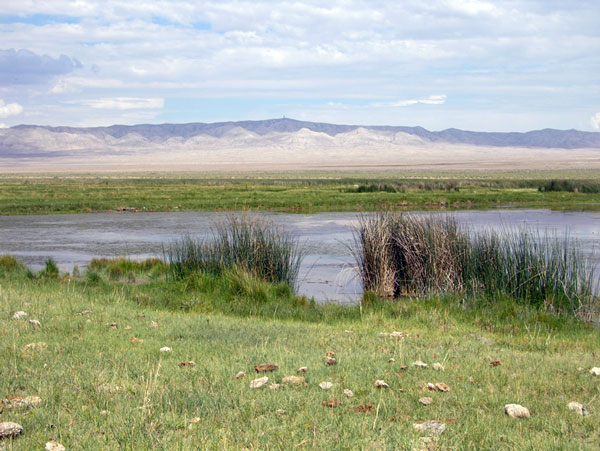
Echoes of Lake Bonneville: North Spring, Fish Springs National Wildlife Refuge, Utah. Courtesy Utah Geological Survey
North Spring, Fish Springs National Wildlife Refuge, Utah. Courtesy Utah Geological Survey

Leland Harris wetlands, Snake Valley, Utah, Courtesy Utah Geological SurveyLeland Harris wetlands
Snake Valley, Utah
Courtesy Utah Geological Survey

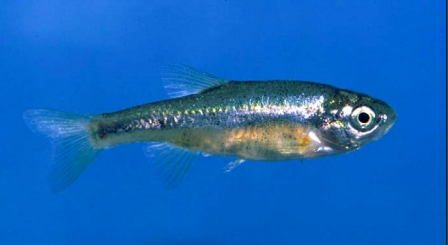
Least Chub, Courtesy and Copyright Mark C. Belk, PhotographerLeast Chub
Courtesy & © Mark C. Belk, Photographer
Echoes of Lake Bonneville

Hi, I’m Holly Strand of the Quinney College of Natural Resources at Utah State University.

Deserts are dry by definition receiving an average of less than 10 inches of precipitation a year. In Utah’s cold West Desert, this skimpy amount of moisture slakes the thirst of sagebrush, saltbush or greasewood, but not much else. However, just like the Sahara, the West Desert has its oases. In certain lowland valleys you’ll find complexes of pools and marshes. There isn’t enough rain to form these freshwater sanctuaries. The water comes from giant underground aquifers.

Underneath the West Desert, the aquifer system acts as a storehouse for runoff from the surrounding mountains. As rainwater or snow melt enters or “recharges” the aquifer system, water pressure can build up in some areas. This pressure moves water through cracks and tunnels within the aquifer, and sometimes this water flows out naturally in the form of springs.

These desert springs–and the resulting pools and marshes–permit concentrations of animals and plants not possible under normal desert conditions. You’ll find sedges, rushes cattails and many other wetland plants. Both migratory and year round birds congregate here. There are even a couple of frog species—the Colombian spotted frog and the northern leopard frog.

But most remarkable are the desert spring residents that have survived from the days when the West Desert formed the floor of giant Lake Bonneville. Surveys have revealed a number of relict snails and other mollusks that still persist from that time. Some, like the Black Canyon Pyrg exist at a single spring complex only; they are found nowhere else on earth.

Certain native fish were also left high and dry by Lake Bonneville’s recession. The least chub is a good example. Now the sole member of its genus, this 3-inch long survivor is an unassuming but attractive little minnow. It is olive-colored on top and sports a gold strip on its steel-blue sides. It swims in dense but orderly schools in either flowing or still water. It can withstand both temperature variations and high salinity. The ability to tolerate different physical conditions has undoubtedly helped the least chub survive the post-Lake Bonneville millennium. Even so, the least chub was hanging on in only six different locations until Utah’s Division of Wildlife Resources reintroduced it to several more sites within its historic range. The Division and its conservation partners are still working to reduce threats to the least chub, to other spring residents and to the spring habitats themselves.

For more information and pictures go to www.wildaboututah.org

Thanks to Chris Keleher of Utah’s Department of Natural Resources for his help in developing this Wild About Utah story.

For Wild About Utah, I’m Holly Strand.

Credits:

Theme: Courtesy & Copyright Don Anderson Leaping Lulu
Image: Least Chub, Mark C. Belk, Professor of Biology, Brigham Young University
Image: Wetlands, Courtesy Utah Geological Survey https://geology.utah.gov/
Text: Holly Strand, Quinney College of Natural Resources at Utah State University

Sources & Additional Reading

Bailey, Carmen L., Kristine W. Wilson Matthew E. Andersen. 2005. CONSERVATION AGREEMENT AND STRATEGY FOR LEAST CHUB (IOTICHTHYS PHLEGETHONTIS) IN THE STATE OF UTAH Publication Number 05-24 Utah Division of Wildlife Resources a division of Utah Department of Natural Resources https://wildlife.utah.gov/pdf/fish/least_chubs.pdf

Jones, Jennifer, Rich Emerson, and Toby Hooker. 2013. Characterizing Condition in At-risk
Wetlands of Western Utah: Phase I UTAH GEOLOGICAL SURVEY a division of Utah Department of Natural Resources,https://geodata.geology.utah.gov/pages/view.php?ref=8364

Nature Serve entry for Least Chub: https://explorer.natureserve.org/servlet/NatureServe?searchName=Iotichthys+phlegethontis

Hanks, Joseph H. and Mark C. Belk. 2004. Threatened fishes of the world: Iotichthys phlegethontis Cope, 1874 (Cyprinidae) in Environmental Biology of Fishes, Vol. 71. N. 4., Kluwer Academic Publishers. https://dx.doi.org/10.1007/s10641-004-1030-x

Sigler W. F. & J. W. Sigler. 1996. Fishes of Utah, A Natural History. University of Utah Press, Salt Lake City. 375 pp. https://www.amazon.com/Fishes-Utah-A-Natural-History/dp/0874804698

Wasatch Front Canyons Geologic Tour, Virtual Tour created from Published Booklet (pdf) Geologic Guide to the Central Wasatch Front Canyons, Utah Geological Survey, State of Utah, https://utahdnr.maps.arcgis.com/apps/MapTour/index.html?appid=5cf1570b998346d98478a5abd50bf096

Geologic guides to the central Wasatch Front Canyons, Utah Geological Survey, 2005, https://geology.utah.gov/popular/utah-landforms/virtual-tour-central-wasatch-front-canyons/ [updated January 2024]