Wily Coyotes

Coyote Canis latrans
Photo Courtesy & Copyright © 1991
Eric Gese, Photographer
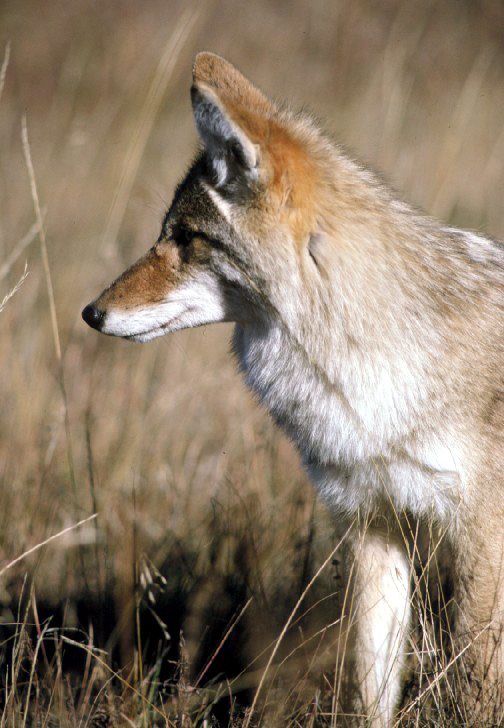
Coyote Canis latrans
Photo Courtesy & Copyright © 1991
Eric Gese, Photographer

In many of the diverse Native American storytelling traditions, the wily coyote plays the same role over and over: that of the smart, sly trickster. For those who study coyote behavior, this characterization is well deserved. Coyotes are incredibly adaptable creatures – intelligent, observant, curious and well, wily.

Their ability to adjust how they live to fit their circumstances can be seen in almost every aspect of the coyote’s life. For starters, coyotes will eat just about anything. As omnivores and opportunistic feeders, coyotes might be found hunting creatures as diverse as small mammals, birds, snakes, mule deer fawns, insects, or fish, and also seek out grasses, berries and seeds. They can hunt alone or in packs, and are not below feasting on carrion, rummaging through your garbage, or raiding the cantaloupe patch.

The environments in which coyotes can be found are similarly diverse. While once restricted to the American West, coyotes are now widespread across all of North America and parts of Central America, and can be found in nearly every ecosystem from deserts to forests to urban areas from Belize to Alaska.

Sometimes called ‘song dogs’ these social creatures are known for their nighttime solos and choruses. Their scientific name, Canis latrans literally means ‘barking dog’, and their many vocalizations help pack members and families bond and communicate over long distances. Coyotes have strong family ties, especially during spring, when puppies are born to monogamous coyote couples.

Coyotes are territorial and defend their space vigorously – especially when breeding and denning. Mating occurs from January through February and after a gestation period of only 60 to 62 days, 3 to 12 pups are born blind and helpless in March or April. Young coyotes are nursed for 4-5 weeks at which point they transition to regurgitated meals brought by both parents. Youngsters tag along on family hunts at 8 weeks old and are able to hunt independently by fall.

Interestingly, studies have shown that even coyote breeding is adaptable – a phenomenon called ‘density dependent reproduction’. In areas where coyote populations are stable, females bear lower numbers of pups. But in areas where there is disturbance to the population – for example through increased predation or hunting – females have larger litters. On average, newborn pups have less than a 50% chance of surviving to adulthood due to threats from disease, predators, and starvation. It therefore makes sense for females to bear more offspring in areas where threats may be even greater.

To learn more about coyote adaptability, join the Stokes Nature Center for a tour of the USDA/National Wildlife Research Center Predator Research Facility on June 16th. For more information visit www.logannature.org. Thank you to the Rocky Mountain Power Foundation for supporting the research and development of this Wild About Utah topic.

For the Stokes Nature Center and Wild About Utah, this is Andrea Liberatore.

Credits:
Images: Courtesy and Copyright © Eric Gese
            National Wildlife Research Center, Predator Behavior and Ecology
Text:     Andrea Liberatore, Stokes Nature Center in Logan Canyon.


Additional Reading:

Stettler, Brett. 2009. Coyote (Canis latrans). Utah Division of Wildlife Resources Wildlife Notebook Series No. 19. Found online at:
https://wildlife.utah.gov/publications/pdf/2010_coyote.pdf

Video: Coyotes Cruise NYC, Science Friday & Mark Weckel, https://www.sciencefriday.com/videos/watch/10444

Men’s Hair and the Male House Finch

Male House Finch, Courtesy US FWS, Gary Kramer, Photographer
Male House Finch
Courtesy US FWS, Gary Kramer, Photographer
This is Linda Kervin for Bridgerland Audubon Society.

A man’s vanity is nowhere more apparent than for the hair atop his head. As men age, their hair may whiten, thin or disappear. As a remedy, some men use dyes or hair growth potions.

But imagine this: What if the right food alone could restore the virile dark hair of youth?

There is a common songbird at your birdfeeder this winter that can do just this. It is the male house finch.

[House Finch Call – #3 Songbirds of the Southwest Canyon Country]

As with many songbirds, the female house finch is drab compared to the brightly colored male. He sports a showy brow and bib in colors that range from tomato red to orange to straw yellow. Like the tomato and carrot, these colors come from pigments called carotenoids. All birds with red feathers get these carotenoid pigments from their diet, ultimately from the plants that can produce them.

What does the red feather color mean for the house finch?

The ornathologist Geof Hill of Auburn University experimentally altered head feather colors of male house finches. To make red-headed males into carrot tops, Jeff used peroxide. Red hair die achieved the opposite transformation. He then let the guys compete for the attentions of females.

Jeff’s experiments demonstrated that plumage does make the male. The redder the male’s head, the higher his place in the pecking order. And the more females that he could attract. Conversely, redheads lost rank after bleaching. Among male house finches, blondes really don’t have more fun.

So now you can predict the likely winners and losers in the mating game from just a glance at the male house finches at your seed feeder. As is common in science, this discovery leads to new questions: What food makes the male’s head feathers red? Is it some red fruit or berry? Why do some males manage to get more carotenoid pigments than others? Do they instinctively know the right seed or fruit to eat? We humans must get our carotenoids from plant sources too, such as the carotine that we transform into Vitamin A for night vision. The produce aisle at the grocery store might be a much different place though if the right fruit or vegetable could transform our hair color too.

This is Linda Kervin for Bridgerland Audubon Society.

Credits:

Photo: Courtesy US FWS, Gary Kramer, Photographer
Bird Sounds: Courtesy and Copyright 2008 Dr. Kevin Colver, Songbirds of the Southwest Canyon Country https://wildstore.wildsanctuary.com/collections/special-collections
Text: Jim Cane and Linda Kervin, Bridgerland Audubon Society https://www.bridgerlandaudubon.org
Voice: Linda Kervin

Additional Reading:

House Finch, Carpodacus mexicanus, Utah Division of Wildlife Resources, Department of Natural Resources, State of Utah, https://fieldguide.wildlife.utah.gov/?species=haemorhous%20mexicanus

House Finch, Utah Bird Profile, UtahBirds.org, https://www.utahbirds.org/birdsofutah/ProfilesD-K/HouseFinch.htm

A Red Bird in a Brown Bag: The Function and Evolution of Colorful Plumage in the House Finch , Dr. Geoffrey, E. Hill, Oxford University Press, September 2002
ISBN-13: 9780195148480, https://www.amazon.com/Red-Bird-Brown-Bag-Ornithology/dp/0195148487

New Addition: How birds turn red, Phys.org, May 19, 2016, http://phys.org/news/2016-05-genes-enable-birds-red.html

Pharr, Lauren D., Seeing Red: What the Color of House Finches Can Tell Us, Cool Green Science, The Nature Conservancy, November 2, 2021, https://blog.nature.org/2021/11/02/seeing-red-what-the-color-of-house-finches-can-tell-us/

Lowe, Joe, Invasive Birds of the U.S.: Seven of the Most Common Species, Bird Calls Blog, American Bird Conservancy, February 24, 2020, https://abcbirds.org/blog20/invasive-birds/

Leffer, Lauren, 10 Fun Facts about the House Finch, News, National Audubon Society, December 21, 2021, https://www.audubon.org/news/10-fun-facts-about-house-finch

Turkey Vultures

Swainsons Thrush
Turkey Vulture in flight
Cathartes aura
Courtesy Utah Division of Wildlife Resources
Scott Root, Photographer
Licensed under CCL

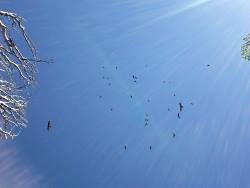
Turkey Vulture Kettle above LoganTurkey Vulture Kettle above Logan
Cathartes aura
Courtesy and Copyright
Andrea Liberatore, Photographer

Turkey Vulture Kettle above LoganTurkey Vulture Kettle above Logan
Cathartes aura
Courtesy and Copyright
Andrea Liberatore, Photographer

On certain days in the spring and fall, the sky above my neighborhood looks like a scene from Alfred Hitchcock’s ‘The Birds’. As many as 60 large black birds swarm the sky, circling above the rooftops. On the busiest of days, people will stop their cars in the middle of the road to gawk at the sight. Some give a visible shiver when told that the birds are turkey vultures. But we have nothing to fear from these birds – in fact they should be embraced for the absolutely vital role they play in our environment.

There are lots of myths surrounding vultures, which in turn creates a misunderstanding about them. So let’s set the record straight on a few things. Vultures circle for two main reasons, neither of which involves waiting for a sick or wounded animal to die. The first reason is to take advantage of rising columns of air, called thermals, which generally occur in the mornings as the sun warms the air closest to the earth. Vultures are soaring birds and flapping their 6-foot wingspans takes a lot of effort, so they rarely do it. In fact these birds can fly for hours without a single flap. Circling within a thermal helps them travel higher and farther on much less energy.
The second reason vultures circle is to hone in on a food source. Turkey vultures are one of the few birds that have a highly developed sense of smell. Working together with their excellent eyesight, the birds soar and circle to pin down the location of their next meal.

Continue reading “Turkey Vultures”

American Invasion

Eurasian Collared Dove, Courtesy invasivespecies.org, Joy Viola, Northwestern University, Photographer
Eurasian Collared Dove
Streptopelia decaocto
Courtesy & © invasivespecies.org/bugwood.org
Joy Viola, Northwestern University, Photographer

Colorado Potato Bug, Courtesy insectimages.org/bugwood.org, USDA ARS, PhotographerColorado Potato Beetle Adult
Leptinotarsa decemlineata
Courtesy IPMimages.org/bugwood.org
USDA ARS, Photographer

Hi, I’m Holly Strand from the Quinney College of Natural Resources at Utah State University.

More and more you are likely to hear this sound in Utah yards, parks and fields. [Eurasian Collared Dove, Courtesy Ryan O’Donnell, www.xeno-canto.org/98068] That’s the call of the Eurasian collared dove. Originally from Asia, this dove has been expanding its territory around the world at an incredible rate. The first sighting in Utah was in Orem in 1997. And now the doves are everywhere. So far, it doesn’t look like our native mourning dove is affected. But such rapid population explosions rarely occur without some sort of undesirable ecological consequence.

In America, the Eurasian collared dove is an invasive species. But not all non-native species are invasive. “Invasive” only applies when species spread far beyond the area where they are first introduced. Luckily, not all invasive species turn out to be serious pests. Ecologist Mark Williamson suggested the tens rule. About 10% of introduced species establish lasting populations and 10% of those go on to become problems.

There’s a long list of Eurasian invasives in Utah. Among them is the highly flammable cheat grass that comes from southwestern Asia. Those massive clouds of starlings? They come from Europe. Tamarisk from Eurasian deserts lines the Colorado River and tributaries. The common carp is an unwelcome Eurasian colonist of our lakes and large rivers. And the American west’s iconic tumbleweed is an invader from the Russian steppe.

Why so many invaders from Eurasia? Well for the last 500 years, there has been a net outflow of Eurasians—especially Europeans—to other parts of the world. And this human population carried its biological baggage along with it—in the form of animals, plants and diseases. Some ecologists believe that the physical geography and human history of Eurasia has conditioned its species in such a way that they will consistently outcompete the species of other continents. But that’s debatable. For in the last decades the New World has started to lob some pretty competitive species over to Eurasia.

For example, the American mink was brought to the Eurasian continent in the 1920s for use on fur farms. But–because of deliberate releases and accidental escapes–the mink is now common in the European wild. And it’s a pest. The American mink is taking the place of the European mink which is now threatened with extinction. Furthermore, the American mink is gobbling up populations of many ground-nesting birds.

Unless you are involved in agriculture, you might not have heard of the Colorado potato beetle. But potato growers around the globe know this striped orange and brown beetle from the American southwest very well. It has a voracious appetite for potato leaves and quickly develops resistance to any chemicals used against it.

And a final example: the American bullfrog is considered one of the world’s most damaging invasives. The bullfrog does amazingly well in a variety of habitats –even artificial ones like millponds, irrigation ditches and reservoirs. Its incredible adaptability helps it spread and outcompete native frogs. Moreover, it has been transmitting a deadly fungus to previously unaffected populations of frogs, toads and salamanders.

Thanks to Lyle Bingham for information on the Eurasian collared dove. And to Ryan ODonnell for his audio recording from xeno-canto.org. For more information on the Eurasian collared dove and other invasive species go to www.wildaboututah.org.

For Wild About Utah, and the Quinney College of Natural Resouces, I’m Holly Strand.

Credits:

Theme: Courtesy & Copyright Don Anderson Leaping Lulu
1. Photographer Joy Viola, Northwestern University, Bugwood.org https://www.invasive.org/browse/detail.cfm?imgnum=5413582
2. USDA ARS Photo Unit, USDA Agricultural Research Service, Bugwood. https://www.insectimages.org/browse/detail.cfm?imgnum=1321015

Audio of Eurasian collared dove:
Ryan P. O’Donnell, XC98068. Accessible at www.xeno-canto.org/98068.
Creative Commons Attribution-NonCommercial-NoDerivs 2.5

Text & Voice: Stokes Nature Center: Holly Strand

Sources & Additional Reading:

Bingham, Lyle. 2009. The New Dove in the Neighborhood. Wild About Utah Program https://wildaboututah.org/the-new-dove-in-the-neighborhood/ October 8, 2009.

di Castri F. 1989. History of biological invasions with special emphasis on the Old World. In: Drake JA, Mooney HA, di CastriF, Groves RH, Kruger FJ, Rejma´nek M, Williamson M, eds. Biological invasions: a global perspective. Chichester, UK: John Wiley and Sons.

European Environment Agency, 2012. The impacts of invasive alien species in Europe EEA Technical report No. 16/2012. EEA, Copenhagen.

National Invasive Species Information Center (NISIC): Gateway to invasive species information; covering Federal, State, local, and international sources.
https://www.invasivespeciesinfo.gov/index.shtml

Simberloff, Daniel. 2013. Invasive Species: What Everyone Needs to Know. Oxford University Press