Western Banded Gecko

Western Banded Gecko, Courtesy NPS
Western Banded Gecko
Courtesy NPS

They might catch your eye as they dart under sagebrush. Or maybe startle you with their pushups on a boulder. Odds are, you won’t leave Arches or Canyonlands national parks without seeing a Western Banded Gecko.

These lizards can grow to six inches in length, though that’s on the large side, and half of that length might be their tail. Pale-pink and brown-banded translucent skin distinguishes Western Banded Geckos from all other lizards that live in the same desert surroundings, and their heads and bodies are speckled with light brown. The brown bands are vibrant in young Western Banded Geckos, and then change into blotches, or spots, with age.

The small scales that cover their body are soft to touch, and their slender toes leave no room for pads. Movable eyelids and vertical pupils also set them apart.

The Western Banded Gecko typically are spotted in rocky or sandy desert areas in the American Southwest. They are fond of open, dry deserts, desert grasslands, and catching the sun in the canyons. You can spot them, or one of the eight subspecies, in Glen Canyon National Recreation Area, as well as in Arches and Canyonlands.

Like other geckos, these lizards generally avoid the day heat and prefer the cool night air. They seek shelter during the day near or under rocks, burrows, and spaces beneath vegetative debris, and even trash piles if necessary. They frequent rodent burrows as they hunt insects, spiders, small arthropods, and baby scorpions.

The Western Banded Gecko stalks its prey, capturing and crushing it with its jaws in a final, fatal lunge. The small gecko is one of the few reptiles credited with controlling the scorpion population, by eating their young. The Western Banded Gecko can also mimic a scorpion, by turning its tail upwards, and waving it to repel predators.

In addition to this deception, Western Banded Geckos use other methods to divert predators. Be forewarned: if you plan on catching a Western Banded Gecko, be prepared to hear a squeak or chirp in disagreement. You may even see them detach their tail. Their tail has particular fracture planes, allowing the lizard to easily detach and escape, similar to other lizards. Blood vessels surrounding the tail rapidly close, so they can prevent blood loss. Regrowth of their tails happens quickly, as it is mostly made up of cartilage.

Though the tail serves as an easy escape route, it means a lot to a Western Banded Gecko: that’s where it stores its food and water. Their tail allows these animals to survive during lean times, up to nine months. As you can imagine, losing a tail puts their life in danger, so look but don’t touch.

For Wild About Utah and National Parks Traveler, I’m Kurt Repanshek.

Credits:
Image: Courtesy and Copyright Kurt Repanshek, www.nationalparkstraveler.com
Text:     Kurt Repanshek, NationalParksTraveler.com.


Additional Reading:
Rufous Hummingbird

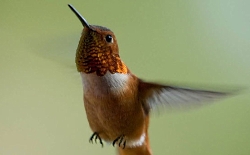
Rufus Hummingbird Courtesy US FWS, Roy W, Lowe, Photographer
Rufus Hummingbird
Courtesy US FWS,
Roy W. Lowe, Photographer

Who doesn’t love hummingbirds! I’m always amazed how a tiny life form with a brain smaller than a pea is capable of such amazing intelligence and behaviors. In fact, a hummingbird’s brain is proportionally larger in size to their body than that of any other bird. And like the corvid family (jays, magpies, and crows), research has found that hummers have an amazing memory.

Now is the seasonal peak for hummingbird activity with young birds fresh off the nest. One of my favorites, the migrating rufous hummingbird, may join the milieu on their long distance marathon as they make their way from as far north as Alaska to winter in Mexico.

The feistiest hummingbird in North America, the brilliant orange male and the green-and-orange female are relentless attackers at flowers and feeders. These fearless competitors will challenge even the largest hummingbirds of the Southwest, which can be double their weight, and often win the contest! Rufous Hummingbirds are wide-ranging, and breed farther north than any other hummingbird. Look for them in spring in California, summer in the Pacific Northwest and Alaska, and now in the Rocky Mountains as they make their annual circuit of the West.

Rufous Hummers have the hummingbird gift for fast, darting flight and pinpoint maneuverability. Like other hummers, they eat insects as well as nectar, taking them from spider webs or catching them in midair.

Rufous Hummingbirds breed in open areas, yards, parks, and forests up to timberline. On migration they pass through mountain meadows as high as 12,600 feet where nectar-rich, tubular flowers are blooming. Winter habitat in Mexico includes shrubby openings and oak-pine forests at middle to high elevation.

They may take up residence (at least temporarily) in your garden if you grow hummingbird flowers or put out feeders. But beware! They may make life difficult for any other species that visit your yard. If you live on their migration route, the visiting Rufous is likely to move on after just a week or two.

Regarding feeders, make sugar water mixtures with about one cup of sugar per quart of water. Food coloring is unnecessary; table sugar is the best choice. Change the water before it grows cloudy or discolored and remember that during hot weather, sugar water ferments rapidly to produce toxic alcohol. If you are among those who have these dazzling sprites of amazing life stop by, consider yourself fortunate indeed!

This is Jack Greene reading for “Wild About Utah”

Credits:

Pictures: Courtesy US FWS, Roy W Lowe, Photographer
Text: Jack Greene, Bridgerland Audubon Society

Additional Reading:

Andrea Explains Fitting the Bill

Andrea Explains Fitting the Bill

Andrea Explains Fitting the Bill: White-winged Crossbill, Courtesy and Copyright Paul Higgins, www.pbase.com/phiggins/
White-winged Crossbill
Copyright © 2009 Paul Higgins
More photos at pbase.com/phiggins/
and utahbirds.org Photo Gallery

Red Crossbill (female)
Copyright © 2009 Paul Higgins
More photos at pbase.com/phiggins/

Few among us would choose to eat a steak with a spoon or soup with a fork. And in the world of birds, it’s the same story – you need the right tool for the right job – and you can tell a lot about a bird by paying attention to its beak.Andrea Explains Fitting the Bill

Physiologically, beaks are a specialized extension of the skull and are coated in keratin – the same material that makes up our fingernails. And like our fingernails, the cutting edges of the beak can be re-grown as they are worn down by use.

Birds use beaks for a multitude of tasks including preening, weaving nests, and defending territories. However it is the task of eating that seems to dictate beak shape and size. Envision the hummingbird, for instance. Its long, thin beak – and corresponding tongue – is designed to reach deep into flowers to collect the nectar within. A hummingbird beak would not work for a woodpecker or a great horned owl. Likewise an eagle’s beak needs to be sharp and strong for tearing flesh, and wouldn’t suit the lifestyle of an ibis or a sparrow.

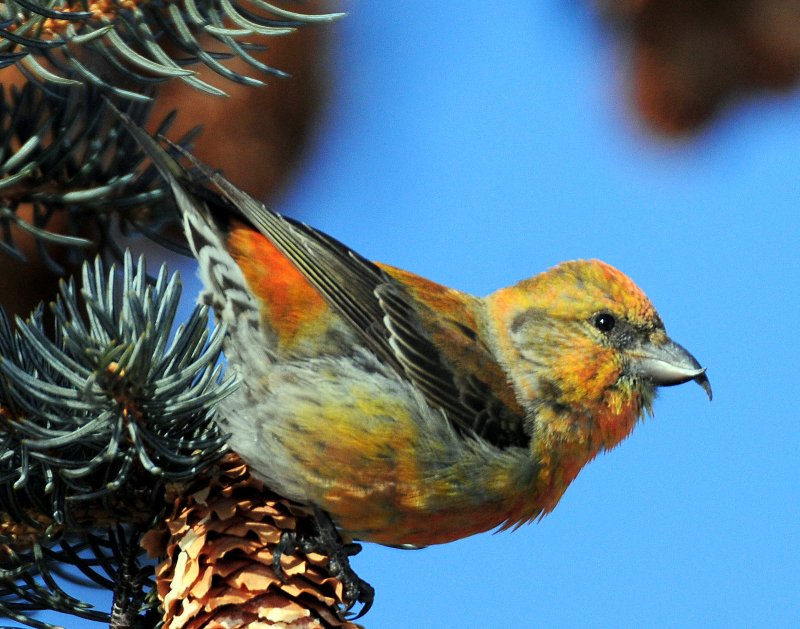
One Utah native, the aptly-named red crossbill, has one of the most unique beaks around. When closed, its curved top and bottom bills overlap crossways in what looks like an awkward and uncomfortable pose.

French naturalist Count Buffon, first laid eyes on a crossbill in the mid-1700’s. The bird was collected in the Americas, then shipped abroad for examination. Without observing the crossbill in its natural habitat, Buffon labeled its beak “an error and defect of nature, and a useless deformity.” More than 50 years later, Scottish-American naturalist Alexander Wilson observed a crossbill in the wild and determined that its beak ‘deformity’ was in reality a magnificently adapted tool. The crossbill’s diet consists mainly of the seeds of conifer trees, and it turns out that the bird’s curiously crossed beak is perfectly adapted to prying apart the scales of pinecones to get at the seeds within.

Members of the finch family, these birds are often seen in flocks and occasionally visit backyard feeders. They are easily identified by their unique beaks, which serve as a reminder that the right tool for the right job can sometimes seem a bit unconventional.

For more information and photographs of crossbills, visit our website at www.wildaboututah.org. Thank you to Rocky Mountain Power Foundation for supporting the research and development of this Wild About Utah topic.

For the Stokes Nature Center and Wild About Utah, this is Andrea Liberatore.
Credits:
Photos: Courtesy & Copyright Paul Higgins(phiggins)www.pbase.com/phiggins
Text:    Andrea Liberatore, Stokes Nature Center, logannature.org

Additional Reading:

Benkman, Craig W. 1987. Crossbill Foraging Behavior, Bill Structure, and Patterns of Food Profitability. The Wilson Bulletin 99(3) p. 351-368 https://www.uwyo.edu/benkman/pdfs%20of%20papers/benkman_1987_wilsonbull.pdf

Conniff, Richard. 2011. The Species Seekers: Heroes, Fools and the Mad Pursuit of Life on Earth. W.W. Norton & Company: NY https://www.amazon.com/Species-Seekers-Heroes-Fools-Pursuit/dp/0393341321

Pearson, T. Gilbert (ed.). 1936. Birds of America. Garden City Publishing Company, Inc. Garden City, NY https://www.amazon.com/T-Gilbert-Pearson/dp/1331531268/ref=pd_lpo_14_t_0/144-1525643-4789824

Andrea Explains Fitting the Bill

Riparian Zones and a Critter Quiz

Hello, this is Jim Goodwin.

In a minute I’ve got a critter quiz for you, but first, a word about the huge importance of riparian areas in semi-arid Utah, the second driest state in the union. Utah State’s Extension Service calls riparian zones the green ribbon of life alongside a stream. They are shadier, cooler and moister than adjacent environments.

And with a diverse mix of plants and animals, our few riparian corridors are heavily used by wildlife for food, rest and shelter.

Ok, now for our critter quiz.

What is the largest rodent in North America? Here’s a hint: they can be up to four feet long and weigh 40 to 60 pounds.

Did that do it? No? Alright, this clue will: They spend much of their life in water. They have a beautiful brown coat, a broad flat hairless tail and big orange buck teeth that continually grow, which is why they chew and chew and chew.

Click for larger picture, Beaver with branch in water, Courtesy US FWS, Steve Hillebrand, Photographer
Beaver with branch in water
Courtesy US FWS,
Steve Hillebrand, Photographer
Good, you got it . . . it’s the North American beaver. Or as Utah environmental author Chip Ward calls them: the Flat Tail Climate Hero for the restoration of damaged watersheds. Beaver are amazing aquatic engineers, second only to humans in their ability to manipulate their environment.

In our nation’s history, they’ve played a big role in literarily shaping our western landscape.
Joe Wheaton, Utah State wildlife and a beaver expert, rightly calls the work of the beaver “cheap and cheerful restoration” of our heat stressed watersheds.

In the wild, these mostly nocturnal animals, normally live five to ten years.
Fortunately, they are rarely killed for their pelts these days. Beaver are usually monogamous. They will produce up to 10 babies. The young kits will stay home until they are two or so, before they will take off on their own.

Beaver are master aquatic builders. the original geo-engineers. They build dams to flood areas for protection from predators, for access to their food supply, and to provide safe underwater entrances to their dens. Their dams create beautiful riparian habitat for many other animals, birds, fish amphibians, insects and plants. The flooded areas slow the flow of water and sediment downstream and raise the area water table.

Aspen, cottonwood, willow and dogwood are their preferred tree. Those trees regenerate quickly after beaver topple them. When their ponds freeze over, beaver jam smaller branches into the mud at the bottom of their pond for food storage.

Beaver dams can be 5 to 10 feet high and 150 feet across. They are constructed with branches, stones, and plants and plastered together with mud. Over 1200 beaver dams have been counted in northern Utah’s Bear River mountains alone. The World’s largest beaver dam in Canada is 2,789 feet in length. That’s more than 9 football fields.

Yes, sometimes beaver can be a nuisance to human property and activities. Often, learning to live with beaver and the many benefits they can bring, can be a solution. There are simple time-tested ways to prevent flooding. But if nothing works, they can be live trapped and moved to another area. There’s no need to shoot them.

Be a “beaver believer.” Here are some organizations you can check with to learn more:
Utah State wildlife researchers Wally McFarland and Joe Wheaton have created something called the Beaver Restoration Assessment Tool to track beaver dam building activities and their effects throughout the state.
The Bear River Watershed Council in Cache Valley and Mary O’Brien with the Grand Canyon Trust in southern Utah are excellent organizations to contact.

I’m Jim Goodwin for Wild About Utah.

Credits:
Image: Courtesy US FWS, Steve Hillebrand, Photographer
Text:     Jim Goodwin
Additional Reading:

Beaver Restoration Assessment Tool, https://brat.joewheaton.org/

Bear River Watershed Council, (disbanded, formerly at: https://www.brwcouncil.org/)

Grand Canyon Trust, https://www.grandcanyontrust.org/

Beaver Castor canadensis, National Geographic, https://animals.nationalgeographic.com/animals/mammals/beaver/

Big Bend Habitat Restoration Project: A Natural Work of Heart, Open Spaces-A Talk on the Wild Side, US FWS, https://www.fws.gov/news/blog/index.cfm/2016/3/25/Big-Bend-Habitat-Restoration-Project-A-Natural-Work-of-Heart [Accessed March 31, 2016]

Beaver Dams Strengthened by Humans Help Fish Rebound
60-Second Science – July 25, 2016 – By Jason G. Goldman02:29 https://www.scientificamerican.com/podcast/episode/beaver-dams-strengthened-by-humans-help-fish-rebound/ Also available through the podcast https://itunes.apple.com/us/podcast/60-second-science/id189330872?mt=2

Restoring Degraded Waters, One Pest at a Time, Utah State Magazine, Utah State University, December 7, 2021, https://utahstatemagazine.usu.edu/environment/restoring-degraded-waters-one-nuisance-at-a-time/