Swainson’s Hawks

Swainson's Hawk, (Buteo swainsoni), Photo Courtesy US FWS
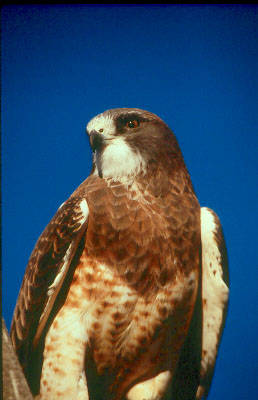
Swainson’s Hawk, (Buteo swainsoni)
Photo Courtesy US FWS
 
Swainson's Hawk, (Buteo swainsoni), Photo Courtesy US FWSSwainson’s Hawk, (Buteo swainsoni)
Photo Courtesy US FWS

The Wellsville Mountains of N. Utah are known for their steepness, spectacular beauty, and an extraordinary fall raptor migration. The perfect mix of thermal uplift on its west slopes funnels the birds along the east side of the Great Salt Lake to their southerly destinations. Many species- eagles, falcons, accipiter’s, and buteos grace its slopes. The migration occurs primarily from mid-August to mid-October. Last Saturday’s hawk watchers were treated to 300 plus birds consisting of 15 species.

There is one in particular that is known for its extraordinary abilities and unusual behaviors that I will dwell on, that being the Swainson’s hawk. Nearly the entire population of these amazing birds will navigate their way to Argentina, a distance not equaled by any other raptor.

This species was named after William Swainson, a British naturalist. It is also known as the grasshopper hawk or locust hawk, as it is very fond of locusts and grasshoppers and will voraciously eat these insects whenever they are available. They have the unusual behavior of congregating in large numbers in fields to attack their prey. I’ve counted over 100 birds occupying cut hay fields in a half mile distance.

Breeding Swainson’s hawks are opportunistic feeders that respond quickly to local concentrations of food and rely heavily upon small mammal, bird, and reptiles such as young ground squirrels, rabbits, pocket gophers, mice, small birds. Birds taken include Mallards, young Sage Grouse, American kestrel, and young short-eared owls. Reptiles include snakes such as racers, gophers, striped whipsnakes, and lizards. Amphibians include tiger salamanders and toads.

In Argentina, Swainson’s hawks feed on flocks of the migratory darner dragonfly, following the hordes of insects and feeding mostly on the wing. Local outbreaks of locusts may also be exploited. There is also some evidence that road-killed birds and animals are consumed both on the wintering grounds and on the breeding grounds. They commonly follow tractors during haying or ploughing, where rodents are exposed for the hawks to capture, or insects are uncovered after crop cutting.

Wildfires often attract foraging hawks, especially grass fires in their South American wintering range where they frequently wait around the edges of the fire, picking off insects and vertebrates including grouse, lizards, and snakes.

This weekend I will be on my way to our raptor observation peak high in the Wellsvilles hoping to see this amazing bird, along with a host of other raptors as they migrate to more favorable climes, but only one of the myriad species will make it all the way to Argentina!

This is Jack Greene reading for Wild About Utah.

Credits:

Pictures: Courtesy US FWS, San Andres NWR
Text: Jack Greene, Bridgerland Audubon Society

Additional Reading:

Animal Fact Sheet: Ringtail, Arizona-Sonora Desert Museum, https://www.desertmuseum.org/kids/oz/long-fact-sheets/Ringtail.php

Ringtail (Bassariscus astutus), Wildscreen Arkive, https://www.arkive.org/ringtail/bassariscus-astutus/

Yellow-Bellied Marmot

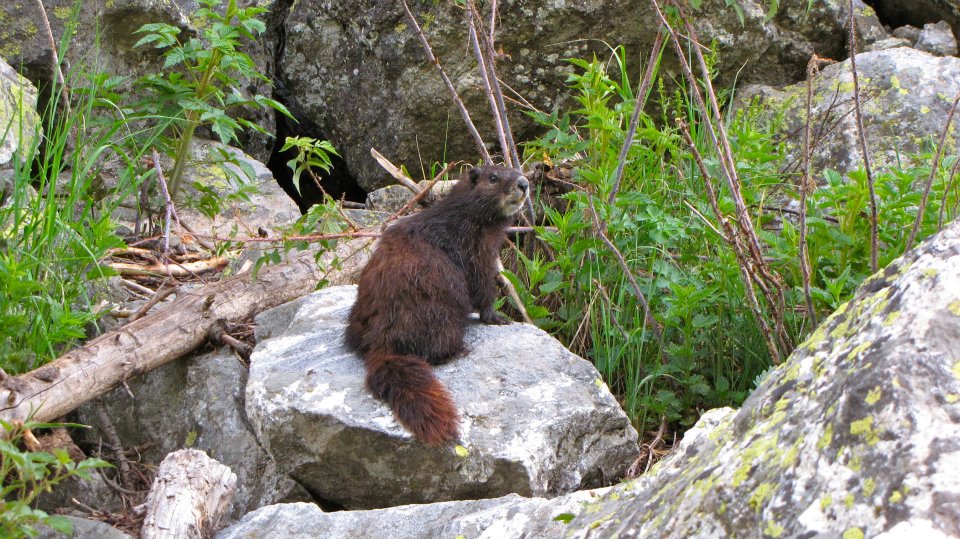
Yellow-bellied Marmots, Photo courtesy and copyright Roslynn Brain, Photographer
Yellow-bellied Marmots
Photo courtesy and copyright
Roslynn Brain, Photographer

Yellow-bellied Marmots, Photo courtesy and copyright Roslynn Brain, PhotographerYellow-bellied Marmots
Photo courtesy and copyright
Roslynn Brain, Photographer

Yellow-bellied Marmots, Photo courtesy and copyright Roslynn Brain, PhotographerYellow-bellied Marmots
Photo courtesy and copyright
Roslynn Brain, Photographer

Yellow-bellied Marmots, Photo courtesy and copyright Roslynn Brain PhotographerYellow-bellied Marmots
Photo courtesy and copyright
Roslynn Brain, Photographer

If you have explored the mountains of Utah, you’ve inevitably heard the iconic high-pitched chirp associated with Utah’s Yellow-Bellied Marmot.

Sporting chubby cheeks, large front teeth, a reddish-brown tail that spins like a helicopter rotor when fleeing, a greyish-brown back, white patch of fur between the eyes, and a yellow-orange belly, these sun-loving, flower-chewing mammals exude a Buddhist-type nature, especially when compared to their frantic neighbors, the pika.

Yellow-bellied marmots belong to the mammalian order Rodentia, in the squirrel family Scirudae. This family includes all species of prairie dog, chipmunk, and the woodchuck. Marmots fall under the genus “marmota.” The scientific name of yellow-bellied marmots is “Marmota flaviventris.” Although the origin of the term marmota is not certain, one accepted interpretation stems from a similar Latin word meaning “mountain mouse.” Flaviventris means “yellow belly” in Latin.

There are 15 species of marmot worldwide, all in the northern hemisphere. Most live in mountainous areas such as the Alpine marmot found only in Europe, though some live in rough grasslands. Although commonly believed to be in the same genus, the prairie dog is not classified in the genus Marmota, but in the related genus Cynomys.

When alarmed, yellow-bellied marmots emit a shrill whistle which earned them the nickname “whistle pigs,” by early settlers. Sometimes they make a “chucking” sound, which could explain another nickname, “rock chuck.” Additional monikers for marmots include “whistlers”, “mountain marmots”, and “snow pigs.”

Yellow-bellied marmots live at average elevations of 6,000-13,000 feet throughout western North America. They are often found in highland meadows and steppes, and almost always near rocks. Burrows are usually constructed in areas with plentiful plants which comprise the marmot’s main diet: herbaceous grasses and forbs, flowers, legumes, grains, fruits, and insects. Marmots spend the summer months sunning on warm rocks and fattening up in preparation for winter hibernation which can last up to 8 months.Thus, they are especially plump in the fall, right before hibernation, and reach weights of around 8-11 pounds. They may also estivate in June in response to dry conditions and a lack of green vegetation, only to reappear later in the summer when food is once again plentiful.

The typical social structure of yellow-bellied marmots includes a single male with a range of one up to four females. Males are territorial and aggressively protect their harem from other male marmots and smaller predators such as the ermine. Other predators to the yellow-bellied marmot include coyotes, foxes, badgers, bears, and eagles. Females raise their annual offspring of 3-8 jointly with other females within the harem. Baby marmots or pups are born relatively undeveloped and require large amounts of care until they emerge from the nest three weeks later. Only about half of marmot pups survive and become yearlings. If they make it through the first year, marmots may live up to 15 years of age.

Given that they spend about 80% of their life in a borrow, 60% of which is in hibernation, consider yourself lucky the next time you encounter a chubby, sun-bathing, whistling marmot!

For Utah State University Extension Sustainability, this is Roslynn Brain.

Credits:
Images: Courtesy and copyright Roslynn Brain McCann, Photographer
Text:     Roslynn Brain McCann, Utah State University Extension Sustainability
Additional Reading:

Yellow-bellied Marmot, Species, Division of Wildlife Resources, Utah Department of Natural Resources, https://fieldguide.wildlife.utah.gov/?species=marmota%20flaviventris

Marmot Burrow, UCLA, Daniel Blumstein, https://www.marmotburrow.ucla.edu/watching.html

Marmot, Rocky Mountain National Park, https://www.nps.gov/romo/learn/nature/marmot.htm

Yellow-bellied Marmot (Rockchuck), Deseret News, 14 Mar, 1998,
https://www.deseretnews.com/article/629775/Yellow-bellied-Marmot-Rockchuck.html

Ringtails

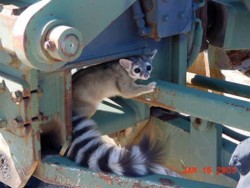
Ringtail (Bassariscus astutus), Photo Courtesy US FWS
Ringtail (Bassariscus astutus)
Photo Courtesy US FWS
San Andres NWR
I’ve long been intrigued by ringtail cats. I wasn’t quite sure where they fit in the grand scheme of things until I did some research while working in Zion N.P. where they were known to vandalize building contents and other mischievous behaviors.
These “mystery” cats are mostly nocturnal, highly secretive, very bright, and full of tricks and athletic feats that place them in an elite animal category. I was intent on seeing one but knew my chances were slight. On a midmorning hike into Hidden Canyon I was startled by something not far ahead of me scrambling up giant boulders. To my amazement, there they were- two ringtails hightailing in broad daylight- my first, and possibly last, sighting of these amazing animals!
The name “ringtail” comes from the seven or eight black rings on the animal’s tail. Although they are not related to cats, people have referred to them as miner’s cat, civet cat, and cacomistle (an Aztec Nahuatl term meaning half mountain lion). Along with raccoons and coatimundis, ringtails are members of the Procyonidae (raccoon) family. The scientific name, Bassariscus astusus, comes from bassar (fox), isc (little), and astut (cunning).

If one were to design an animal to climb along ledges and up vertical cliffs, the ringtail might be it. Their large tail provides balance for narrow ledges and limbs, even allowing them to reverse directions by doing a cartwheel. They can rotate their hind feet 180 degrees to quickly climb back down cliffs or trees as well as cacti. Furthermore, ringtails can ascend narrow passages by stemming (pressing all feet on one wall and their back against the other or pressing both right feet on one wall and both left feet on the other), and wider cracks or openings by ricocheting between the walls.

A ringtail’s total length ranges between inches with a tail length of 12 to 17 inches. They weigh two pounds or so. Vocalizations include squeaks, metallic chirps, whimpers, chitters, chucking, hisses, grunts, growls, and howls.
Like most omnivores, these hunters eat a wide variety of food. They have a seasonal diet, with plants and insects the favorite fall food, mammals and birds more common in winter, and insects dominate in summer. Preferred mammals include mice, woodrats, squirrels and rabbits. Ringtails also feed on nectar from agaves. Great horned owls are their major predator, along with coyotes, raccoons and bobcats.

Primarily nocturnal, ringtails don’t like daylight at a young age. Ringtails inhabit rough, rocky habitat, usually not too far from water, although they can subsist without free water if their diet consists of high protein prey or fruit and insects. In addition, they occur in semi-arid landscapes such as pinyon-juniper pygmy forests and oak woodlands. Ringtails den in tree hollows, rock crevices, other animals’ abandoned burrows or even abandoned buildings. Except in bad weather, they move frequently, rarely spending more than three straight nights in one den.

Mating occurs between February and May with one to four, hairless young born in May or June. Eyes open and fur covers their bodies by five to six weeks. They are weaned by fall and can mate near the end of their second year. Ringtails range across the southwestern USA and most of Mexico with outliers in northern California, Nebraska, Missouri and extreme southwest Wyoming.The genus Bassariscus consists of only one other species which lives in Central America. Because ringtails do not walk on the soles of their feet, unlike coatis or raccoons, they are sometimes placed in their own family, Bassariscidae. The ringtail became the State Mammal 1986.

For Wild About Utah, this is Jack Greene.

Credits:

Pictures: Courtesy US FWS, San Andres NWR
Text: Jack Greene, Bridgerland Audubon Society

Additional Reading:

Animal Fact Sheet: Ringtail, Arizona-Sonora Desert Museum, https://www.desertmuseum.org/kids/oz/long-fact-sheets/Ringtail.php

Ringtail (Bassariscus astutus), Wildscreen Arkive, https://www.arkive.org/ringtail/bassariscus-astutus/

Western Banded Gecko

Western Banded Gecko, Courtesy NPS
Western Banded Gecko
Courtesy NPS

They might catch your eye as they dart under sagebrush. Or maybe startle you with their pushups on a boulder. Odds are, you won’t leave Arches or Canyonlands national parks without seeing a Western Banded Gecko.

These lizards can grow to six inches in length, though that’s on the large side, and half of that length might be their tail. Pale-pink and brown-banded translucent skin distinguishes Western Banded Geckos from all other lizards that live in the same desert surroundings, and their heads and bodies are speckled with light brown. The brown bands are vibrant in young Western Banded Geckos, and then change into blotches, or spots, with age.

The small scales that cover their body are soft to touch, and their slender toes leave no room for pads. Movable eyelids and vertical pupils also set them apart.

The Western Banded Gecko typically are spotted in rocky or sandy desert areas in the American Southwest. They are fond of open, dry deserts, desert grasslands, and catching the sun in the canyons. You can spot them, or one of the eight subspecies, in Glen Canyon National Recreation Area, as well as in Arches and Canyonlands.

Like other geckos, these lizards generally avoid the day heat and prefer the cool night air. They seek shelter during the day near or under rocks, burrows, and spaces beneath vegetative debris, and even trash piles if necessary. They frequent rodent burrows as they hunt insects, spiders, small arthropods, and baby scorpions.

The Western Banded Gecko stalks its prey, capturing and crushing it with its jaws in a final, fatal lunge. The small gecko is one of the few reptiles credited with controlling the scorpion population, by eating their young. The Western Banded Gecko can also mimic a scorpion, by turning its tail upwards, and waving it to repel predators.

In addition to this deception, Western Banded Geckos use other methods to divert predators. Be forewarned: if you plan on catching a Western Banded Gecko, be prepared to hear a squeak or chirp in disagreement. You may even see them detach their tail. Their tail has particular fracture planes, allowing the lizard to easily detach and escape, similar to other lizards. Blood vessels surrounding the tail rapidly close, so they can prevent blood loss. Regrowth of their tails happens quickly, as it is mostly made up of cartilage.

Though the tail serves as an easy escape route, it means a lot to a Western Banded Gecko: that’s where it stores its food and water. Their tail allows these animals to survive during lean times, up to nine months. As you can imagine, losing a tail puts their life in danger, so look but don’t touch.

For Wild About Utah and National Parks Traveler, I’m Kurt Repanshek.

Credits:
Image: Courtesy and Copyright Kurt Repanshek, www.nationalparkstraveler.com
Text:     Kurt Repanshek, NationalParksTraveler.com.


Additional Reading: