A “no-trouts-land” on the Logan River

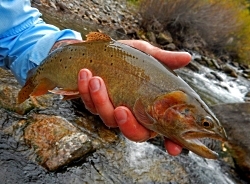
Cutthroat Trout A no-trouts-land on the Logan River, Copyright (c) Chadd VanZanten, Photographer vanzanten-cutthroat_trout.250x184
Cutthroat Trout
Copyright © Chadd VanZanten, Photographer
Northern Utah’s Logan River is known for its solitude and grandeur. Drive just a few miles up Logan Canyon in Cache Valley and find yourself in a wild setting on the bank of a picturesque mountain stream. It would be difficult to find a place in Utah that is more accessible and yet so peaceful.

However, just a few inches beneath the riffles of the Logan River, a war rages.

This conflict has gone unresolved for more than a century. The combatants fight continuously all day, all night, and all year.

The indigenous defender is the Bonneville cutthroat trout, which migrated here hundreds of thousands of years ago from the west coast of America by way of the Snake and Columbia rivers. They’ve been here ever since, making this Logan River cutthroat army the largest wild and natural population of its kind. Presently, cutthroats hold the upper river, above Twin Bridges or thereabouts.

Invading from downstream is the brown trout, whose antecedents hail from Eurasia. The brown trout isn’t an intentional trespasser; they were stocked here in the 1880s by humans who wanted more fish to catch. However, brown trout are aggressive, and they don’t know or care that the Logan River used to belong to some other species. Brown trout dominate the lower river, especially in the neighborhood of Third Dam.

And so they fight.

The middle portion of the river is a “no-trouts-land,” where the two species meet to wage their desperate struggle. They contend for living space, compete for forage, and, when it’s convenient, they devour each other with gusto.

Which will prevail? Each species has its advantages.

The brown trout are indisputably stronger, tougher, and meaner. They tolerate low water quality and wide swings in water temperature. When brown trout encounter cutthroats of their same size, they aggressively drive out the more-docile cutthroats. Every year, the brown trout gain a little ground, pressing inch by inch upstream.

Cutthroats may not be great fighters, but they are resilient, having survived clear-cut logging, overgrazing, and the damming of the river. The cutthroats were here first, too, so they hold the high ground, and it’s much easier for fish to move downstream than up. And the cutthroats rule the upper tributaries of the Logan River, which they use to spawn and replenish their numbers. But perhaps most importantly, the cutthroats have an immensely powerful ally: humans.

That’s right. The race that brought the brown trout here in the first place now sides with the cutthroats. The humans could easily exterminate all brown trout in Logan River, from its headwaters to the confluence of the Bear River, but that’s not what’s happening. Instead, conservation measures, such as strategically placed barriers to fish passage and fishing regulations that protect cutthroats during their spawning season, give the natives a fighting chance against their fierce invaders.

Fly anglers, too, favor the cutthroat trout, which they fondly refer to as “cutties.” Fly anglers seem averse to harvesting cutties, releasing them instead unharmed after capture. Opinions vary among experts about how much catch-and-release practices actually help the Cutthroats, but this is war, and these natives, besieged by a relentless and superior foe, can use every advantage they can get.

For Wild About Utah I’m Chadd VanZanten.

Credits:
Images: Courtesy and Copyright Chadd VanZanten, Photographer
Text:     Chadd VanZanten


Additional Reading:

The Cutthroat Trout, Anna Bengston, Wild About Utah, July 10, 2014, https://wildaboututah.org/cutthroat-trout/

Cutthroat Trout, Native trout of the interior west, Utah Division of Wildlife Resources, https://wildlife.utah.gov/cutthroat-home.html

Small Stream Cutthroat Trout, Matt McKell, May 10, 2016, https://wildlife.utah.gov/blog/2016/small-stream-cutthroat-trout/
Irruptive Migrations Move Birds South

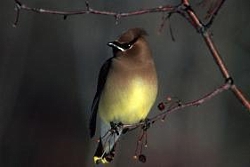
Irruptive Migrations Move Birds South: Cedar Waxwing
Cedar Waxwing US FWS FWS Digital Library, David Menke, Photographer
Every winter, many of Utah’s breeding birds migrate south to avoid the cold. After the warblers, tanagers, and orioles leave each fall, we share the snowy winter with hardier residents, such as chickadees, nuthatches, and juncos. But even hardier birds breed in the far north and venture south to Utah only during the most severe winters.

CEDW call, Western Soundscape Archive; University of Utah, Audio file copyright 2007, Kevin Colver. All rights reserved

Many people are familiar with the high, thin calls of Cedar Wawings. Less frequently heard in Utah are the slightly lower calls of their close cousins, Bohemian Waxwings.

Bohemian Waxwings(BOWA) call, Western Soundscape Archive; University of Utah, Audio file copyright 2007, Kevin Colver. All rights reserved

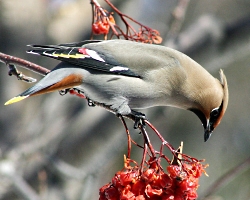
Bohemian Waxwing
Bohemian Waxwing, licensed under the Creative Commons Attribution-Share Alike 2.0 Generic license. Source Wikimedia.org, Randen Pederson, Photographer.
Bohemian Waxwings are slightly larger than Cedar Waxwings, and a little fancier—their wing feathers include red, yellow, black, and white, and the underside of their tails is a rich cinnamon. Both species gather by the hundreds to eat berries, so you won’t miss a flock if there’s one nearby. Although waxwings are songbirds, the calls you hear don’t serve the same functions as true songs, advertising mate quality and defending territories. Instead, waxwings cooperate to find and feed on scattered fruit, their main winter diet. Unlike most birds, waxwings are able to smell, which may help them find their food. If waxwings eat berries that have begun to ferment over the winter months, they may become intoxicated even though their ability to metabolize ethanol is very high. The last time Bohemian Waxwings were abundant in Utah was during the winter of 2012-2013.

White-winged Crossbill(WWCR) call, Western Soundscape Archive; University of Utah, Audio file copyright 2007, Kevin Colver. All rights reserved

If you look in a pine tree, you may see a flock of White-winged Crossbills. Last abundant in Utah during the winter of 2008-2009, this species of finch forages on the seeds inside of conifer cones.

White-winged Crossbill, Courtesy and Copyright Paul Higgins, www.pbase.com/phiggins/
White-winged Crossbill
Copyright © 2009 Paul Higgins
More photos at pbase.com/phiggins/
and utahbirds.org Photo Gallery
As the name crossbill suggests, the lower part of its bill is bent to the right and the upper part to the left, allowing crossbills to wedge open pinecone scales and lift the seeds free with their tongues. In the winter, crossbills forage in flocks of ten to fifty. They quickly assess the quality of a tree’s cones, using visual and vocal cues from their flockmates, which are quiet when they are eating but chatter when they are not. When the volume of the chatter increases to a crescendo, all the crossbills in the flock know that it’s time to switch to a new tree. Unlike most songbirds, crossbills can breed at any time of year, as long as conifer seeds are abundant.

When the weather gets cold, keep an eye and an ear out for these winter nomads.

For Wild About Utah, I’m Andrew Durso.

Credits:

Waxwing Images: Courtesy US FWS, David Menke, Photographer
White-winged Crossbill Image: Courtesy and Copyright © 2009 Paul Higgins, Photographer
Text: Andrew Durso, https://www.biology.usu.edu/htm/our-people/graduate-students?memberID=6753

Additional Reading:

Fitting the Bill, Andrea Liberatore, August 11, 2011, https://wildaboututah.org/fitting-the-bill/

White-winged Crossbill, All About Birds, Cornell Lab of Ornithology, https://www.allaboutbirds.org/guide/White-winged_Crossbill/id

Cedar Waxwing, All About Birds, Cornell Lab of Ornithology, https://www.allaboutbirds.org/guide/Cedar_Waxwing/id

Bohemian Waxwing, All About Birds, Cornell Lab of Ornithology, https://www.allaboutbirds.org/guide/Bohemian_Waxwing/id

There is a Giant Among Us–The Great Salt Lake

A Giant Among Us, The Great Salt Lake: The Great Salt Lake Breach
The Great Salt Lake Breach
Courtesy U.S. Geological Survey
Department of the Interior/USGS
Mike Freeman, Photographer
10 Nov 2015
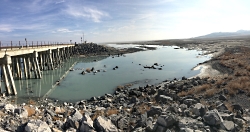
Water flowing through the Great Salt Lake breach in 2011, when lake levels were high due to above average snowfall in the Wasatch and Uinta Mountains. The Great Salt Lake breach is an area that allows water to travel between the southern and northern parts of the lake.
There is a giant among us with a profound influence on our past, present, and future. My first encounter with this giant was both buoyant and delightful as I floated in the brine on a lovely summer day. But I was oblivious to the Great Salt Lake’s immense value as an environmental, cultural, and economic resource.

A Giant Among Us–The Great Salt Lake

Much of what follows is taken from a very recently released collaborative study titled “Impacts of Water Development on Great Salt Lake and the Wasatch Front” which was a collaborative effort from four institutions(Utah State University, Utah Division of Water Resources, Salt Lake Community College, and the Utah Division of Wildlife Resources.)

A 2012 analysis by Bioeconomics estimated the economic value of the lake at $1.32 billion per year for mineral extraction, brine shrimp cyst production, and recreation. The abundant food and wetlands of the lake attract 3 million shorebirds, as many as 1.7 million eared grebes, and hundreds of thousands of waterfowl during spring and fall migrations. Because of this, it has been designated as a Western Hemisphere Shorebird Reserve Network Site. Due to its enormous surface area, it produces the “lake affect” which enhances our snow pack by an estimated 8%, a significant amount for both skiers and our available water. But our giant is shrinking.

Since the arrival of 19th Century pioneers water diversions for irrigation have decreased its elevation by 11 feet exposing much of the lake bed. Natural fluctuations in rainfall and river flow cause the lake level to rise and fall, but there has been no significant long‐term change in precipitation and water supply from the main tributaries since their coming in 1847.

The Great Salt Lake Breach 2015
The Great Salt Lake Breach
Credit: U.S. Geological Survey
Department of the Interior/USGS
Mike Freeman, Photographer
10 Nov 2015

For the first time since it was opened in 1984, water has stopped flowing through the Great Salt Lake causeway breach, an area that allows water to travel between the southern and northern parts of the lake.
To significantly reduce water use, a balanced conservation ethic needs to consider all uses, including agriculture, which consumes 63 percent of the water in the Great Salt Lake Basin. There are no water rights to protect our Great Lake, so water development currently focuses solely on whether there is water upstream to divert. If future water projects reduce the supply of water to the lake, (such as the Bear River Development Project, its level will (most likely) continue to drop.

We must look beyond the next few decades and decide how we value the lake for future generations. Lower lake levels will increase dust pollution and related human health impacts, and reduce industrial and environmental function of Great Salt Lake. We must be willing to make decisions now that preserve Great Salt Lake’s benefits and mitigate its negative impacts into the coming centuries.

John Muir, one of my favorite early American naturalists would most certainly agree with me. From his baptismal plunge into the Great Salt Lake. “I found myself undressed as someone else had taken me in hand and got myself into right lusty relationship with the brave old lake. I was conscious only of a joyous exhilaration….”
And where else could John and I have such a wonderfully buoyant experience?

This is Jack Greene reading for Wild About Utah.

2015 Great Salt Lake Breach at Lakeside, Utah
Gauge near the Great Salt Lake Breach
Credit: U.S. Geological Survey
Department of the Interior/USGS
Mike Freeman, Photographer
10 Nov 2015
A gauge to measure lake water levels stands dry in the lake bed of the Great Salt Lake. For the first time since it was opened in 1984, water has stopped flowing through the Great Salt Lake causeway breach, an area that allows water to travel between the southern and northern parts of the lake.
Credits:
Image: Courtesy U.S. Department of the Interior, U.S. Geological Survey(USGS), gallery.usgs.gov
Text:     Jack Greene, Bridgerland Audubon Society & USU Office of Sustainability
Additional Reading:

Great Salt Lake, Utah, Stephens, Doyle W. and Gardner, Joe, USGS Science for a Changing World, https://pubs.usgs.gov/wri/wri994189/PDF/WRI99-4189.pdf

Salt Lake Brine Shrimp, https://saltlakebrineshrimp.com/harvest/

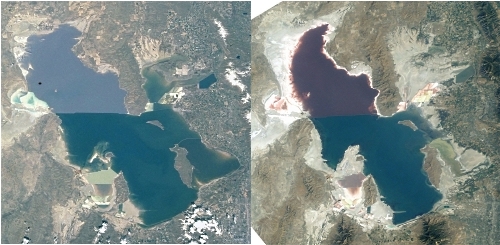
Great Salt Lake Footprint 2001 vs 2003 Comparison
Great Salt Lake Footprint Comparison
2001 vs 2003
Images Courtesy NASA
NASA’s Earth Observatory

Jack’s Urban Deer

Jack's Urban Deer: Click for a larger view of Mule Deer, Odocoileus hemionus, Courtesy US FWS, Ryan Moehring, Photographer

Mule DeerOdocoileus hemionus
Courtesy US FWS
Ryan Moehring, Photographer 
As I look out my front window, 7 mule deer are cavorting, feeding, with some lying down for a mid-day siesta. With the final week of the regular season deer hunt winding down, some have taken sanctuary from the nimrods to join the urban herd.

For our 30 years in Smithfield canyon, deer have been regulars, disappearing for the most part from mid-May to mid-June to give birth, as do the bucks, perhaps somewhat embarrassed with strange bumps forming on their crowns.
Spotted fawns begin adorning our lawn in mid-July. With enough speed to outrun all but the fastest predator’s, mom drops her guard a bit. Bucks begin parading their new, fully formed head gear.

As fall and winter approach, the neighborhood herd grows, with a few dozen hanging out when winter finally sets in. Their snow trails through the yard become conspicuous, further defined with sprinkles of fecal material. Out back the steep hillside across Summit Creek becomes a winter playground as small groups run repeatedly up and down and around. Apparently, their abundant stores of energy allow them to break winter’s lethargy. This is generally not the case for deer in the wilds where every calorie is conserved for winter hardships as snow deepens and temperatures plunge.

We’ve witnessed a few humorous behaviors during our 3 decades of observation. Deer are very curious which occasionally works against their best interests. We had an especially aggressive rooster who became our “feathered” watchdog. A small deer herd passing through the front yard noticed the stocky cock guarding the front door and decided on closer inspection. The lead deer approached stretching his neck and tender nose to get a closer whiff. Old roaster rooster gave her a welcoming sharp jab to the nose which sent the herd bounding off.
On another occasion, our tomcat found itself taking refuge under the trampoline as 4 deer approached from a patch of forest. The cat’s movement piqued the deer’s curiosity. They surrounded the trampoline, bent down on front knees with noses poked underneath for a close-up. Poor tom was terrified- to be munched by a deer- what a horrible end!

Of course, we realize that not everyone is enamored with deer in their space. Deer can be a nuisance causing damage to landscapes and gardens. With proper fencing and plant selection, this can be managed. A greater concern is safety, vehicle-deer collisions. Here again, with proper signage, this can be minimized. I’ve experienced close encounters on my bike, so always go slow when deer appear near or on the roadway.
An excellent resource for landscaping is found at wildlife.utah.gov/habitat/deer-browse.php Blending a variety of native and ornamental plants into a home landscape can create a highly attractive environment for family, friends, mule deer and other wildlife species. Enhancing the home environment and replacing some of the lost wildlife habitat can be enjoyable and beneficial.

This is Jack Greene for Wild About Utah.

Credits:
Image: Courtesy US FWS Ryan Moehring, Photographer
Text:     Jack Greene, Bridgerland Audubon Society


Additional Reading:

Copeland, H. E., H. Sawyer, K. L. Monteith, D. E. Naugle, A. Pocewicz, N. Graf, and M. J. Kauffman. 2014.
Conserving migratory mule deer through the umbrella of sage-grouse. Ecosphere 5(9):117. https://dx.doi.org/10.1890/ES14-00186.1
https://www.fws.gov/greatersagegrouse/documents/research/muledeer_mig_grouse_14-00186.pdf

Mule Deer, Utah Species, Utah Division of Wildlife Resources, Department of Natural Resources, State of Utah, https://fieldguide.wildlife.utah.gov/?species=odocoileus%20hemionus

Mule Deer, Utah Division of Wildlife Resources, https://wildlife.utah.gov/learn-more/mule-deer.html