Bobcat in plants Courtesy US FWS Steve Hillebrand, PhotographerI remember well my first encounter with a wild cat. I was sitting in a deer stand beneath a cross-country powerline, at the edge of a meadowed thoroughfare the whitetails frequented. Dusk was settling in—nearly time to go—as the trees opposite me began to rustle. With a few minutes of legal light left, I readied my trigger finger; but instead of a deer, a bobcat exited the woods. I was shocked. This—I had not expected. I watched as the cat looked left, then right, then straight at me, making eye contact. There was no reason I should have been noticed. I hadn’t made a sound, hadn’t moved in nearly three hours save the scanning of my eyes and the slight rise and fall of my chest with every breath. Bobcat Public Domain image courtesy US FWS National Conservation Training CenterStill, I had been found. The cat ambled slowly but with purpose toward the ladder that connected my seat to the ground, stopping a few meters away. He or she never broke eye contact. Neither did I. I’m not sure why. Instinct, perhaps. I would learn many years later from a man who had stared down a mountain lion from a meter away that you never break eye contact with a big cat in the wild. Never. I have no idea how long we sat there together. Minutes? Seconds? Hours? It was fully dark when the animal turned to leave—so dark I had lost the pattern of its coat in the shadows. I never saw where it went; but I’ve been enamored with wild cats ever since.
Bobcat Courtesy US FWS Gary Kramer, PhotographerThe landscapes that have shifted and morphed and been politically bordered into what is now the state of Utah has been populated by wild cats since at least 40,000 years ago. During the Pleistocene Epoch’s last ice age, the infamous saber-toothed cat roamed Utah’s glacier-clogged crags. Bones of the saber-toothed species known as Smilodon have been unearthed in Utah, most notably from the Silver Creek site near present-day Park City. Smilodon, with its legendary curved, saber-like canine teeth, was a fearsome hunter of ancient Utah’s mega fauna like the mastodon and wooly mammoth; but when the glaciers receded and the Earth began to melt, the mega fauna couldn’t adapt, so Smilodon had nothing to hunt.
Smilodon gave way through the millennia to the smaller but no less impressive cats that occupy Utah’s crags and hills today—the bobcat, the Canada Lynx, and, of course, the famous mountain lion.
Big cat footprint Courtesy & Copyright Josh Boling, PhotographerIt hasn’t been too long since that spring evening in the canyons of southern Utah. We had just rappelled into a small grotto where, at the bottom, there was an ephemeral pool. The sand was already wet with little droplets along the edge, a footprint here and there leading away—the way we would take—down the only path toward home. We chattered more loudly, making ourselves known, as we proceeded. Then we’d grow quiet again, eyes sweeping here and there, secretly hoping we would get a peak of the lion as it sauntered away from us. We never did, but it was there.
I’m Josh Boling, and I’m Wild About Utah.
Credits:
Photos: Courtesy US FWS
Big cat track photo courtesy and copyright Josh Boling
Audio: Includes audio from North Sounds, Inc.
Text: Josh Boling, 2018
Sources & Additional Reading
Golla, Julie M., “Urban Bobcat (Lynx rufus) Ecology in the Dallas-Fort Worth, Texas Metroplex” (2017). All Graduate Theses and Dissertations. 6857. https://digitalcommons.usu.edu/etd/6857
A suet feeder, individual cake and a box of cakes. To the right are three gravity feeders with black oil sunflower seeds as well as other seeds. Courtesy Ron Hellstern, photographerMost people enjoy watching birds, except for their occasional deposits on cars or windows. In an earlier program, I mentioned at least fifteen benefits that birds provide to humans and planet Earth. But as human population and developments increase, the survival of many bird species becomes threatened. Now, as winter approaches, colder weather and lack of food adds to the life-threatening dilemmas birds face. Some birds migrate to warmer habitats, but for those that stay in the northern regions a helping-hand from humans is no doubt appreciated.
Presenting “gifts” of birdfeeders and seeds to others (and your own family) will help songbirds and fowls to survive so they can provide their songs and beauty in the Spring. Consider these tips:
Buy large birdfeeders so you don’t have to fill them so often. Wet seed can grow harmful bacteria, so use feeders with wide covers.
If deer, or other pests, invade your feeders, hang them up higher in trees.
Place feeders 10’ away from dense cover to prevent sneak attacks from cats.
Provide multiple feeders to increase amounts and diversity of foods.
“Favorite” winter foods depends on the species. Black Oil sunflower seeds are loved by most birds, but niger, millet, peanuts, corn, and wheat will attract a diverse range of birds. Experiment and see what comes to your feeders.
A combination of beef-fat, with seeds or fruit, is called suet. It is a high-energy food which helps birds stay warm. The 4” cakes are placed in small cages and are loved by flickers, woodpeckers and many other birds. Peanut butter is also relished by birds, but is more expensive than suet.
Once birds find your feeders, they will rely on them for regular food supplies. If your feeders become empty, especially during ice storms or blizzards, birds will have a hard time finding natural food. If you take a trip, have a neighbor keep your feeders filled.
Buy extra seed and store it in a cool, dry place like a covered plastic trash can which can be kept on a deck, porch, or in a garage.
Make sure the feeders are kept clean with hot water, and then dried, about once a month.
Some birds, like juncos, towhees, doves and pheasants prefer eating seed which has fallen to the ground. Compact the snow below your feeders so they can find that seed easier.
Unless you live near a natural water source, place a pan of water near a feeder on warmer days. Or you could consider a heated bird bath to provide drinking water.
If you have fruit trees or berry bushes, leave some of the fruit on the plants to provide natural foods.
You may wish to leave birdhouses and nest-boxes up all year for winter roosting sites.
Now the fun part comes. After your feeders have been discovered by some birds, word soon gets around the neighborhood and others will arrive. But do you know what they are? The Peterson Field Guidebooks are a great help for beginners because the illustrations are often grouped by color. Then you can become a citizen-scientist and submit your observations to Cornell’s Project Feederwatch or participate in the Great Backyard Bird Count each December. Look online for details.
Time to get started with your own feeders, or as gifts to others, and begin enjoying the colorful company of finches, woodpeckers, towhees, juncos, sparrows, doves and many others.
Credits:
Images: Courtesy & Copyright Ron Hellstern, Photographer
Audio: Contains bird audio Courtesy & Copyright Kevin Colver
Text: Ron Hellstern, Cache Valley Wildlife Association
Greenback Cutthroat Trout Courtesy US FWS Bruce Roselund, PhotographerIn 2009, officials from the US Division of Wildlife Resources who were out searching for isolated populations of Colorado River Cutthroat Trout found something better—and far more perplexing. Within a 1.2-mile stretch of Beaver Creek, which runs down the eastern flank of the La Sal Mountains near Moab, Utah, surveyors discovered a small, but genetically pure population of a subspecies of Cutthroat Trout known as the Greenback. The fish is not only rare among its fellow Cutthroats; it was heretofore unknown to Utah waters.
The natural history of the Greenback Cutthroat is fascinating! As a member of the genus Oncorhynchus, Greenback Cutthroat Trout trace their lineage back about 2 million years to Salmonid ancestors that chose to forego their return to the Pacific Ocean and instead pursued habitat further and further up the Columbia and Snake River drainages into the Green and Yellowstone River Basins. From here, cutthroat predecessors diversified into subspecies we know today: the Alvord, Bonneville, Humboldt, Lahontan, Yellowfin, Yellowstone, Colorado River, and, among others, the Greenback Cutthroat.
Greenbacks took a particularly arduous path to what is now their native home range. About 20,000 years ago, during the Pleistocene Epoch’s glacial maximum, Greenbacks hitched a ride via advancing ice sheets and their runoff, crossing eastward over the Continental Divide. And, historically, that’s where they’ve been found—east of the continental divide. However, in a 2014 summary report of a meeting among experts on the Greenback Cutthroat Trout’s whereabouts in Colorado, the US Fish and Wildlife Service says this about the fish’s home range: “Until recently, delineations of subspecies of cutthroat trout in Colorado were believed to follow geographic boundaries within the state, with greenback cutthroat trout on the eastern side of the Continental Divide and Colorado River cutthroat trout on the western side.” That seems to have changed.
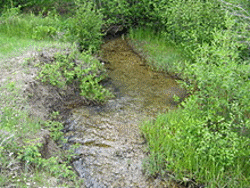
Greenback Cutthroat Trout were found in Beaver Creek in the La Sal Mountains Experts are at a loss as to how Greenbacks came to occupy the waters of Utah. Speculations abound from rogue fishermen stocking their favorite backwaters with favorite species from the Colorado Front Range to a remnant population of an ancient strand that may have ridden the glaciers all the way to La Sal runoffs. What’s even more perplexing is the population’s pure genetic makeup. Cutthroat Trout hybridize easily with other fish; but the Beaver Creek population hasn’t. One reason may be the creek’s inaccessibility. Disease and non-native trout haven’t threatened the resident Greenbacks; and so they have lived on undisturbed, unadulterated, and, until about a decade ago, unknown to their human counterparts. This gives the wildlife conservation community some hope for the fish’s viability moving forward.
Greenbacks currently only occupy roughly 1% of their historic native range and were once thought to be extinct altogether. This hardy and adventurous fish refuses to call it quits, though. Who knows, maybe the valiant reclamation of its old territory has already begun along so many other inaccessible and unadulterated creek beds.
I’m Josh Boling, and I’m Wild About Utah!
Credits:
Images:
Greenback Cutthroat Trout, Courtesy Fish and Wildlife Service, US Department of the Interior, Bruce Roselund, Photographer
Beaver Creek, LaSal Mountains, Courtesy Utah Division of Wildlife Resources,
Audio: Includes audio provided by Friend Weller, UPR
Text: Josh Boling, 2018
A dusky grouse chick, several weeks old. Captured up Logan Canyon. The chick was marked with an aluminum leg band with cotton glued to the inside of the band so the leg could grow into the adult-sized band.
Photo Credit: Skyler FarnsworthIn the early winter, when most wildlife are migrating down the mountains, dusky grouse are heading up. The grouse rely on the evergreen needles for their sole food source during winter.
The female’s feathers are more camouflaged, while males are a slate grey.
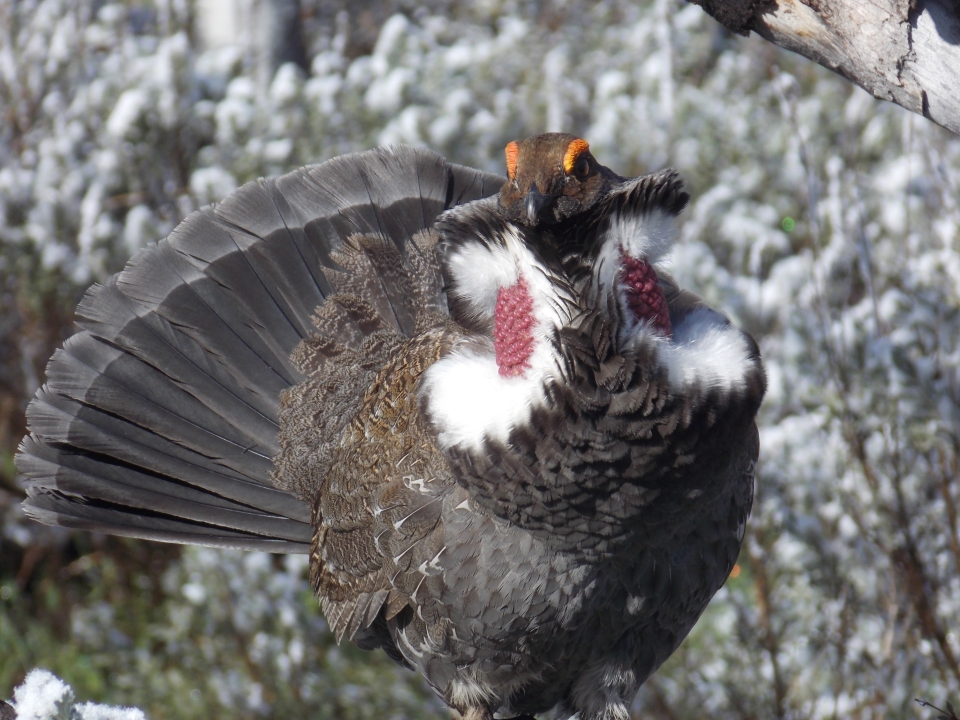
In the Spring, during mating season, male duskies develop bright red air-sacs surrounded by pure white under-feathers on their necks. To attract the females, they make a deep hooting sound with their air sacs. This sound is made at the lowest decibel humans can hear. When close enough, researchers say they often feel the low vibrations of the hooting, before hearing it with their ears.
Although duskies are forest grouse, they are more closely related to prairie grouse than other forest grouse. They often use habitats, such as sagebrush and serviceberry outside of the forest canopy and can move up to 20 miles or more in a given year.
The other forest grouse species found in Utah, the ruffed grouse, prefer staying in a small area about 40 acres their whole life and are small, being slightly larger than a pigeon.
A dusky grouse female marked with a solar-powered GPS radio using a rump-style attachment. This was a brood hen with several small chicks with her. She was captured in July and released after several minutes of marking and data collection.
Photo Credit: David DahlgrenThey have a sole winter diet of aspen buds; and remain at a lower elevation during the winter. At night they burrow into snow caves to conserve body heat and energy.
The feathers of the ruffed grouse form a black band on their tails and black “ruffs” on their neck. These features are more prominent on males. During the spring breeding season, males produce a loud “drumming” sound with their wings to attract the females. The rhythm begins slowly then quickens to a climax.
Similar to their prairie cousins, forest grouse can be impacted by habitat fragmentation, human development, climate change, and improper grazing and may be a key species for these areas.
Due to the lack of scientific data, managers do not know the full impact these risks have on the forest grouse.
Researcher, Dr. Dwayne Elmore from Oklahoma State University, holding a male ruffed grouse after capture. The bag is used to contain the grouse while getting a weight.
Photo Credit: David DahlgrenDavid Dahlgren, assistant professor in the Quinney College of Natural Resources was discussing this deficit with Jason Robinson, upland game coordinator, for Utah Division of Wildlife Resources. Both recognized the potential benefits of using modern research techniques with forest grouse.
Dahlgren explains, “We wanted to get ahead of the ball.” If forest grouse, particularly duskies, are to be considered key species for our mountain ecosystems, we needed scientific information for management.
Dahlgren began the research with DWR in Fall 2015, in an area where the forest grouse get the highest hunting pressure – the Bear River Range, [in northern Utah, between Cache Valley and Bear Lake].
From 2015 to 2017, 120 grouse were leg banded. This provided data on harvest, habitat use, and survival.
Skyler Farnsworth, the project’s graduate student, discovered pointing dogs would help him find and capture grouse during the research. He started the project dog-less and ended with two bird dogs of his own.
An adult male dusky grouse in full breeding season display just after a snow in late April. Notice the red air sacs surrounded by white under-feathers, yellow eye combs, and the fanned tail with a grey band.
Photo Credit: Skyler Farnsworth.Of the 120 bands, only three bands have been returned since 2015 and one of those was found by a hiker after the bird had been caught by a predator.
Dahlgren explains, “With such a small return, the chance of [hunter harvest] impacting the population is very low, which is comforting and provides real data for forest grouse management.”
The research on the forest grouse is expanding. Dahlgren explains, “we recently started a similar project focused on dusky grouse in Nevada, working with the Nevada Department of Wildlife.”
Many partners have supported these forest grouse research projects including, Utah Division of Wildlife Resources, Nevada Department of Wildlife, Sportsman organizations and individuals. USU’s Agricultural Experiment Station provided the bulk of funding support.