Summer is here. People will be using the great outdoors more often, and that includes the many tourists who have discovered Utah’s beauty and diversity. Caution is always needed when traveling in wild country, and today I refer to an article titled “Living in Snake Country-Six Things to Consider” written by Terry Messmer, Utah State University Extension wildlife specialist.
Western rattlesnake strike ready Courtesy 123RF.com Stephen Mcsweeny, Photographer Licensed, Royalty-free imageAsk an Expert: Living in snake country – six things to consider
Written by Terry Messmer, Utah State University Extension wildlife specialist
June 14, 2019
For many, the sight of a snake is what nightmares are made of. Unfortunately, all too often Hollywood has taken advantage of people’s fear of snakes for profit. Some companies may also market products or services that are ineffective at repelling snakes, and in some cases, these products may actually increase the risk to people and pets.
The U.S. Centers for Disease Control estimates that 6,000 to 8,000 people are bitten by venomous snake annually and that up to six snake bite victims may die. Annually, an estimated 90 human deaths occur from various venomous animal encounters. The stings and subsequent anaphylaxis from bees, wasps and hornets are responsible for over 90% of the reported human deaths.
Of the 31 species of snakes found in Utah, seven are venomous. These are commonly called pit vipers because of the pit located between their nostrils and eyes. Most pit vipers found in Utah also have tails with a series of rattles, hence the name rattlesnake.
All snakes are classified as non-game animals and are protected by Utah state law. A person cannot lawfully collect or possess a live wild snake without receiving a Certificate of Registration from the Utah Division of Wildlife Resources. When there are human, domestic pet and livestock safety concerns, a venomous snake may be killed without a certificate.
Because most snakes in Utah are non-venomous, most human-snake encounters are generally not dangerous. However, if you encounter a venomous snake and are bitten, the consequences could be serious. Consider these tips.
If you encounter a snake, your best strategy is to leave it alone. Every year, hundreds of want-to-be herpetologists and snake charmers are bitten when they try to capture or kill a snake. Even dead snakes have been known to bite by reflex action. More than half of the reported snake bites were a result of someone trying to handle or kill the snake. It is always best to leave the area if you encounter one.
When rattlesnakes are encountered or disturbed, the rapid vibration of their tails will make a characteristic rattling sound to warn the intruder of their presence. However, not all rattlesnakes will “rattle” when disturbed. For this reason, when you are in rattlesnake country, you must pay close attention to where you walk, sit and place your hands. Rattlesnakes can be found throughout Utah in sagebrush, pinon-juniper woodlands, sand dunes, rocky hillsides, grasslands and mountain forests.
If you hear a rattlesnake “rattle,” stand still until you can locate where the sound is coming from. Do not try to jump or run. If you do, you may end up within the snake’s striking range.
If bitten by a venomous snake, do not engage in physical activity such as walking or running. Do not apply a tourniquet to the area above the wound and do not apply a cold compress to the bite area. Do not cut into the bite. Do not take anything by mouth, including stimulants or pain medications, unless instructed by a physician. Do not raise the bite area above the level of the heart, and do not try to suction the venom, as doing so may cause more harm than good.
All venomous snakebites should be considered life threatening. When someone has been bitten by a venomous snake, time is of the essence. If possible, call ahead to the emergency room so anti-venom can be ready when the victim arrives. Until then, keep the victim calm, restrict movement and keep the affected area below heart level to reduce the flow of venom. Wash the bite area with soap and water. Remove any rings or constricting items, as the affected area will swell. Cover the bite with clean, moist dressing to reduce swelling and discomfort. Monitor the victim’s vital signs (pulse, temperature, breathing, blood pressure). If there are signs of shock, lay the victim flat and cover with a warm blanket. Get medical help immediately. If possible, bring in the dead snake for identification if this can be done without risk of injury.
Bites from venomous snakes will almost instantly show signs of swelling and discoloration of the surrounding tissue. Other symptoms include a tingling sensation, nausea, rapid pulse, loss of muscle coordination and weakness. Also, bites from rattlesnakes will show two characteristic fang marks (punctures) as well as other teeth marks. Non-venomous snakebites are harmless, but there is still a risk of infection. If bitten, clean and sterilize the wound much like you would a cut or abrasion.
This is Ron Hellstern, and I am Wild About Utah.
Credits:
Images: Courtesy & Copyright 123RF.com, Stephen Mcsweeny, Photographer
Audio: Courtesy and Copyright Kevin Colver
Text: Ron Hellstern, Cache Valley Wildlife Association
A tiny razorback sucker larvae under a microscope. They look like tiny noodles when seen swimming in the wetlands. Courtesy & Copyright Katie Creighton, PhotographerJust outside Moab between the cold, fast flowing water of the Colorado River and the slow, warmer waters of the Matheson Wetland Preserve stands a newly constructed escape passage for larvae of the endangered razorback sucker.Building a Warm Home for Endangered Razorback Suckers’ Young:
The fish nursery was built to provide the newly hatched razorbacks a way to escape the appetites of the large predators in the Colorado River.
The tiny “noodle like” larvae enter the passage, swim through a screen which holds the predators back, then live a peaceful few months in the safe, nutrient rich water of the preserve.
Katie Creighton and Zach Ahrens both native aquatics biologists for Utah Division of Wildlife Resources (UDWR) standing on the temporary Matheson screen. The Nature Conservancy and UDWR partnered together to build the structure to allow the endangered razorback sucker larvae to enter the Scott M. Matheson Wetlands Preserve without the predators also coming in. Courtesy & Copyright Katie Creighton, PhotographerThe larvae will stay in the Matheson Wetland preserve during the summer to grow and gain strength. When water levels drop, the razorback young will be moved back into the Colorado River when they are much larger and have a better chance of survival.
The razorback sucker has lived in the Colorado River for thousands of years and has adapted to Utah’s warm turbid desert waters and rivers.
But during the twentieth century the razorbacks faced two threats: the growing population of non-native predator fish that consume the razorbacks, and the changing flow regime in the Colorado River Basin due to increasing water demand and development. These two threats decreased the razorbacks’ ability to maintain a sustainable population, which eventually led to the listing of the sucker as a federally endangered species.
Light trap near control structure in the Scott M. Matheson preserve. The traps are used to catch and monitor razorback sucker larvae. Courtesy & Copyright Katie Creighton, PhotographerKatie Creighton, the native aquatics project leader with the Utah Division of Wildlife Resources said, “In the Upper Basin [of the Colorado River], specifically around Moab, we saw [a] pretty significant decline in [population] numbers in the mid-90s [which] prompted stocking. We began to augment the populations with fish we reared in hatcheries.”
For 30 years, managers stocked razorback in the Colorado River. Then in 2008, they began noticing an increase in adult razorback numbers and detecting spawning aggregations which prompted managers to begin tracking reproduction.
Creighton explains, “We [went] into the rivers around Moab, in the Green and the Colorado Rivers, and…set larval light traps… to determine whether or not these fish were successfully spawning.”
Light trap in the Scott M. Matheson Wetlands Preserve. The trap is used to determine how many larvae make it into the preserve. Courtesy & Copyright Katie Creighton, PhotographerThe light traps collected a promising amount of razorback larvae in both the Green and Colorado Rivers.
Managers could now say the razorbacks do well as stocked adults, they reproduce in the wild, and their eggs hatch successfully.
The question left unresolved is why the “young of the year” are not surviving, juvenile razorbacks are rarely seen in the wild.
Unravelling the bottleneck between when the razorbacks hatch and when they become adults has become the new focus for managers. This is where the Matheson Wetlands project came in. Utah Division of Wildlife Resources partnered with the Natural Conservancy to build the fish nursery.
Katie Creighton, native aquatics biologists for Utah Division of Wildlife Resources, setting light traps in Matheson Preserve. The traps are used to monitor razorback sucker larvae. Courtesy & Copyright Katie Creighton, PhotographerCreighton explains, “The main goal [of the project] is to get [the razorback suckers] off the endangered species list. To recover them to self-sustaining populations that can maintain their numbers without…stocking. It’s a pretty ambitious goal, especially because we have to do [it] in the face of continued water use and water development…The recovery program is not battling or trying to stop water development, its goal is [simply] to recover these species in the face of what is currently happening with water use.”
Phaedra Budy, professor in the Watershed Sciences Department at USU and unit leader for U.S. Geological Survey Cooperative Fish & Wildlife Research Unit said, “The Razorback sucker has intrinsic value to the [Colorado River system], is a critical member of the ecosystem, and deserves every effort for recovery.”
This is Shauna Leavitt and I’m Wild About Utah.
Building a Warm Home for Endangered Razorback Suckers’ Young-Credits:
Photos:
Courtesy US NPS, Zach Schierl, Photographer, Education Specialist, Cedar Breaks National Monument
Courtesy & Copyright Shauna Leavitt,
Audio: Courtesy and Copyright
Text: Shauna Leavitt, Utah Cooperative Fish and Wildlife Research Unit, Quinney College of Natural Resources, Utah State University
Building a Warm Home for Endangered Razorback Suckers’ Young-Additional Reading
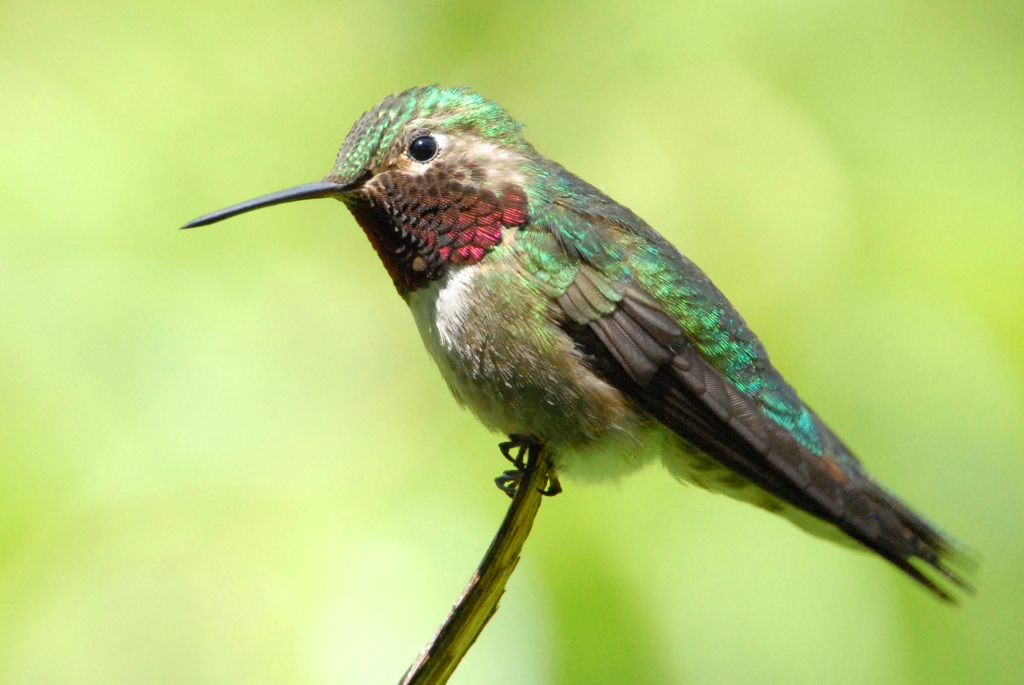
Hummingbird at Feeder Courtesy and Copyright Ron Hellstern, PhotographerHaving witnessed people in poverty, as well as starving animals, I can never condone the fascination some Americans have with Hot Dog Eating Contests. Yet humans are poor competitors when compared to some members of the animal kingdom.
Hummingbirds at Feeder Courtesy and Copyright Ron Hellstern, PhotographerTo simplify the math, let’s say you weigh 100 pounds. Imagine eating 150 pounds of food every day just to maintain your energy level! I have about twenty guests at my home near Logan right now that eat one and one-half times their body weight every day, and they’ve been doing it for months. Hummingbirds!
Some scientists are concerned about rising temperatures because flowers are blooming earlier in northern areas, which means that food source may be gone when the hummingbirds arrive.
While they also eat insects, you can attract hummingbirds to your yards with the right plants. They like nectar plants like Columbines, Honeysuckle, Penstemon, Paintbrush, Bleeding Hearts and Trumpet Vines. You can also supplement those nectar sources with feeders.
Long-nosed Leopard Lizard Gambelia-wislizenii Free Image, Courtesy PXhere.comEverywhere we go, people want to know, who we are, so we tell them- we are the herpers, the mighty, mighty herpers!
Stumbling around the desert with fishing poles in hand. Hot, dry, no water within miles. A casual observer might question our sanity. But here’s the deal. We have full control over our mental faculty.
Our defense. First, our fishing poles are used for the capture and release of lizards. Remarkably fast and allusive, these rigs are the answer. A small slipknot noose using monofilament fishing line is attached to the end of the pole. The lizards often freeze as the line is dangled slightly in front of their nose and gently slipped over their heads. A quick upward flip and bingo (with a bit of luck) a lizard dances freely from the line’s end.
“I caught one!” alerts the others within shouting distance, and the crew soon assembles to view the prize. Photos are taken which includes GPS coordinates, then the victim passes multiple hands, and is released to resume its lizard business following the rude interruption.
Western Banded Gecko Courtesy NPS
This has become an April tradition for our USU Wildlife Society students with a keen interest in herpetology. We relish the Mojave Desert surrounding St. George with flowers in full bloom and bird song in full tilt.
Our desert ramblings have revealed many herp treasures- spiny lizards, spectacled rattle snakes, desert iguanas, desert tortoise, chuckwalla, canyon tree frog to name a few. Within the past two years, we have assembled well over two dozen different species. The Mojave is second only to the Sonoran Desert for biodiversity. I’m always amazed how this parched, desolate land can support such a remarkable abundance of life forms. The Mojave Desert hosts about 200 endemic plant species found in neither of the adjacent deserts.
I’m going to end with a brief description of my favorite little lizard that appears so delicate, like a desert flower, it stands in stark contrast to this seemingly inhospitable environment. In good light its paper thin skin covered with minute scales, allows one to see the interior workings of its slender body.
The western banded gecko is secretive and nocturnal, foraging at night for small insects and spiders, often seen, silhouetted against the black asphalt of desert roads. It is one of the few reptiles that controls scorpion populations by eating their babies. If captured it may squeak and discard its tail. As a defense mechanism, it can also curl its tail over its body to mimic a scorpion. Geckos also store fat in their tails. Being they maintain a reduced metabolism at low temperatures, their tail fat can sustain them for up to nine months. Because the western banded gecko restricts its activities to nights, it is often seen, silhouetted against the black asphalt of desert roads.
This is Jack Greene and I’m wild about the banded gecko, all its cousins, and this amazing land we call Utah!
Credits:
Pictures: Banded Gecko Courtesy US NPS
Pictures Leopard Lizard, Courtesy PXHere.com
Text: Jack Greene, Bridgerland Audubon Society