Fitting the bill

Fitting the bill

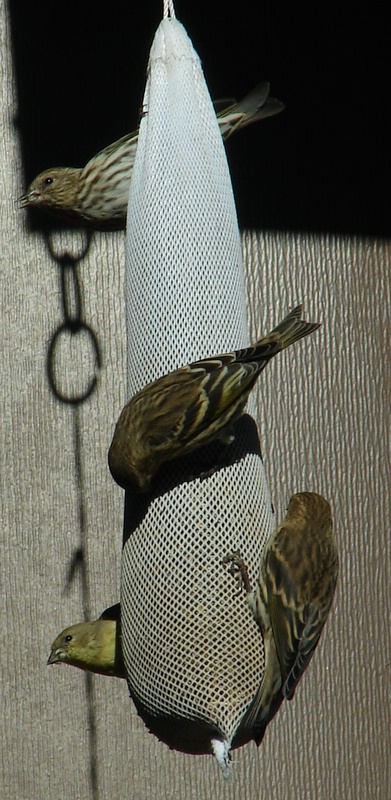
Fitting the bill: White-winged Crossbill, Courtesy and Copyright Paul Higgins, www.pbase.com/phiggins/
White-winged Crossbill
Copyright © 2009 Paul Higgins
More photos at pbase.com/phiggins/
and utahbirds.org Photo Gallery

Fitting the bill: Red Crossbill, Courtesy and Copyright Paul Higgins, www.pbase.com/phiggins/Red Crossbill (female)
Copyright © 2009 Paul Higgins
More photos at pbase.com/phiggins/

Few among us would choose to eat a steak with a spoon or soup with a fork. And in the world of birds, it’s the same story – you need the right tool for the right job – and you can tell a lot about a bird by paying attention to its beak.Fitting the bill

Physiologically, beaks are a specialized extension of the skull and are coated in keratin – the same material that makes up our fingernails. And like our fingernails, the cutting edges of the beak can be re-grown as they are worn down by use.

Birds use beaks for a multitude of tasks including preening, weaving nests, and defending territories. However it is the task of eating that seems to dictate beak shape and size. Envision the hummingbird, for instance. Its long, thin beak – and corresponding tongue – is designed to reach deep into flowers to collect the nectar within. A hummingbird beak would not work for a woodpecker or a great horned owl. Likewise an eagle’s beak needs to be sharp and strong for tearing flesh, and wouldn’t suit the lifestyle of an ibis or a sparrow.

One Utah native, the aptly-named red crossbill, has one of the most unique beaks around. When closed, its curved top and bottom bills overlap crossways in what looks like an awkward and uncomfortable pose.

French naturalist Count Buffon, first laid eyes on a crossbill in the mid-1700’s. The bird was collected in the Americas, then shipped abroad for examination. Without observing the crossbill in its natural habitat, Buffon labeled its beak “an error and defect of nature, and a useless deformity.” More than 50 years later, Scottish-American naturalist Alexander Wilson observed a crossbill in the wild and determined that its beak ‘deformity’ was in reality a magnificently adapted tool. The crossbill’s diet consists mainly of the seeds of conifer trees, and it turns out that the bird’s curiously crossed beak is perfectly adapted to prying apart the scales of pinecones to get at the seeds within.

Members of the finch family, these birds are often seen in flocks and occasionally visit backyard feeders. They are easily identified by their unique beaks, which serve as a reminder that the right tool for the right job can sometimes seem a bit unconventional.

For more information and photographs of crossbills, visit our website at www.wildaboututah.org. Thank you to Rocky Mountain Power Foundation for supporting the research and development of this Wild About Utah topic.

For the Stokes Nature Center and Wild About Utah, this is Andrea Liberatore.
Fitting the Bill-Credits:
Fitting the Bill
Photos: Courtesy & Copyright Paul Higgins(phiggins)www.pbase.com/phiggins
Text:    Andrea Liberatore, Stokes Nature Center, logannature.org

Fitting the Bill-Additional Reading:

Benkman, Craig W. 1987. Crossbill Foraging Behavior, Bill Structure, and Patterns of Food Profitability. The Wilson Bulletin 99(3) p. 351-368 https://www.uwyo.edu/benkman/pdfs%20of%20papers/benkman_1987_wilsonbull.pdf

Conniff, Richard. 2011. The Species Seekers: Heroes, Fools and the Mad Pursuit of Life on Earth. W.W. Norton & Company: NY https://www.amazon.com/Species-Seekers-Heroes-Fools-Pursuit/dp/0393341321

Pearson, T. Gilbert (ed.). 1936. Birds of America. Garden City Publishing Company, Inc. Garden City, NY https://www.amazon.com/T-Gilbert-Pearson/dp/1331531268/ref=pd_lpo_14_t_0/144-1525643-4789824

Fitting the bill
Fitting the bill
Fitting the bill

USA National Phenology Network

Courtesy USA National Phenology Network

The study of recurring plant and animal life cycle events is phenology. It is the calendar of nature. This includes when plants flower, when birds migrate and when crops mature. Phenology is relevant to interactions between organisms, seasonal timing and large-scale cycles of water and carbon. Phenology is important to us for many reasons. Farmers need to know when to plant and harvest crops and when to expect pests to emerge. Resource managers use it to monitor and predict drought and assess fire risk. Vacationers want to know when the best fall colors will be or when the wildflower blooms will peak. Timing varies but we can discern patterns.

The USA National Phenology Network monitors the influence of climate on the phenology of plants, animals and landscapes. They encourage people to observe phenological events such as flowering, migrations and egg laying. The Phenology Network provides a place to enter, store and share these observations, which are then compiled and analyzed nationwide. Participants range from individual observers in their own backyards to professional scientists monitoring long-term plots. My husband and I monitor leafing and flowering of lilacs, a key species in the program.

These observations support a wide range of decisions made routinely by citizens, managers, scientists and others. This includes decisions related to allergies, wildfires, pest control, and water management.

I urge you to participate. The National Phenology Network has many public, private and citizen partners. It is a great way to become involved in a nation-wide effort to better understand our environment. All this information and much more is available at the National Phenology website, to which there is a link from our Wild About Utah website.

This is Linda Kervin for Bridgerland Audubon Society.

Credits:

Text: Linda Kervin, Bridgerland Audubon Society
Additional Reading:

Linda Kervin’s pieces on Wild About Utah

Phenology Tools for Community Science
USA National Phenology Network, https://www.usanpn.org/
Nature’s Notebook Education Program, US National Phenology Network, https://www.usanpn.org/nn/education

North American Bird Phenology Program, USGS Patuxent Wildlife Research Center, https://www.pwrc.usgs.gov/bpp/BecomeAParticipant.cfm

eBird, https://www.ebird.org/

iNaturalist, https://www.inaturalist.org/

Blackbears

Black Bear Sitting
Photo Courtesy US FWS
Mike Bender, Photographer

Hi, this is Mark Larese-Casanova from the Utah Master Naturalist Program at Utah State University Extension.

I have to admit that it didn’t make much sense to me that yesterday was the start of summer. While sitting in the warm sun, feeling like winter forgot to give spring a turn in the seasonal cycle, I though of the American black bear, another mammal that also probably wondered when the warm weather would finally arrive.

Black bears are native to most of North America, even into northern Mexico. In Utah, black bears are common throughout many of the state’s forests. Contrary to its name, black bears tend to be medium to dark brown in the western US, although its color can range all the way from blonde or cinnamon to black.

As black bears emerge from their winter slumber, they are particularly hungry from several months of living mostly off of fat reserves. This is an even greater challenge for females because cubs are born in January or February and survive on the mother’s milk until spring. So, when spring arrives, they are more than happy to feed on a wide variety of foods, including fruits, nuts, grubs and other insects, small vertebrates, and carrion. Bears are most actively feeding around dawn or dusk, but may feed at other times of day if they become habituated to human food sources.

Young Male Blackbear Climbing Tree
Photo Courtesy US FWS
Steve Maslowski, Photographer

Black bears have been known to attack humans, although usually very infrequently. Attacks most often happen when a black bear is defending cubs or food, or as a result of becoming accustomed to obtaining food from people.

Will the black bears be as hungry for summer as we are? It might be best to not take any chances while out exploring the mountains this summer. When not eating, be sure to carry all food, garbage, and scented items, such as toothpaste and chapstick, in an airtight plastic bag or securely store them in a vehicle or bear-proof container. I’d even recommend carrying bear spray just to be safe. And, don’t forget to hold on tight to those pic-a-nic baskets!

For Wild About Utah, I’m Mark Larese-Casanova.

Credits:

Images: Courtesy US FWS: https://Images.fws.gov
Text:     Mark Larese-Casanova, Utah Master Naturalist Program at Utah State University Extension.
Additional Reading:

Burt, W. H. and R. P. Grossenheider. 1980. A field guide to the mammals. Houghton Mifflin Company, Boston. 289 pp.

Safety in Bear Country https://wildlife.utah.gov/dwr/learn-more/bear-safety.html

Utah Division of Wildlife Resources Utah Conservation Data Center https://dwrcdc.nr.utah.gov/rsgis2/Search/Display.asp?FlNm=ursuamer


Spotted Sandpiper

Spotted Sandpiper
Courtesy US FWS and
Photographer: Dave Menke

An ancient Latin proverb declares that: “Nature abhors a vacuum”. Every naturalist comes to learn that Nature also loves an exception. Sandpipers are a good example. Coastal beaches bring sandpipers to mind, their flocks either loafing about the upper beach or manically advancing and retreating just ahead of the surf line. Every beachcomber can picture the scene.

Imagine, then, hearing this solitary call during your hike past some montane stream, lake or beaver pond.

[Spotted Sandpiper recording, hosted by Western Soundscape Archive, J Willard Marriott Library, University of Utah Copyright 2007 Kevin Colver https://wildstore.wildsanctuary.com/collections/special-collections]

Spotted Sandpiper Habitat
Courtesy & Copyright 2010 Linda Kervin

That sure sounds like a sandpiper, but isn’t the context all wrong? Here you can trust your ears and not your experience. When the bird flushes and flies away on stiff shallow wing beats, you’ll see that the calling bird was indeed a Spotted Sandpiper, easily recognized by the dark spots that speckle its pale breast. This bird is sometimes called a “teeter peep” too, because it bobs its tail incessantly. Its an odd bird, for it is the male Spotted Sandpiper who tends nest and chicks, while the female busily courts other males. That’s polyandry and among birds, its very rare.

Unlike its more coastal kin, the Spotted Sandpiper is right at home in Utah’s high alpine habitats, just so long as it has shallow water and meadows in which to search for its invertebrate meals. Maybe the Spotted Sandpiper is not so exceptional after all, for the upthrust limestones, shales and other sedimentary rocks that compose many of our mountains were deposited under ancient seas that once inundated Utah. Perhaps the Spotted Sandpiper is just exceptional for its late arrival at that prehistoric beach party.

This is Linda Kervin for Bridgerland Audubon Society.

Credits:
Audio: Spotted Sandpiper audio courtesy and Copyright Kevin Colver https://wildstore.wildsanctuary.com/collections/special-collections
Photos: Courtesy US FWS, Photographer Dave Menke
and habitat photo Courtesy & Copyright 2010 Linda Kervin
Text: Jim Cane, Bridgerland Audubon Society

Additional Reading:

Spotted Sandpiper on Utahbirds.org, https://www.utahbirds.org/birdsofutah/ProfilesS-Z/SpottedSandpiper.htm