
Bat Netting at Antelope Island State Park

After the sun sets, fine mist nets are raised high into the air to capture passing bats. Courtesy and © Jessie Bunkley, Photographer
After the sun sets, fine mist nets are raised high into the air to capture passing bats.
Courtesy and © Jessie Bunkley, Photographer

[Sounds of a bat echolocating]

Jessie Bunkley – The sound you are hearing is a bat echolocating through the darkness of the night. Bats use sound to detect their surroundings. They produce frequencies that are much higher than what we’re able to hear and as those sound waves hit objects in front of them and reflect off the bats interpret the echoes to sense their environment. What you’re hearing is a bat detector that has taken these high frequency sounds and cut them down to a level that we can hear.

Adam Brewerton – I’m Adam Brewerton. I’m the wildlife conservation biologist for the Northern Region with the Division of Wildlife Resources.

Jessie – And I’m Jessie Bunkley. I’m a wildlife technician with UDWR.

Large ears and prominent nose glands are conspicuous features of this appropriately name Townsend’s big-eared bat. Her thumbs are also visible as she holds them in front of her face. Courtesy and © Jessie Bunkley, Photographer
Large ears and prominent nose glands are conspicuous features of this appropriately name Townsend’s big-eared bat. Her thumbs are also visible as she holds them in front of her face.
Courtesy and © Jessie Bunkley, Photographer

Adam – And our bat survey tonight out at Antelope Island we’ve been pretty successful so far. We’ve caught a little brown bat and we’ve caught seven Townsend’s big-eared bats. It’s part of the statewide species distribution and occupancy study and we’ve got several survey locations that have been randomly selected out of a grid system. So Antelope Island is just one of those randomly selected sites. In addition to that it’s also close and convenient for people to come out and learn about bats so that’s why we’ve invited [the] public to come out and join us tonight.

Jessie – To capture the bats we’ve set up several mist nets, which are very long, fine nets. We have stacked the nets two or three nets high and we use a pulley system to raise and lower them.

Adam – They fly into the net and they get caught and tangled. We go get the bats out as gently as we can and we come back for the measuring and weighing and identifying. It helps us to track relative species occurrence throughout the state. So being able to say that the species is doing well or declining or increasing. We can really only say that based off of how frequently we catch it in different places relative to other species.

[Bats echolocating and squeaking in the background]

A Townsend’s big-eared bat (Corynorhinus townsendii) is carefully untangled from a mist net. Courtesy and © Jessie Bunkley, Photographer
A Townsend’s big-eared bat (Corynorhinus townsendii) is carefully untangled from a mist net.
Courtesy and © Jessie Bunkley, Photographer

Jessie – Bats are the second most diverse group of mammals, right behind rodents. There are over twelve hundred species of known bats throughout the world and this represents about twenty percent of all mammals. In Utah we have eighteen species that regularly occur in the state.

Adam – The wing membranes connect all their fingers together so their hand is shaped very much like ours, their thumb sticks up with a little claw hook on it, and then that membrane stretches between their finger digits. They’re cool because they’re interesting, they’re unique, they’re the only mammals that fly, they’re skeletal structure is totally different than other mammals, they echolocate, they’re intelligent, social, they live in a completely foreign world that we can’t really understand how they view the world through echolocation. What makes them interesting too is just so much that we don’t know and [there is] so much more to learn about them.

Jessie – For Wild About Utah that was Adam Brewerton and I’m Jessie Bunkley signing off from Antelope Island State Park.

Adam Brewerton, the conservation biologist for the Utah Division of Wildlife Resources Northern region, holds a Townsend’s big-eared bat after taking measurements and examining her. Courtesy and © Jessie Bunkley, Photographer
Adam Brewerton, the conservation biologist for the Utah Division of Wildlife Resources Northern region, holds a Townsend’s big-eared bat after taking measurements and examining her.
Courtesy and © Jessie Bunkley, Photographer

Bats & Echolocation, Holly Strand, Wildaboututah, https://wildaboututah.org/bats-and-echolocation/

Bat Echolocation recordings from the Western Soundscape Library at the University of Utah Marriott Library,

Credits:
Images: Courtesy US FWS and USDA Forest Service
Text: Jessie Bunkley. Wildlife technician, Utah DWR/Jessie Bunkley, Graduate Teaching Assistant, BNR, Utah State University

Sources & Additional Reading

Bat Conservation International. 1997. Bat Chat: An Introduction to Echolocation
https://www.batcon.org/, https://www.batcon.org/resources/media-education/learning/bat-squad/bat-squad-ep-4-bat-chat-join-the-bat-squad

Wilson, Don E. 1997 Bats in Question: The Smithsonian Answer Book. Smithsonian Institution Press, Washington, DC https://www.amazon.com/Bats-Question-Smithsonian-Answer-Book/dp/1560987391

Bats Live, Prince William County Public Schools, Manassas, VA, https://batslive.pwnet.org/

Bat Week 2015
Sometimes misunderstood, bats are important and fascinating animals. Watch this video to learn some bat facts, find out what challenges are facing bats today and what you can do to help #savethebats.
Bat Week Video

13 Facts About Bats, US Department of the Interior, Blog, 10/24/2016, https://www.doi.gov/blog/13-facts-about-bats

Human-Ringtail Interactions in Zion National Park

Ringtail (Bassariscus astutus), Photo Courtesy US FWS, San Andres NWR
Ringtail (Bassariscus astutus)
Photo Courtesy US FWS
Within Zion national park, there is a small, little known creature named the ringtail. It is related to the raccoon and is completely nocturnal. With big eyes, bigger ears, and a black and white striped tail, they seem like a fairy tale critter. However, they are very real, albeit elusive and extremely smart. They are about the size of a house cat and spend their time hunting for mice, lizards, bird eggs, and insects while also foraging for berries and seeds. They are quite adaptable mammals, changing their diet to suit their surroundings. They can be found throughout the southwest and western coastal states from Oregon to Texas, in all sorts of habitats. However, they are rarely seen, so their presence in the desert of southern Utah usually goes unnoticed. Many residents of southern Utah don’t even know that ringtails exist, let alone live in their back yard.

A relatively large population of ringtails exist in Zion National Park, one of the most heavily traveled national parks in the US. Last year, alone, over 3.6 million people visited the park. Those tourists and visitors often eat packaged and pre-cooked foods while in the park, disposing of their trash in proper receptacles or, rather irresponsibly, along trails and campgrounds. This creates ample opportunities for ringtails to gain access to human food, such as trashcans, and may encourage them to forage for food around campsites and visitor lodging. This behavior is a problem for the guests and employees of Zion National Park, but it is also extremely problematic for the ringtails in this area.

Ringtail (Bassariscus astutus), Photo Courtesy US BLM
Ringtail (Bassariscus astutus)
Photo Courtesy US BLM
© Lee Dittmann, Photographer
The consumption of human foods and trash items are creating a significant shift in the composition of the diets of ringtails in this park. Researchers at Utah State University collected scats from ringtails in the park to analyze what they were eating. While the scats collected far from human buildings and activity showed the diet that is expected for wild ringtails in this area (e.g. insects, plant material, and some small rodent remains), the scats collected around and inside human buildings told a much more disconcerting story. There was trash and non-digestible food items present in over a third of the scats collected. These items perhaps could be due to the wrappings of human food, such as napkins, or they could be a byproduct of trying to gain access to the food, such as eating foil candy bar wrappers. A lot of human food is accessed through improperly sealed trash containers, poor food storage in campsites and cabins, and potentially hand feeding, all of which put the ringtails at risk for dietary problems, behavioral problems, and possibly death.

The ringtails are also coming towards buildings in the communities around Zion National Park, such as Springdale and Rockville, to seek easy shelter in the colder months, something that is not necessary for their survival. Properly sealing homes, particularly attics, in the areas where ringtails occur will prevent the ringtails from entering the living spaces of humans, and gaining access to food items dangerous to them. It will also prevent the homeowner from dealing with the aftermath of having a ringtail take up residence in an attic or crawlspace. Any hole larger than 2″ in diameter is enough to allow an adult male ringtail to enter. Surveying a house’s foundations and siding each fall to identify any such holes, and fill them in, can go a long way toward preventing ringtails from entering a home; helping ringtails practice healthy, wild behavior.

Ringtails are a certainly a wildlife sighting to remember, but make sure you only see them on their terms. Always properly store, prepare, and dispose of food items when in areas with wildlife. It protects you and it protects them, making sure your experience in natural areas remains a positive one.

Credits:
Images:   Courtesy US FWS
               Courtesy US BLM & Copyright © Lee Dittmann, Photographer
Text:        Adrian Roadman, Nicki Frey and Mary-Ann Muffoletto
Read by:  Mary-Ann Muffoletto, Utah State University College of Natural Resources
Credits:    Adrian Roadman and Nicki Frey

Additional Reading:

Kit Foxes: Sentinels of Utah’s Desert Nights

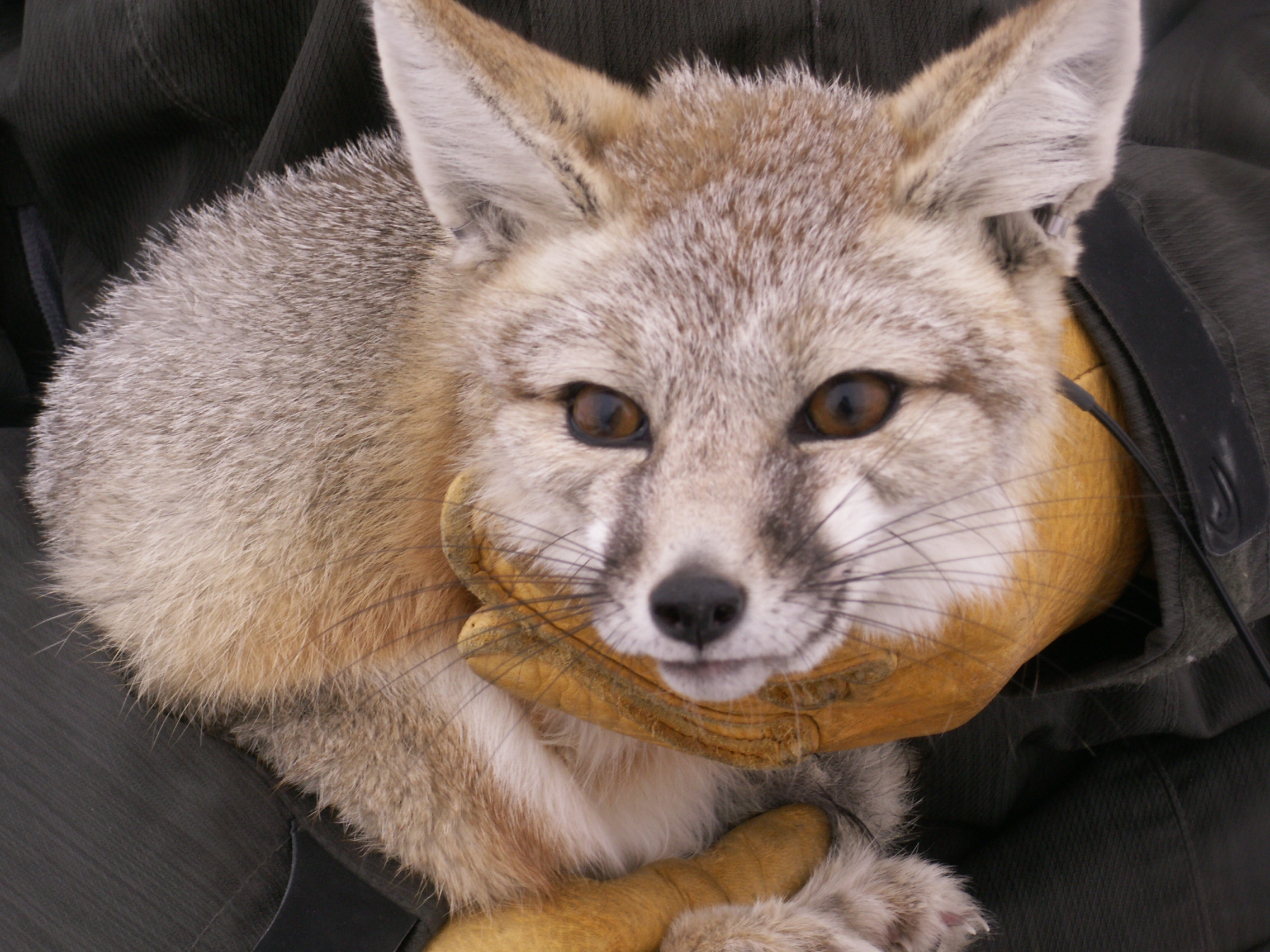
Kit Fox, click to view larger image, Photo Courtesy and Copyright © 2009 Bryan Kluever
Adult Kit Fox
captured with a box trap.
Kit foxes are weighed,
fitted with a radio collar,
and then released
Courtesy & Copyright © 2010
Bryan Kluever
Graduate Research Assistant
Utah State University
Dept of Wildland Resources

Kit Fox, click to view larger image, Photo Courtesy and Copyright © 2009 Bryan Kluever Adult kit fox prior to being
released. Note the black
collar antenna on the right
side of the fox.
Courtesy & Copyright © 2010
Bryan Kluever

One of the first things observers notice about the kit fox is its tiny size. Weighing in at a mere four pounds or so, Vulpes macrotis is among the smallest canids on the planet.

Often mistaken for swift foxes, kit foxes are a distinct species that sport larger ears and a leaner, more angular appearance. The small mammal has a long, black-tipped bushy tail and a yellowish-gray coat tinged with rusty orange.

Listed as a sensitive species in Utah, the carnivores live primarily in the state’s arid, western regions, where they reside in family dens and hunt for smaller mammals such as field mice and jackrabbits, as well as insects, birds, amphibians and fish.

But the diminutive hunter is susceptible to predation by a host of larger beasts, including coyotes, bobcats and golden eagles, says USU alum and wildlife biologist Bryan Kluever.

“With small size comes disadvantages; however, the advantage is increased agility and mobility,” he says.

Kit foxes have little difficulty leaping over sagebrush and rabbitbrush that towers over them and provides a welcome refuge from hungry predators. Given a choice, the foxes prefer to stay in open areas, where they can put their sense of sight to full use. Their vulnerability to larger members of the food chain partially explains the animal’s nocturnal habits.

“The life of a kit fox is ruled by the night,” Kluever says. “They are rarely active during the day and, when they are, this activity is limited to near dawn and dusk. This behavior is likely a function of eluding their enemies and avoiding harsh desert temperatures, especially in summer.”

One of the kit foxes’ most distinctive traits is its insatiable curiosity.

“If one word had to be used to describe the kit fox, it would be inquisitive,” says Kluever, who extensively studied the creatures at the Army’s Dugway Proving Ground. “Most canids cannot be captured with cage traps but kit foxes are one of the exceptions. When we released them after capture, they often began to walk toward us, rather than running away.”

Thanks to USU’s Quinney College of Natural Resources for supporting research and development of this Wild About Utah topic.

Credits:

Theme: Courtesy & Copyright Don Anderson Leaping Lulu
Images: Courtesy & Copyright Bryan Kluever
Text & Voice:     Mary-Ann Muffoletto, Utah State University College of Natural Resources
Credits:
Bryan Kluever, wildlife biologist, Fort Carson Military Installation, Colorado.

Additional Reading:

Utah’s Desert Fox, Mary-Ann Muffoletto, Wild About Utah, May 27, 2010, https://wildaboututah.org/utahs-desert-fox/

White, P. J. and K. Ralls. 1993. Reproduction and spacing patterns of kit foxes relative to changing prey availability. Journal of Wildlife Management 57:861–867 The Wildlife Society, https://si-pddr.si.edu/dspace/bitstream/10088/510/1/White1993.pdf

Kit Fox (Vulpes macrotis), Species, Utah Division of Wildlife Resources, Utah Department of Natural Resources, https://fieldguide.wildlife.utah.gov/?species=vulpes%20macrotis

The Pygmy Rabbit: A ‘Cryptic’ Resident of the Sagebrush

Pygmy Rabbit, Brachylagus idahoesis
Pygmy Rabbit
Brachylagus idahoesis
Courtesy & Copyright 2007 Len Zeoli
Within the Intermountain West’s vast sagebrush ocean lives a tiny, furry creature that spends the majority of its time in or near a burrow of its own making. The Pygmy Rabbit, North America’s smallest member of the rabbit family, weighs about a pound and is about the size of a grapefruit.

The pint-sized mammal makes its home in sagebrush-studded areas in northern and western Utah, says Utah State University alum and National Park Service ecologist Tammy Wilson. Sagebrush provides food and cover for the rabbit and, in winter, provides 99 percent of its diet. The rabbit’s activity pattern is described as “crepuscular,” meaning that the animal is primarily active at dawn and dusk.

In addition to its petite size, the pygmy rabbit can be distinguished from cottontail rabbits and jackrabbits by its coloring and its ears. The pygmy lacks white fur on its tail; has smaller, very hairy, white-margined ears and a narrower face. Its fur ranges in color from salt and pepper gray on its back, to reddish-brown on its feet.

The Pygmy rabbit is a great example of ‘cryptic’ coloration; that is, a coloration that conceals or disguises the animal’s shape. The animal’s mottled coloring makes it virtually invisible in the shade of a sagebrush plant, which helps it to elude predators.

Pygmy rabbits produce up to three litters during a breeding season and the average litter size is six. The animals need to produce large families as they’re popular prey for a host of predators, including weasels, coyotes, badgers, bobcats, raptors, owls, badgers, foxes, along with rats, ravens and crows. Not surprisingly, the elusive animal is never far from the protection of thick brush and a maze-like network of tunnels.

Burrows

Known for their burrowing skills, Pygmy rabbits prefer loamy soils where they dig networks of tunnels with several entrances. In winter, the animals build tunnels in snow that connect to large cavities created by the weight of the snow on tall shrubs. The rabbits build the snow tunnels on top of the burrows they’ve dug in the ground.

“Everything the rabbit needs is inside,” Wilson says. “Their multi-chambered refuges provide food, protection from predators and protection from extreme cold.”

For example, on a zero-degree day in Utah’s northernmost Rich County, a pygmy rabbit in a snow tunnel enjoys a relatively balmy 32 degrees.

While ravenous predators are a hazard for pygmy rabbits, an even greater threat is shrinking habitat. As Utah’s sagelands give way to development, the tiny animal will have less food and less area for its cozy abode.

Thanks to USU’s Quinney College of Natural Resources for supporting research and development of this Wild About Utah topic.

Credits:
Images: Courtesy & Copyright 2007 Len Zeoli
Text:     Mary-Ann Muffoletto, Utah State University College of Natural Resources
credit: Tammy Wilson, quantitative ecologist, National Park Service.

Additional Reading:

Pygmy Rabbits, Val Grant, https://wildaboututah.org/pygmy-rabbits/

Pygmy Rabbits, Nevada Fish & Wildlife Office, US FWS, https://www.fws.gov/nevada/nv_species/pygmy_rabbit.html

Brachylagus_idahoensis, pygmy rabbit, Animal Diversity Web, https://animaldiversity.org/accounts/Brachylagus_idahoensis/

Brachylagus idahoensis (Pygmy Rabbit), The IUCN Red List of Threatened Species, https://www.iucnredlist.org/details/2963/0