Hummingbirds in Utah

Hummingbird feeding from Corrine Thul’s Hand
Courtesy & Copyright © 2009 Corrine Thul

Holly: Hi, I’m Holly Strand from Stokes Nature Center in beautiful Logan Canyon.

Depending on where you are in Utah, fall is just around the corner. Or it may already be here. That means it’s time for many of our Utah birds to migrate south to warmer temperatures and more abundant food sources. Here in Logan Canyon, we’re getting ready to bid farewell to our charismatic little friends, the hummingbirds.

Hummingbirds are a New World phenomenon, living only in the western hemisphere. They are primarily tropical. Of the 330 species we know about, 95% live south of the US-Mexico border. Ecuador has 163 species–more than any other country. Colombia is next with 136 including a new species discovered just 5 years ago. Hummingbirds are known by a number of different names in Spanish including the generic term colibrí, picaflores meaning flower pickers ; and the more poetic term, joyas voladores or “flying jewels.”

In spite of its great size, only 16 different hummingbirds regularly found on the North American continent. Interestingly, –except for the Ruby-throated Hummingbird—all of these species breed west of the Mississippi River.

In Utah—roughly comparable to the size of Ecuador—5 species are regular visitors. Broad-tailed hummingbird and the black-chinned hummingbird are the most common and most widespread. They both overwinter in Mexico.

The calliope hummingbird is also seen in Utah. It is the smallest breeding bird in North America weighing about as much as a penny! The calliope is also the smallest long distant migrant bird in the world traveling up to 5600 miles in a single year. The rufous hummingbird is another long distance migrant seen in Utah, traveling from as far north as Alaska all the way down to central Mexico .

There is some controversy over whether or not you should continue to feed hummingbirds in fall. Some say you should quit feeding by late August or the hummingbirds won’t migrate. This is not true– in fact many hummingbirds begin migrating when their natural food sources are still intact. According to Audubon Society website, in the fall, you should keep your feeders up for two weeks after you see the last bird using it. The tiny birds need to double their body mass before migration, and a bit of extra nectar can only help.

Thanks to the Rocky Mountain Power Foundation for supporting the research and development of this Wild About Utah topic.
And thanks to Corrine Thul for supporting both hummingbird conservation and educational programming in Logan Canyon.

For Wild About Utah and Stokes Nature Center, I’m Holly Strand.

Credits:

Theme: Courtesy & Copyright Don Anderson Leaping Lulu
Image: Courtesy and Copyright 2009 Corrine Thul
Text & Voice: Holly Strand, Stokes Nature Center

Sources & Additional Reading:

Hummingbirds/Nectar Feeders, National Audubon Society, https://audubon.org/bird/at_home/bird_feeding/hum_feeders.html (accessed September 2, 2009)

Johnsgard, Paul A. 1997.  The Hummingbirds of North America.  Washington DC:  Smithsonian Institution Press. https://www.amazon.com/Hummingbirds-North-America-Paul-Johnsgard/dp/1560987081

Klesius, Michael.  2007.  Flight of Fancy.  National Geographic. Vol. 211.  pp. 114-129.

https://ngm.nationalgeographic.com/2007/01/hummingbirds/klesius-text.html

Utah woman has a way with hummingbirds, Daily Herald, July 19, 2009, https://www.heraldextra.com/news/state-and-regional/article_c8e879cd-c5bc-5a9a-810a-63cce86cd09c.html

Nature News, Evolution News and Views, David Klinghoffer, The Genius of Birds: Watch a Hummingbird’s Tongue in Action – See more at: https://www.evolutionnews.org/2013/06/the_genius_of_b073491.html

Coro Arizmendi Arriaga, Maria del, Hummingbirds of
Mexico and North America, In Spanish and English, CONABIO, 2014, https://www.biodiversidad.gob.mx/Difusion/pdf/colibries_mexico_y_norteamerica.pdf

Coro Arizmendi Arriaga, Maria del, Hummingbirds of
Mexico and North America, In Spanish and English, CONABIO, 2014, https://www.biodiversidad.gob.mx/Difusion/pdf/colibries_mexico_y_norteamerica.pdf

Samuels, Ashe, 10 Hummingbird Feeding Mistakes Everyone Makes (and How to Avoid Them), Wild Bird Scoop, June 19, 2025, https://www.wildbirdscoop.com/hummingbird-feeding-mistakes.html

USA National Phenology Network

Courtesy USA National Phenology Network

The study of recurring plant and animal life cycle events is phenology. It is the calendar of nature. This includes when plants flower, when birds migrate and when crops mature. Phenology is relevant to interactions between organisms, seasonal timing and large-scale cycles of water and carbon. Phenology is important to us for many reasons. Farmers need to know when to plant and harvest crops and when to expect pests to emerge. Resource managers use it to monitor and predict drought and assess fire risk. Vacationers want to know when the best fall colors will be or when the wildflower blooms will peak. Timing varies but we can discern patterns.

The USA National Phenology Network monitors the influence of climate on the phenology of plants, animals and landscapes. They encourage people to observe phenological events such as flowering, migrations and egg laying. The Phenology Network provides a place to enter, store and share these observations, which are then compiled and analyzed nationwide. Participants range from individual observers in their own backyards to professional scientists monitoring long-term plots. My husband and I monitor leafing and flowering of lilacs, a key species in the program.

These observations support a wide range of decisions made routinely by citizens, managers, scientists and others. This includes decisions related to allergies, wildfires, pest control, and water management.

I urge you to participate. The National Phenology Network has many public, private and citizen partners. It is a great way to become involved in a nation-wide effort to better understand our environment. All this information and much more is available at the National Phenology website, to which there is a link from our Wild About Utah website.

This is Linda Kervin for Bridgerland Audubon Society.

Credits:

Text: Linda Kervin, Bridgerland Audubon Society
Additional Reading:

Linda Kervin’s pieces on Wild About Utah

Phenology Tools for Community Science
USA National Phenology Network, https://www.usanpn.org/
Nature’s Notebook Education Program, US National Phenology Network, https://www.usanpn.org/nn/education

North American Bird Phenology Program, USGS Patuxent Wildlife Research Center, https://www.pwrc.usgs.gov/bpp/BecomeAParticipant.cfm

eBird, https://www.ebird.org/

iNaturalist, https://www.inaturalist.org/

Avian Cyrano de Bergerac- long-billed Curlew

Long-billed Curlew
Lee Karney, US Fish & Wildlife Service
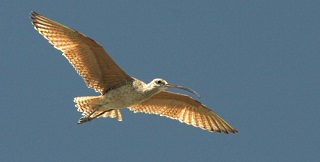
Long-billed Curlew in Flight
Cresent Lake NWR, US Fish & Wildlife Service

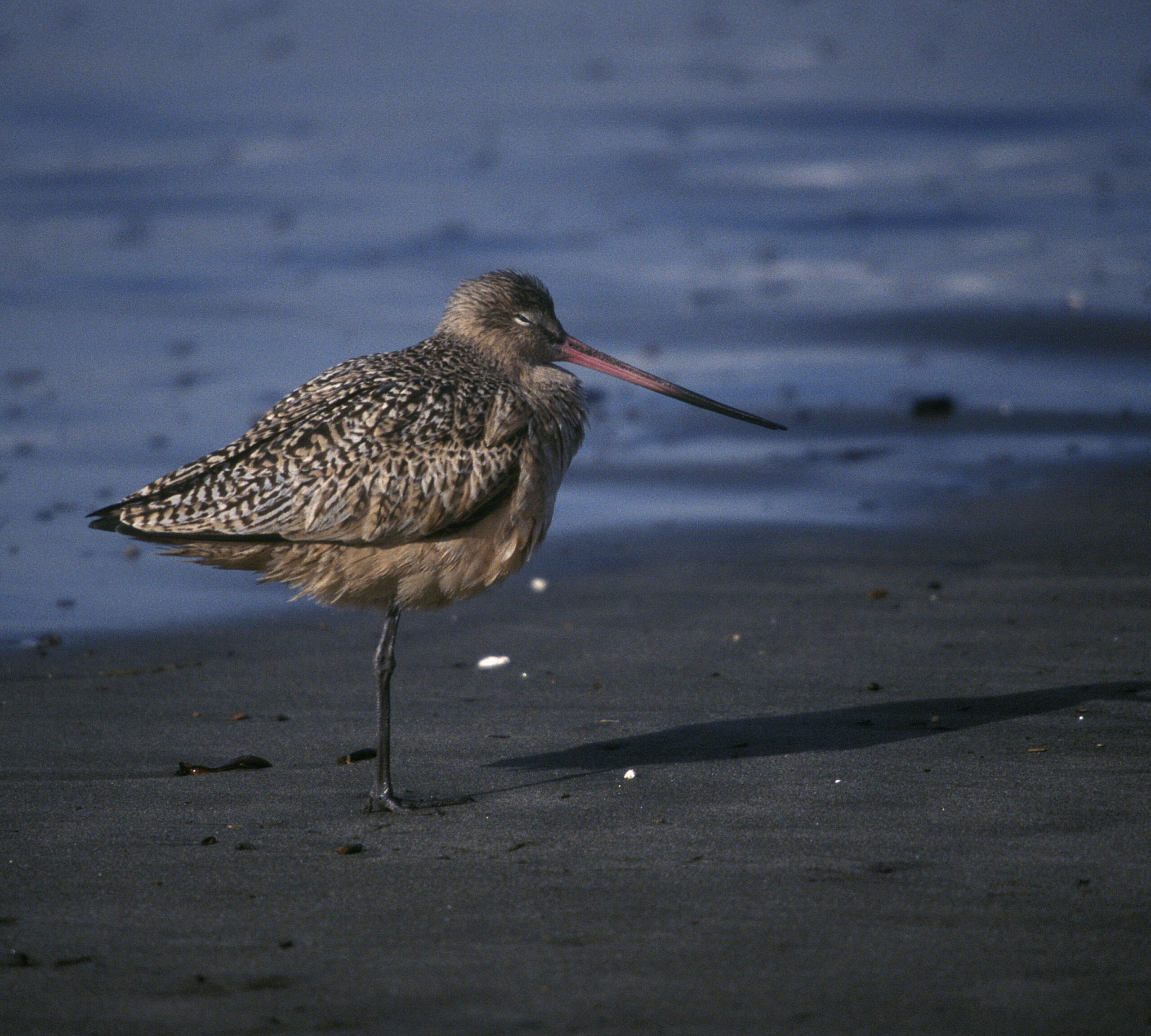
The Cyrano de Bergerac of the bird world is the long-billed curlew. Its bill is 9 inches long and curves downward at the tip. This 19-inch bird is the largest shorebird of North America. The long-billed curlew is cinnamon brown above and buff brown below. It is similar in size to a marbled godwit, but the bill of the godwit is shorter and turns up.

Like Cyrano, the long-billed curlew is shy. They arrive in Utah in mid-March, seeking open fields and grasslands away from trees, posts, power poles or any other perches of use to predators. They can been seen walking through fields, probing with their bill for worms, insects, spiders and even berries.

In breeding season the male repeatedly flies high, then glides downward, calling all the while.
[Kevin Colver, Songs of Yellowstone #9 Long-billed Curlew]

Like other shorebirds, their nest is just a shallow scrape on the ground, lightly lined with grass. Typically 4 eggs are laid. Both sexes incubate the eggs for about 2 weeks. The down covered young hatch with their eyes open and feed themselves. Two to three weeks after the chicks hatch, the female departs. Dad stays with his chicks until after they fledge when they are about 35 days old. Soon thereafter curlews flock up to migrate south. In mid July, they fly to California or Mexico, where they frequent coastal mudflats eating crabs and other aquatic life.

The long-billed curlew was once much more common. Market hunting in the 19th century and habitat loss more recently have reduced their numbers, but they persist in parts of Utah.

Thanks to Kevin Colver for the use of his recording.

To view pictures visit the Wildaboututah link on upr.org

This is Linda Kervin for Bridgerland Audubon Society.

Credits:

Photos: Courtesy Fish and Wildlife Service Online Digital Media Library

https://www.fws.gov/digitalmedia/

Audio: Dr. Kevin Colver, www.wildsanctuary.com & https://wildstore.wildsanctuary.com/collections/special-collections

Text: Lyle Bingham, Bridgerland Audubon Society
Additional Reading:

Washington State Birdweb:
https://birdweb.org/birdweb/bird_details.aspx?id=157

Long-billed curlew Numenius americanus, USGS Migratory Bird Research – Patuxent Wildlife Research Center,
https://www.mbr-pwrc.usgs.gov/id/framlst/i2640id.html

Long-billed Curlew Satellite Tracking
https://ibo.boisestate.edu/curlewtracking/locations/

Prairie Birds: Fragile Splendor in the Great Plains, Paul A. Johnsgard, 2001, University Press of Kansas, https://www.amazon.com/Prairie-Birds-Fragile-Splendor-Plains/dp/0700610677

Long-billed Curlew Mating flight (Video),
https://www.youtube.com/watch?v=Vv-cNA6IBG8

Short-tailed Bird of Perdition-Starlings

European Starling
Courtesy US FWS, Dr. Thomas G. Barnes, Photographer
I’ll bet you’ve always wanted to know about starlings (Sturnus vulgaris), whose Latin name speaks volumes. They’re noisy, gregarious, messy and are blamed for forcing many hole-nesting birds, bluebirds and flickers, even an occasional kestrel, out of their nests for fun and profit. For this the starlings plead “no contest.” They spread across the United States and Canada like the plague after their introduction into New York City’s Central Park in the late 1800’s, just so we unwashed Americans could have the joy of being able to associate, up close and personal, with all the birds mentioned by Shakespeare. I think Pay Back by the Brits sums it up nicely, kind of like the Russians and cheat grass, halogeton, tamarisk and Russian thistle (tumbleweed).

So what can be said that could possibly redeem this rapid breeding invader whose short intestinal tract means they have to consume beaucoup amounts of food to survive? This is great during the summer when insects and creepy-crawlies are their favorite cuisine; it’s during the winter when man-produced food pellets meant for our livestock are like Quaker’s puffed rice or wheat, the digesta are “shot from guns”, another not so an endearing image of the starling. They cost feedlot owners and berry farmers hundreds of thousands of dollars every year. Imagine 100,000 and up to two million starlings descending on your holly orchard or your feedlot. Imagine them staying around for the winter. It’s not hard to imagine spreading Starlicide-treated pellets around your livestock.

Not to defend this image, especially after working with the little rounders for 14 years (six years with the Feds, eight years as a graduate research topic), but they showed me that I was working with quite an intelligent species. Observing these birds in the field, in large pens in Green Canyon and in Skinner boxes in the Experimental Psychology laboratory on USU’s campus, these birds made reasoned judgments concerning the food they ate, spatially and temporally learning to avoid poisoned food, teaching another the avoidance pattern they had learned, making decisions just like we do, thinking, learning from mistakes. We tried to eliminate them without success. We could try convincing them that eating at feedlots or orchards is a dangerous game and repel the little rounders. Whatever the case they are here to stay, but it would be nice if there weren’t quite so many.

This is Linda Kervin for Bridgerland Audubon Society.

Credits:

Photo: Courtesy US FWS, Dr. Thomas G. Barnes, Photographer
Theme music: Trout and Berry Days, by Don Anderson and performed by Leaping Lulu
Text: C. Val Grant, Bridgerland Audubon Society
Voice Talent: Linda Kervin, Bridgerland Audubon Society

Listen for this Bird:

European Starling 1, European Starling 2, and European Starling 3, as recorded by Kevin Colver of https://wildstore.wildsanctuary.com/collections/special-collections and found on the Western Soundscape Archive at the University of Utah. (Opens in a separate window.)

Additional Reading:

European Starling Identification, All About Birds, The Cornell Lab of Ornithology, Cornell University,
https://www.allaboutbirds.org/guide/European_Starling/id

Mayntz, Melissa, European Starling Identification, The Spruce, September 17, 2020, https://www.thespruce.com/european-starling-identification-385980

European Starling, Sturnus vulgaris, National Invasive Species Information Center, US Department of Agriculture (USDA), https://www.invasivespeciesinfo.gov/animals/eurostarling.shtml

European Starling, Sturnus vulgaris, Seattle Audubon Society, https://www.birdweb.org/birdweb/bird_details.aspx?id=360

European Starling – Sturnus vulgaris, Utah Species, Utah Division of Wildlife Resources, Department of Natural Resources, State of Utah, https://fieldguide.wildlife.utah.gov/?species=sturnus%20vulgaris

EPA R.E.D Facts–Starlicide(3-chloro-p-toluidine hydrochloride), US Environmental Protection Agency (EPA),
https://www3.epa.gov/pesticides/chem_search/reg_actions/reregistration/fs_PC-009901_1-Sep-95.pdf