Christmas Bird Count

National Audubon
Christmas Bird Count page
Image courtesy National Audubon,
https://audubon.org

The Christmas holidays bring us a bevy of welcome annual traditions. We listen to the melodies of the Nutcracker and traditional carols.

[Black-capped Chickadee recording by Kevin Colver: Songbirds of the Rocky Mountain Foothills]

Many also listen for bird melodies as we join in the annual Christmas Bird Count. These are exhaustive, one-day surveys of all the individuals of every species of bird found in a locality. Christmas Bird Counts began 111 years ago in New York City as a holiday alternative to the excesses of a hunt that targeted all birds. Provo’s count followed soon after in 1903.

From that first inspiration, the Christmas Bird Count has spread to all 50 states and throughout the Americas. Last year, there were 2,600 counts, totaling 56 million individual birds representing over 2,300 species. Last holiday season, hundreds of Utahns participated in 24 local counts, reporting 184 bird species from Saint George north to Bear Lake.

I always join Logan’s Bridgerland Audubon count, which has been running for 54 years. Last year, with 62 participants we found 99 bird species in our standard count circle of 150 square miles. That’s remarkable for a chilly winter’s day, considering that many of our feathered friends have hightailed it south for the winter. But note that some northerly species, such as Rough-legged Hawks, view Utah as the balmy endpoint of their fall migration.

Christmas Bird Counts offer something for everyone, from novices to seasoned birders. Some choose simple feeder counts; others undertake vigorous back country walkabouts. Some will be up in the predawn, listening for owls.

[Great Horned Owl recording by Kevin Colver: Songbirds of the Southwest Canyon Country]

Every count’s data contributes to long-term research about winter dispersal patterns of birds and their population trends. If you like birds, join in the fun and make the Christmas Bird Count one of your holiday traditions.

All counts are scheduled between December 14 and January 5. Utah’s Christmas Bird counts are listed on our website: just search for Wild About Utah or go to the UtahBirds website directly. Our Logan count is on Saturday, December 18. That evening, we’ll all flock together for a big potluck party where we tally up our bird count totals.

This is Linda Kervin for Bridgerland Audubon Society.
Credits:

Photos: Courtesy National Audubon,
https://www.audubon.org/
Sounds: Courtesy & Copyright Kevin Colver, https://wildstore.wildsanctuary.com/collections/special-collections
https://wildstore.wildsanctuary.com/collections/special-collections
Text: Linda Kervin & Jim Cane, Bridgerland Audubon Society

Additional Reading:

Christmas Bird Counts in Utah, Utahbirds.org, Milt Moody, Webmaster, https://www.utahbirds.org/cbc/cbc.html

The 109th Christmas Bird Count: Citizen Science in Action, National Audubon Society, Inc. https://www.audubon.org/bird/cbc/index.html
Idaho Circles: https://app.audubon.org/cbcapp/findCircles.jsp?state=US-ID&start=1
Utah Circles: https://app.audubon.org/cbcapp/findCircles.jsp?state=US-UT&start=1

Cutler Marsh-Amalga Barrens Important Bird Areas

Cutler Marsh-Amalga Barrens Important Bird Areas: Cutler Marsh, Photo Copyright 2010 Mike Fish
Cutler Marsh
Copyright © 2010 Mike Fish

Important Bird Area Sign, Photo Courtesy Lyle Bingham, Bridgerland Audubon Society Important Bird Area Sign
Courtesy Bridgerland Audubon Society

Cutler marsh near the Ibis rookery, Photo Copyright © 2006 Stephen Peterson Cutler marsh near the Ibis rookery
Copyright © 2006 Stephen Peterson

White-faced Ibis, Photo Copyright 2010 Mike Fish White-faced Ibis
Copyright © 2010 Mike Fish

Ibis flying over Cutler marsh, Photo Copyright © 2006 Stephen Peterson Ibis flying over Cutler marsh
Copyright © 2006 Stephen Peterson

Setting up the count, Photo Copyright © 2006 Stephen Peterson Dan Zamecnik, Bryan Dixon, & Chris Cokinos setting up to count ibis
Copyright © 2006 Stephen Peterson

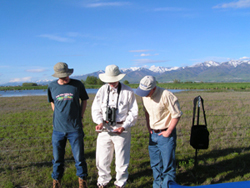
Jean Lown, John Stewart, & Frank Howe counting ibis on the marsh, Photo Courtesy Bridgerland Audubon Society Jean Lown, John Stewart, & Frank Howe counting ibis on the marsh
Copyright © 2010 Bryan Dixon

Hi, I’m Holly Strand

Earlier this year, Cutler Marsh and nearby Amalga Barrens in Cache Valley were recognized as one of the world’s most important bird habitats. This recognition came from Birdlife International and its US partner — the National Audubon Society. In an earlier episode I talk about the criteria for becoming an Important Bird Area –or IBA for short. The Cutler Marsh-Amalga Barrens IBA was recognized because of its large population of nesting white-faced ibis.

The strange thing is—that 30 years ago—there were relatively few ibis in the area. But when the Great Salt Lake flooded in the mid 1980s, many of its rookeries went under water. So some ibises moved to higher ground in Cache Valley. And apparently found it to their liking.

Local birders were amazed at the influx. Wayne Martinson, head of Utah’s IBA program advised the local Audubon Society to start formal counts. The worldwide total of white-faced ibis estimated to be 150,000. So to become a globally important IBA, the Marsh and Amalga Barrens would have to hold at least 1,500 birds.

Bryan Dixon of Bridgerland Audubon Society organized the censuses. Observations were made during the breeding season from 2005 to 2010. Observers defined an imaginary vertical plane to the north and south of the rookery. They would count the birds as they crossed the plane into the rookery and subtract the birds that flew out. Birds on the ground could not be counted for they were hidden in the bulrushes and cattails. Observers kept a respectable distance; if approached the adult birds might abandon its eggs or chicks.

The results took the census takers by surprise. The first years count was well over 6000. The second year’s count was 8094 birds. The site had 5 times as many birds as was needed to be designated as a globally important IBA. Then in 2007, the birds mysteriously vanished. Not a single ibis was counted in the rookery. Perhaps a severe weather discouraged nesting? The reason is still unclear. But the following year the ibis returned and by 2009, the count exceeded 7000.

Hats off to Bridgerland Audubon Society’s Bryan Dixon for organizing the counts! For some photos of the new IBA and the white-faced ibis, go to www.wildaboututah.org

For Wild About Utah, I’m Holly Strand


Credits:

Theme: Courtesy & Copyright Don Anderson as performed by Leaping Lulu
Photos: Cutler Marsh, Courtesy & Copyright 2010 Mike Fish
IBA sign, Courtesy Bridgerland Audubon Society
Ibis: Courtesy US FWS, Dave Menke Photographer
Cutler marsh near the Ibis rookery, flying ibis, setting up the count, Courtesy and Copyright 2006 Stephen Peterson
Ibis counters, Courtesy and Copyright 2010 Bryan Dixon
Text & Voice: Holly Strand

Sources & Additional Reading:

Cutler Marsh-Amalga Barrens IBA site description https://www.audubon.org/important-bird-areas/cutler-reservoir-and-marsh-ut08

Ryder, Ronald A. and David E. Manry. 1994. White-faced Ibis (Plegadis chihi), The Birds of North America Online (A. Poole, Ed.). Ithaca: Cornell Lab of Ornithology; Retrieved from the Birds of the Worls Online: https://birdsoftheworld.org/bow/species/whfibi/cur/introduction [Updated February 12, 2026]

Important Bird Areas, Audubon Society, www.audubon.org/bird/IBA/ Note: Website changed to https://www.audubon.org/important-bird-areas
See also
https://www.audubon.org/important-bird-areas/state/utah
https://www.audubon.org/important-bird-areas/cutler-reservoir-and-marsh-ut08 [Accessed September 19, 2021]

Protecting the most important habitats for birds, BirdLife International, https://www.birdlife.org/worldwide/programme-additional-info/important-bird-and-biodiversity-areas-ibas [Accessed September 19, 2021]

Cutler Reservoir and Marsh, Important Bird Areas(IBAs), BirdLife International, https://datazone.birdlife.org/site/factsheet/29572-cutler-reservoir-and-marsh-ut08

Bird vs. Window

Contractor applies anti-bird strike film to a window
Photo Courtesy US FWS
Brett Billings Photographer

Hi, I’m Holly Strand.

Every fall, I cringe when I hear the soft thumps caused by feathery bodies slamming into the windows of our house. Etched designs into the window glass do not seem to deter these miniature kamikaze pilots.

The most intense period of window strikes occurs when birds are feasting on our chokecherries and crabapples. The birds get intoxicated from the naturally fermented fruit and their judgement flies out the window—or rather, into the window. Robins, waxwings and other fruit eaters are the most frequent flyers under the influence.

Ornithologists estimate that in the United States alone well over 100 million birds are killed each year by window collisions. Many accidents occur when birds see trees, sky, or clouds reflected on a glass but do not see the hard transparent window surface itself. Sometimes the birds are merely stunned and recover in a few moments. Often, however, window hits lead to severe internal injuries and death.

Ornithologist Pete Dunne found that feeders placed 13 feet away from a window corresponded with maximum deaths. However, a feeder place within a meter of window actually reduced the accident rate. Birds focus on the feeder as they fly toward the window. If they strike the glass leaving the feeder, they do so at very low speed.

You can redirect the accident prone birds by putting up awnings, beads, bamboo, or fabric strips. Stickers or silhouettes will help if they are spaced 2-4 in. apart across the entire window. At our house, taping some reflective ribbon to the window so that it flutters in the breeze has been very effective.

If you find a bird dazed from a window hit, place it in a dark container with a lid such as a shoebox, and leave it somewhere warm and quiet, out of reach of pets and other predators. If the weather is extremely cold, you may need to take it inside. Do not try to give it food and water, and resist handling it as much as possible. The darkness will calm the bird while it revives, which should occur within a few minutes, unless it is seriously injured. Release it outside as soon as it appears awake and alert.

For Wild About Utah, I’m Holly Strand.

Credits:

Photo Courtesy US FWS, Brett Billings Photographer, https://www.fws.gov/digitalmedia/cdm4/item_viewer.php?CISOROOT=/natdiglib&CISOPTR=9516
Text: Holly Strand

Sources & Additional Reading:

Dunne, Pete. 2003. Pete Dunne on Bird Watching: The How-to, Where-to, and When-to of Birding. HMCo Field Guides. https://www.amazon.com/Pete-Dunne-Watching-Where-When/dp/0395906865

Cornell Lab of Ornithology. Bird Notes from Sapsucker Woods. https://www.birds.cornell.edu/AllAboutBirds/notes/BirdNote10_Windows.pdf (Accessed Nov 30, 2008)

Leahy, Christopher. 1982. The Birdwatcher’s Companion. NY: Grammercy Books. https://www.amazon.com/Birdwatchers-Companion-North-American-Birdlife/dp/0691113882/ref=sr_1_1?ie=UTF8&s=books&qid=1228882143&sr=1-1

Wildlife Rehabilitation Center of Northern Utah, Ogden, UT https://www.wrcnu.org/

Heading South

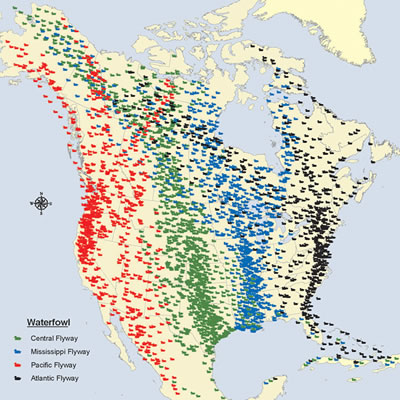
US Flyways
Courtesy US FWS

Hi I’m Holly Strand.

Every fall, I scan the sky for the fluid lines of birds heading south to their winter homes. Although the flocks are fascinating to watch, I get a bit melancholy. I imagine the warm and balmy weather ahead of them and the frigid temperatures that are in store for me.

Migration behavior in birds –and other animals– evolved to help them cope with a scarcity of resources during a particular time of the year. Severe weather and lack of food are characteristic of winters in the far north of the Northern Hemisphere. Therefore almost all of the birds migrate. Although more hospitable than the arctic, Utah winters are no picnic. Therefore, birds that breed in Utah have also bought heavily into migration.

Huge numbers of Wilson’s Phalarope
gather at the Great Salt Lake
before migration.(female)
Photo courtesy and
Copyright © 2008 Stephen Peterson

Looking at a map of Western Hemisphere migration routes –or flyways—you might be reminded of the route map of a major airline. There are short regional flights, say to an adjacent state to the south or sometimes just to a lower altitude. There are medium distance flights to Mexico or Central America. And then there are the long haul flights, with birds flying from northern tundra all the way to Argentina, Chile or Antarctica.

Wilson’s phalarope is one of Utah’s long-distance migrators. After the breeding season, about 500,000 birds form the largest staging concentration of phalaropes in the world at the Great Salt Lake. After fueling up on brine shrimp and brine flies, the birds head off to wetlands in Bolivia and Argentina.

Huge numbers of Wilson’s Phalarope
gather at the Great Salt Lake
before migration.(male)
Photo courtesy and
Copyright © 2008 Stephen Peterson

Swainson’s hawk travels farther than any other North American hawk. It migrates to the Argentinian pampas in huge flocks with as many as 5,000–10,000 individual. If a Swainson’s hawk begins migration in the northern part of its range, total round trip distance will exceed 20,000 km.

The rufous hummingbird doesn’t breed in Utah but flies though on its remarkable journey from the northwest and Alaska to Central America. If you measure its travel in body lengths as opposed to distance, this tiny little aviator makes world’s longest known migration.

For pictures and sources please go to www.wildaboututah.org

Thanks to the knowledgeable folks on the UtahBirds chatline for their help in developing this story.

The Swainson’s hawk photographed
in Starr, UT will overwinter
in Argentina.
Photo courtesy and
Copyright © 2006 Lu Giddings

For Wild About Utah, I’m Holly Strand

Credits:
Photo: Courtesy US FWS National Digital Library
Swainson’s Hawk: Courtesy and Copyright 2006 Lu Giddings
Text: Holly Strand

Sources & Additional Reading

Bechard, Marc J., C. Stuart Houston, Jose H. Sarasola and A. Sidney England. 2010. Swainson’s Hawk (Buteo swainsoni), The Birds of North America Online (A. Poole, Ed.). Ithaca: Cornell Lab of Ornithology; Retrieved from the Birds of North America Online: https://bna.birds.cornell.edu/bna/species/265

With a length of 9.5 cm,
the rufous hummingbird
has the longest migration
in the world in relation to its size.
Photo courtesy and
Copyright © 2010 Michael Fish

Berthold, Peter. 2001. Bird Migration: A General Survey (second edition). Oxford Ornithology Series. Oxford University Press. https://www.amazon.com/Bird-Migration-General-Survey-Ornithology/dp/0198507879

Colwell, M. A. and J. R. Jehl, Jr. 1994. Wilson’s Phalarope (Phalaropus tricolor), The Birds of North America Online (A. Poole, Ed.). Ithaca: Cornell Lab of Ornithology; Retrieved from the Birds of North America Online: https://birdsoftheworld.org/bow/species/wilpha/cur/introduction/

Elphick, Jonathan, Ed. The Atlas of Bird Migration. 1995. NY: Random House. https://www.amazon.com/Random-House-Atlas-Bird-Migration/dp/0679438270

Healy, Susan and William A. Calder. 2006. Rufous Hummingbird (Selasphorus rufus), The Birds of North America Online (A. Poole, Ed.). Ithaca: Cornell Lab of Ornithology; Retrieved from the Birds of North America Online: https://birdsoftheworld.org/bow/species/rufhum/cur/introduction

A Rufous hummingbird
collects nesting material
Photo courtesy US FWS
George Gentry, Photographer

USGS. Northern Prairie Wildlife Research Center Migration of Birds. https://www.npwrc.usgs.gov/resource/birds/migratio
/routes.htm
[ Accessed October 28, 2010]

Weidensaul, Scott 1999. Living on the Wind. NY: North Point Press https://www.amazon.com/Living-Wind-Across-Hemisphere-Migratory/dp/0865475911

Salt Lake Brine Shrimp, https://saltlakebrineshrimp.com/harvest/