Heading South

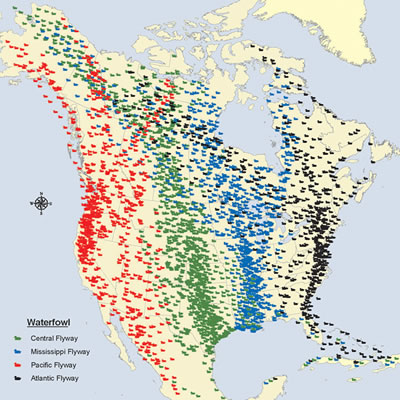
US Flyways
Courtesy US FWS

Hi I’m Holly Strand.

Every fall, I scan the sky for the fluid lines of birds heading south to their winter homes. Although the flocks are fascinating to watch, I get a bit melancholy. I imagine the warm and balmy weather ahead of them and the frigid temperatures that are in store for me.

Migration behavior in birds –and other animals– evolved to help them cope with a scarcity of resources during a particular time of the year. Severe weather and lack of food are characteristic of winters in the far north of the Northern Hemisphere. Therefore almost all of the birds migrate. Although more hospitable than the arctic, Utah winters are no picnic. Therefore, birds that breed in Utah have also bought heavily into migration.

Huge numbers of Wilson’s Phalarope
gather at the Great Salt Lake
before migration.(female)
Photo courtesy and
Copyright © 2008 Stephen Peterson

Looking at a map of Western Hemisphere migration routes –or flyways—you might be reminded of the route map of a major airline. There are short regional flights, say to an adjacent state to the south or sometimes just to a lower altitude. There are medium distance flights to Mexico or Central America. And then there are the long haul flights, with birds flying from northern tundra all the way to Argentina, Chile or Antarctica.

Wilson’s phalarope is one of Utah’s long-distance migrators. After the breeding season, about 500,000 birds form the largest staging concentration of phalaropes in the world at the Great Salt Lake. After fueling up on brine shrimp and brine flies, the birds head off to wetlands in Bolivia and Argentina.

Huge numbers of Wilson’s Phalarope
gather at the Great Salt Lake
before migration.(male)
Photo courtesy and
Copyright © 2008 Stephen Peterson

Swainson’s hawk travels farther than any other North American hawk. It migrates to the Argentinian pampas in huge flocks with as many as 5,000–10,000 individual. If a Swainson’s hawk begins migration in the northern part of its range, total round trip distance will exceed 20,000 km.

The rufous hummingbird doesn’t breed in Utah but flies though on its remarkable journey from the northwest and Alaska to Central America. If you measure its travel in body lengths as opposed to distance, this tiny little aviator makes world’s longest known migration.

For pictures and sources please go to www.wildaboututah.org

Thanks to the knowledgeable folks on the UtahBirds chatline for their help in developing this story.

The Swainson’s hawk photographed
in Starr, UT will overwinter
in Argentina.
Photo courtesy and
Copyright © 2006 Lu Giddings

For Wild About Utah, I’m Holly Strand

Credits:
Photo: Courtesy US FWS National Digital Library
Swainson’s Hawk: Courtesy and Copyright 2006 Lu Giddings
Text: Holly Strand

Sources & Additional Reading

Bechard, Marc J., C. Stuart Houston, Jose H. Sarasola and A. Sidney England. 2010. Swainson’s Hawk (Buteo swainsoni), The Birds of North America Online (A. Poole, Ed.). Ithaca: Cornell Lab of Ornithology; Retrieved from the Birds of North America Online: https://bna.birds.cornell.edu/bna/species/265

With a length of 9.5 cm,
the rufous hummingbird
has the longest migration
in the world in relation to its size.
Photo courtesy and
Copyright © 2010 Michael Fish

Berthold, Peter. 2001. Bird Migration: A General Survey (second edition). Oxford Ornithology Series. Oxford University Press. https://www.amazon.com/Bird-Migration-General-Survey-Ornithology/dp/0198507879

Colwell, M. A. and J. R. Jehl, Jr. 1994. Wilson’s Phalarope (Phalaropus tricolor), The Birds of North America Online (A. Poole, Ed.). Ithaca: Cornell Lab of Ornithology; Retrieved from the Birds of North America Online: https://birdsoftheworld.org/bow/species/wilpha/cur/introduction/

Elphick, Jonathan, Ed. The Atlas of Bird Migration. 1995. NY: Random House. https://www.amazon.com/Random-House-Atlas-Bird-Migration/dp/0679438270

Healy, Susan and William A. Calder. 2006. Rufous Hummingbird (Selasphorus rufus), The Birds of North America Online (A. Poole, Ed.). Ithaca: Cornell Lab of Ornithology; Retrieved from the Birds of North America Online: https://birdsoftheworld.org/bow/species/rufhum/cur/introduction

A Rufous hummingbird
collects nesting material
Photo courtesy US FWS
George Gentry, Photographer

USGS. Northern Prairie Wildlife Research Center Migration of Birds. https://www.npwrc.usgs.gov/resource/birds/migratio
/routes.htm
[ Accessed October 28, 2010]

Weidensaul, Scott 1999. Living on the Wind. NY: North Point Press https://www.amazon.com/Living-Wind-Across-Hemisphere-Migratory/dp/0865475911

Salt Lake Brine Shrimp, https://saltlakebrineshrimp.com/harvest/

Species Names

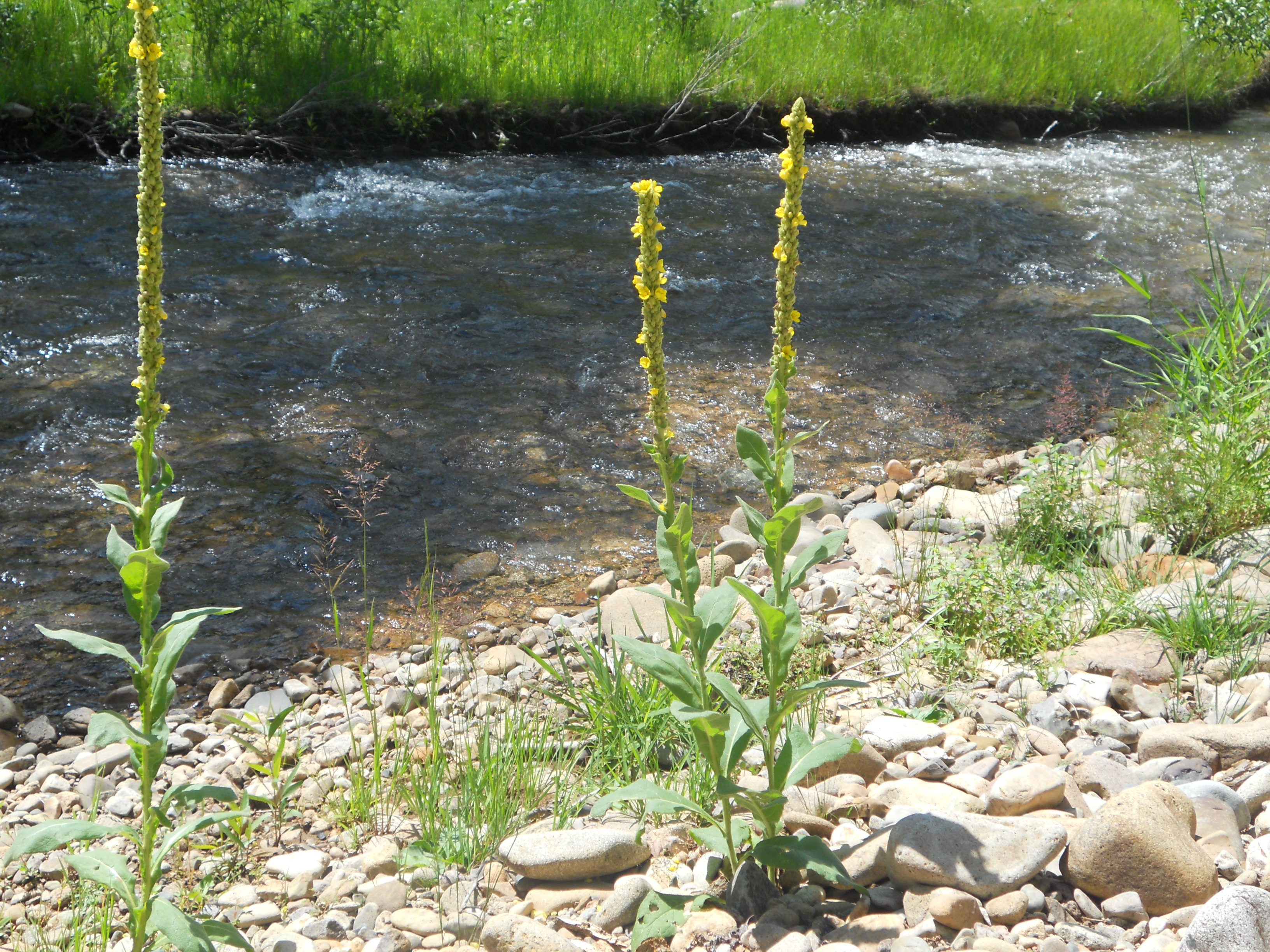
Common Mullein
Courtesy &
Copyright 2010 Holly Strand

Hi, I’m Holly Strand from Stokes Nature Center in beautiful Logan Canyon.

Common Mullein , Our Lady’s Flannel. Velvet Plant. Clown’s Lungwort. Jupiter’s Staff. Shepherd’s Clubs. Beggar’s Blanket. Hare’s Beard, Bear’s ear, and Nature’s Toilet Paper. These are just a few of the names that apply to a single species that is a widely distributed across Europe and Central Asia and naturalized in North America.

Common names are descriptive and often charming, but they are local names and won’t be understood beyond their particular region or in another language. And sometimes common names are downright misleading. For example a koala bear isn’t a bear. And a red panda isn’t a panda.

To avoid confusion, scientists use a unique two word designation—usually taken from Latin or Greek – to identify a species unambiguously. The first word is the name of the genus to which the organism belongs. The genus comprises a group of closely related animals or plants. The second term is chosen by the person that describes and publishes the species account.

Vampyroteuthis infernalis
“vampire squid from Hell”
Illustration by Carl Chun 1911
Public Domain/expired copyright

It is a huge breach of etiquette to name a species after yourself. But the taxonomist can name the organism after the person who actually found it in the field. An example is Mentzelia shultziorum, a blazingstar named after Utah botanist Leila Schultz who first found the plant in Professor Valley in Grand County. Taxonomists can also name the species after a friendly colleague and then hope that the friendly colleague will name one after them.

Often the name will describe some physical characteristics of the species. Earlier this year, a paleontologist unearthed a new dinosaur here in Utah and named it Jeyawati rugoculus. That’s a combination of Zuni and Latin for “grinding mouth, wrinkle eye.”

Other names are based on location: Penstemon utahensis is a penstemon found in our state. Amblyoproctus boondocksius is a scarab, and was apparently found in the middle of nowhere.

Often the name will represent a subjective reaction toward the organism. Vampyroteuthis infernalis translates into “vampire squid from Hell”, Indeed it is rather scary looking cross between a squid and an octopus.

Some scientists get sentimental at naming time. They’ll name species after their loved ones. Or their favorite artists. Thus we have 2 trilobites in the Avalanchurus genus named lennoni and starri. McCartney and Harrison are honored in a neighboring genus.

I’m proud to say that a Utah biologist named a parasitic louse, Strigiphilus garylarsoni. The Far Side cartoonist should not take offense. In a letter to Larson, Dr. Dale Clayton praised him for “the enormous contribution that my colleagues and I feel you have made to biology through your cartoons.”

For sources and archives of past programs see www. Wild About Utah.org

For Wild About Utah and Stokes Nature Center, I’m Holly Strand.

Credits:
Photo: Mullein-Courtesy & Copyright 2010 Holly Strand
Squid Illustration Carl Chun 1911 (Public Domain Courtesy Wikimedia.org)
Text: Stokes Nature Center: Holly Strand

Sources & Additional Reading

Gotch, A.F. 1996. Latin Names Explained: A Guide to the Scientific Classification of Reptiles, Birds & Mammals. NY: Facts on File, Inc.

Isaak, Mark. Curiosities of Biological Nomenclature website. https://www.curioustaxonomy.net/rules.html [Accessed September 15, 2010]

O’Donoghue, Amy Joi. 2010. ‘Grinding mouth, wrinkle eye’ is name of newly discovered species dinosaur. Deseret News, May 27, 2010.

Prigge, Barry A. 1986. New Species of mentzelia (Loasaceae) from Grand County, UT. Great Basin Naturalist Vol. 46, No. 2 pp. 361-365

Birds of a Feather Bird Collective Nouns

A “congregation”, a “stand”, or
(when flying) a “wedge” of ibises.
White-faced Ibis with
Marbled Godwits in background
Courtesy US FWS
Bear River Migratory Bird Refuge

Hi, I’m Holly Strand from Stokes Nature Center in beautiful Logan Canyon.

The word flock is a collective noun that refers to a natural grouping of any kind of bird.

Certain bird species commonly flock together to feed, to travel or to help defend themselves. Flocks are usually thought of as composed of just one species but mixed species flocks also occur. A mixture of species can take advantage of a variety of abilities to find food or detect predators.

When you are talking about a group of single species–birds of a feather so to speak– there exist specific and sometimes eloquent terms that can be used instead of the word flock. We’ve all heard the term “gaggle of geese.” But did you know that earlier this spring, we saw a “season” of tanagers come through the valley? I have never seen a flock of owls, but if there were one, we could call it a “parliament” of owls. More common than a parliament of owls is a “congress” of crows. You can also call this same group a murder of crows.

A “pod”, “scoop”, or “squadron” of American Pelicans with Black-necked Stilts & White-faced Ibis Courtesy US FWS Bear River Migratory Bird Refuge

The word siege can apply to either bitterns or herons. A congregation may refer to plovers, egrets or ibises. A bouquet connotes warblers, hummingbirds or pheasants. However, for hummingbirds I prefer the collective terms shimmer or charm.”

Punsters might appreciate a seasoning of cinnamon teal, a chain of bobolinks a ladle of dippers or– my husband’s favorite—an outfield of flycatchers.

Sometimes, a bunch of birds in the water is different from a bunch of birds in the air. You’ll find a paddling of ducks in the water but a team of ducks flying overhead. Likewise a gaggle of geese is swimming, while a skein of geese is airbourne.

American Avocet Flock
Courtesy US FWS
Bear River Migratory Bird Refuge

One collective phrase is so evocative that it became the title of an entire book on collective nouns for birds and other animals. In An Exaltation of Larks, (now in it’s 3rd printing) author James Lipton explains that many collective nouns were hunting terms that originated in the 15th century or earlier. Nevertheless, the collective terms are correct and appropriate for use today.

This Saturday, August 21st, experience a shimmer of hummingbirds with Stokes Nature Center. Our hummingbird program will take place just east of the Second Dam in Logan Canyon. Drop in anytime between 8-11am. Signs or people will direct you on where to park. For more information call the Nature Center at 435.755.3239.

Cinnamon Teal Pair
In larger numbers a “seasoning of teal”
Courtesy US FWS
Bear River Migratory Bird Refuge

For Wild About Utah and Stokes Nature Center, I’m Holly Strand.

Credits:
Photo: Courtesy Bear River Migratory Bird Refuge
Text: Stokes Nature Center: Holly Strand

Sources & Additional Reading

William Blades, Juliana Berners, Boke of St. Albans, Nabu Press (March 29, 2010) https://www.amazon.com/Boke-Saint-Albans-William-Blades/dp/1148085742

James Lipton, An Exaltation of Larks, Penguin Books, 1991, ISBN 0-670-30044-6. https://www.amazon.com/Exaltation-Larks-Ultimate-James-Lipton/dp/0140170960

Mixed-Species Flocking, Birds of Stanford Essays, Stanford University, https://www.stanford.edu/group/stanfordbirds/text/essays/Mixed-Species_Flocking.html

Animal Congregations, or What Do You Call a Group of…..?, Northern Prairie Wildlife Research Center USGS, https://www.npwrc.usgs.gov/about/faqs/animals/names.htm#birds

Names – Bird Groups and Young Birds, Utah County Birders, UtahBirds.org, https://www.utahbirds.org/featarts/2009/BirdGroupNames.htm

Spotted Sandpiper

Spotted Sandpiper
Courtesy US FWS and
Photographer: Dave Menke

An ancient Latin proverb declares that: “Nature abhors a vacuum”. Every naturalist comes to learn that Nature also loves an exception. Sandpipers are a good example. Coastal beaches bring sandpipers to mind, their flocks either loafing about the upper beach or manically advancing and retreating just ahead of the surf line. Every beachcomber can picture the scene.

Imagine, then, hearing this solitary call during your hike past some montane stream, lake or beaver pond.

[Spotted Sandpiper recording, hosted by Western Soundscape Archive, J Willard Marriott Library, University of Utah Copyright 2007 Kevin Colver https://wildstore.wildsanctuary.com/collections/special-collections]

Spotted Sandpiper Habitat
Courtesy & Copyright 2010 Linda Kervin

That sure sounds like a sandpiper, but isn’t the context all wrong? Here you can trust your ears and not your experience. When the bird flushes and flies away on stiff shallow wing beats, you’ll see that the calling bird was indeed a Spotted Sandpiper, easily recognized by the dark spots that speckle its pale breast. This bird is sometimes called a “teeter peep” too, because it bobs its tail incessantly. Its an odd bird, for it is the male Spotted Sandpiper who tends nest and chicks, while the female busily courts other males. That’s polyandry and among birds, its very rare.

Unlike its more coastal kin, the Spotted Sandpiper is right at home in Utah’s high alpine habitats, just so long as it has shallow water and meadows in which to search for its invertebrate meals. Maybe the Spotted Sandpiper is not so exceptional after all, for the upthrust limestones, shales and other sedimentary rocks that compose many of our mountains were deposited under ancient seas that once inundated Utah. Perhaps the Spotted Sandpiper is just exceptional for its late arrival at that prehistoric beach party.

This is Linda Kervin for Bridgerland Audubon Society.
Credits:
Audio: Spotted Sandpiper audio courtesy and Copyright Kevin Colver https://wildstore.wildsanctuary.com/collections/special-collections

Photos: Courtesy US FWS, Photographer Dave Menke
and habitat photo Courtesy & Copyright 2010 Linda Kervin
Text: Jim Cane, Bridgerland Audubon Society

Additional Reading:

Spotted Sandpiper on Utahbirds.org, https://www.utahbirds.org/birdsofutah/ProfilesS-Z/SpottedSandpiper.htm