A Trip to the Utah Museum of Natural History

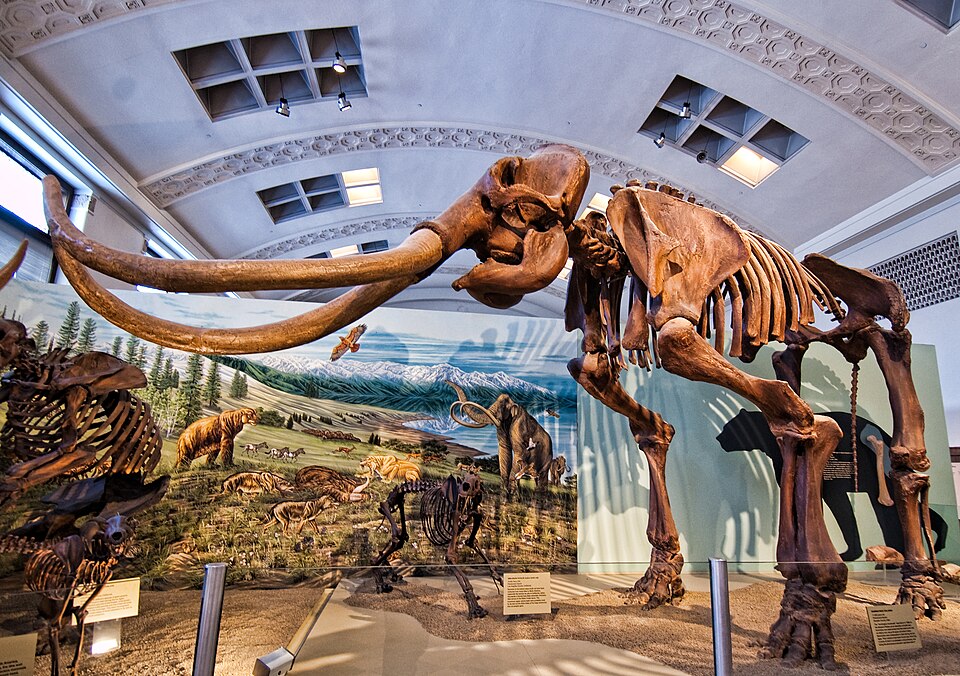
Mounted cast of a Columbian mammoth (Mammuthus columbi) in the old building of the "Utah Museum of Natural History" Courtesy Wikimedia, Brett Neilson, Photographer, Licensed under the Creative Commons, https://en.wikipedia.org/wiki/en:Creative_Commons, Attribution 2.0 Generic license, https://creativecommons.org/licenses/by/2.0/deed.en
Mounted cast of a Columbian mammoth (Mammuthus columbi) in the old building of the “Utah Museum of Natural History”
Courtesy Wikimedia, Brett Neilson, Photographer
Licensed under the Creative Commons Attribution 2.0 Generic license.
When I opened the door to the special exhibit on the Ice Age at Salt Lake’s Natural History Museum, I found myself face to face with the long, looping tusks of a wooly mammoth. Once I caught my breath, I could see the mammoth’s head was painted on a piece of wood, but the tusks were 3 dimensional and towered above me – about 10 feet in the air and stretching out to about 9 feet. This magnificent mammal, now extinct, was well adapted to living on an icy planet. Its hair grew as long as 35 inches and its skin was slightly over 3 inches thick. By comparison, the museum pointed out, the modern Asian elephant has little or no hair and its skin is less than an inch thick.

The special ice age exhibit has left Salt Lake, but a visit to the Museum of Natural History is always a treat. Its skeleton of a mammoth clearly conveys a feeling for its massive size. Also looking huge is their skeleton of a giant sloth, standing 8 feet high and sporting a hand claw over 12 inches long. Back when Thomas Jefferson was president of the United States, some explorers found a similar claw in a cave in Virginia and sent it to him.. Jefferson quickly sent off an urgent message to Lewis and Clark on their trek west to keep an eye out for this fiercesome beast. As it turns out, the giant sloth was extinct and had just been a vegetarian who lived mostly in the trees. The giant sloth used the claw to pull tree branches closer so he could eat the leaves.

If you walk down the museum ramp leading away from the giant sloth, you leave the Ice Age and go deeper back in time to the Age of Dinosaurs. You pass by a prehistoric crocodile and a giant birdlike creature standing on large, three toed claw feet. This bird would run down its prey at speeds as high as 30 mph. Soon you arrive at a section of glass flooring, exposing a massive jumble of bones underfoot. You have arrived at the exhibit on Utah’s unique Cleveland-Lloyd quarry. In the early 1900’s, some cowboys and sheepherders noticed some large bones sticking out of a hillside about 30 miles away from the current town of Price. The scientific community was alerted, and digging at the site began. To this day, over 10,000 bones have been unearthed, and the majority identified as belonging to predator dinosaurs. But we still don’t know how or why this massive bone yard was created.

Four paleontologists have stepped forward and offered their best guess as to why so many dinosaur bones are here. One by one these four men appear on video screens along the museum path. The first one says this was once a watering hole. The dinosaurs came to drink, but the watering hole dried up. The dinosaurs died of thirst.

Oh no, said the second. There was actually too much water. The mud surrounding the watering hole became so deep the dinosaurs got stuck in the mud.

The third agreed that the dinosaurs came to the site to drink. But somehow the water had become contaminated. The dinosaurs drank and died of poison.

The fourth simply said the dinosaurs had died somewhere else, and the bones had been washed down to this site.

It’s still a mystery waiting to be solved.

In the meantime, the work of discovery goes on. Fossils are being found, and the promising ones are wrapped in plaster casts and sent to the lab. You can look in the lab windows as you exit the museum. A crew of staff and volunteers in white lab coats are picking up small hammers, picks and dentist drills. Slowly, carefully, they are cutting back the layers of time.

The answer to the question about the origin of Utah’s dinosaur bone yard seems to still lie just around the corner.

This is Mary Heers and I’m Wild About Utah

Credits:
Photos: Courtesy Wikimedia and US Bureau of Land Management
Featured Audio: Courtesy & Copyright © Anderson, Howe, and Wakeman Utah Public Radio upr.org
Text: Mary Heers, https://cca.usu.edu/files/awards/art-and-mary-heers-citation.pdf
Additional Reading: Lyle Bingham, https://bridgerlandaudubon.org/

Additional Reading

Wild About Utah, Mary Heers’ Wild About Utah Postings

Natural History Museum of Utah, University of Utah, http://nhmu.utah.edu
301 Wakara Way, Salt Lake City, UT 84108

Cleveland Lloyd Dinosaur Quarry, US Bureau of Land Management (BLM), US Department of the Interior, https://www.blm.gov/visit/cleveland-lloyd-dinosaur-quarry

Cleveland Lloyd Dinosaur Quarry, Jurassic National Monument, US Bureau of Land Management (BLM), US Department of the Interior, https://www.blm.gov/programs/national-conservation-lands/utah/jurassic-national-monument/photos

Cleveland Lloyd Dinosaur Quarry: Paleontological Resource Management, https://yout-ube.com/watch?v=YotsxDLDMSE

Cleveland Lloyd Dinosaur Quarry: The Interpretive Center, US Bureau of Land Management (BLM), US Department of the Interior, https://yout-ube.com/watch?v=YotsxDLDMSE
Footprints of Dinosaurs in Our Past

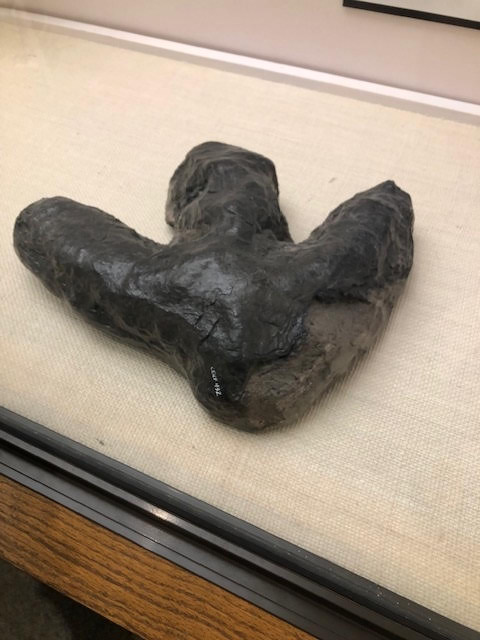
Dinosaurs in our past: Dinosaur Footprint Cast, The Prehistoric Museum, USU Eastern Campus, Price, UT Courtesy Mary Heers, Photographer
Dinosaur Footprint Cast
The Prehistoric Museum,
USU Eastern Campus, Price, UT
Courtesy Mary Heers, Photographer

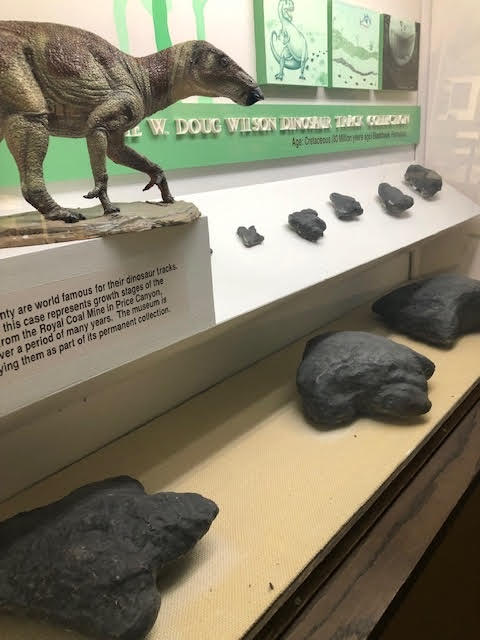
Dinosaur Footprint Display, The Prehistoric Museum, USU Eastern Campus, Price, UT  Courtesy Mary Heers, Photographer Dinosaur Footprint Display
The Prehistoric Museum,
USU Eastern Campus, Price, UT
Courtesy Mary Heers, Photographer

When I saw my first giant dinosaur footprint a the Natural History Museum of Utah, I said it was terrific.

“Dime a dozen, “ said my father-in-law, who was standing next to me. “The ceiling of the coal mine is littered with them.”

My ears perked right up. “Really,?” I said. “Maybe I could get one?”

As a young mining engineer right out of college, my father in law had been hired to run the Sunnyside coal mine about 25 miles outside of Price. He went on to explain that it was impossible to take a footprint out of the mine ceiling with risking bringing the whole roof down on your head. I had to agree it sounded difficult, but that didn’t stop me from sighing and saying, “I sure would like a dinosaur footprint for Christmas. “

In the end, he compromised by arranging a trip into the mine to see the footprints.

So, on a day no one was working in the mine, we climbed into the low riding miner’s car that carried us deep, deep into the heart of the mountain. When we got to the face we stopped and got out. In the dim light of our headlamps I could see we were in a huge cavernous room with massive pillars of coal, seven feet high and almost as wide, holding up the roof. And then I looked up and saw them – three toed footprints pressed down into the ancient mud that had turned into coal millions of years ago. Whole families of dinosaurs had strolled through this prehistoric swamp, leaving big prints, as long as two feet, and small ones, as small as six inches.

I found out later that the preservation of these footprints was a happy accident of sand filling up the prints soon after they were made. Millions of years later, when the decaying swamp plants were compressed into coal, the sand (itself pressed into sandstone,) held the shape of the foot.

A similar lucky mix of sand, water and pressure was needed to preserve dinosaur bones. Not all bones become fossils. So you can imagine the excitement in the scientific community when a fossil bed containing more than 12,000 dinosaur bones were discovered 30 miles south of Price. There were enough bones to qualify as a crime scene. To this day, my favorite spot in the Natural History Museum of Utah is the corner where 4 paleontologists on 4 TV screens square off with their earnest explanations for this massive bone pile-up.

    One says it was a watering hole that dried up so the dinosaurs died.

    “No,” says the second. There was too much water. The site became so muddy that the dinosaurs got stuck in the mud.

    The third offers up the idea that it could have been poison or a lethal germ that got in the water.

    “Oh, no,” says the fourth. The dinosaurs died somewhere else, and floodwaters floated them here.

It’s a mystery still waiting to be solved, and that’s what makes studying Utah’s past so interesting.

This is Mary Heers, and I’m Wild About Utah.

Credits:
Photos: Courtesy Mary Heers,
Featured Audio: Courtesy & Copyright © Friend Weller, Utah Public Radio upr.org
Text: Mary Heers, https://cca.usu.edu/files/awards/art-and-mary-heers-citation.pdf
Additional Reading: Lyle Bingham, https://bridgerlandaudubon.org/

Additional Reading

Wild About Utah, Mary Heers’ Wild About Utah Postings

Sunnyside Coal Mines, UtahRails.net, Last Updated March 8, 2019, https://utahrails.net/utahcoal/utahcoal-sunnyside.php

Prehistoric Museum, USU Eastern Campus, Price, UT, https://eastern.usu.edu/prehistoric-museum/

Natural History Museum of Utah, Rio Tinto Center, University of Utah, https://nhmu.utah.edu/

Galloping Thru Time

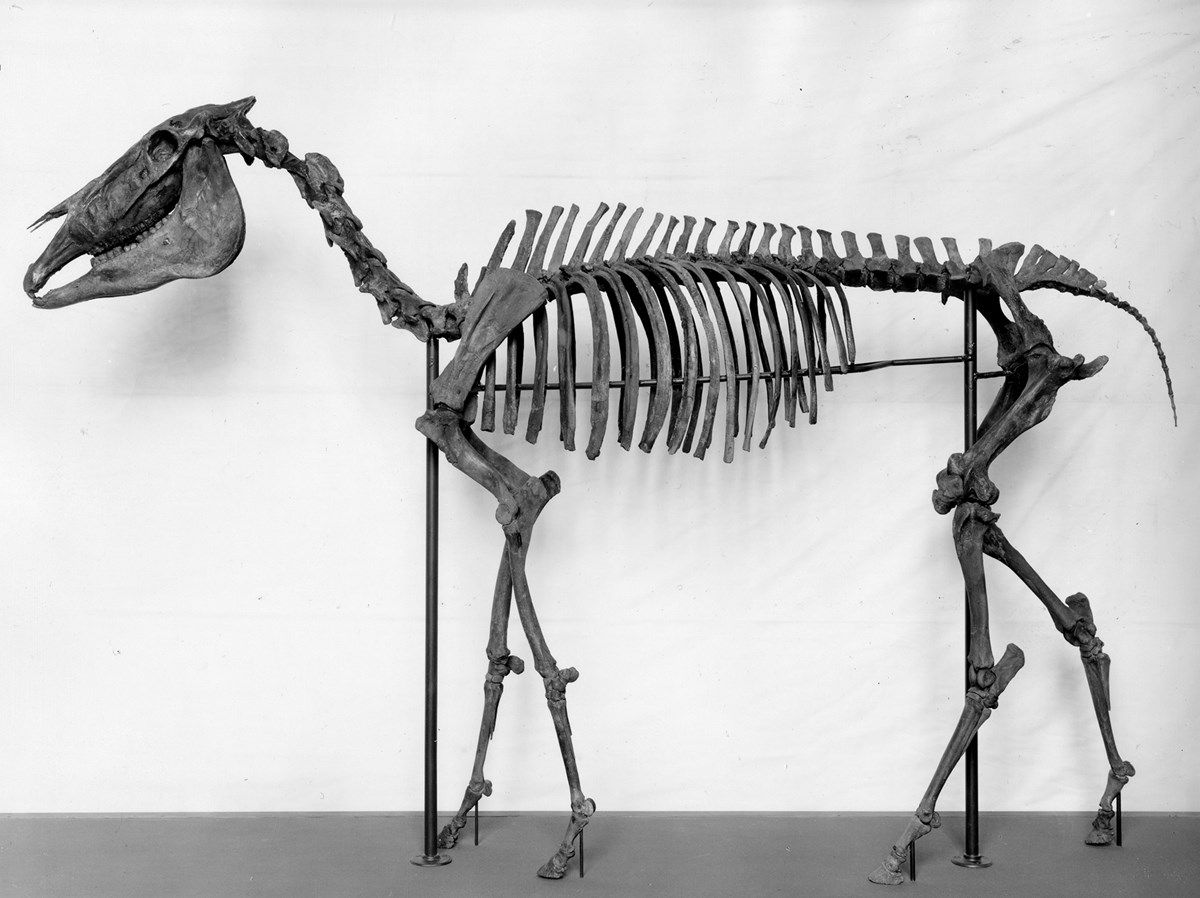
Gallop Thru Time: The Hagerman Horse (Equus simplicidens), Hagerman Fossil Beds National Monument, Courtesy US NPS
The Hagerman Horse (Equus simplicidens), Hagerman Fossil Beds National Monument, Courtesy US NPS

Elmer Cook Recognition Plaque Hagerman Fossil Bed National Monument Courtesy & © Mary Heers, Photographer Elmer Cook Recognition Plaque
Hagerman Fossil Bed National Monument
Courtesy & © Mary Heers, Photographer

Mary Heers' Selfie with the Hagerman Horse Hagerman Fossil Bed National Monument Courtesy & © Mary Heers, Photographer Mary Heers’ Selfie with the Hagerman Horse
Hagerman Fossil Bed National Monument
Courtesy & © Mary Heers, Photographer

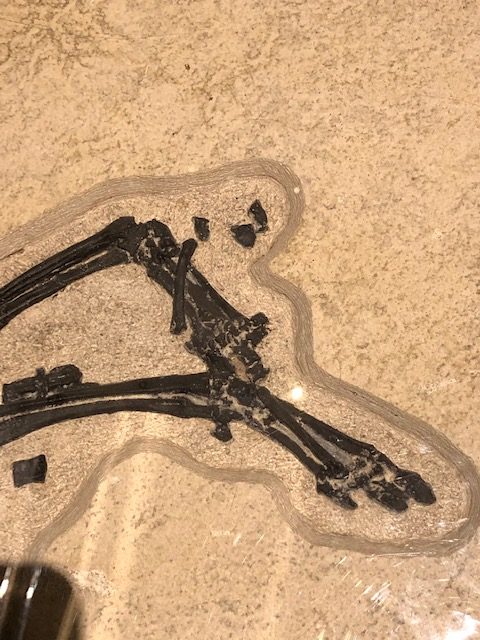
Three Toes on the Kemmerer Horse Utah Museum of Natural History Courtesy & © Mary Heers, Photographer Three Toes on the Kemmerer Horse
Utah Museum of Natural History
Courtesy & © Mary Heers, Photographer

Metacarpal Toe, Hoof Hagerman Horse Equus simplicidens Hagerman Fossil Bed National Monument Courtesy & © Mary Heers, Photographer Metacarpal Toe, Hoof Hagerman Horse
Equus simplicidens
Hagerman Fossil Bed National Monument
Courtesy & © Mary Heers, Photographer

Metacarpal Toe, Hoof Domestic Horse Equus ferus caballus Hagerman Fossil Bed National Monument Courtesy & © Mary Heers, Photographer Metacarpal Toe, Hoof Domestic Horse
Equus ferus caballus
Hagerman Fossil Bed National Monument
Courtesy & © Mary Heers, Photographer

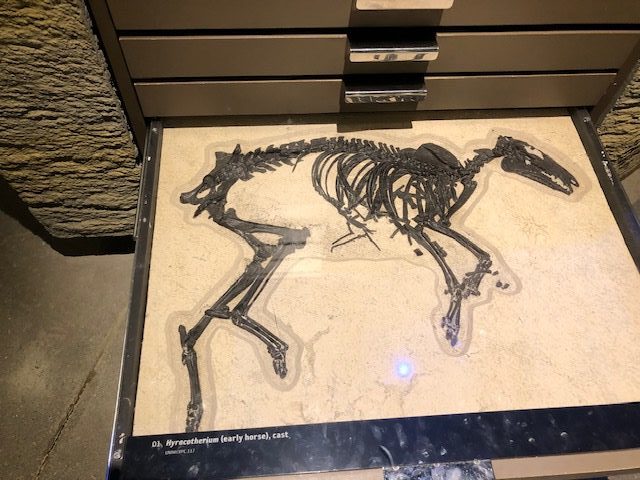
Cast of Kemmerer Early Horse Utah Museum of Natural History Courtesy & © Mary Heers, Photographer Cast of Kemmerer Early Horse
Utah Museum of Natural History
Courtesy & © Mary Heers, Photographer

In 1928 Elmer Cook, a rancher in Hagerman, Idaho, noticed an interesting bone sticking our of the hillside on his land overlooking the Snake River. Intrigued, he started to dig around and discovered it was a fossilized bone and there were plenty more like it. Elmer alerted the National Smithsonian Museum, who sent out a team. This team determined the bones were ancestors of the modern horse. They were 3½ million years old. In the end, after digging into the hillside for 2 years, they took over 200 fossils, including 12 complete horse skeletons, back to Washington D.C.

My own fascination with horse fossils actually began a few years ago when I was giving tours at the Utah Museum of Natural History in Salt Lake City. A fossil hunter near Kemmerer, Wyoming, had been quite surprised to find a small mammal while digging through layers of fossilized fish in an ancient seabed. This skeleton is now also in the Smithsonian Museum in D.C., but the Utah museum owns a copy.

When giving tours, I always paused my group as we entered the dinosaur floor. “I’m going to pull a whole horse out of here,” I’d say as I pulled a sliding drawer out of a chest with a flourish.

It was a fully grown horse about the size of a small dog – 24 inches long and 20 inches high.

It was over 50 million years old. In that time, the Intermountain West was a lush, swampy place. Fierce predators like the Utah Raptor roamed the land, and the mammals that survived were small and stayed hidden in the dense forested undergrowth.

Over the next 50 million years, the dinosaurs went extinct and the terrain dried out The Hagerman Horse (dating back 3 ½ million years ) stood about 4 ½ feet high. Most notably, it now stood on four hooves. The 3 toes on the Kemmerer Horse had evolved into a single dominant toe, perfectly adapted to running away from predators over dry terrain.

Unfortunately, this remarkable adaptation was not enough to save the horse. The horse went extinct in the Americas (along with other large mammals like the mammoth and giant sloth) about 10,000 years ago. It was the Spanish Conquistadors that reintroduced the horse to North America. When Hernan Cortez and his 200 soldiers landed in Mexico in 1519, they brought 16 horses with them. Over time, some of these horses got away to form wild bands, and others fell into the hands of the Native Americans.

This summer I made a small archeological pilgrimage into Idaho, to see the Hagerman Fossil Beds, now a National Monument. In the newly opened visitor center I found a life size replica of the Hagerman Horse. As I stood next to it, admiring its shapely hoof, I remembered one more remarkable fact about the horse. The bows now used to play violins are made from horse hair It takes 5 horse tails to make a violin bow. To this day, absolutely nothing has been found that makes the strings of a violin sing as sweetly.

This is Mary Heers and I am Wild About Utah.

Credits:
Photos: Courtesy & Copyright © Mary Heers
Photos: Courtesy
Featured Audio: Courtesy & Copyright © Kevin Colver, https://wildstore.wildsanctuary.com/collections/special-collections/kevin-colver
Text: Mary Heers, https://cca.usu.edu/files/awards/art-and-mary-heers-citation.pdf
Additional Reading: Lyle Bingham, https://bridgerlandaudubon.org/

Additional Reading

Wild About Utah, Mary Heers’ Wild About Utah Postings

Hagerman Fossil Beds National Monument, History, National Parks Service, US Department of the Interior, https://npshistory.com/publications/hafo/index.htm

The Hagerman Horse (Equus simplicidens), Hagerman Fossil Beds National Monument, National Parks Service, US Department of the Interior, https://www.nps.gov/articles/000/equus_simplicidens.htm

Hagerman Fossil Beds, National Parks Service, US Department of the Interior, https://www.nps.gov/hafo/index.htm

The Horse (Exhibit), Natural History Museum of Utah, July 21, 2014 – January 4, 2015, https://nhmu.utah.edu/horse#:~:text=The%20Natural%20History%20Museum%20of,and%20spiritual%20connections%20with%20them.
Natural History Museum of Utah,https://nhmu.utah.edu/

Fossil Horse Quarry Near Hagerman, Idaho, Worked by National Museum, Smithsonian Libraries and Archives, The Smithsonian Institution, https://www.si.edu/object/fossil-horse-quarry-near-hagerman-idaho-worked-national-museum:siris_arc_367758

Plesippus shoshonensis Gidley, 1930, National Museum of Natural History, The Smithsonian Institution, https://www.si.edu/object/plesippus-shoshonensis-gidley-1930:nmnhpaleobiology_3590445


Dinosaurs in Our Past

Dinosaurs in our past: Dinosaur Footprint Cast, The Prehistoric Museum, USU Eastern Campus, Price, UT Courtesy Mary Heers, Photographer
Dinosaur Footprint Cast
The Prehistoric Museum,
USU Eastern Campus, Price, UT
Courtesy Mary Heers, Photographer

Dinosaur Footprint Display, The Prehistoric Museum, USU Eastern Campus, Price, UT  Courtesy Mary Heers, Photographer Dinosaur Footprint Display
The Prehistoric Museum,
USU Eastern Campus, Price, UT
Courtesy Mary Heers, Photographer

When I saw my first giant dinosaur footprint a the Natural History Museum of Utah, I said it was terrific.

“Dime a dozen, “ said my father-in-law, who was standing next to me. “The ceiling of the coal mine is littered with them.”

My ears perked right up. “Really,?” I said. “Maybe I could get one?”

As a young mining engineer right out of college, my father in law had been hired to run the Sunnyside coal mine about 25 miles outside of Price. He went on to explain that it was impossible to take a footprint out of the mine ceiling with risking bringing the whole roof down on your head. I had to agree it sounded difficult, but that didn’t stop me from sighing and saying, “I sure would like a dinosaur footprint for Christmas. “

In the end, he compromised by arranging a trip into the mine to see the footprints.

So, on a day no one was working in the mine, we climbed into the low riding miner’s car that carried us deep, deep into the heart of the mountain. When we got to the face we stopped and got out. In the dim light of our headlamps I could see we were in a huge cavernous room with massive pillars of coal, seven feet high and almost as wide, holding up the roof. And then I looked up and saw them – three toed footprints pressed down into the ancient mud that had turned into coal millions of years ago. Whole families of dinosaurs had strolled through this prehistoric swamp, leaving big prints, as long as two feet, and small ones, as small as six inches.

I found out later that the preservation of these footprints was a happy accident of sand filling up the prints soon after they were made. Millions of years later, when the decaying swamp plants were compressed into coal, the sand (itself pressed into sandstone,) held the shape of the foot.

A similar lucky mix of sand, water and pressure was needed to preserve dinosaur bones. Not all bones become fossils. So you can imagine the excitement in the scientific community when a fossil bed containing more than 12,000 dinosaur bones were discovered 30 miles south of Price. There were enough bones to qualify as a crime scene. To this day, my favorite spot in the Natural History Museum of Utah is the corner where 4 paleontologists on 4 TV screens square off with their earnest explanations for this massive bone pile-up.

    One says it was a watering hole that dried up so the dinosaurs died.

    “No,” says the second. There was too much water. The site became so muddy that the dinosaurs got stuck in the mud.

    The third offers up the idea that it could have been poison or a lethal germ that got in the water.

    “Oh, no,” says the fourth. The dinosaurs died somewhere else, and floodwaters floated them here.

It’s a mystery still waiting to be solved, and that’s what makes studying Utah’s past so interesting.

This is Mary Heers, and I’m Wild About Utah.

Credits:
Photos: Courtesy Mary Heers,
Featured Audio: Courtesy & Copyright © Friend Weller, Utah Public Radio upr.org
Text: Mary Heers, https://cca.usu.edu/files/awards/art-and-mary-heers-citation.pdf
Additional Reading: Lyle Bingham, https://bridgerlandaudubon.org/

Additional Reading

Wild About Utah, Mary Heers’ Wild About Utah Postings

Sunnyside Coal Mines, UtahRails.net, Last Updated March 8, 2019, https://utahrails.net/utahcoal/utahcoal-sunnyside.php

Prehistoric Museum, USU Eastern Campus, Price, UT, https://eastern.usu.edu/prehistoric-museum/

Natural History Museum of Utah, Rio Tinto Center, University of Utah, https://nhmu.utah.edu/