Spring’s Earliest Butterflies

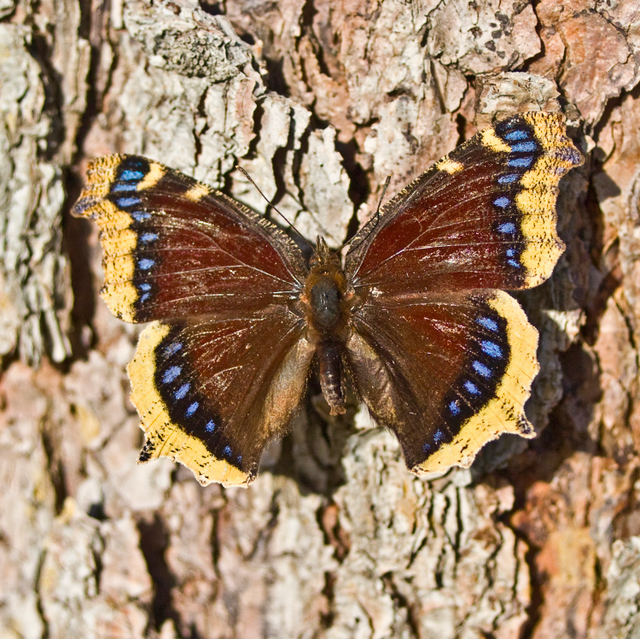
Mourning cloak butterfly courtesy and copyright 2010 Don Rolfs
Mourning cloak butterfly (pinned)
Photo by Don Rolfs 2010

Utah’s earliest solar collectors are smaller than a credit card; their carbon footprints are likewise tiny. They convert the sun’s energy to heat, not electricity, and they self multiply. I am referring to butterflies, particularly those that can be found flying on sunny days of late winter while our snow still lingers.

Our earliest butterflies transformed to adults last fall and have spent the winter wedged in nooks and crannies, such as cracks in deadwood or under flaps of bark. The butterflies’ names are generally more colorful than their appearance: red admirals, painted ladies, mourning cloaks, tortoise shells, commas and question marks. Their wing edges are scalloped and irregular, the topsides patterned or banded in tawny browns and muted oranges sometimes edged with yellow or red. Beneath, they tend to be camouflaged with patterns in shades of brown like a moldering leaf.

Satyr Anglewing butterfly
Photo © Jim Cane 2010

Being insects, butterflies generate little metabolic heat, so for warmth they quite literally turn to the sun on chilly spring days. Watch where they land and you will see them with their wings folded over their backs, their stance and tilt perfectly aligning their wings perpendicular to the sun’s rays. The sunshine that they intercept warms their bodies and enables them to fly even when the air is cold. Butterflies of early spring often fuel their flights with the sugars of tree sap where it leaks from a bark injury.

The mourning cloak butterfly is particularly recognizable, it’s rich brown wings edged with gold like gilt paint.

Red Admiral Butterfly
Thomas G. Barnes
US FWS Digital Library

If you see a mourning cloak flying among willows, watch carefully, for the females will be laying their tiny eggs singly on the tips of young emerging willow leaves. Like our migratory birds, the appearance of these early butterflies are living harbingers of the spring to come, a welcome sight indeed.

This is Linda Kervin for Bridgerland Audubon Society.

Credits:

Pictures: Don Rolfs
Jim Cane, Bridgerland Audubon Society
Thomas G. Barnes, US FWS

Painted Lady Butterfly
Thomas G. Barnes
US FWS Digital Library

Theme: Courtesy & Copyright Don Anderson as performed by Leaping Lulu
Text: Jim Cane, Bridgerland Audubon Society
Voice: Linda Kervin, Bridgerland Audubon Society

Additional Reading:

The National Audubon Society Field Guide to North American Butterflies, Robert Michael Pyle, National Audubon Society, https://www.amazon.com/National-Audubon-Society-American-Butterflies/dp/0394519140

Peterson First Guide to Butterflies and Moths, Paul A. Opler, Roger Tory Peterson, and Amy Bartlett Wright, Houghton Mifflin Harcourt, https://www.amazon.com/Peterson-First-Guide-Butterflies-Moths/dp/0395906652

Butterflies on Utah Bug Club web site, Utah Lepidopterists’ Society, https://www.utahbugclub.org/finding-utah-butterflies.php

Butterflies of Utah, Butterflies and Moths of North America, https://www.butterfliesandmoths.org/map?ds=45&_dcs=1

Question Mark Butterfly
Thomas G. Barnes
US FWS Digital Library

Painted Lady

Red Admiral

Mourning Cloak

Grey Comma

Milbert’s Tortoiseshell

Utah Paper Wasps

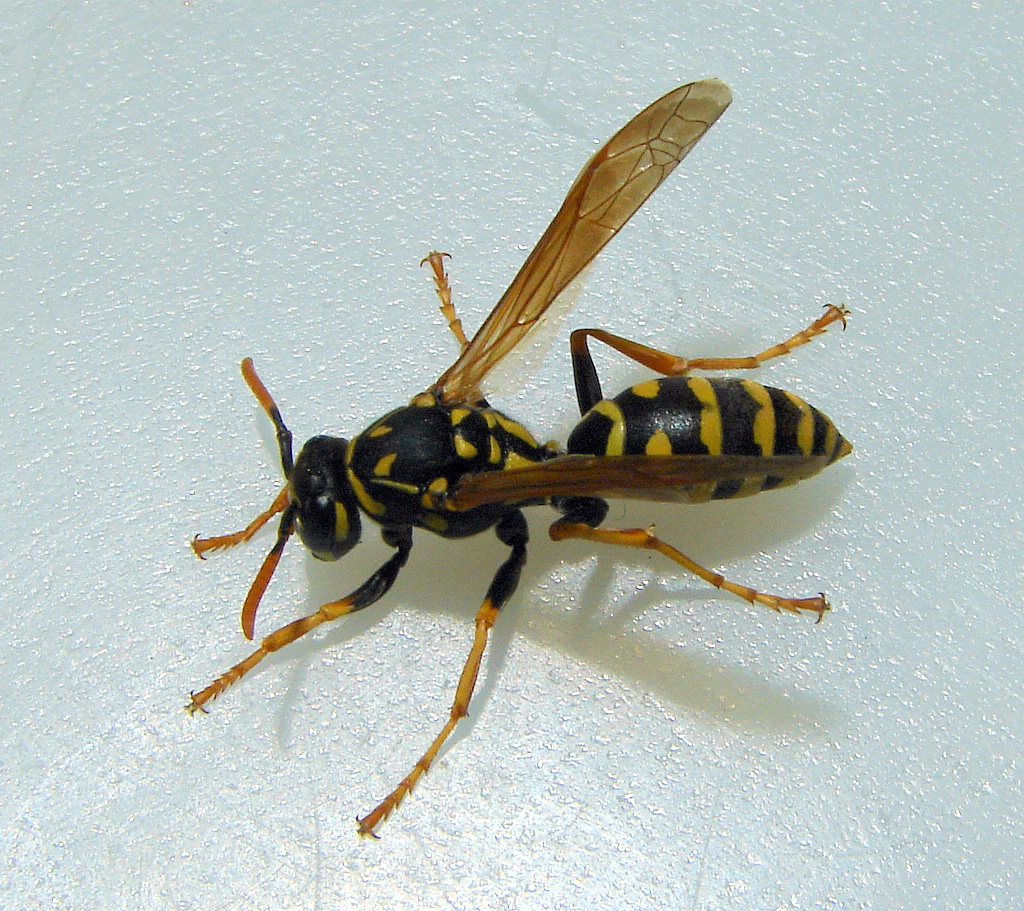
Adult Poliste Paper Wasp
Copyright © 2009 Jim Cane

We credit the Chinese with inventing paper 2000 years ago, but some social wasps have been making their paper nests for eons. Species of paper wasps are found throughout Utah.

The burly bald-faced hornet workers are patterned in black and white. They place their grey, basketball sized paper nests in tree branches.

Bold yellow and black striped Yellowjackets are the persistent unwelcome guests at summer picnics. They too wrap their round nests in an envelope of paper, but typically place it in a shallow underground chamber. Within the paper envelope, both hornets and yellowjackets have a muti-tiered stack of paper honeycombs, like an inverted pagoda.

Open-faced nest of Polistes
paper wasp with grub-like larvae
Copyright © 2009 Jim Cane

Our most familiar paper wasps belong to the genus Polistes. These are the reddish-brown spindly looking wasps. They make their simple paper nests under your home’s roof eaves and deck railings. A Polistes nest consists of a single inverted paper honeycomb suspended from a stiff, short stalk. There is no paper envelope, so you can readily see the hexagonal paper cells. Around your yard, look for the workers scraping fibers from weathered wood surfaces. Workers mix the chewed fibers with saliva and water, carry the ball of wood pulp home, and add it to the thin sheets of their paper nest. The nest is their nursery, where you can see the queen’s tiny sausage shaped eggs and the fat white grubs. The grubs are fed by their sisters, the workers, who scour the surrounding habitat for insect prey or damaged fruit.

The enclosed nest of the
bald-faced hornet
Copyright © 2009 Jim Cane

Utah has been invaded by the European species Polistes dominula. These interlopers are displacing our native Polistes. Where these European Polistes wasps are a stinging nuisance, you can easily dispatch them at their nests with a sprayed solution of dishwashing detergent and water. Thus stripped of its clever defenders, take the opportunity to admire their homes of paper.

This is Linda Kervin for Bridgerland Audubon Society.

Credits:

Photo: Courtesy and © Copyright 2009 Jim Cane

Text: Jim Cane, Bridgerland Audubon Society

Additional Reading:

https://extension.usu.edu/files/publications/factsheet/yellowjackets-hornets-wasps09.pdf

https://ohioline.osu.edu/hyg-fact/2000/2077.html

https://insects.tamu.edu/fieldguide/cimg348.html


Squash Bees

Audio:  mp3 Listen to WildAboutUtah

Three Squash Bees
Peponapis pruinosa
Copyright © 2009 Jim Cane

At long last we are enjoying full summer, and with it, the bounty of our gardens. Last August on this program, you learned about our native squash bees. Unlike honeybees and bumblebees, Squash bees are not social. Each female excavates a simple vertical tunnel in the dirt the diameter of a pencil. Lateral tunnels terminate in tiny chambers where she caches pollen and nectar to feed her progeny. She lays one egg per chamber. These nests are well concealed.

But you can readily see the feverish activity of males and females at squash, pumpkin and gourd flowers soon after sunrise, often before honeybee activity. Squash bees are the size of honey bees, but earlier, faster and more deliberate in their flight. Males have a yellow spot on the face. Unlike honeybees, female squash bees carry squash pollen dry in a brush of hairs on their hind legs.

Both sexes of squash bee are valuable pollinators, indeed they are the unheralded pollinators of most of the nations squash and pumpkins. But there is more to their story in Utah. Their native hosts, the wild gourds, only grow in the hot low deserts. Native Americans domesticated and cultivated squashes and gourds, but the practice did not spread north of the red rock country. Across most of Utah and the northern US in general, we have squash bees because we grow squash. In Utah, European settlers first grew squashes only 150 years ago. Each annual generation of squash bees spread further north, hopscotching from homestead to homestead, reaching as far north today as Boise Idaho. As you pick your zucchinis, butternuts and pumpkins, realize that your squash’s flowers also fed the descendants of our squash bee pioneers.

This is Linda Kervin for Bridgerland Audubon Society.

Credits:

Photo: Courtesy and © Copyright 2009 Jim Cane

Text: Jim Cane, Bridgerland Audubon Society

Additional Reading:

Our Native Squash Bees, Wild About Utah, 12 August 2008, https://wildaboututah.org/squash-bees/

Squash Pollinators of the Americas Survey (SPAS), James Cane, USDA Pollinating Insect Research Unit, Utah State University

2009: https://www.ars.usda.gov/Research/docs.htm?docid=16595

2005: https://www.ars.usda.gov/Research/docs.htm?docid=12041

Perfect Pumpkin Pollinators: The Squash Bees!, James Cane, Frank A. Eischen, Blair J. Sampson, USDA-ARS, https://www.ars.usda.gov/is/AR/archive/nov08/bees1108.htm Also published in Agricultural Research magazine Nov/Dec 2008 https://www.ars.usda.gov/is/AR/archive/nov08/

Across the Americas, Squash and Gourd Bees Are Superb Pollinators, Marcia Wood, Dec 30, 2008, https://www.ars.usda.gov/is/pr/2008/081230.htm

Celebrating Wildflowers, Pollinator of the Month, Squash Bees, Jim Cane, USDA ARS, Bee Biology & Systematics Lab, Logan, Utah https://www.fs.usda.gov/wildflowers/pollinators/pollinator-of-the-month/squash_bees.shtml (updated 8/22/2024)

Crop domestication facilitated rapid geographical expansion of a specialist pollinator, the squash bee Peponapis pruinosa, Margarita M. López-Uribe, James H. Cane, Robert L. Minckley, Bryan N. Danforth
Proc. R. Soc. B 2016 283 20160443; DOI: 10.1098/rspb.2016.0443. Published 22 June 2016, https://rspb.royalsocietypublishing.org/content/283/1833/20160443.abstract

The Migratory Locust in North America; a post mortem

The Migratory Locust in North America; a post mortem
Rocky Mountain Locust were similar
to this Large Grasshopper
Melanoplus sanguinipes
Photo#215400
Copyright © 2008 Lynette Schimming
As found on www.bugguide.net

Vast migratory swarms of flying grasshoppers, or locusts, have periodically scoured arid parts of Africa and the Middle East since Biblical times, devastating crops and causing famine. But did you know that during the 19th century, American homesteaders were likewise plagued by migratory swarms of grasshoppers? The largest swarm passed through Nebraska in June of 1875; it was 110 miles wide, 1800 miles long and more than a 1/4 mile thick, taking five days to pass overhead. It remains the world’s largest recorded insect outbreak.

Here in Utah, at the time of the transcontinental railroad, migratory locusts periodically descended on the homesteads of Mormon settlers, laying up to 1 billion eggs per acre. These ravenous swarms devoured crops, vegetation, even laundry hung out to dry. Around the Great Salt Lake, drowned pickled grasshoppers would wash ahore in vast drifts. Native peoples gathered these salty, sun-dried hoppers for food, a rich source of protein and fat.

Why are we no longer plagued by locust swarms? It appears that the Rocky Mountain locust, went extinct at the turn of the 20th century. Entomologist Jeffrey Lockwood reports that the DNA of specimens preserved in the ice of glaciers in the Wind River Range are like no other grasshopper alive today. The cause of the locust’s abrupt extinction may never be known with certainty, but Lockwood believes that these outbreaks originated in the mountain meadows of the northern Rockies. By the 1880s, these public lands were packed with cattle and sheep, far more than the land could sustain. In a few short years, livestock stripped bare the very core habitats needed by the Rocky Mountain locust, leading to its abrupt extinction and the end of locust swarms in North America.

This is Linda Kervin for Bridgerland Audubon Society.

Credits:

Photo: Courtesy & Copyright © 2008 Lynette Schimming (As found on www.bugguide.net)

Text: Jim Cane, Bridgerland Audubon Society
Additional Reading:

Locust: The Devastating Rise and Mysterious Disappearance of the Insect that Shaped the American Frontier, Jeffrey Lockwood, Basic Books, 2004,ISBN:9780738208947, https://www.amazon.com/Locust-Devastating-Mysterious-Disappearance-American/dp/0465041671

Read more: 1. https://historyphilosophybooks.suite101.com/article.cfm/locust_by_jeffrey_lockwood#ixzz0IVh4qXFR&C

First and annual report of the United States Entomological commission for the year 1877 relating to the Rocky Mountain locust and the best methods of preventing its injuries and of guarding against its invasions Digitized by Google Books from Harvard University

https://en.wikipedia.org/wiki/Locust

Pestiferous Ironclads: The Grasshopper Problem in Pioneer Utah, Davis Bitton and Linda P Wilcox, Utah Historical Quarterly, 46 #4 as found on “Utah History to Go” https://historytogo.utah.gov/utah_chapters/pioneers_and_cowboys/pestiferousironclads.html

Andersen, Rebecca, Miracle of the Crickets, Utah Stories from the Beehive Archive, 2011, accessed June 9, 2024, https://www.utahhumanities.org/stories/items/show/223