Tulips and Daffodils- It’s Spring!

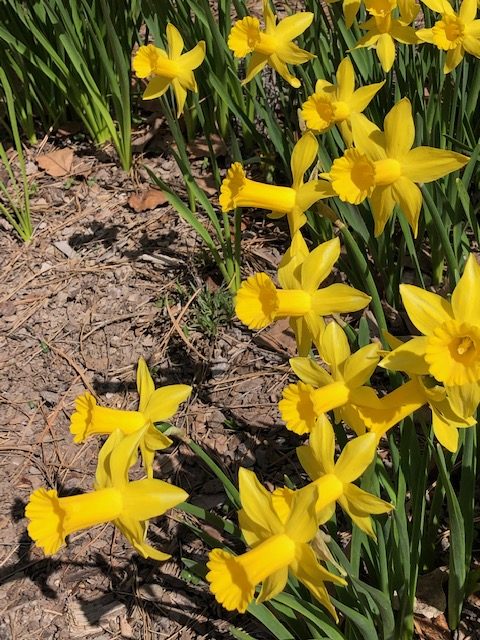
Tulips and Daffodils- It’s Spring! The Trumpet Choir Daffodils at Thanksgiving Point Courtesy & © Mary Heers, Photographer
The Trumpet Choir
Daffodils at Thanksgiving Point
Courtesy & © Mary Heers, Photographer

Daffodil Encore, Thanksgiving Point Courtesy & © Mary Heers, Photographer Daffodil Encore
Thanksgiving Point
Courtesy & © Mary Heers, Photographer
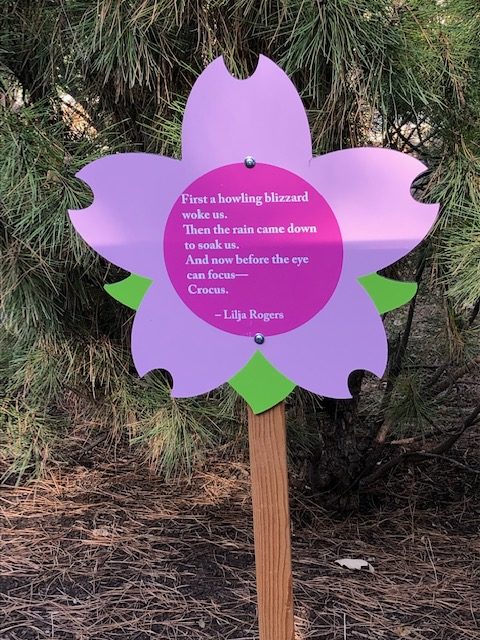
My Favorite Sign Along the Path, Lilja Rogers, Published as Hocus Pocus in the Saturday Evening Post, 1961, Image Courtesy & © Mary Heers, Photographer My Favorite Sign Along the Path
Lilja Rogers, Published as Hocus Pocus in the Saturday Evening Post, 1961
Image Courtesy & © Mary Heers, Photographer
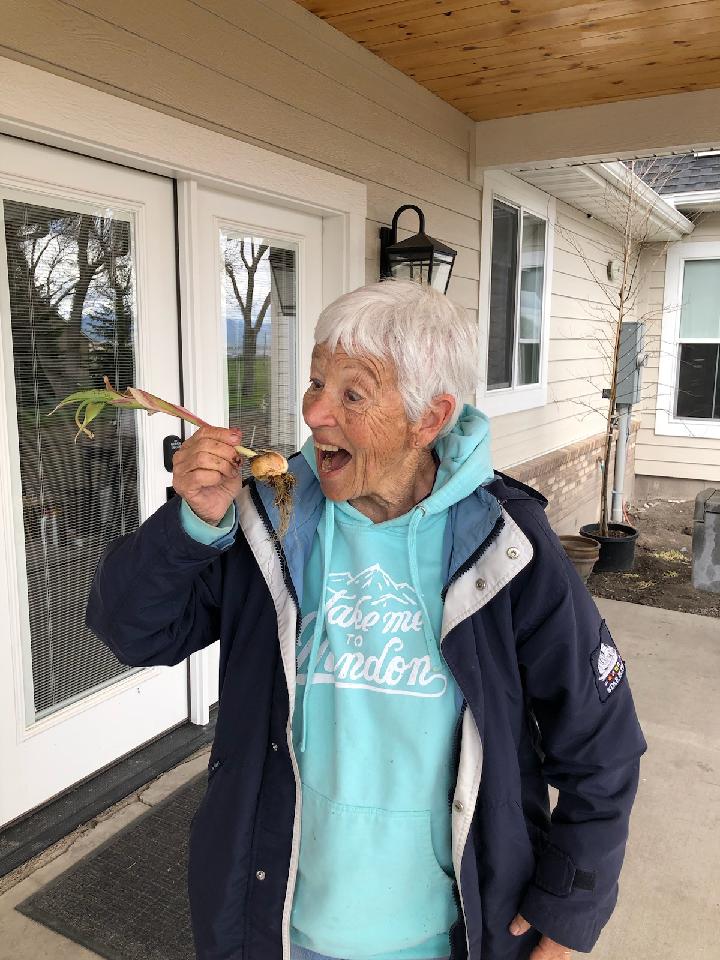
Mary Eating a Tulip, Courtesy & © Mary Heers Mary Eating a Tulip
Courtesy & © Mary Heers
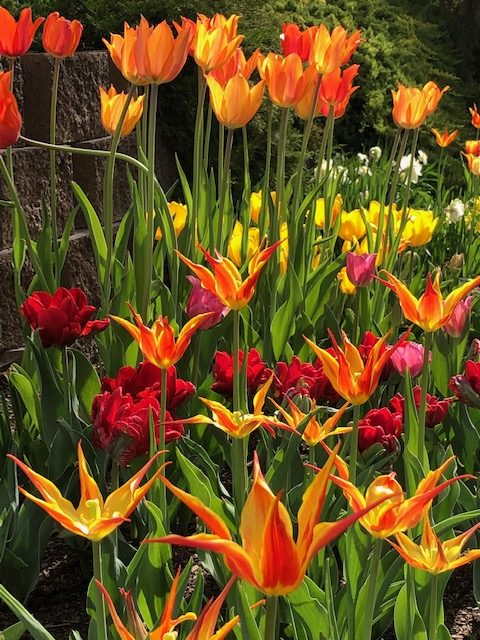
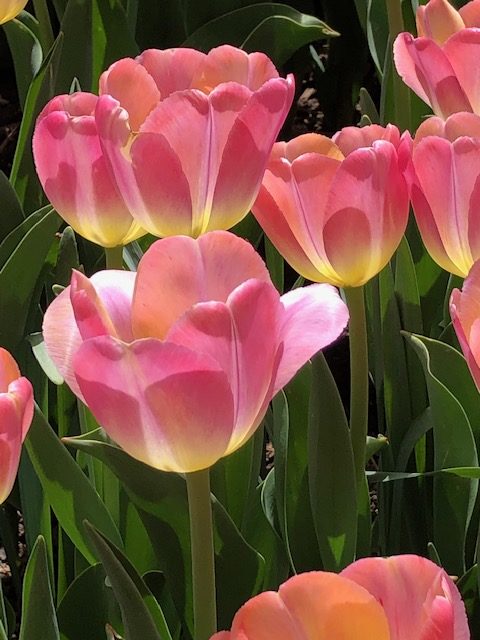
My Favorite Photo Tulips at Thanksgiving Point Courtesy & © Mary Heers, Photographer
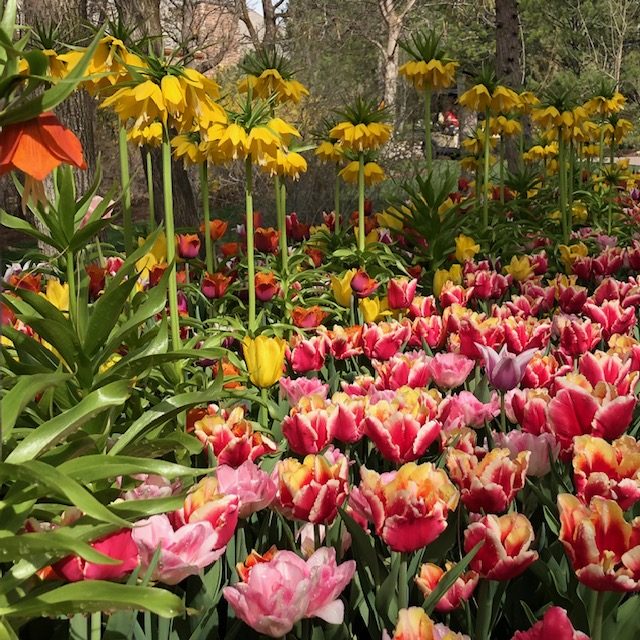
More Tulips Thanksgiving Point Courtesy & © Mary Heers, Photographer
Close Up - Tulips Thanksgiving Point Courtesy & © Mary Heers, Photographer
Mix of Tulips Thanksgiving Point Courtesy & © Mary Heers, Photographer
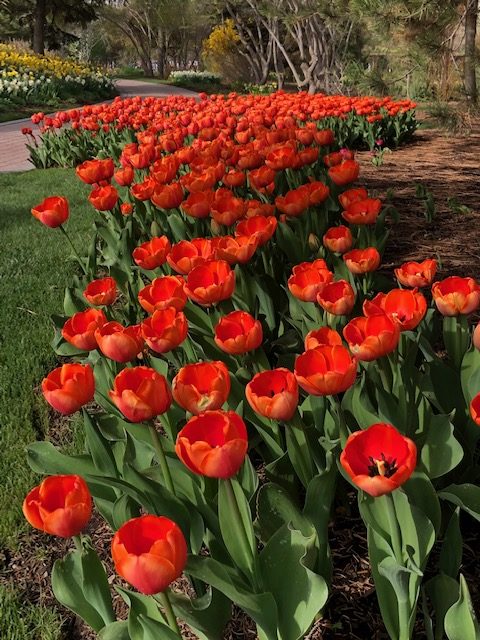
Red Tulips Thanksgiving Point Courtesy & © Mary Heers, Photographer
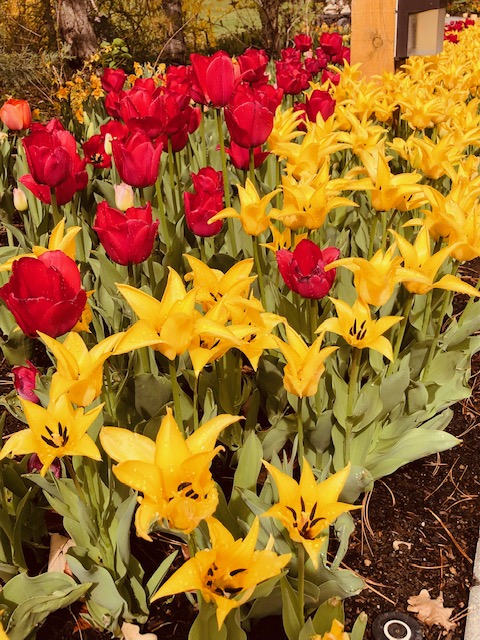
Red and Yellow Tulips Go Well Together Thanksgiving Point Courtesy & © Mary Heers, Photographer Above Tulips From Rebound Visit
Thanksgiving Point
Courtesy & © Mary Heers, Photographer

When I arrived at the Tulip Festival at Thanksgiving Point I was informed by a guide that the tulips were running late.

“No tulips?” I asked. I had heard they had planted 250,000.

“It has everything to do with the soil temperature,” my guide explained. It was April 14. She wasn’t expecting the tulips to emerge for at least another two weeks.

All was not lost, she hastened to add.

“The daffodils are up.”

So off we went along the paths of the 50 acre Ashton Gardens. Sure enough, hundreds of daffodils were waving their heads in the light breeze. I was especially drawn to a patch that they were intensely yellow, almost orange.

“Those are the ‘Tweety-Birds’,” my guide said.

I knelt down to get a good look at the trumpet shape of the flowers. Wow, I thought. This is the trumpet choir heralding the end of winter and the coming of spring.

So with my return ticket secure in my pocket, I went back to Mendon to wait. Snow was still on the ground.

This gave me time to read up on tulips. I found they were originally from Turkey. Tulip, in Turkish, means turban.

The exotic plant arrived in Holland in the 1500’s., It soon became so popular that the price went through the roof. At the height of the tulip mania, some people were willing to pay the price of a house for a single bulb.

About this time, a friend loaned me a book about this phenomenon, Tulip Fever. It turned out to be a real page turner. Set in 1630, young lovers in Amsterdam concocted an incredible scheme to run away and live comfortably in the colonies – if they played their tulips right.

Back in Mendon, when the snow finally started to melt, my neighbors began to tell me how the hungry deer had come into their gardens and beheaded their tulips. Their daffodils were left untouched.

Time for more research. I learned the daffodils produce a toxic alkaloid, lycorine, which makes them taste bitter. Tulips, however, are not only edible, but delicious.

About this time I noticed a lone tulip popping up next to my apple tree. No one planted a bulb here. This tulip had arrived as a seed. Years ago, the wind, or a bird. or an animal dropped this seed . Tulip seeds only take a few months to germinate. But it can take up to 5 years for the plant to produce a bulb which, in turn, produces the flower.

During WWII, when the German army occupied Holland, a large part of the population found themselves with nothing to eat but the tulip bulbs they had set aside to plant. They survived because a tulip bulb has as many calories as a potato.

I was sharing this tidbit of information with my good friend and neighbor when she reminded me the early Mormon pioneers had staved off hunger by eating the wild Sego Lilies that were growing on the nearby mountainsides.

Then she disappeared into her kitchen. She came back with a flower pot holding a tulip that had already bloomed. She pulled out the bulb and asked me if I wanted to taste it.

Never one to refuse a gift, I peeled off the outer layers and took a bite.

I chewed. She waited. It wasn’t bitter and it wasn’t sweet. I chewed some more. I wanted to say

green. Finally it came to me.

“Celery!”

This is Mary Heers and I’m Wild About Utah.

Credits:
Photos: Courtesy & Copyright Mary Heers, Photographer
Featured Audio:
Text: Mary Heers, https://cca.usu.edu/files/awards/art-and-mary-heers-citation.pdf
Additional Reading: Lyle Bingham, https://bridgerlandaudubon.org/

Additional Reading

Wild About Utah, Mary Heers’ Postings

Tulip Festival, Thanksgiving Point, https://thanksgivingpoint.org/events/tulip-festival/
Tulip Festival: Bounce-back!, https://thanksgivingpoint.org/tulip-festival-bounce-back/ [accessed 5/13/2023]

Pace, Eliza, Tulip festival to return to Thanksgiving Point, KSL TV, March 7, 2023, https://ksltv.com/530567/tulip-festival-to-return-to-thanksgiving-point/ [accessed 5/13/2023]

Stefanaki, A., Walter, T. & van Andel, T. Tracing the introduction history of the tulip that went wild (Tulipa sylvestris) in sixteenth-century Europe. Sci Rep 12, 9786 (2022). https://doi.org/10.1038/s41598-022-13378-9 AND https://www.nature.com/articles/s41598-022-13378-9 [accessed 5/13/2023]

The Amsterdam Tulip Museum, https://amsterdamtulipmuseum.com/tulip/
Tulip History Outside Of Holland, The Amsterdam Tulip Museum, https://amsterdamtulipmuseum.com/topics/tulip-history-in-many-nations/

Moggach, Deborah, Tulip Fever: A Novel, Dial Press Trade Paperback, April 10, 2001,https://www.amazon.com/Tulip-Fever-Novel-Deborah-Moggach/dp/0385334923

Eating tulip bulbs, Fluwel, https://www.fluwel.com/pages/eating-tulip-bulbs

Brown, Janice, First a Howling Blizard… A Poem by Lilja Rogers, Posted May 31, 2007, Cow Hampshire, https://www.cowhampshireblog.com/2007/05/31/poem-first-the-howling-winds-awoke-us-by-lilja-rogers/
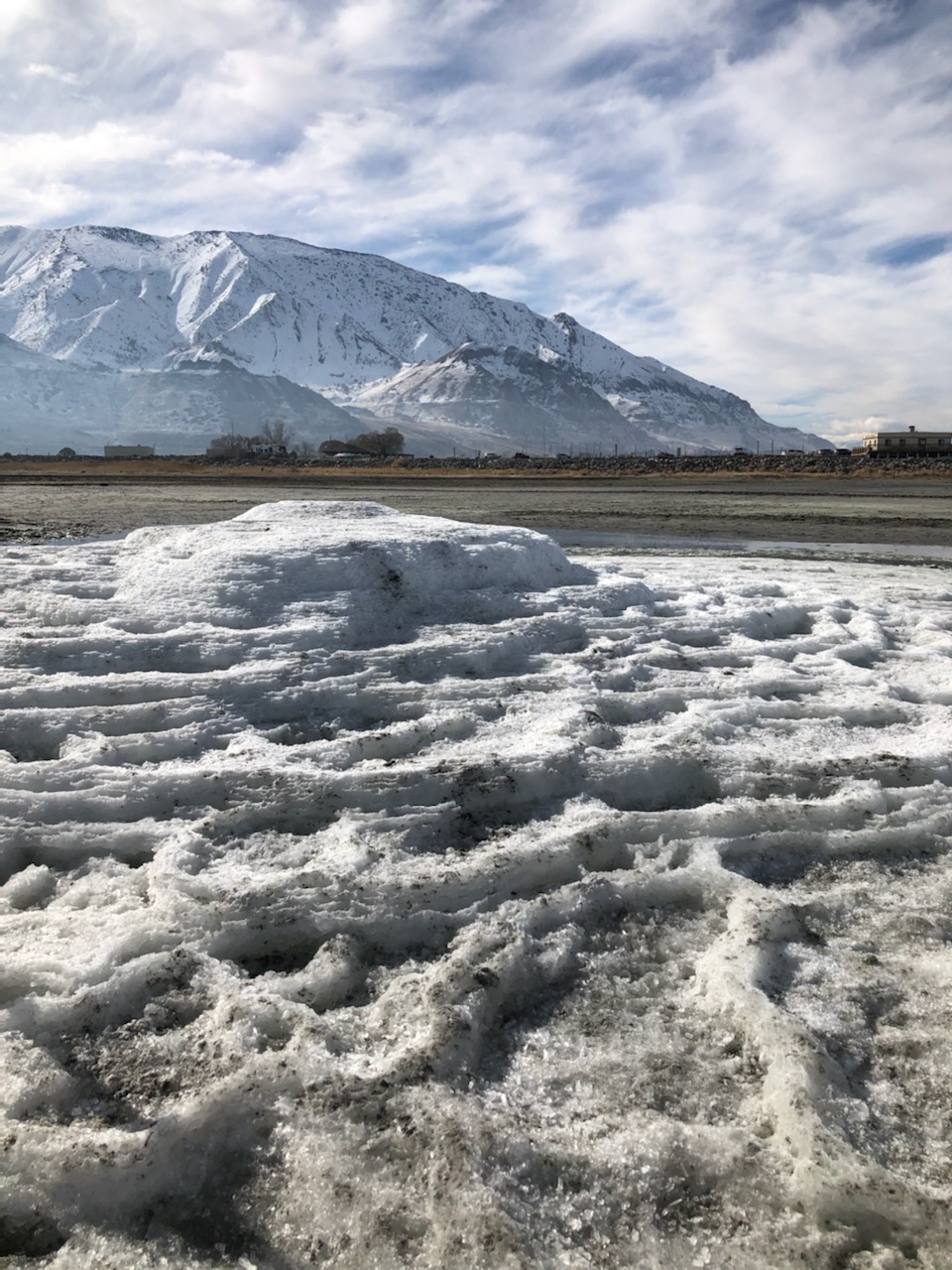
Great Salt Lake Mirabilite Mounds

Mirabilite Mounds in the Great Salt Lake Courtesy & © Mary Heers, Photographer
Mirabilite Mounds
in the Great Salt Lake
Courtesy & © Mary Heers, Photographer
Back in October 2019, the ranger at the Great Salt Lake State Park began to notice a white mound forming on the sand flats behind the visitor center. The white mounds turned out to be hydrated sodium sulfate – known as mirabilite- which was being carried to the surface by the upwelling of a fresh water spring. Since the 1940’s geologists have known that in this area, 30 inches below the surface, there was a 3 – 6 foot thick shelf of mirabilite. They knew about the fresh water springs What was new was cold air. Since this stretch of sand was no longer underwater, the mirabilite carried to the surface stayed there as crystals, piling up on each other, puddling and spreading out. One mound rose to the height of 3 feet.

Mirabilite Springs in the shadow of the Kennecott Smelter stack Courtesy & © Mary Heers, Phorographer
Mirabilite Springs in the shadow of the Kennecott Smelter stack
Courtesy & © Mary Heers, Phorographer
When the mounds started to form again this winter, I jumped at the chance to to go and take a look. I must admit at first I was a little underwhelmed at the size, perhaps because the Kennecott Smelter Stack nearby dominates the view, rising to 1,215 feet – roughly the same height as the Empire State Building. But the park ranger got my attention when she told us that mirabilite mounds have only been seen in four places in the entire world – the Canadian Arctic, Antarctica, Central Spain, – and Utah. Just seeing them turns out to be a rare winter treat. When the air warms to 50 degrees, the mirabilite will crumble into a fine white powder and disappear.

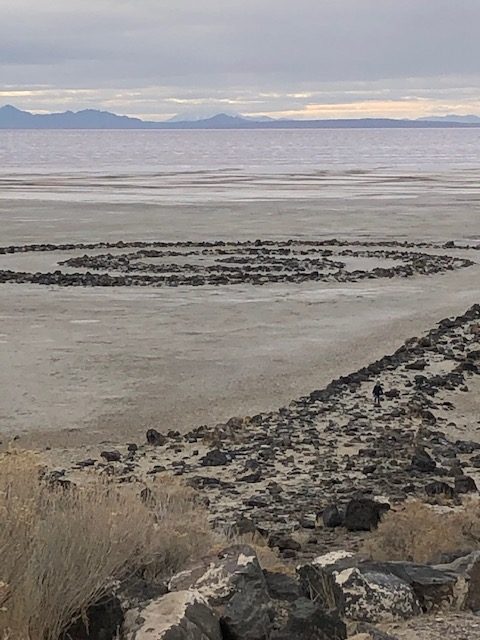
Robert Smithson's Spiral Jetty (1970) Courtesy & © Mary Heers, Photographer
Robert Smithson’s Spiral Jetty (1970)
Courtesy & © Mary Heers, Photographer
My mind flashed back to a trip I’d made to the other end of the lake ten years ago. I’d just graduated from the docent training class at the Utah Museum of Fine Art, and a friend and I wanted to celebrate by having High Tea at the center of the Spiral Jetty, a 1,500 foot, long, 15 foot wide coil of black basalt rock – a stunning example of land art jutting out from the northern shore. We’d been warned that it might be underwater, but when we arrived we were delighted to find we could easily walk to the very center of the spiral as the lake water gently lapped at the edges of our shoes. We clinked our tea cups, and toasted the greatness of the lake.

Suddenly I wanted to see the jetty again, so I hopped in my car and drove to the remote site. I saw the Spiral Jetty was now high and dry. Drifting sand had already started to bury parts of it. The water’s edge was now over 300 yards away. I thought of the millions of migratory birds that would be arriving in the spring to rest and feast on the tiny treasures of the lake, the brine shrimp. I hoped a smaller lake would still be enough for all of them.

The recent words of the director of Friends of the Great Salt Lake, Lynn de Freitas, rang in my head: “The Great Salt Lake is a gift that keeps on giving. Just add water.”

This is Mary Heers and I’m Wild About Utah.

Credits:
Photos: Courtesy & Copyright Mary Heers, Photographer
Featured Audio: Courtesy and Copyright Kevin Colver https://wildstore.wildsanctuary.com/collections/special-collections/kevin-colver
Text & Voice: Mary Heers, Generous Contributor, Utah Public Radio
Additional Reading: Lyle Bingham, Webmaster Bridgerland Audubon Society

Additional Reading

Mirabilite Spring Mounds Near Great Salt Lake Marina, Utah Geological Survey (UGS), Utah Department of Natural Resources, https://geology.utah.gov/popular/general-geology/great-salt-lake/mirabilite-spring-mounds/

Mirabilite, Mindat.org, Hudson Institute of Mineralogy, https://www.mindat.org/min-2725.html

Tabin, Sara, Rare salt formations return to Great Salt Lake’s shores; take a tour while they last, The Salt Lake Tribune, Jan. 13, 2021, https://www.sltrib.com/news/2021/01/14/rare-salt-formations/

USGS 412613112400801 The Great Salt Lake at Spiral Jetty, Site Map for the Nation, U.S. Geological Survey(USGS), U.S. Department of the Interior, https://waterdata.usgs.gov/nwis/nwismap/?site_no=412613112400801&agency_cd=USGS

Case, William, GEOSIGHTS: PINK WATER, WHITE SALT CRYSTALS, BLACK BOULDERS, AND THE RETURN OF SPIRAL JETTY!, Survey Notes, v. 35 no. 1, Utah Geological Survey (UGS), Utah Department of Natural Resources, January 2003, https://geology.utah.gov/map-pub/survey-notes/geosights/spiral-jetty/

Board & Staff, Friends of the Great Salt Lake, https://www.fogsl.org/about/board-staff

Salt Lake Brine Shrimp, https://saltlakebrineshrimp.com/harvest/

Sled Dogs-Sheer Joy

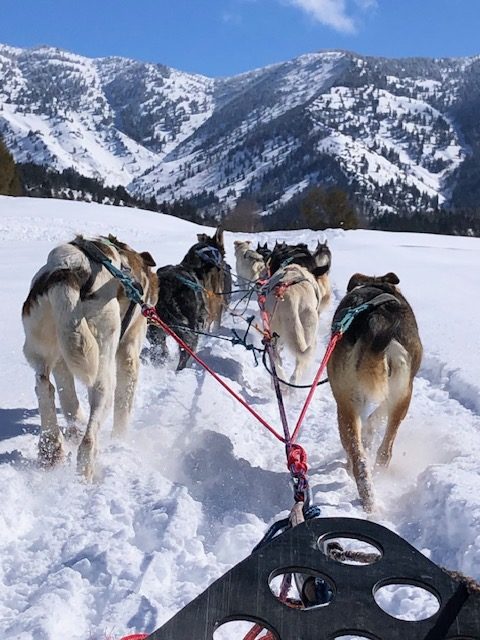
Sled Dogs-Sheer Joy: Sun, Snow, Sheer Joy, Courtesy & © Mary Heers, Photographer
Sun, Snow, Sheer Joy
Courtesy & © Mary Heers, Photographer
As the snow continued to pile up this winter, I started to ask around about sled dogs.

I soon bumped into a friend who had a friend in Preston who trained and occasionally raced his team of 14 Alaskan Huskies.

This musher graciously offered to give me a ride on one of his training runs. I showed up all smiles as he was harnessing his team. The dogs were excited to go and actually howling with happiness. The musher asked if I wanted to get in – or ride up the trail a bit on a snowmobile with his teenage son to a more level spot. In a rare moment of sanity, I opted for the snowmobile.

The machine had just pulled out of the yard when I heard his son say, “Oh, No!”

I looked back in time to see the sled tip over, sending the musher sliding across the driveway and under my car parked at the end of it. I jumped off the snowmobile as the dogs shot past us with the empty sled. The dogs were gaining on a truck up ahead, then shot past it with the snowmobile in hot pursuit.

I was left standing in a snowbank wondering if I’d wandered into a James Bond movie.

My first encounter with sled dogs had gone a lot smoother. I was visiting Denali National Park in Alaska and the rangers were introducing us to one of the dog teams that they still use to patrol the park.

But the most famous sled dogs are the freight teams that carried anti-toxin from Anchorage to Nome during an outbreak of Diphtheria in 1925. The dog teams ran a thousand miles and are credited with saving hundreds of lives.

For the last 50 years, modern mushers have retraced this journey in the ultimate sled dog race, the Ididarod. The best account I’ve read about the world of training sled dogs and running the Ididarod is Gary Paulsen’s book Winterdance. Just before going on a training ride, he discovered, “the gangline was trembling, quivering like a string on a guitar. It fairly hummed and I felt there was great power there. The trees in the yard went by in a mad blur and we left the yard at warp speed.”

Paulsen also lets us in on the deep relationship mushers form with their dogs: “As they understand you will give them meat when they run, and love when they run, and your soul when they run – as they learn to feel that, understand that, know that – they are no longer sled dogs – they become distance dogs, dogs that cannot, will not be stopped.” Paulson ran the Iditarod in 1983. It was a wild ride that took 17 days. But he finished.

Meanwhile, back in Preston, our teenage hero had caught up with the runaway team, made a flying leap from the snowmobile onto the empty sled, and somehow managed to stop the team. Pretty soon the musher and I caught up.

“Do you still want to get in?” he asked.

“Sure,” I said.

And we were off. The dogs settled into a steady trot. From then on it was all Sun and Snow and the sheer Joy of sliding quietly through the magnificent winter scenery.

This is Mary Heers and I’m Wild About Utah

Credits:
Photos: Courtesy & Copyright Mary Heers, Photographer
Featured Audio: Courtesy & Copyright Mary Heers
Text: Mary Heers, https://cca.usu.edu/files/awards/art-and-mary-heers-citation.pdf
Additional Reading: Lyle Bingham, https://bridgerlandaudubon.org/

Additional Reading

Wild About Utah, Mary Heers’ Postings

Paulsen, Gary, Winterdance: The Fine Madness of Running the Iditarod, Harvest Books, HarperCollins February 17, 1995, https://www.amazon.com/Winterdance-Fine-Madness-Running-Iditarod/dp/0156001454/

Idaho Sled Dog Challenge, https://idahosleddogchallenge.com/

Team Fishing White Pelicans

American White Pelicans at the Bear River Migratory Bird Refuge Courtesy & Copyright © Mary Heers
Pelicans at the Bear River Migratory Bird Refuge
Courtesy & Copyright © Mary Heers

American White Pelicans Fishing at the Bear River Migratory Bird Refuge Courtesy & Copyright © Mary Heers American White Pelicans Fishing
at the Bear River Migratory Bird Refuge
Courtesy & Copyright © Mary Heers

Jordan Falslev's Pelican Perch at the Benson Marina on Cutler Reservoir, Click to view a larger image. Courtesy & Copyright © Mary Heers Jordan Falslev’s Pelican Perch
at the Benson Marina on Cutler Reservoir,
Click to view a larger image.
Courtesy & Copyright © Mary Heers

I first caught sight of the eight pelicans swimming in s straight line towards the waters edge, looking a lot like a tank division in in an old WWII movie I slammed on the brakes just in time to see them all dip their bills into the water, come up spilling water and cock their heads back And then, gulp! Fish slid down their throats.

Wow, I thought. These pelicans are working together to to drive the fish into the shallow water’s edge where they can easily scoop the up And then it got better. Fanning out, the pelicans regrouped in a circle Swimming towards the center, they tightened the noose. And bam! Dip, scoop, knock back some more fish

I was amazed at how soundless and seamless it all was and could have watched for hours, but I was on the one lane auto route at the Bear River Migratory Bird Refuge and the cars behind me were starting to honk their horns, so I reluctantly moved on.

As soon as I got home I plunged into research on this majestic bird, beginning with the bill. When the pelican dips its bill into the water, the lower portion expands into a flexible sac that allows the bird to to scoop up as much as 3 gallons of fish and water. When the pelican cocks back its head, the sac contracts, the water is expelled through a barely open bill, and the fish swallowed. The huge pelican bill, which at first glance looks like a formidable weapon, is actually an exquisitively designed fishing net.

Archeologists have found pelican skulls dating back 30 million years, so this unique bill has definitely passed the test of time.

Back at the refuge I was able to turn into a visitor pull out and pick up the rather stunning bit of information: these pelicans fly in from Gunnison Island in the Great Salt Lake, over the Promontory Mountains, daily to forage for fish. That’s a 30 mile trip each way!

Long before the Mormon pioneers arrived in Utah, pelicans were building their nest on Gunnison Island. They were briefly disturbed when an artist, Albert Lambourne, tried to homestead for a year in 1850, and a guano mining company dropped off a crew – a Pole, a Russian, a Scot and an Englishman- to mine the bird poop. But the operation wasn’t profitable, and when it closed down, the pelicans reclaimed the island. Each March the birds fly in from as far away as Mexico, build their nests, and raise their chicks. The rookery is the largest in the US. In 2017 the pop was estimated to be as high as 20,000.

Back in Cache Valley in 2010, Jordan Falslev built a viewing platform near Benson Marina, The Pelican Perch, as his Eagle scout project. There used to be hundreds of pelicans out there on the water, but when I stopped by last week I didn’t see a single one. Numbers are way down now largely because the dropping water level in the Great Salt Lake have exposed a land bridge to Gunnison Island that allows predators to ravage the nesting site.

You can still catch sight of a pelican in flight in Cache Valley. (Their wingspan is 10 ft. Rudy Gobert, in comparison, has a wingspan of 7 ft 9 in.) But for my money, the best show in town is watching packs of pelicans hunt for fish at the Bear River Migratory Bird refuge.

This is Mary Heers and I am Wild About Utah.

Credits:

Photos: Courtesy & Copyright © Mary Heers
Featured Music: Courtesy & Copyright © Anderson, Howe, Wakeman
Text: Mary Heers
Voice: Mary Heers

Additional Reading

American White Pelican Pelecanus erythrorhynchos, Species, Utah Division of Wildlife Management, Utah Department of Natural Resources, https://wildlife.utah.gov/fieldguide/species.html?q=pelecanus+erythrorhynchos [Updated February 9, 2026]

American White Pelican (AWPE), Aquatic Birds, Great Salt Lake Bird Survey 1997-2001, Utah Division of Wildlife Management, https://wildlife.utah.gov/gsl/waterbirdsurvey/awpe.htm

Larsen, Leia, As Great Salt Lake shrinks, fate of nesting pelicans unknown, Standard Examiner, October 11, 2015, https://www.standard.net/news/environment/2015/oct/11/as-great-salt-lake-shrinks-fate-of-nesting-pelicans-unknown/ [Link updated January 2024]

Butler, Jaimi, The Great Salt Lake Is An ‘Oasis’ For Migratory Birds, Science Friday, September 21, 2018, https://www.sciencefriday.com/segments/the-great-salt-lake-is-an-oasis-for-migratory-birds/

Hager, Rachel, Great Salt Lake Pelicans Under Threat, Utah Public Radio, May 28, 2018, https://www.upr.org/post/great-salt-lake-pelicans-under-threat

Leefang, Arie, Gunnison Island, Heritage and Arts, Utah Division of State History, September 16, 2019, https://history.utah.gov/exploring-the-history-and-archaeology-of-the-great-salt-lakes-gunnison-island/

Hoven, Heidi, Gunnison Island: Home of up to 20,000 nesting American White Pelicans, Audubon California, National Audubon Society, September 25, 2017, https://ca.audubon.org/news/gunnison-island-home-20000-nesting-american-white-pelicans

The low-speed stampede, Wildlife Blog, Utah Division of Wildlife Resources, https://wildlife.utah.gov/news/wildlife-blog/701-the-low-speed-stampede.html

The paths of pelicans, Wildlife Blog, Utah Division of Wildlife Resources, https://wildlife.utah.gov/news/wildlife-blog/428-the-paths-of-pelicans.html

Brewerton, Adam, Round Trip Flights: Salt Lake City to Mazatlan, Wildlife Blog, Utah Division of Wildlife Resources, February 25, 2016, https://wildlife.utah.gov/news/wildlife-blog/698-round-trip-flights-salt-lake-city-to-mazatlan.html